There are six main types of TRT: injectable testosterone, transdermal gel, topical cream, skin patch, implanted pellet, and oral testosterone pills, plus nasal and buccal (cheek) options, for eight delivery routes in all. Every one of them delivers the same hormone, bioidentical testosterone, but they differ in how often you dose, how steady your blood levels stay, how much they cost, and how convenient they are to live with day to day. There is no single "best" form for everyone. The right type of TRT depends on your lab results, your goals, your tolerance for needles, whether you want to protect fertility, and who else is in your household, and it is always chosen with a prescriber because testosterone is a prescription-only, Schedule III medication. This guide is the complete menu, with FDA status, dosing frequency, real cost ranges, and a decision framework at the end. It also clears up the biggest point of confusion online: today's oral testosterone capsules are not the old liver-damaging pills people worry about.
Key Takeaways
- There are six main delivery routes plus nasal and buccal options: injections, gels, creams, patches, pellets, and oral pills, all delivering the same bioidentical testosterone in different ways 320.
- Injections are the cheapest and most adjustable: short-acting cypionate or enanthate, dosed weekly or twice weekly as prescribed, give clinicians the most control over your levels 61120.
- Gels and creams are needle-free but carry a transfer risk: testosterone can rub off onto a partner or child through skin contact, which is an FDA-labeled caution 718.
- Pellets are set-and-forget: implanted under the skin, they release testosterone over about 3 to 6 months, with no daily routine and no transfer risk 20.
- Modern oral TRT is FDA-approved and not liver-toxic: Jatenzo, Tlando, and Kyzatrex are testosterone undecanoate capsules that absorb through the intestinal lymphatics and largely bypass first-pass liver metabolism, unlike the old alkylated pills 891015.
- Nasal testosterone (Natesto) is the most fertility-sparing option: its short, pulsatile dosing is the form most likely to preserve the body's own sperm production 13.
- The best type depends on you, and all require a prescription: every form is a monitored medical therapy, not a supplement, chosen with a clinician based on labs, symptoms, and lifestyle 3414.
What Are the Different Types of TRT?
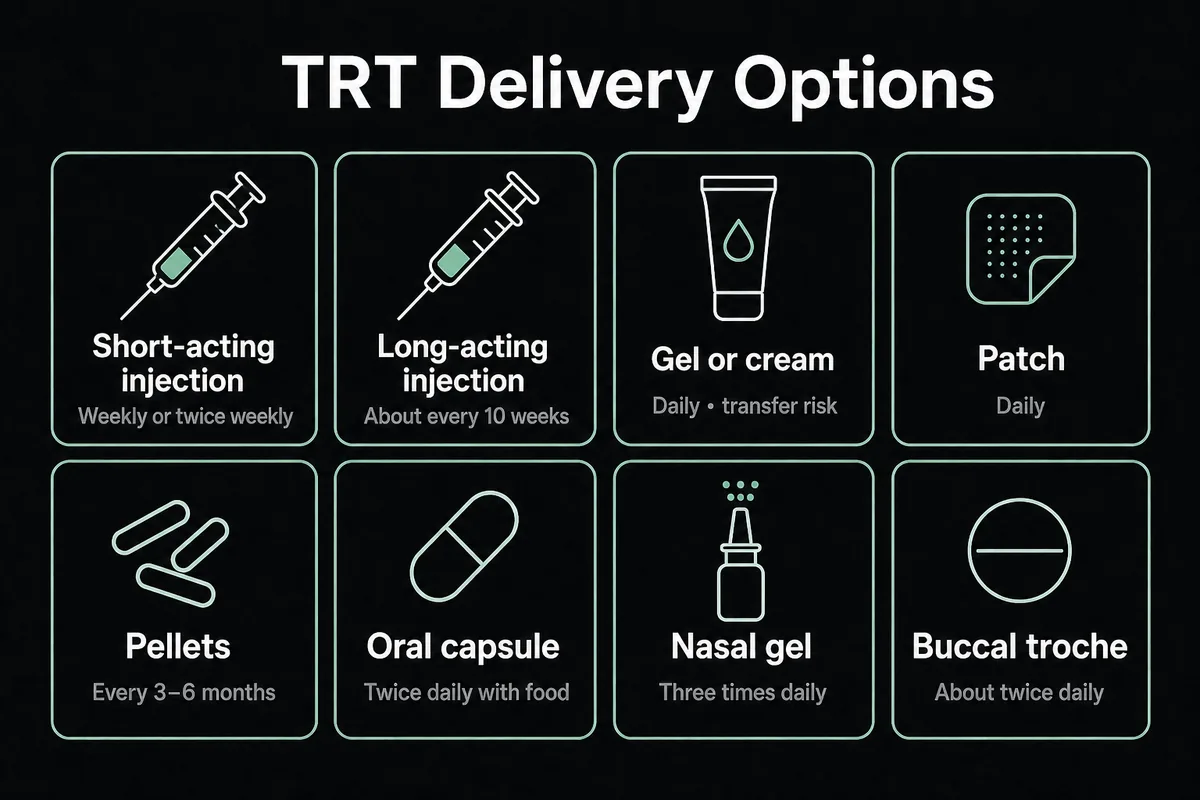
The different types of TRT all supply the same molecule, testosterone that is chemically identical to what your body makes, and they differ only in how that molecule gets into your bloodstream. That single fact is the key to reading the whole menu: an injection, a gel, a pellet, and a pill are not different drugs, they are different delivery systems for the same hormone. What changes between them is the release pattern (steady versus peak-and-trough), the dosing schedule, the cost, and the practical trade-offs like needles, skin contact, and household transfer 20.
One distinction matters before you go further: FDA-approved versus compounded. FDA-approved products (most injections, brand-name gels, the newer oral capsules, pellets, and the nasal gel) have been reviewed for quality, dosing, and safety and carry standardized labels 2. Compounded products (many testosterone creams and troches) are mixed by a pharmacy to a prescriber's specification and are not individually FDA-approved, which does not make them useless but does mean less standardization in strength and absorption 20. Every TRT medication below is prescription-only, and guidelines from the Endocrine Society and the American Urological Association stress that treatment starts only after low testosterone is confirmed on more than one morning blood test and symptoms are present 34.
TRT Injections: Cypionate, Enanthate, and Long-Acting
Injectable testosterone is the most common and usually the cheapest of all the TRT medications, and it gives clinicians the tightest control over your levels 19. The workhorses are the short-acting esters, testosterone cypionate and testosterone enanthate, dosed weekly or twice weekly as prescribed 611. FDA-approved products include Depo-Testosterone (testosterone cypionate) given intramuscularly and Xyosted (testosterone enanthate), a subcutaneous autoinjector, plus generic enanthate 611. Because these esters clear over days, your level peaks after a shot and drifts down before the next one, which is why smaller, more frequent doses are often used to smooth the ride. If you are choosing between sites and routes, our guide to TRT injection sites walks through the practical side, and dosing schedules are covered in TRT dosage.
Testosterone Cypionate vs Enanthate for TRT
For most people, testosterone cypionate vs enanthate is a distinction without a practical difference. Both are short-acting esters, both are dosed on a similar schedule, and both produce comparable results; the ester (the chemical tail attached to the testosterone) only changes how quickly the hormone is released 20. Cypionate has a slightly longer half-life than enanthate, but the gap is small enough that the choice usually comes down to what your pharmacy stocks, what your insurance covers, and which FDA product your prescriber uses 61120.
Table 3. Testosterone cypionate vs enanthate for TRT
| Feature | Testosterone cypionate | Testosterone enanthate |
|---|---|---|
| Ester half-life | About 8 days | About 7 days |
| Typical frequency | Weekly or twice weekly | Weekly or twice weekly |
| US FDA product | Depo-Testosterone | Xyosted (subcutaneous), generics |
| Practical difference | Minimal, near-interchangeable | Minimal, near-interchangeable |
Long-acting injections: testosterone undecanoate (Aveed)
At the opposite end of the schedule is Aveed, a long-acting testosterone undecanoate injection given deep into the muscle roughly every 10 weeks after an initial loading dose 12. The appeal is obvious: a handful of injections a year instead of dozens. The catch is that Aveed carries a rare but serious risk of pulmonary oil microembolism (an oil droplet reaching the lungs) and of anaphylaxis, so it is given only in a certified healthcare setting under a REMS safety program, and you are observed for about 30 minutes after each dose 12. That in-office requirement is the main reason it is less common than the do-it-at-home short esters.
Is Sustanon good for TRT?
Sustanon 250 is a blend of four testosterone esters designed to give both a fast and a prolonged release from one injection, and it is widely used for TRT in the UK, Europe, and international clinics, usually dosed every 2 to 3 weeks. One point matters most: Sustanon is not FDA-approved in the United States, so it is not a standard option for US patients 20. Does it work? Yes, it raises testosterone effectively, but the mixed esters release unevenly, which can produce more of a peak-and-trough swing than a single-ester cypionate or enanthate program 20. For US patients, single-ester injections cover the same ground with a cleaner, better-studied profile and easier legal access.
Intramuscular vs subcutaneous injection
Testosterone can be injected into muscle (intramuscular, IM) or into the fat just under the skin (subcutaneous, SC), and both routes are effective. Subcutaneous injection, used by the Xyosted autoinjector and increasingly with vials, tends to be less painful and easier to self-administer, with efficacy comparable to the traditional IM shot 11. Which one you use is a practical choice made with your clinician; more on the mechanics is in TRT injection sites.
TRT Gel
TRT gel is the leading needle-free option and one of the most prescribed forms overall. FDA-approved products include AndroGel 1.62%, Testim, Vogelxo, and Fortesta, applied once daily to clean, dry skin on the shoulders, upper arms, or abdomen depending on the product 718. The upside is steady day-to-day levels and no injections. The defining downside is transfer risk: because the medicine sits on your skin, it can rub off onto anyone you touch, and the FDA labels warn specifically about transferring testosterone to women and children through skin-to-skin contact, which can cause unwanted effects in them 718. The practical rules are to wash your hands after applying, let the gel dry, cover the area with clothing, and avoid skin contact at the application site with others 7. If transfer is a concern in your home, that alone can steer the decision. The method-by-method side effects are covered in TRT side effects.
TRT Cream: Does TRT Cream Work?
Does TRT cream work? Yes, a topical testosterone cream raises testosterone levels much like a gel does. The important nuance is that most TRT creams are compounded rather than FDA-approved, which means a pharmacy mixes them to a prescriber's specification, often at a higher concentration than commercial gels, and they are sometimes applied to the scrotal skin, which absorbs testosterone efficiently 1820. Because compounded creams are not standardized the way an FDA gel is, absorption can be more variable from batch to batch 20. Creams carry the same transfer-to-others caution as gels, so the hand-washing and skin-contact precautions apply equally 18. Compounded creams are also a common delivery method in low-dose female testosterone dosing, covered separately in TRT for women. If you want a standardized, FDA-reviewed topical, a brand-name gel is the more predictable choice.
TRT Patches
The TRT patch is a transdermal system, historically sold as Androderm, worn on the skin (usually applied at night) and replaced daily to deliver a steady 24-hour level 18. In principle the patch is appealing: no needles, no gel to rub off, and smooth levels. In practice, skin irritation at the patch site is the single most common reason men stop using it, and US availability of testosterone patches has become limited, so it is prescribed far less than it once was 1820. It remains a legitimate option for men who want steady transdermal dosing and tolerate the adhesive, but supply and skin reactions keep it a niche choice.
TRT Pellets
TRT pellets are small, rice-grain-sized implants (the FDA-approved product is Testopel) placed just under the skin of the hip or buttock during a quick in-office procedure with a local anesthetic. Once in, they slowly release testosterone over roughly 3 to 6 months 20. The big advantage is convenience: nothing to do daily, no needles at home, and no household transfer risk. The trade-offs are real: it is a minor surgical procedure, you cannot dial the dose up or down once the pellets are in, and there is a small risk of the pellet working its way back out (extrusion), bruising, or site infection 20. Pellets also tend to carry a higher upfront cost per visit. Because levels build and then taper over months, expectations about onset and wear-off matter; see how long TRT takes to work.
Oral TRT: TRT Pills and Tablets
Is TRT a pill? Today, yes, it can be, and resolving the confusion around oral TRT is the single most useful thing this page can do. For decades, "testosterone pills" had a bad reputation because the old oral forms strained the liver. That reputation no longer applies to the modern FDA-approved oral capsules, which use a completely different absorption pathway. The table below lays out the oral options, and the sections after it explain the crucial difference between the new capsules and the old pills.
Table 2. Oral TRT options compared
| Product | Type | FDA status | Dosing | Liver note |
|---|---|---|---|---|
| Jatenzo | Testosterone undecanoate | FDA-approved (2019) | Capsules twice daily with food | Absorbs via lymphatics, bypassing first-pass liver; blood-pressure warning 8 |
| Tlando | Testosterone undecanoate | FDA-approved | Capsules twice daily with food | Same lymphatic absorption; blood-pressure warning 10 |
| Kyzatrex | Testosterone undecanoate | FDA-approved | Capsules twice daily with food | Same lymphatic absorption; blood-pressure warning 9 |
| Troches (buccal or sublingual) | Compounded testosterone | Not FDA-approved | Lozenge about twice daily | Absorbed in the mouth, skips the liver; can irritate gums 20 |
| Methyltestosterone (older) | 17-alpha-alkylated oral | FDA-approved but rarely used for TRT | Oral | Hepatotoxic; the source of the "pills harm the liver" reputation 1620 |
New FDA-approved testosterone pills (Jatenzo, Tlando, Kyzatrex)
Jatenzo, Tlando, and Kyzatrex are all oral testosterone undecanoate capsules, taken twice daily with food 8910. Here is why they matter: instead of going straight to the liver and being broken down (the first-pass metabolism that made old oral testosterone both weak and hepatotoxic), testosterone undecanoate is absorbed largely through the intestinal lymphatic system, which delivers it into the circulation while bypassing that first liver pass 15. That is what lets a testosterone pill work without the liver toxicity of the older drugs. These capsules are genuine FDA-approved TRT, taken by mouth, no needles and no skin transfer. They are not free of cautions: all three carry a class blood-pressure warning, so your clinician will monitor your blood pressure, and they must be taken with food for reliable absorption 18. The Mayo Clinic's oral-route drug information covers the standardized dosing detail 15.
Older oral testosterone and liver risk
The pills that earned "testosterone tablets" their bad name are the 17-alpha-alkylated orals, chiefly methyltestosterone. That chemical modification lets the hormone survive the liver, but at a cost: these drugs are linked to liver strain, abnormal liver tests, and, rarely, liver tumors and a condition called peliosis hepatis, so they are not used for routine TRT today 1620. When you read that "oral testosterone is bad for your liver," this older class is what that warning is really about, and it is important not to tar the modern undecanoate capsules with the same brush, because they do not share that alkylated structure or the same liver risk 20.
TRT troches (buccal and sublingual)
TRT troches are compounded lozenges that you park against your cheek (buccal) or dissolve under your tongue (sublingual), usually about twice daily. Like the modern capsules, they are absorbed through the lining of the mouth, which delivers testosterone into the bloodstream while skipping the first liver pass 20. Because they are compounded, troches are not FDA-approved, so strength and absorption are less standardized than a commercial product, and the most common complaints are gum or mouth irritation and changes in taste 20. They are a legitimate niche option for men who want an oral or oromucosal route through a compounding pharmacy, and they are worth asking a knowledgeable prescriber about if pills or lozenges suit your life better than shots or gels.
Best TRT pills: what to know
There is no universal "best" among the oral options, and the honest answer to "what are the best TRT pills" is that it depends on FDA status, dosing convenience, cost, and how your blood pressure responds. The FDA-approved undecanoate capsules (Jatenzo, Tlando, Kyzatrex) are the most standardized and best-studied oral choice; compounded troches trade that standardization for flexibility and a different route 891020. Cost is a real factor, because the branded capsules often run higher than generic injections. Rather than ranking them, treat the choice as a conversation with a prescriber who can weigh your labs, your blood pressure, and your budget 4.
TRT Nasal Spray (Natesto)
TRT nasal spray, sold as Natesto, is an FDA-approved testosterone gel delivered as one pump into each nostril three times a day 13. That frequent, short-acting dosing is the point of its standout feature: because it mimics the body's own quick pulses of testosterone rather than flooding the system continuously, Natesto is the form most shown to preserve the pituitary signals (LH and FSH) that drive the testicles, which makes it the option least likely to shut down your own sperm production 13. For men who want the benefits of TRT while protecting fertility, that is a meaningful advantage. The trade-offs are the three-times-daily schedule and possible nasal irritation or a runny nose 13. Fertility preservation is covered in depth in TRT and fertility, and men focused on protecting fertility often discuss adjuncts such as hCG or a fertility-sparing alternative to exogenous testosterone like enclomiphene with their clinician.
TRT Types Compared: Cost, Frequency, and Pros and Cons
Putting the whole menu side by side makes the trade-offs clear: injections win on cost and control but require needles, gels and creams are needle-free but can transfer to others, pellets and long-acting shots minimize your daily effort but cannot be adjusted mid-cycle, and oral and nasal forms avoid both needles and skin transfer at a higher price. The costs below are cash-pay ballpark ranges and vary widely with insurance, pharmacy, and location, so treat them as a rough guide, not a quote.
Table 1. Types of TRT compared
| Type | Example FDA-approved products | How often | Route | Dose control | Est. cost/month (cash) | Transfer risk | Best for |
|---|---|---|---|---|---|---|---|
| Injection (short ester) | Depo-Testosterone, Xyosted | Weekly or twice weekly | IM or SC | High | $20 to $100 | None | Cost and control; comfortable with needles |
| Injection (long-acting) | Aveed | About every 10 weeks | Deep IM (in office) | Low | Higher, varies | None | Fewest injections |
| Gel | AndroGel 1.62%, Testim, Vogelxo, Fortesta | Daily | Topical | Moderate | $30 to $300+ | High (skin contact) | Needle-averse, steady levels |
| Cream (compounded) | Compounded (not FDA-approved) | Daily | Topical | Moderate | $30 to $120 | High (skin contact) | Needle-averse, flexible dosing |
| Patch | Androderm (limited US supply) | Daily (overnight) | Transdermal | Low | Varies | Minimal (intact patch) | Steady levels, no needles |
| Pellet | Testopel | Every 3 to 6 months | Implanted (in office) | Low (cannot adjust) | Higher upfront | None | Set-and-forget convenience |
| Oral pill | Jatenzo, Tlando, Kyzatrex | Twice daily with food | Oral capsule | Moderate | Higher, often $200+ | None | No needles, no transfer, no skin or gum site |
| Nasal gel | Natesto | Three times daily | Intranasal | Moderate | Higher, varies | None | Fertility-conscious men |
Costs vary widely with insurance and pharmacy, so the ranges above are cash-pay ballparks, not quotes 67820.
What Is the Best Form of TRT for You?
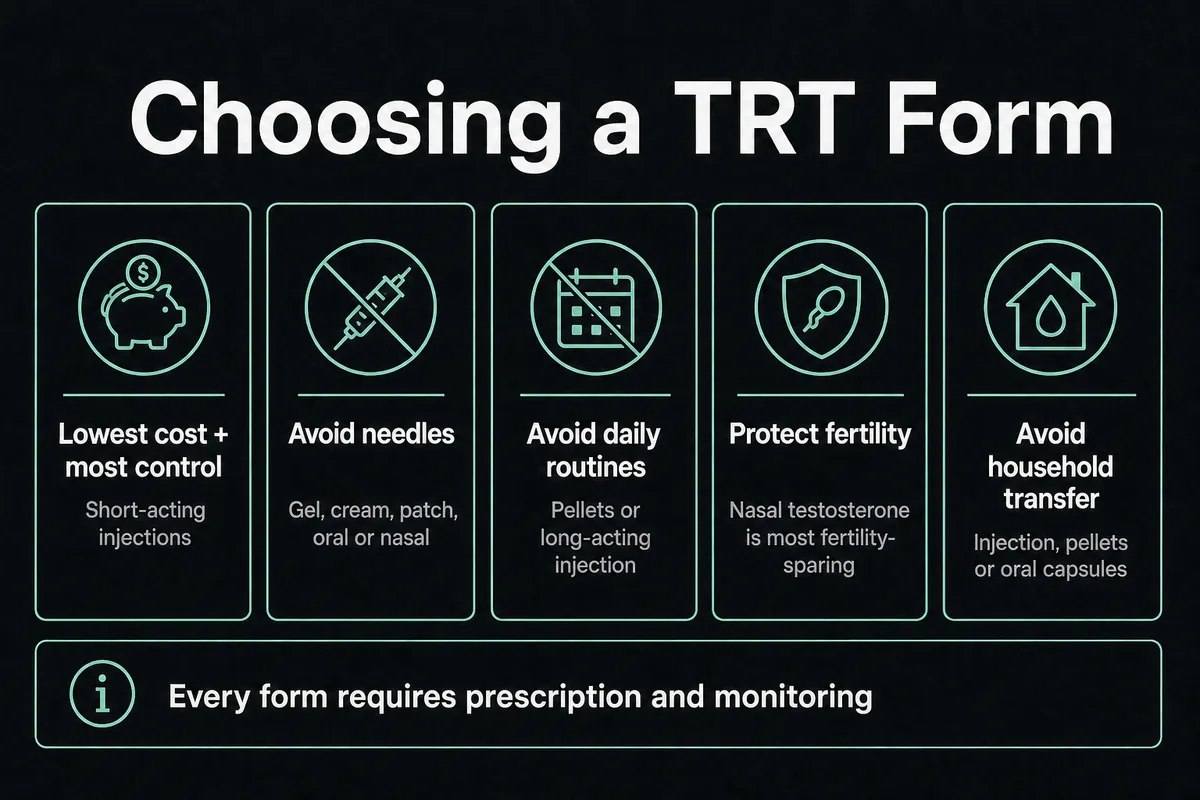
The best form of TRT is the one that fits your labs, your lifestyle, and your priorities, and choosing it is a decision framework, not a leaderboard. Your clinician will weigh your symptoms, your blood work, and your day-to-day life before recommending a route. Use these priorities to frame the conversation:
- If you want the lowest cost and the most control: short-acting injections (cypionate or enanthate) are usually cheapest and the easiest for a clinician to fine-tune 611.
- If you are needle-averse: gels, creams, patches, oral capsules, or the nasal spray all avoid injections, each with its own trade-off 718.
- If you hate daily routines: pellets (every 3 to 6 months) or long-acting Aveed injections minimize how often you think about it, at the cost of adjustability 1220.
- If you want to protect fertility: nasal testosterone (Natesto) is the most fertility-sparing, and it pairs with a discussion of hCG or enclomiphene 13.
- If household transfer is a worry: injections, pellets, or oral capsules avoid the skin-to-skin transfer risk that comes with gels and creams 718.
Age and long-term goals also shape the choice, which is why guidelines emphasize an individualized decision after a proper workup; our guide to the best age for TRT and the pillar on testosterone replacement therapy put this in context 3414.
FDA Safety Update: 2025 Testosterone Labeling Changes
One recent change touches every type above. For years, all testosterone products carried a boxed warning about a possible heart-attack and stroke risk. Then the large TRAVERSE trial (more than 5,000 men with low testosterone and high cardiovascular risk) found no increase in major adverse cardiac events versus placebo, though it did note more cases of atrial fibrillation and pulmonary embolism in the testosterone group 5. Acting on that evidence, in February 2025 the FDA removed the boxed cardiovascular warning class-wide and, at the same time, added a new class-wide warning that testosterone can raise blood pressure 12. This applies to injections, gels, creams, pellets, oral capsules, and the nasal gel alike, so blood-pressure monitoring is now a standard part of follow-up on any form 1. It does not mean testosterone is risk-free; it means the strongest available trial did not show the feared heart signal while blood pressure earned a clearer caution 17. We cover the details in TRT and blood pressure and TRT and heart health.
Frequently Asked Questions
Yes, TRT can be a pill today. Three FDA-approved oral capsules, Jatenzo, Tlando, and Kyzatrex, are testosterone undecanoate taken twice daily with food 8910. They absorb through the intestinal lymphatic system and largely bypass the liver, so they do not carry the liver toxicity of the older oral testosterone pills 15. They are prescription-only and come with a blood-pressure warning 1.
Yes, topical testosterone cream raises testosterone levels similarly to a gel 18. The main caveat is that most TRT creams are compounded rather than FDA-approved, so their strength and absorption are less standardized, and they carry the same skin-to-skin transfer caution as gels 1820. A standardized FDA gel is the more predictable topical option.
Sustanon 250, a four-ester testosterone blend, does raise testosterone and is used for TRT in the UK and Europe, but it is not FDA-approved in the United States, so it is not a standard US option 20. Its mixed esters release unevenly, which can cause more level swings than a single-ester cypionate or enanthate program.
There is no single best form. Short-acting injections are cheapest and most adjustable, gels and patches avoid needles, pellets and long-acting shots are the lowest-maintenance, and nasal testosterone is the most fertility-sparing 61320. Your clinician picks the right one based on your labs, symptoms, budget, and lifestyle 34.
The modern FDA-approved oral capsules (Jatenzo, Tlando, Kyzatrex) are testosterone undecanoate, which bypasses first-pass liver metabolism and does not carry the liver toxicity of older pills 1520. The liver risk people worry about comes from the old 17-alpha-alkylated orals like methyltestosterone, which are not used for routine TRT today 1620. The modern capsules do require blood-pressure monitoring 1.
References
- U.S. Food and Drug Administration. FDA issues class-wide labeling changes for testosterone products. February 2025.
- U.S. Food and Drug Administration. Testosterone Information (patient and provider). Accessed 2026.
- Bhasin S, et al. Testosterone Therapy in Men With Hypogonadism: An Endocrine Society Clinical Practice Guideline. J Clin Endocrinol Metab. 2018;103(5):1715-1744.
- Mulhall JP, et al. Evaluation and Management of Testosterone Deficiency: AUA Guideline. J Urol. 2018;200(2):423-432 (amended).
- Lincoff AM, Bhasin S, et al. Cardiovascular Safety of Testosterone-Replacement Therapy (TRAVERSE). N Engl J Med. 2023;389(2):107-117.
- U.S. Food and Drug Administration. Depo-Testosterone (testosterone cypionate injection) prescribing information. 2018.
- U.S. Food and Drug Administration. AndroGel 1.62% (testosterone gel) prescribing information. 2025.
- U.S. Food and Drug Administration. Jatenzo (testosterone undecanoate oral capsules) prescribing information. 2019.
- U.S. Food and Drug Administration. Kyzatrex (testosterone undecanoate oral capsules) prescribing information. 2025.
- U.S. Food and Drug Administration. Tlando (testosterone undecanoate oral capsules) prescribing information. 2025.
- U.S. Food and Drug Administration. Xyosted (testosterone enanthate subcutaneous injection) prescribing information. 2018.
- U.S. Food and Drug Administration. Aveed (testosterone undecanoate injection) prescribing information. 2014.
- U.S. Food and Drug Administration. Natesto (testosterone nasal gel) prescribing information. 2014.
- Mayo Clinic. Testosterone therapy: Potential benefits and risks as you age. Accessed 2026.
- Mayo Clinic. Testosterone (oral route) description and dosing. Accessed 2026.
- Cleveland Clinic. Low Testosterone (Male Hypogonadism). Accessed 2026.
- Harvard Health Publishing. Is testosterone therapy safe? Take a breath before you take the plunge. Accessed 2026.
- MedlinePlus. Testosterone Topical (gel, cream, patch). U.S. National Library of Medicine. Accessed 2026.
- MedlinePlus. Testosterone Injection. U.S. National Library of Medicine. Accessed 2026.
- Shoskes JJ, et al. Pharmacology of testosterone replacement therapy preparations. Transl Androl Urol. 2016;5(6):834-843.
The information in this article is for educational purposes only and does not constitute medical advice. Always consult a healthcare professional before starting any new supplement or compound. Results vary by individual.