Does TRT make you infertile? For as long as you stay on it, testosterone replacement therapy almost always suppresses fertility, often driving sperm counts all the way to zero, but for the large majority of men that effect is reversible after stopping 67. The key is to separate two different questions. "Am I infertile while on TRT?" and "Am I permanently infertile?" have very different answers. On therapy, most men become functionally infertile. After stopping, roughly 9 in 10 recover to fertile sperm thresholds within about a year, with a small minority who stay impaired 7. This guide walks through the real numbers, why it happens, whether you can father a child on TRT, and the physician-directed options that let you protect fertility.
| Quick fact | What it means |
|---|---|
| On contraceptive-dose testosterone, about 65% of men reach azoospermia (no sperm) by roughly 4 months | TRT is a powerful suppressor of sperm production, not a mild one 6 |
| About 90% recover to 20 million sperm/mL within 12 months of stopping | For most men the effect reverses, but it takes months, not days 7 |
| Median time to recover a fertile threshold is around 110 days after stopping | Recovery is measured in months and varies person to person 7 |
| Both the Endocrine Society and AUA advise against starting TRT in men who want to conceive soon | This is a mainstream guideline position, not a fringe warning 13 |
Key Takeaways
- On TRT, most men are functionally infertile. Exogenous testosterone shuts down the signals your testes need to make sperm, and about 65% of men on contraceptive-dose testosterone reach zero sperm within a few months 6.
- For most men it reverses. Around 90% recover fertile sperm counts within 12 months of stopping, and close to 100% by 24 months, though a small minority stay impaired 7.
- TRT is not birth control and not a fertility plan. Some men keep viable sperm and some do not, so you should never rely on TRT either to prevent or to achieve pregnancy 8.
- Testicular shrinkage is common but usually temporary. The same signal withdrawal that stops sperm also softens and shrinks the testes, and size typically returns after stopping 10.
- Penis size does not change on TRT. Adult penis size is fixed; TRT can improve erectile firmness, which is a different thing from size 3.
- You can often protect fertility. HCG, enclomiphene, sperm banking, or simply not starting TRT yet are physician-directed ways to keep your options open 6.
The short answer: does TRT make you infertile?
Yes, in a practical sense, while you are on it. Exogenous testosterone (whether by injection, gel, or pellet) suppresses your body's own sperm production, and in most men it does so profoundly. The FDA prescribing information for testosterone gel states plainly that spermatogenesis may be suppressed through feedback on the brain-testes axis, and lists testicular atrophy and reduced sperm counts among recognized effects 5.
But "infertile while on TRT" is not the same as "permanently infertile." In the largest pooled analysis of men who stopped hormonal suppression, about 90% recovered to a fertile sperm threshold within a year, and essentially all had recovered by two years, apart from a small group with lasting impairment 7. So the honest framing is: TRT reliably lowers fertility now, and for most men that reverses later. It is a preventable and usually recoverable cause of infertility, not a guaranteed permanent one 6. If you are still deciding whether therapy is right for you, our overview of testosterone replacement therapy covers the full picture, and TRT alternatives covers fertility-sparing routes.
How does TRT affect fertility? The HPG-axis explanation
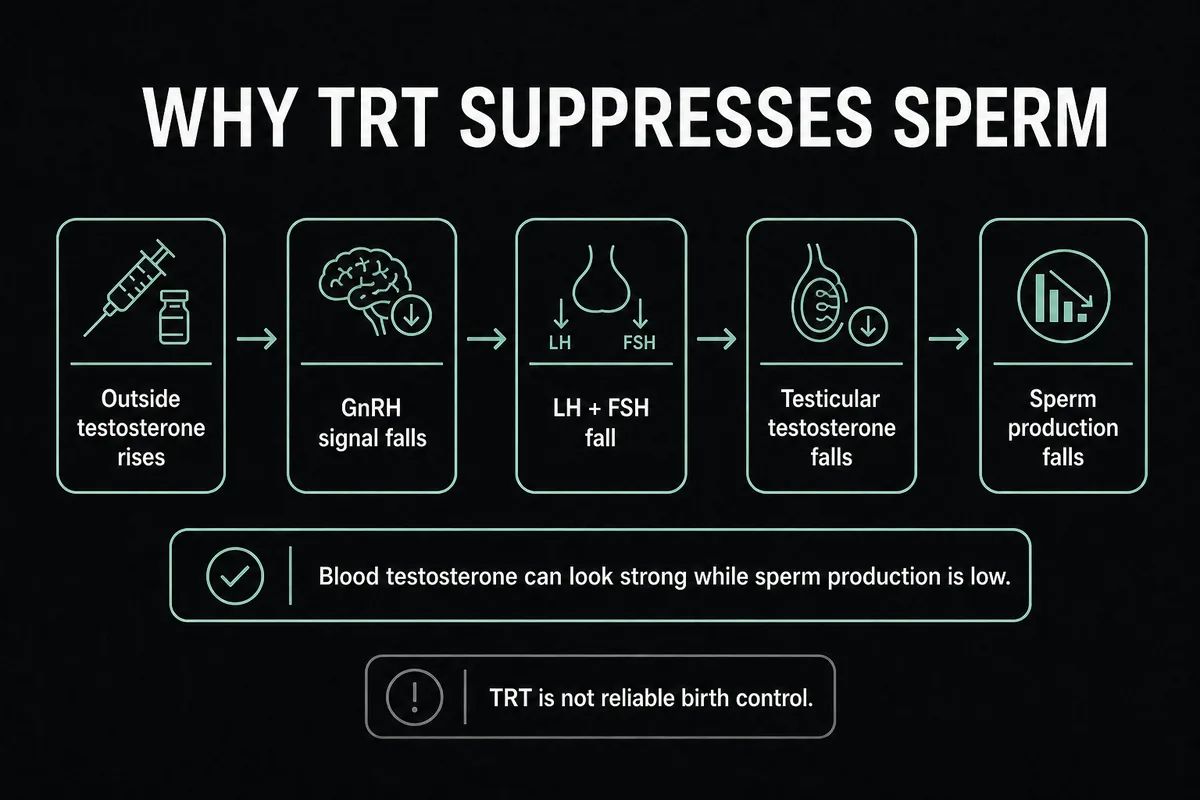
To understand how does TRT affect fertility, you have to look at a feedback loop called the hypothalamic-pituitary-gonadal (HPG) axis. Your brain constantly measures how much testosterone is in your blood and adjusts its signals to match.
Why exogenous testosterone shuts down sperm production
Normally the hypothalamus releases GnRH, which tells the pituitary to release two hormones: LH and FSH. LH tells the testes to make testosterone, and FSH (together with high local testosterone) drives sperm production. When you add testosterone from outside, the brain senses that levels are high and dials the whole system down. GnRH falls, LH and FSH fall, and without those signals the testes stop both making their own testosterone and making sperm 6. This is the same shutdown described in the FDA label as suppression of spermatogenesis through negative feedback 5.
Intratesticular testosterone vs blood testosterone (the key confusion)
Here is the single most misunderstood point. Sperm production does not depend on the testosterone in your bloodstream. It depends on the testosterone concentration inside the testes, which is normally many times higher than blood levels. TRT raises your blood testosterone but collapses that intratesticular testosterone, because the LH signal that keeps it high is switched off 6. That is why a man can feel great, have excellent blood testosterone numbers, and still produce little or no sperm at the same time. Blood levels look strong while the factory inside the testes has gone quiet.
Does TRT lower sperm count? What the data shows
Does TRT lower sperm count? Yes, and usually far more than people expect. This is not a gentle 10% or 20% dip. In studies of testosterone used at contraceptive doses, roughly 65% of men reached azoospermia (no measurable sperm) by about 4 months, and the great majority saw a steep decline within 6 months 6. The suppression is the whole point of why testosterone was studied as a male contraceptive in the first place 8.
TRT and sperm count: from reduced to zero (azoospermia)
For TRT and sperm count, the realistic expectation is a large drop, often to zero, within the first few months of consistent therapy. Some men retain a low level of sperm and some fall to complete azoospermia; the response varies, but the direction is nearly always downward 68. Because the effect is so reliable, one review concluded testosterone should be treated as a contraceptive and not prescribed to men who want to father a child 8. If you are on therapy and thinking about kids, a semen analysis is the only way to know where you actually stand.
The delivery method influences how hard and how consistently sperm production is suppressed.
| TRT delivery method | Note on fertility suppression |
|---|---|
| Injectable (cypionate or enanthate) | Strong, consistent suppression; steady high levels keep the axis shut down |
| Gel or topical | Suppresses sperm production; some data suggest slightly less consistent shutdown than injectables |
| Pellets or long-acting | Suppresses, and cannot be stopped quickly once implanted, so the effect lingers |
The comparison of types of TRT and our TRT dosage guide go deeper on how form and dose relate to suppression.
Can you get someone pregnant on TRT?
Can you get someone pregnant on TRT? It is possible for some men, but materially harder, and you should not count on it either way. A subset of men keep enough viable sperm to conceive, while most become azoospermic and cannot 68. Because you cannot tell which group you are in without testing, TRT is unreliable as a fertility plan and equally unreliable as birth control 8.
Can you get your wife pregnant on TRT?
If you are asking whether you can get your wife pregnant on TRT, or can I get my wife pregnant on TRT, the answer is: maybe, but only if you are still producing viable sperm, which many men on TRT are not. The practical step is a semen analysis to see what you are working with. If conception is the goal, most clinicians will either add a medication like HCG to protect sperm production or have you come off TRT first so your own axis can recover 6. The guideline position is clear: do not start TRT if you are trying to conceive right now 3.
Is TRT infertility reversible? Recovery timeline after stopping
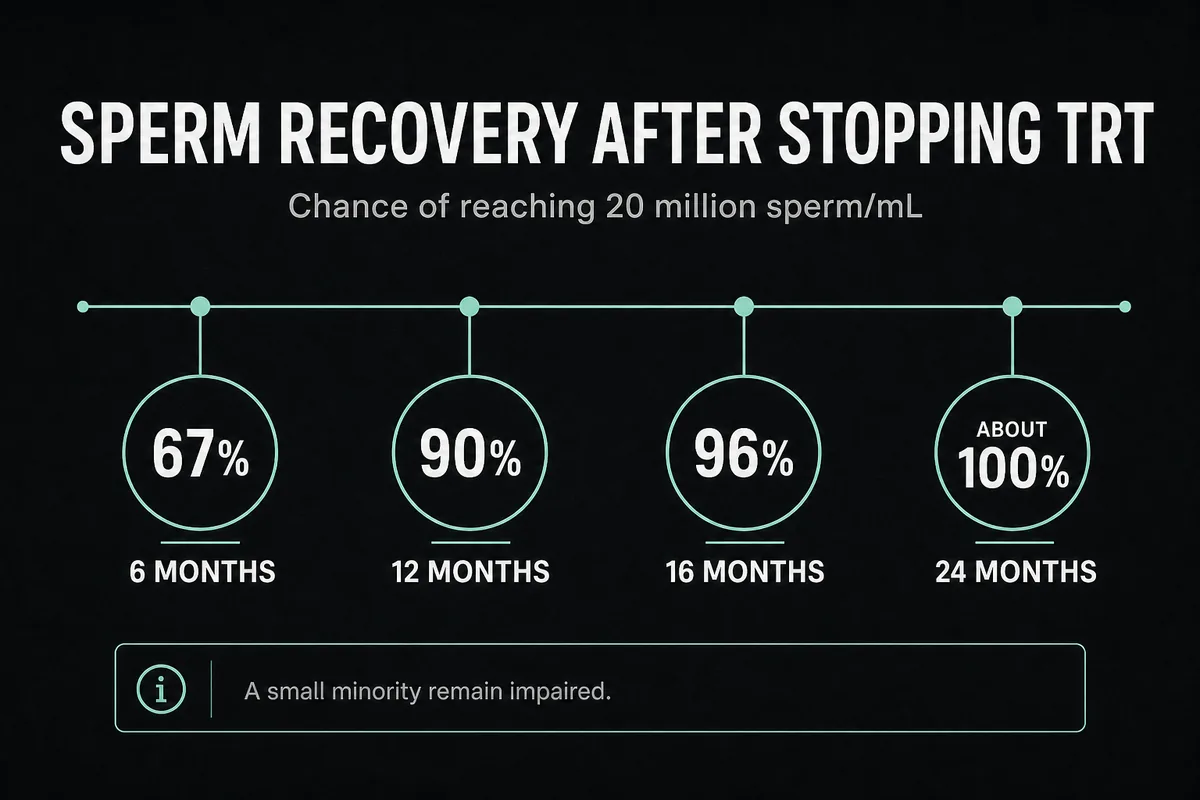
For most men, yes. Is TRT infertility reversible is one of the most searched questions in this cluster, and the pooled data are reassuring. Recovery is not instant, because sperm take roughly two to three months to develop, so the axis has to restart and then a full cycle of sperm production has to complete 67.
How long after stopping TRT does sperm count recover?
The best estimate of how long after stopping TRT sperm count recovers comes from an integrated analysis of 30 studies. It found a median of about 110 days to reach a fertile threshold, with the probability of recovery climbing steadily over the following months 7.
| Time after stopping TRT | Chance sperm count recovers to 20 million/mL |
|---|---|
| 6 months | about 67% |
| 12 months | about 90% |
| 16 months | about 96% |
| 24 months | about 100% (a small minority remain impaired) |
Source: integrated recovery analysis 7; mechanism and supporting figures 6.
Several factors predict slower recovery: older age, a longer time spent on testosterone, lower baseline LH, and longer-acting or injectable preparations that keep the axis suppressed for longer 67. A small number of men do not fully recover, which is exactly why guidelines urge planning ahead rather than assuming reversibility. If your plan is to come off therapy, read stopping TRT for how that process is usually managed.
Does TRT shrink your testicles? Testicular atrophy explained
Yes. Does TRT shrink your testicles is a common worry, and the answer is that testicular atrophy from TRT is a recognized and expected effect for many men 510. The mechanism is the same LH withdrawal that stops sperm: without the LH signal telling them to work, the testes get less stimulation, produce less internal testosterone, make fewer sperm, and lose some volume as a result 610.
How much do testicles shrink on TRT?
For how much do testicles shrink on TRT, the change is usually modest and gradual rather than dramatic. Men often notice their testes feel softer and somewhat smaller within the first few months, and reported average reductions in testicular volume, when atrophy occurs, fall in a modest range of roughly 15% to 20% 10. Shrinkage tends to be greater with injectables and in men who started with larger testes 10. Importantly, a urologist at the University of Utah notes that testicle size has minimal bearing on overall health; the main concerns tied to shrinkage are fertility and, for some men, the cosmetic change 10.
Is testicular shrinkage from TRT permanent? Do testicles grow back?
For most men, no, it is not permanent. Is testicular shrinkage from TRT permanent is answered the same way as fertility: once the HPG axis recovers after stopping, LH signaling returns and the testes usually regain volume over several months 610. So do testicles grow back after TRT? Typically yes, over a similar timeline to sperm recovery, though the same predictors (age, duration on therapy) apply. Men who want to avoid shrinkage in the first place often add HCG, which keeps the testes stimulated during therapy (covered below). Testicular atrophy is discussed in context alongside other effects in our TRT side effects guide.
Does TRT make your penis bigger or smaller? (myth check)
Neither. Does TRT make your penis bigger is a persistent myth, and the honest answer is that TRT does not change adult penis size in either direction. Androgen-driven penile growth is a puberty-only event; once you have finished puberty, testosterone does not lengthen the adult penis, so TRT will not increase penis size 3. It also does not shrink it.
What TRT can do, in men who are genuinely testosterone deficient, is improve erectile firmness and function, which is a completely separate thing from size. A firmer erection can feel larger, but the underlying anatomy has not changed. If erectile function is your real concern, that is a distinct topic covered in TRT and erectile dysfunction. Any product or clinic promising that testosterone will enlarge the adult penis is overselling; the evidence does not support it.
How to maintain fertility on TRT (and how to increase sperm count while on TRT)
If you want to know how to maintain fertility on TRT, or how to increase sperm count while on TRT, there are several physician-directed options. None of these are do-it-yourself protocols, and none should be dosed without a prescriber managing them, but they are the tools clinicians actually use.
HCG alongside TRT
HCG mimics LH, so it keeps the testes stimulated even while outside testosterone suppresses your own LH. That helps preserve intratesticular testosterone, sperm production, and testicular size. In the published literature, a regimen around 500 IU every other day maintained semen parameters in men on testosterone 6. HCG is prescription-only and supply can vary. Learn more about the HCG peptide and how it fits alongside therapy.
Enclomiphene and clomiphene (SERMs)
These selective estrogen receptor modulators work the opposite way: instead of replacing testosterone, they nudge your own brain to release more LH and FSH, restarting the axis. Enclomiphene tends to be used as an alternative to TRT for men who want to raise testosterone while preserving fertility, giving a milder rise than TRT 6. Clomiphene stimulates FSH and LH as well, though very high doses can actually harm sperm, which is why dosing is physician-managed. See our enclomiphene guide and the comparison in sermorelin vs TRT vs MK-677 vs enclomiphene.
hMG or FSH therapy
When HCG alone does not restore sperm production, some men need direct FSH stimulation in the form of hMG or recombinant FSH. This is more involved and more expensive, and it is reserved for cases where the simpler approaches fall short 6.
Sperm banking before starting TRT
The one guaranteed option is banking. Freezing sperm before you start (or around) TRT gives you insurance that does not depend on your axis recovering later. It is a one-time collection plus an annual storage cost, and it removes the recovery question entirely.
Coming off TRT for fertility
For some men, the cleanest route is coming off TRT for fertility and letting the natural axis recover, sometimes with HCG or a SERM to speed the restart. The tradeoff is that low-testosterone symptoms return and recovery takes months. This is exactly the situation stopping TRT walks through.
| Option | How it works | Stay on TRT? | Caveat |
|---|---|---|---|
| HCG | LH analog; keeps intratesticular testosterone up | Yes (add-on) | Prescription; supply and compounding vary |
| Enclomiphene | Restarts LH and FSH via SERM action | Often used instead of TRT | Milder testosterone rise than TRT |
| Clomiphene | SERM; stimulates FSH and LH | Usually instead of TRT | Very high doses can harm sperm |
| hMG or FSH | Direct FSH stimulation of sperm production | Add-on when HCG is not enough | Costly and injectable |
| Sperm banking | Freeze sperm before or around TRT | Any | One-time collection plus yearly storage |
| Stop TRT | Let the axis recover on its own | No | Symptoms return; months to recover |
All of these are prescription, physician-directed decisions. If you are exploring non-TRT routes generally, see testosterone boosters vs peptides.
What the guidelines say (Endocrine Society and AUA)
Mainstream guidelines are consistent and clear on this, which is worth knowing because it is not controversial medicine.
The Endocrine Society clinical practice guideline recommends against testosterone therapy in men who are planning fertility in the near term, precisely because it suppresses sperm production 12. The American Urological Association is equally direct: clinicians should not prescribe testosterone to men who are currently trying to conceive, should discuss the impact on spermatogenesis before starting therapy, and should note that fertility can be affected (a Grade A statement in its guideline) 34. A patient fact sheet from reproductive medicine specialists summarizes the same position: testosterone should not be used in men who want to father a child in the next 6 to 12 months 9. Because TRT is a prescription therapy (and testosterone is a controlled substance), these conversations are meant to happen with your clinician before you start, not after. It is also worth understanding that exogenous testosterone suppresses fertility through the same pathway that anabolic steroids do, a parallel covered in is TRT a steroid.
Related comparison: gonadorelin vs HCG.
Frequently Asked Questions
For most men, yes. In pooled data, about 90% of men recover to a fertile sperm threshold within 12 months of stopping, and nearly all by 24 months, though a small minority remain impaired 7. Recovery takes months, not days.
No. TRT does not change adult penis size in either direction, because penile growth is a puberty-only androgen effect 3. It may improve erectile firmness, which is different from size.
The bottom line
Does TRT make you infertile? While you are on it, almost always, and often completely, but for most men that is reversible once they stop 67. The safe way to think about it: TRT is not a fertility plan and not a contraceptive, so if children are anywhere on your horizon, plan ahead rather than assume you can undo it later. Bank sperm, consider fertility-sparing options like enclomiphene, or add HCG to protect sperm production, and have the conversation with a clinician before you start. Testicular shrinkage is common but usually temporary, and the penis-size worries are a myth 310. For the next step, start with testosterone replacement therapy, weigh the alternatives to TRT, and read stopping TRT if coming off for fertility is on the table.
References
- Endocrine Society. Testosterone Therapy for Hypogonadism Clinical Practice Guideline. Accessed 2026.
- Bhasin S, Brito JP, Cunningham GR, et al. Testosterone Therapy in Men With Hypogonadism: An Endocrine Society Clinical Practice Guideline. J Clin Endocrinol Metab. 2018;103(5):1715-1744.
- American Urological Association. Testosterone Deficiency Guideline. Accessed 2026.
- Mulhall JP, Trost LW, Brannigan RE, et al. Evaluation and Management of Testosterone Deficiency: AUA Guideline. J Urol. 2018.
- U.S. FDA. AndroGel (testosterone gel) Prescribing Information. Accessed 2026.
- Crosnoe LE, Grober E, Ohl D, Kim ED. Exogenous testosterone: a preventable cause of male infertility. Transl Androl Urol. 2013.
- Liu PY, Swerdloff RS, Christenson PD, et al. Rate, extent, and modifiers of spermatogenic recovery after hormonal male contraception: an integrated analysis. Fertility and Sterility.
- Patel AS, Leong JY, Ramasamy R. Testosterone Is a Contraceptive and Should Not Be Used in Men Who Desire Fertility. World J Mens Health. 2019.
- American Society for Reproductive Medicine (ReproductiveFacts.org). Testosterone use and male infertility (patient fact sheet). Accessed 2026.
- University of Utah Health. What Men Should Know About Testicular Shrinkage and Testosterone. 2024.
The information in this article is for educational purposes only and does not constitute medical advice. Always consult a healthcare professional before starting any new supplement or compound. Results vary by individual.