The benefits of TRT are real but conditional: they apply to men with clinically diagnosed low testosterone (bothersome symptoms plus repeatedly low morning testosterone), not to men with normal levels chasing an anti-aging or performance boost. For the right patient, testosterone replacement therapy can improve libido and sexual function, lift energy and mood, increase lean muscle and reduce fat, strengthen bone, and correct unexplained anemia. 48 But TRT also carries trade-offs, from reduced fertility to thickened blood, and it is a lifelong commitment with regular monitoring. This guide separates what the evidence supports from the hype, gives you a realistic timeline, and lays out the pros and cons of TRT side by side so you can have an informed conversation with your clinician.
| Quick fact | Detail |
|---|---|
| What it treats | Male hypogonadism (clinically low testosterone) 412 |
| FDA-approved use | Low testosterone from a known medical cause, not age alone 17 |
| Common forms | Injection, gel, patch, pellet, nasal, oral undecanoate 21113 |
| Strongest-evidence benefits | Sexual function, energy and mood, lean mass, bone density, anemia correction 8 |
| Main risks | Infertility, erythrocytosis, gynecomastia, acne, worsened sleep apnea 14 |
| Legal status | Schedule III controlled substance (prescription only) 2 |
Key Takeaways
- Benefits apply to diagnosed low testosterone only. TRT is not a tonic for men with normal levels, and guidelines advise against treating age alone. 14
- The best-supported benefits are sexual function, energy and mood, body composition, bone density, and anemia correction. 8
- The timeline is domain-specific. Libido, mood, and energy often shift within weeks, while muscle, bone, and metabolic changes build over months. 8
- The cons are real. Reduced fertility, testicular shrinkage, erythrocytosis (thickened blood), gynecomastia, acne, possible worsened sleep apnea, and lifelong monitoring all belong on the ledger. 14
- The cardiovascular picture is more reassuring than it was. After the TRAVERSE trial, the FDA removed the class-wide cardiovascular boxed warning in February 2025 and added a new blood pressure warning. 67
- This is a guideline-anchored decision. The Endocrine Society and AUA both frame TRT as treatment for confirmed deficiency, individualized and monitored, not a lifestyle choice. 45
What Is TRT and What Does TRT Do to Your Body?
Testosterone replacement therapy restores serum testosterone into the mid-normal range in men whose bodies no longer make enough on their own. To understand what TRT does to your body, it helps to remember what testosterone regulates: libido and erectile function, muscle protein synthesis, bone mineral density, red blood cell production, fat distribution, and aspects of mood and drive. 1212 When testosterone is genuinely deficient, symptoms in several of these areas tend to cluster, and restoring the hormone can relieve them.
That is the key qualifier for every claim on this page. The FDA approves testosterone products for hypogonadism caused by a known medical condition, such as a problem with the testicles, pituitary, or hypothalamus, and not for the natural decline that comes with aging. 17 A proper diagnosis requires both symptoms and repeat morning blood tests showing low testosterone, because a single low reading is not enough. 45 For the full workup and pillar overview, see our guide to testosterone replacement therapy.
TRT comes in several forms, and the choice affects convenience, cost, and how steady your levels stay. The main options are intramuscular or subcutaneous injections, topical gels, skin patches, implantable pellets, a nasal gel, and oral testosterone undecanoate. 21113 Each has trade-offs in dosing frequency and side-effect profile, which we break down in types of TRT.
Benefits of TRT for Men: What the Evidence Shows
The clearest evidence for the benefits of TRT for men comes from the Testosterone Trials (TTrials), a set of coordinated placebo-controlled studies in men 65 and older with unequivocally low testosterone. The TTrials found moderate improvement in sexual function, small gains in mood and depressive symptoms and walking distance, correction of anemia, and increased bone density, while showing no benefit for cognition. 8 Reading benefit domains one at a time keeps expectations honest.
Libido and Sexual Function
Sexual function is where TRT delivers its most reliable benefit. In the TTrials, testosterone produced a moderate improvement in sexual activity, desire, and erectile function compared with placebo in deficient men. 8 This is consistent with what testosterone does physiologically, and it is the domain most men notice first. It is a moderate effect, not a guarantee of a complete return to youthful function.
Energy, Mood, and Vitality
TRT can lift mood and reduce depressive symptoms in men with low testosterone, and the TTrials showed a small but real signal here. 8 Be careful with the word energy, though. General vitality and fatigue gains in the TTrials were modest, and testosterone is not a stimulant. If low mood is the main problem, TRT is not a stand-in for treating depression, and your clinician will look at the whole picture. 38
Muscle Mass and Body Composition
Restoring testosterone to the normal range increases lean muscle mass and reduces fat mass in deficient men. 14 This is a therapeutic effect at physiological doses, and it is not the same thing as anabolic steroid abuse, where supra-physiological doses are used to build muscle far beyond normal. Conflating the two is a common and harmful mistake; we explain the difference in is TRT a steroid. TRT is not a shortcut to a bodybuilder physique, and using it that way defeats the purpose of replacement.
Bone Mineral Density
Testosterone supports bone, and the TTrials showed that treatment increased bone mineral density and estimated bone strength. 8 There is an important nuance from the larger TRAVERSE program: its fracture substudy did not show a reduction in clinical fractures, and actually observed more fractures in the testosterone group, so improved density on a scan does not automatically translate into fewer broken bones. 9 TRT is not a treatment for osteoporosis on its own, and your clinician will weigh bone health alongside your other risks.
Red Blood Cells and Anemia Correction
Testosterone stimulates red blood cell production, and in the TTrials it corrected anemia in a meaningful share of men who had it, including men whose anemia had no otherwise identifiable cause. 8 That same mechanism is double-edged: pushed too far it causes erythrocytosis, an overproduction of red cells that thickens the blood. That is why hematocrit monitoring and, sometimes, blood donation matter, which we cover below.
TRT Benefits Timeline: When You Notice Changes
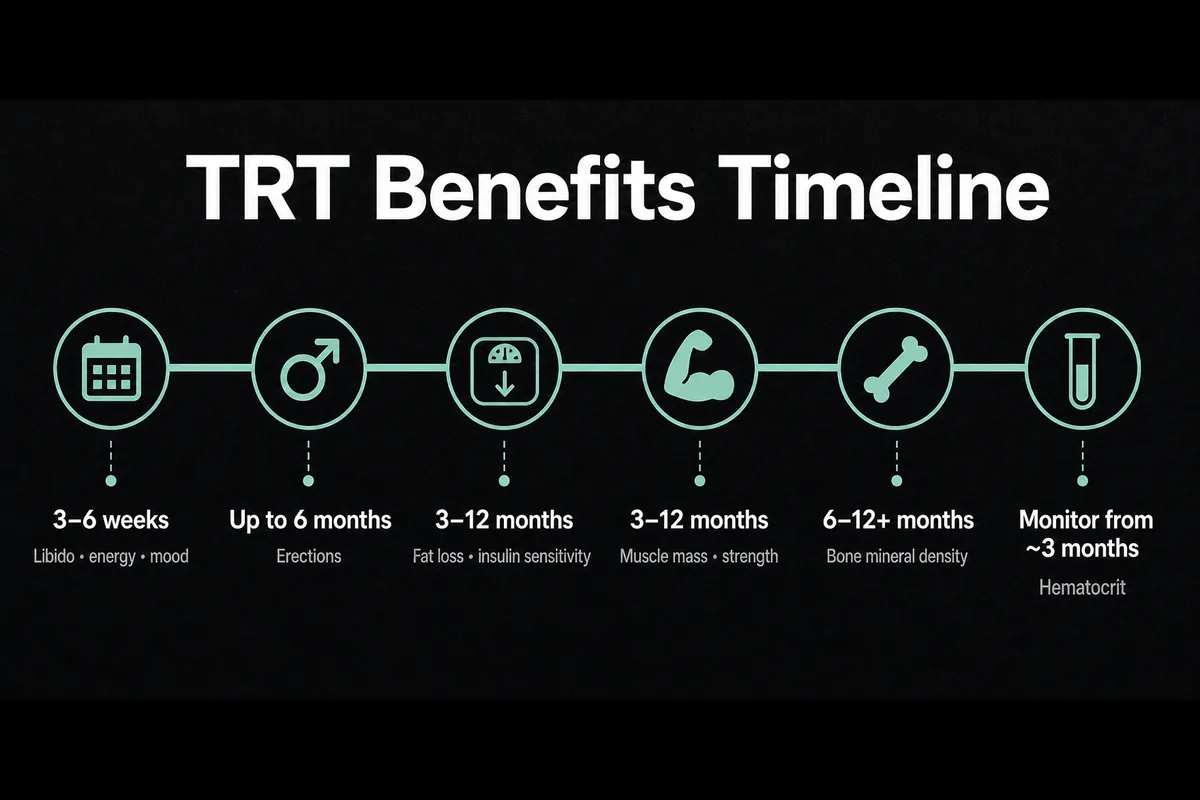
One of the most common questions is how fast the benefits arrive. There is no fixed schedule, but the different benefit domains tend to appear in a predictable order, with sexual and mood changes coming first and body-composition and bone changes building over months. 8 The table below gives typical ranges, not promises; individual response varies widely, and some men respond faster or slower.
Table: TRT benefits timeline by domain
| Benefit | Typical onset | Peak or plateau |
|---|---|---|
| Libido and sexual desire | 3 to 6 weeks | Around 3 months |
| Energy and mood | 3 to 6 weeks | Around 3 months |
| Erections | Weeks to months | Up to 6 months |
| Fat loss and insulin sensitivity | Around 3 months | 6 to 12 months |
| Muscle mass and strength | 3 to 6 months | 6 to 12 months |
| Bone mineral density | 6 months or more | 12 months or more |
| Hematocrit rise (monitor) | From about 3 months | Ongoing, needs monitoring |
Typical ranges based on the pattern of onset seen in trial and clinical data; individual results vary. Source: 8.
A practical rule follows from this: if you have had no meaningful benefit after a fair trial of about 3 to 6 months at an adequate dose, that is usually a signal to reassess the diagnosis or consider stopping, rather than pushing the dose higher. 4 For a deeper look at what to expect week by week, see how long TRT takes to work.
Does TRT Help With ED?
Whether TRT helps with erectile dysfunction depends on the cause. When ED is driven by genuinely low testosterone, restoring it improves erectile function, and the TTrials confirmed a benefit for erectile function in clearly deficient men. 8 But most erectile dysfunction has vascular, neurological, or psychological causes that testosterone does not fix, so many men who ask will TRT help with ED still need a PDE5 inhibitor such as sildenafil or tadalafil, either instead of or alongside TRT. 18
The honest summary is that testosterone is not a first-line ED drug, and it should not be prescribed to a man with normal testosterone who simply wants firmer erections. If your levels are normal, TRT is unlikely to help your ED and exposes you to risks for no benefit. We go deeper in TRT and erectile dysfunction.
TRT and Anxiety, Mood, and Sleep
Low testosterone is associated with depressive symptoms and, in some men, anxiety, and correcting a true deficiency can modestly improve mood. 38 But the question does TRT help with anxiety deserves a careful answer: the evidence for anxiety specifically is weaker than for mood or depressive symptoms, and TRT is not an anxiety treatment. If anxiety is your primary concern, it should be evaluated and treated on its own terms, not with testosterone. 13
Sleep is a two-sided story. Some men sleep better once low-testosterone symptoms improve, but testosterone can worsen obstructive sleep apnea, and untreated sleep apnea is a genuine caution before and during therapy. 13 So the answer to does TRT help with sleep is: it may help indirectly for some men, but it can also aggravate a common sleep disorder, which is exactly why your clinician screens for sleep apnea. Do not expect TRT to fix insomnia.
Does TRT Help With Joint Pain and Inflammation?
This is where honesty matters most, because the marketing runs well ahead of the science. Some men on TRT report less joint pain, possibly through changes in body composition, and testosterone has been studied for anti-inflammatory effects, but the high-quality evidence is thin. 13 The question does TRT help with joint pain does not have a strong randomized answer, and TRT is not an approved or proven treatment for arthritis.
The same caution applies to inflammation. Does TRT help with inflammation is an active research question rather than a settled benefit, and you should treat any claim that TRT reverses arthritis or is an anti-inflammatory therapy as unproven. If joint pain is a leading symptom, it deserves its own evaluation. Any relief some men notice is a possible bonus for those already treating a real deficiency, not a reason to start TRT.
Pros and Cons of TRT
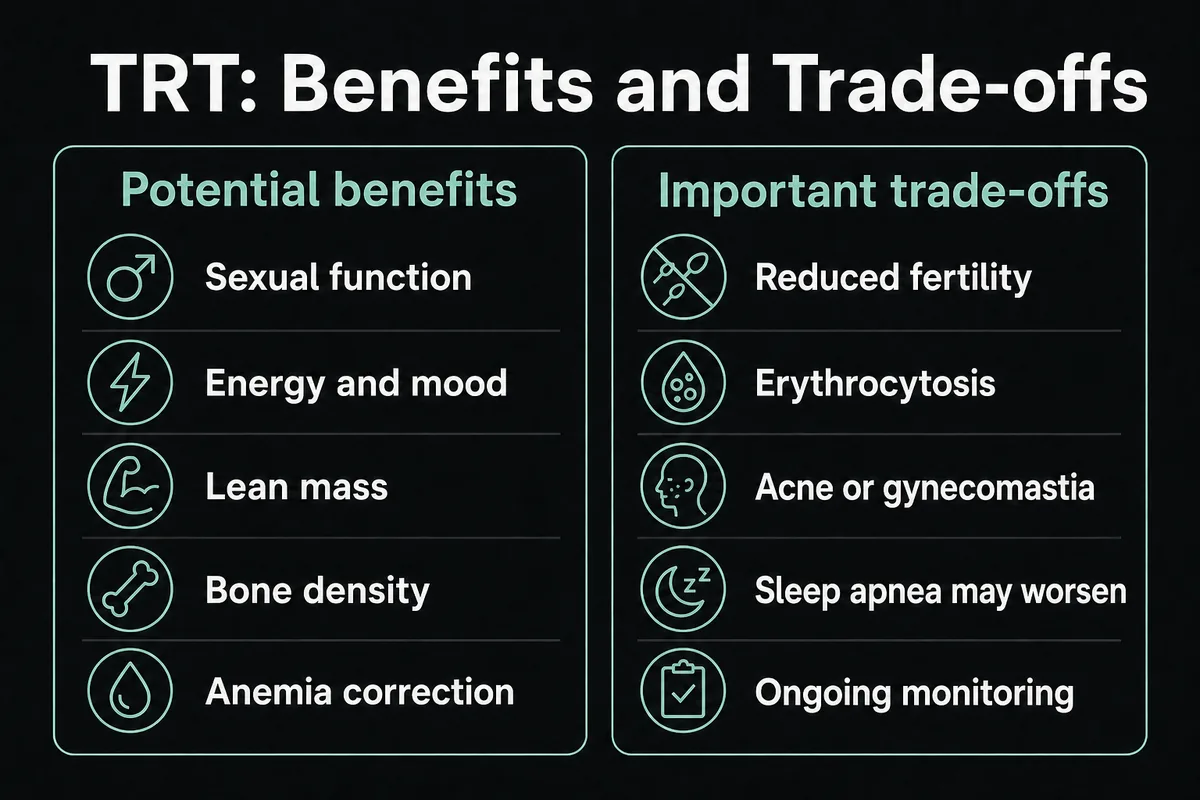
A balanced view of the pros and cons of TRT keeps the benefits above in perspective against the trade-offs. The scoreboard below summarizes both sides; the cons that need the most explanation follow it.
Table: Pros and cons of TRT
| Pros | Cons |
|---|---|
| Improved libido and sexual function 8 | Reduced fertility and sperm production 14 |
| More energy and better mood 8 | Testicular shrinkage 2 |
| Increased lean mass, reduced fat 1 | Erythrocytosis (thickened blood) 48 |
| Better bone mineral density 8 | Gynecomastia and acne 1 |
| Corrected unexplained anemia 8 | Possible worsened sleep apnea 1 |
| Possible glycemic benefit as a lifestyle adjunct 10 | Possible blood pressure elevation 67 |
| Symptom relief for confirmed low T 4 | Lifelong commitment, cost, and ongoing monitoring 24 |
The pros side deserves one clarification. The possible glycemic benefit comes from the T4DM trial, in which two years of testosterone reduced progression to type 2 diabetes in overweight or obese men with impaired glucose tolerance, but only as an adjunct to a structured lifestyle program, not as a standalone diabetes drug. 10 Now the cons that carry the most weight.
Fertility and Testicular Shrinkage
The most important con for younger men is fertility. TRT signals the brain to stop its own testosterone production, which suppresses sperm production and can cause testicular shrinkage; the effect is usually reversible after stopping but not always, and recovery can take months. 12 Men who want to preserve fertility should discuss alternatives before starting, since testosterone by itself is a poor choice for anyone trying to conceive. Options that support the body's own production, such as enclomiphene or hCG, and the broader menu in TRT alternatives, are worth raising. We cover this in depth in TRT and fertility.
TRT and Gynecomastia
Some of the testosterone you take is converted to estrogen through a process called aromatization, and in some men that can cause breast tissue growth, or gynecomastia. 1 TRT gynecomastia is not inevitable, and it is often managed through dose adjustment and monitoring, sometimes with additional medication under a clinician's care. It is a manageable risk to be aware of, not a reason for alarm.
Cardiovascular and Blood Pressure Notes
The cardiovascular story has changed. The TRAVERSE trial, which enrolled more than 5,000 men with existing or high cardiovascular risk, found testosterone noninferior to placebo for major adverse cardiac events, though it did signal more atrial fibrillation, pulmonary embolism, and acute kidney injury in the testosterone group. 6 On the strength of that data, the FDA in February 2025 removed the class-wide cardiovascular boxed warning from testosterone products and added a new warning about possible increases in blood pressure. 7 The practical takeaway is that for men with a genuine indication, the heart picture is more reassuring than the old warnings suggested, but blood pressure now needs watching. See TRT and heart health and TRT and blood pressure. For the complete side-effect list, read side effects of TRT.
Donating Blood on TRT
Because testosterone boosts red blood cell production, one of the more common effects of TRT is a rise in hematocrit, the fraction of blood made up of red cells. Pushed too high, this erythrocytosis thickens the blood and can raise the risk of clot-related problems, which is why guidelines recommend checking hematocrit at baseline, again at 3 to 6 months, and then periodically, and reducing the dose or pausing therapy if it climbs too high (the Endocrine Society flags stopping or adjusting above roughly 54 percent). 42
This is the context for donating blood on TRT. Giving blood, or therapeutic phlebotomy ordered by a clinician, physically removes red cells and lowers an elevated hematocrit, which is the real benefit of donating blood on TRT: it is a management tool, not a wellness ritual. Standard donor eligibility rules still apply, and you should coordinate with your prescriber rather than self-managing. If your hematocrit is normal, routine donation for its own sake is not required.
Is TRT Worth It?
Whether TRT is worth it comes down to who you are. For a man with confirmed hypogonadism (repeatedly low morning testosterone plus real, bothersome symptoms), the benefits usually outweigh the risks when therapy is properly monitored, and most guideline-based clinicians consider it worthwhile. 45 For a man with normal testosterone hoping for an edge in the gym, more energy, or slower aging, the honest answer is that TRT is not worth the risks, because the benefits above depend on correcting a deficiency you do not have. 13
That framing is the whole point. TRT is a treatment for a diagnosed condition, not a supplement. If your testosterone is borderline or your symptoms are vague, it is reasonable to address sleep, weight, alcohol, and other drivers of low testosterone first, and to explore TRT alternatives or compare testosterone boosters versus peptides before committing to a lifelong prescription. Your clinician will help you weigh it honestly.
Frequently Asked Questions
TRT restores testosterone to the mid-normal range in men with a deficiency, which can support libido and erections, muscle protein synthesis, bone mineral density, red blood cell production, fat distribution, and mood. 18 These effects show up mainly when testosterone is genuinely low to begin with.
Libido, mood, and energy often shift within about 3 to 6 weeks, while muscle, bone, and metabolic benefits build over roughly 3 to 12 months. 8 If nothing has improved after a fair 3 to 6 month trial, that is a cue to reassess with your clinician.
References
- Mayo Clinic. Testosterone therapy: Potential benefits and risks as you age.
- Cleveland Clinic. Testosterone Replacement Therapy (TRT).
- Harvard Health Publishing. Is testosterone therapy safe? Take a breath before you take the plunge.
- Bhasin S, et al. Testosterone Therapy in Men With Hypogonadism: An Endocrine Society Clinical Practice Guideline. J Clin Endocrinol Metab, 2018.
- American Urological Association. Evaluation and Management of Testosterone Deficiency: AUA Guideline.
- Lincoff AM, et al. Cardiovascular Safety of Testosterone-Replacement Therapy (TRAVERSE). N Engl J Med, 2023.
- FDA. FDA issues class-wide labeling changes for testosterone products, Feb 28, 2025.
- Snyder PJ, et al. Effects of Testosterone Treatment in Older Men (The Testosterone Trials). N Engl J Med, 2016.
- Snyder PJ, et al. Testosterone Treatment and Fractures in Men with Hypogonadism. N Engl J Med, 2024.
- Wittert G, et al. Testosterone treatment to prevent or revert type 2 diabetes (T4DM). Lancet Diabetes Endocrinol, 2021.
- MedlinePlus. Testosterone Injection (drug information).
- MedlinePlus Medical Encyclopedia. Hypogonadism.
- Mayo Clinic. Testosterone (topical application route).
The information in this article is for educational purposes only and does not constitute medical advice. Always consult a healthcare professional before starting any new supplement or compound. Results vary by individual.