Does TRT help with weight loss? For men with clinically confirmed low testosterone, testosterone replacement therapy can modestly reduce fat mass and increase lean muscle, but it treats diagnosed testosterone deficiency rather than weight itself 19. The benefits are real but modest, they are largest in men with a genuine deficiency, and they only show up when the therapy is paired with sensible eating and resistance training. Just as important, the scale can rise before it falls, because water, appetite, and new muscle all arrive before visible fat loss does. This guide walks through what the controlled trials and the guidelines actually say, with honest numbers and clear labels on what is proven versus what is uncertain.
| Quick stat | What it means |
|---|---|
| Fat mass change in RCTs: roughly 1.6 to 2.3 kg reduction | Real but modest fat loss in men with low testosterone, not dramatic 4 |
| Lean mass change: about 1.5 to 3.5 kg gain on therapeutic doses | Muscle adds weight to the scale, which is a healthy change 14 |
| Long-term registry weight change: up to roughly 10% over 5 years | Observed in an uncontrolled registry, not a guaranteed or typical result 6 |
| FDA status | Approved for classical hypogonadism only, not for weight loss or age-related low T 910 |
| Best candidate | A man with lab-confirmed low testosterone who also trains and controls calories 12 |
| Time to visible fat change | Often 3 to 6 months, with the largest shift over 6 to 12 months 111 |
Key Takeaways
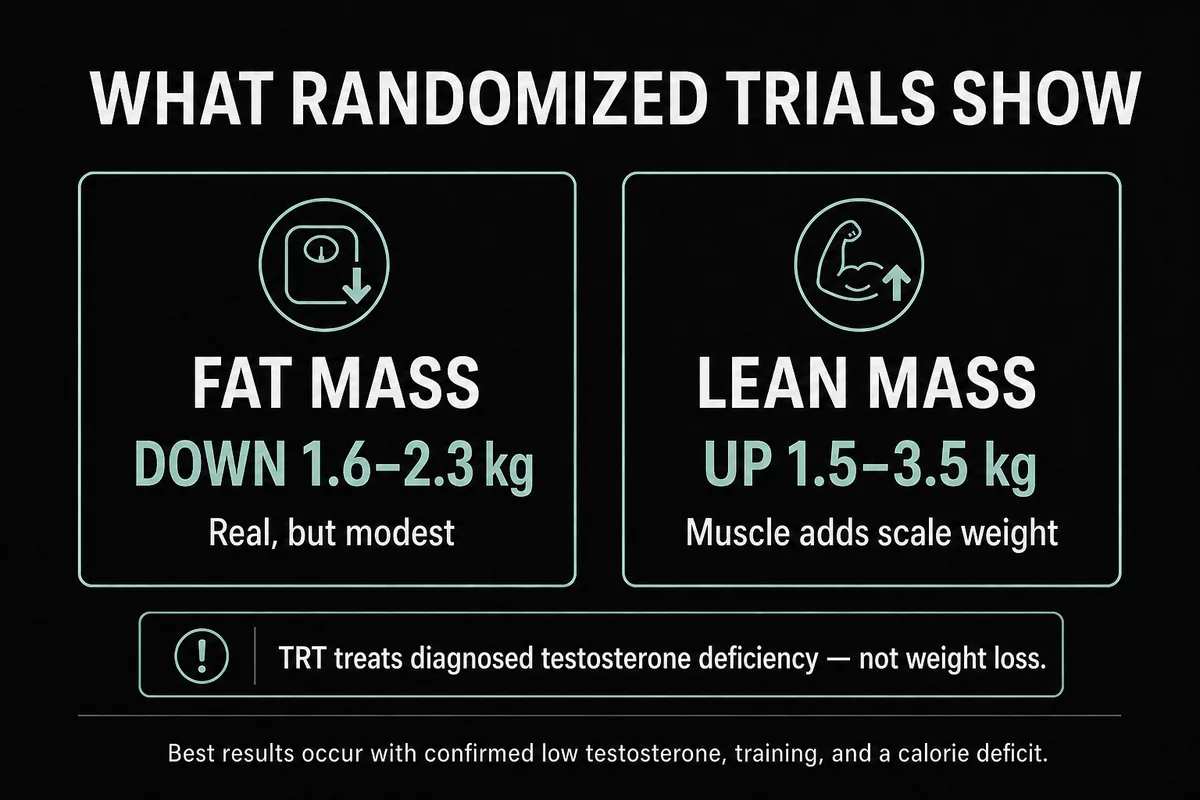
- The effect is modest, not magic. In randomized trials, testosterone therapy trims fat mass by roughly 1.6 to 2.3 kg and adds lean mass, but it does not melt pounds off on its own 4.
- TRT treats diagnosed testosterone deficiency rather than weight itself. Body-composition changes are a secondary effect and should not be treated as a substitute for nutrition, training, or medical weight management 910.
- The scale can rise before it falls. Early water retention, a returning appetite, and new muscle can all nudge the number up in the first weeks even when body composition is improving 111.
- The biggest results happen in confirmed deficiency. Men with genuinely low, lab-verified testosterone respond most; men with normal levels should not expect a fat-loss benefit 12.
- Lifestyle still does the heavy lifting. Fat loss requires a calorie deficit and resistance training; testosterone supports those efforts rather than replacing them 5.
- This is not an anabolic-steroid cycle. Therapeutic TRT restores testosterone to a normal range; it is a very different thing from supraphysiologic steroid use 1.
Does TRT Help With Weight Loss? What the Evidence Shows
Here is the honest picture. Does TRT help with weight loss in men with low testosterone? The controlled evidence says it produces a modest, favorable shift in body composition, meaning less fat and more muscle, rather than a big drop on the bathroom scale. The Endocrine Society clinical practice guideline summarizes the trial data plainly: testosterone therapy increases fat-free mass and reduces whole-body and intra-abdominal fat, and the effect is dose-related 1.
The single cleanest demonstration of the mechanism comes from Finkelstein and colleagues in the New England Journal of Medicine. When researchers deliberately suppressed testosterone in healthy men, fat mass rose in a dose-dependent way, which is the mirror image of what replacement does 3. In other words, low testosterone drives fat accumulation, and restoring it reverses part of that drift.
A meta-analysis by Isidori pooled multiple randomized trials in middle-aged men and found that testosterone treatment reduced fat mass and increased lean mass, with a typical fat-mass reduction on the order of 1.6 to 2.3 kg 4. That is a meaningful body-composition change, but notice the size: a few kilograms of fat, not the double-digit numbers marketing pages love to quote.
The long-term observational data look more dramatic and need a big caveat. Saad and colleagues followed 411 men with low testosterone and obesity in a treatment registry and reported sustained weight and waist reductions, reaching roughly 10% of body weight over about five years and continuing to fall over longer follow-up 6. That is impressive, but a registry has no control group, so it cannot separate the drug's effect from the effect of years of medical follow-up, coaching, and lifestyle change. We label it observational for exactly that reason, and you should never treat it as the loss you are guaranteed to see.
For older men specifically, the Testosterone Trials (Snyder 2016) found modest gains in lean mass and some physical function measures in men over 65, again confirming a real but restrained effect 7. And on the safety side, the TRAVERSE trial provides reassurance that testosterone therapy in men with low levels and cardiovascular risk did not raise the rate of major cardiac events over its follow-up, which matters for deciding who should be on therapy at all 8. For the fuller benefit and safety picture, see our overview of TRT benefits and the pillar guide to testosterone replacement therapy.
How Testosterone Affects Fat: Does TRT Burn Fat?
Does TRT burn fat directly? Not in the sense of setting a match to your fat cells. What testosterone does is shift the biology that governs where your body stores and releases energy. Understanding the mechanism explains why TRT fat loss is real in deficient men yet still depends on diet.
Testosterone promotes lipolysis, the breakdown of stored fat, and it favors the differentiation of stem cells toward muscle rather than fat. Higher testosterone is also linked to better insulin sensitivity, which helps the body handle carbohydrate and reduces the tendency to store visceral fat around the organs 1. More lean muscle also raises resting energy expenditure a little, so a body with more muscle burns slightly more even at rest.
There is also a self-reinforcing loop worth understanding, because it explains why so many men with belly fat also have low testosterone. Excess fat tissue, especially around the abdomen, contains the enzyme aromatase, which converts testosterone into estrogen. That lowers testosterone, which encourages more fat storage, which produces more aromatase, and the cycle tightens. Obesity-related inflammation adds to the suppression 12. TRT can help interrupt that loop in men who are genuinely deficient, but so can losing the fat itself, which is why lifestyle is never optional here.
The practical takeaway: testosterone changes the terrain in your favor, but you still have to walk the path. Without a calorie deficit, TRT fat loss stalls, because no hormone overrides a chronic energy surplus.
Average Weight Loss on TRT: Realistic Numbers
The average weight loss on TRT is one of the most oversold numbers on the internet, with clinic pages quoting "15 to 25 pounds" as if it were routine. The truth is more nuanced, and it depends heavily on whether you are reading a controlled trial or an uncontrolled registry. Below is what the actual published studies report, with the study design labeled so you can judge each figure honestly.
| Study | Population | Design | Fat / weight change |
|---|---|---|---|
| Isidori 2005 4 | Middle-aged men (pooled trials) | Meta-analysis of RCTs | Fat mass down about 1.6 to 2.3 kg; lean mass up |
| Finkelstein 2013 3 | Healthy adult men | RCT (hormone manipulation) | Fat mass rose dose-dependently when testosterone was suppressed |
| Ng Tang Fui 2016 5 | Obese men on a hypocaloric diet | RCT | Extra fat loss and preserved lean mass versus diet alone |
| Saad 2016 6 | 411 hypogonadal men with obesity | Observational registry (uncontrolled) | Around 10% body weight over 5 years; up to roughly 17 kg over longer follow-up |
| Snyder 2016 7 | Men aged 65 and older | RCT (Testosterone Trials) | Modest lean-mass and function gains |
Two patterns jump out. First, the tightly controlled trials show modest, believable numbers: a couple of kilograms of fat, some lean gain. Second, the eye-popping figures come from the uncontrolled registry, where years of medical supervision and lifestyle change are baked into the result and cannot be separated from the drug. The most useful RCT for a practical answer is Ng Tang Fui: when obese men followed a reduced-calorie diet, adding testosterone produced extra fat loss and protected the muscle that dieting usually strips away 5. That is the realistic role of TRT in weight loss: it makes a diet work a little better and protects lean mass, not that it replaces the diet.
Results vary widely, and they are largest in men who start with a real deficiency. If your testosterone is already normal, do not expect these numbers. To see the kinds of composition changes men actually document, read our page on TRT before and after for grounded expectations rather than transformation-photo hype.
TRT Weight Loss Timeline: What to Expect Month by Month
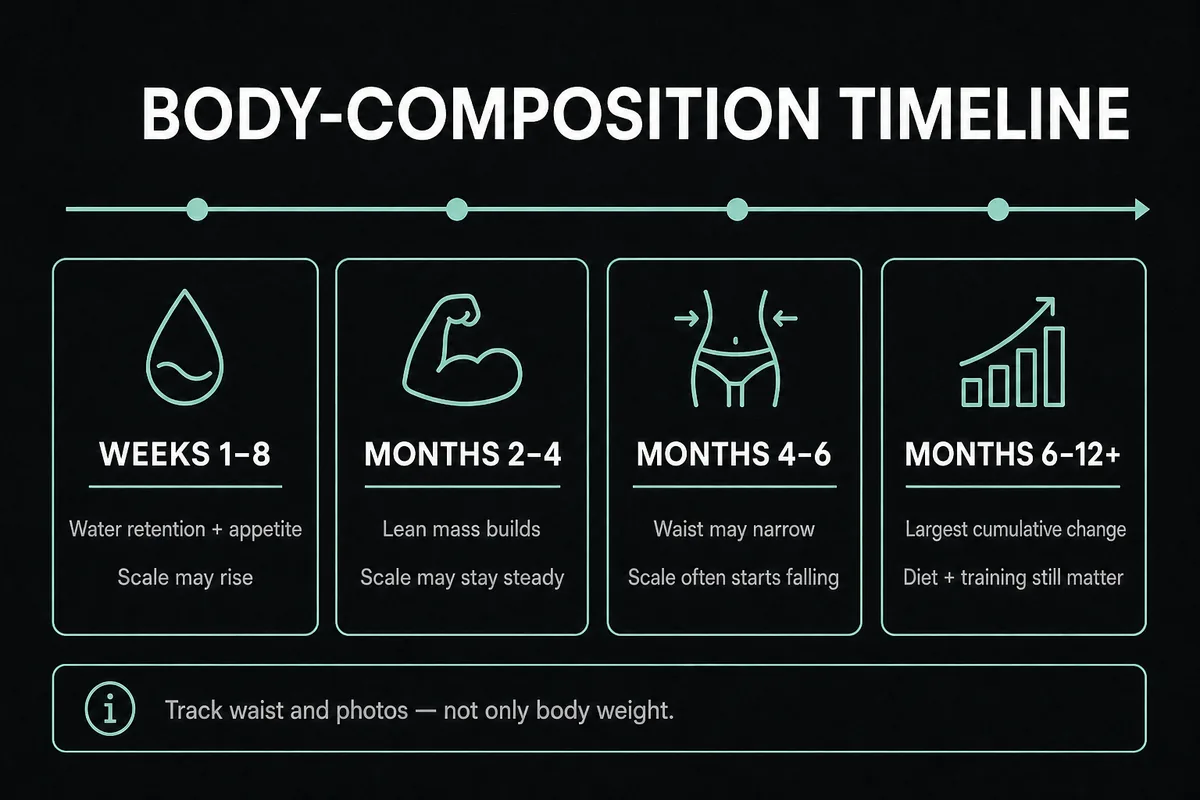
The TRT weight loss timeline confuses people because fat loss lags behind almost everything else. Muscle, water, and appetite all respond before the fat does, so the scale can move the wrong way at first even when things are going right. Here is a rough month-by-month sketch based on how testosterone therapy typically ramps up 111.
| Phase | What is happening | What the scale may show |
|---|---|---|
| Weeks 1 to 8 | Water retention, returning appetite, early metabolic shifts | May rise slightly; this is fluid and appetite, not fat |
| Months 2 to 4 | Lean mass builds with training, energy and mood improve | Roughly steady; muscle is masking early fat loss |
| Months 4 to 6 | Fat oxidation and a maintained deficit start to show | Waist narrows; scale often begins to fall |
| Months 6 to 12+ | Largest cumulative composition change | Clearest fat loss, provided diet and training hold |
The single most important thing to understand from this table is that an early rise on the scale is normal and usually healthy. If you quit at week 6 because the number went up, you abandon the therapy right before the part that helps. For a deeper look at how long the medication takes to reach full effect, see how long does TRT take to work.
Does TRT Help Build Muscle?
Does TRT help build muscle? Yes, in a measured way. Restoring testosterone to a normal physiological range increases muscle protein synthesis and lean body mass, and the Endocrine Society guideline notes this fat-free-mass increase is one of the more consistent effects of therapy 1. In randomized trials, therapeutic doses add roughly 1.5 to 3.5 kg of lean mass, with the larger end of that range seen in men who were most deficient to begin with 14.
But there is a crucial honesty point that separates a trustworthy source from a bodybuilding blog. TRT muscle gain happens because therapy returns testosterone to the normal range, not because it pushes levels sky-high. That normal-range restoration is a completely different thing from anabolic-steroid use, where men take many multiples of a replacement dose to force supraphysiologic growth. We cover this distinction in detail in is TRT a steroid, and the short version is: TRT is replacement, not enhancement.
Muscle also does not appear on its own. Testosterone raises the ceiling on what training can build, but you still have to train and eat enough protein. Studies that pair testosterone with resistance exercise see more lean gain than testosterone alone, which is exactly why "your clinician will" frame TRT as a support for a training program, not a substitute for one.
How Much Muscle Can You Gain on TRT?
How much muscle can you gain on TRT? A realistic figure for a man on a therapeutic dose who trains consistently is in the range of 1.5 to 3.5 kg of lean mass over the first several months to a year, with the most deficient men gaining toward the top of that band 14. After that initial restoration, further gains follow the same slow rules that govern any natural lifter: progressive training, adequate protein, and sleep.
A few caveats keep this honest. Some of that early "lean mass" gain is water and glycogen, not pure muscle. Older men gain less than younger men 7. And the TRT muscle gain timeline is gradual, not a sudden surge, because you are working within a normal hormonal range. Anyone promising rapid, dramatic muscle from a replacement dose is describing steroid use, not TRT.
Does TRT Cause Weight Gain? Healthy vs Unhealthy
It surprises men, but yes, TRT can cause the scale to go up, and it is worth separating the healthy reasons from the unhealthy ones. Does TRT cause weight gain that you should worry about? Usually not. Most early TRT weight gain is water, muscle, and a returning appetite, none of which is fat.
Healthy weight change on TRT comes from three sources. First, water: testosterone causes mild sodium and fluid retention, especially in the first weeks, which can add a quick couple of pounds that fluctuate day to day 1013. Second, muscle: new lean mass is denser than fat and adds real weight to the scale even as your body composition improves 1. Third, appetite: as energy and mood recover, appetite often normalizes, which is fine as long as you keep an eye on portions.
Unhealthy weight gain is real fat gain, and it has identifiable causes: eating in a chronic calorie surplus, a dose that over-converts to estrogen, or the wrong regimen for you. Rapid weight gain on TRT that is clearly fat, not fluid or muscle, is a signal to review your intake and your labs with your prescriber, not to push through. If you are asking why am I gaining weight on TRT, the first questions are how many calories you are eating and how your estradiol looks. Our guide to TRT side effects covers fluid retention, appetite, and estradiol management in more depth.
Gaining Belly Fat on TRT: Why It Happens
Gaining belly fat on TRT feels like a contradiction, since the whole point is to shed visceral fat, but it happens and it usually has a fixable cause. The most common culprit is estradiol. Testosterone converts to estrogen through aromatase, and excess body fat has more of that enzyme, so a man who is already carrying abdominal fat can convert more of his dose to estrogen, which encourages fluid and central fat storage 12. A dose that is too high for you can worsen this.
The other causes are the ordinary ones: a calorie surplus, poor sleep, and untreated sleep apnea, which is common in men with low testosterone and independently drives weight gain. None of this means TRT is failing. Belly fat on therapy is a signal to adjust, usually by tuning the dose, addressing estradiol, tightening the diet, or fixing sleep, and it is a conversation to have with your clinician rather than a reason to quit.
Not Losing Weight on TRT? Troubleshooting
Not losing weight on TRT is one of the most common complaints, and the reason is almost always the same: TRT is not a substitute for a calorie deficit. If you are asking why am I not losing weight on TRT, run through this honest checklist before blaming the therapy.
- Diet still governs the deficit. Testosterone supports fat loss, but it cannot override eating at maintenance or above. A modest, sustained calorie deficit is still the engine 5.
- Muscle is masking the scale. If you are gaining lean mass while losing fat, the scale can stay flat even as your waist shrinks. Track measurements and photos, not just weight.
- Check your labs and dose. Testosterone that is still below range, or estradiol that is high, can blunt results. Your clinician will confirm you are actually in the therapeutic window 12.
- Fluid can hide progress. Early water retention can offset real fat loss on the scale for a few weeks 10.
- Give it 3 to 6 months. Fat loss lags lean gain, so short-term judgments are misleading. The largest changes come over 6 to 12 months 1.
If you have addressed all of these and the scale still will not move after several months, that is a reason to review the whole plan with your prescriber, not to increase the dose on your own.
Who TRT Actually Helps: Classical vs Functional Low T
This is the honesty anchor that most clinic pages skip, and it is the most important part of the article. Testosterone therapy is FDA-approved only for classical hypogonadism, meaning low testosterone caused by an identifiable disease of the testicles, pituitary, or hypothalamus. It is not approved for age-related decline and not approved for weight loss 910. The class-wide labeling on testosterone products reflects exactly this 9, and Mayo Clinic notes that the benefits of testosterone for otherwise healthy age-related decline remain unproven 11.
There are, broadly, two situations. In classical (organic) hypogonadism, a real deficiency from disease, TRT is indicated and the body-composition benefits above apply. In functional (obesity-related) low testosterone, the low reading is driven largely by excess weight and the aromatase-inflammation loop, and here the guideline-consistent first move is weight loss itself, because losing fat raises testosterone naturally 112. For many men in this second group, lifestyle change is first-line, and TRT is not the starting point.
That distinction reframes the whole question. If your low testosterone is a consequence of your weight, then treating the weight can lift the hormone without a prescription. Testosterone is also a Schedule III controlled substance and a prescription-only medication, so the decision to use it belongs with a clinician who has confirmed a genuine deficiency, typically a total testosterone below about 300 ng/dL on repeat morning testing before treatment 212. If you are exploring options short of therapy, see our overview of TRT alternatives and our honest comparison of testosterone boosters versus peptides, which explains why most over-the-counter "boosters" do very little.
Frequently Asked Questions
It can, and most of it is healthy. Early on, testosterone causes mild fluid retention, adds lean muscle, and can normalize appetite, all of which raise the scale without adding fat 110. Genuine fat gain usually points to eating in a calorie surplus or an estradiol issue, which is worth reviewing with your clinician 12.
In controlled trials, testosterone reduces fat mass by roughly 1.6 to 2.3 kg in men with low levels, which is modest 4. Long-term registry data show larger losses, near 10% of body weight over five years, but that is uncontrolled and reflects years of medical follow-up and lifestyle change, so it is not a guaranteed result 6.
Not directly, but it shifts your biology toward fat loss by promoting fat breakdown, improving insulin sensitivity, and building muscle that raises resting energy use 1. Those effects only translate into visible fat loss when you also maintain a calorie deficit, so TRT supports fat loss rather than causing it on its own.
The usual reason is that diet still governs the calorie deficit, and testosterone cannot override eating at or above maintenance 5. Muscle gain can also mask fat loss on the scale, labs or dose may be off, and fat loss lags lean gain, so give it 3 to 6 months and track your waist, not just your weight 1.
A realistic range is about 1.5 to 3.5 kg of lean mass over the first several months to a year on a therapeutic dose with consistent training, with the most deficient men gaining toward the top of that band 14. Older men gain less, and some of that early figure is water and glycogen rather than pure muscle 7.
References
- Bhasin S, et al. Testosterone Therapy in Men With Hypogonadism: An Endocrine Society Clinical Practice Guideline. J Clin Endocrinol Metab. 2018;103(5):1715-1744.
- Mulhall JP, et al. Evaluation and Management of Testosterone Deficiency: AUA Guideline. American Urological Association, 2018.
- Finkelstein JS, et al. Gonadal Steroids and Body Composition, Strength, and Sexual Function in Men. N Engl J Med. 2013;369:1011-1022.
- Isidori AM, et al. Effects of testosterone on body composition, bone metabolism and serum lipid profile in middle-aged men: a meta-analysis. Clin Endocrinol. 2005;63(3):280-293.
- Ng Tang Fui M, et al. Effects of testosterone treatment on body fat and lean mass in obese men on a hypocaloric diet: a randomised controlled trial. BMC Med. 2016;14:153.
- Saad F, et al. Effects of long-term treatment with testosterone on weight and waist size in 411 hypogonadal men with obesity classes I-III: observational data from two registry studies. Int J Obes. 2016;40:162-170.
- Snyder PJ, et al. Effects of Testosterone Treatment in Older Men (The Testosterone Trials). N Engl J Med. 2016;374:611-624.
- Lincoff AM, et al. Cardiovascular Safety of Testosterone-Replacement Therapy (TRAVERSE). N Engl J Med. 2023;389:107-117.
- U.S. Food and Drug Administration. FDA issues class-wide labeling changes for testosterone products.
- U.S. Food and Drug Administration. AndroGel (testosterone gel) Prescribing Information.
- Mayo Clinic. Testosterone therapy: Potential benefits and risks as you age. Accessed 2026.
- Cleveland Clinic. Low Testosterone (Male Hypogonadism). Accessed 2026.
- MedlinePlus. Testosterone Topical. U.S. National Library of Medicine. Accessed 2026.
The information in this article is for educational purposes only and does not constitute medical advice. Always consult a healthcare professional before starting any new supplement or compound. Results vary by individual.