Does TRT cause hair loss? It can, but not for everyone, and not in the way the fear usually goes. Testosterone replacement therapy does not universally make men bald. What it can do is speed up male pattern hair loss in men who are already genetically predisposed to it, through a hormone called DHT. If pattern balding does not run in your family and you are not already thinning, the odds that TRT triggers it are much lower. In the best data available, only a minority of men develop any new hair loss in the first year, and clinicians often summarize the early risk as roughly one in five men or fewer, weighted heavily toward those with a family history 910. This guide gives the honest, guideline-anchored version: who is actually at risk, why the same hormone thickens your beard while thinning your scalp, what is reversible and what is not, and the physician-directed ways to prevent it. For the bigger picture on treatment itself, start with our testosterone replacement therapy overview.
Key Takeaways
- Genetics gate it, not TRT itself: hair loss on TRT happens mainly in men who inherited androgen-receptor sensitivity and a family history of male pattern baldness 45.
- DHT is the mechanism: testosterone converts to dihydrotestosterone (DHT), which binds scalp follicle receptors far more tightly and shrinks susceptible follicles over time 48.
- Body and facial hair rise while the scalp thins: the same DHT that miniaturizes crown and hairline follicles thickens beard, chest, and limb hair, the so-called DHT paradox 12.
- It is often preventable: physician-directed DHT blockers such as finasteride, plus minoxidil and formulation adjustments, can protect at-risk men, ideally started early 7.
- Some loss reverses, established baldness does not: temporary shedding after starting therapy usually recovers, but long-standing miniaturized follicles are generally not recoverable 78.
- TRT is not a hair treatment: it does not regrow scalp hair, and in susceptible men it does the opposite, so "does TRT help with hair loss" is answered no.
Does TRT cause hair loss?
The short answer is that TRT can accelerate hair loss, but only in men who are genetically set up for it, and it is far from guaranteed. The clearest evidence we have comes from studies of people taking testosterone as masculinizing hormone therapy, because those cohorts are followed prospectively over years. In the first year, new androgenetic alopecia (the medical name for pattern hair loss) appeared in only about 5 to 17 percent of people, and most early loss was mild 910. That is where the "one in five or fewer" framing comes from.
The risk is not fixed, though. It builds with time on therapy. In longer follow-up, roughly 63 percent of people on masculinizing testosterone showed some androgenetic alopecia by about ten years, with incidence peaking around year four and a diagnostic lag of nearly three years before it was formally noted 9. Compared with baseline populations, masculinizing hormone therapy carried about 2.5 times the pattern-loss rate of cisgender women and about 1.3 times that of cisgender men 10. Translation: TRT nudges you toward the male pattern-baldness curve you were already on, faster, if you were on it at all.
That is the honest, absolute-risk way to read this. Most men on TRT do not go bald because of it. A meaningful minority, concentrated among those with the genetic setup, see their existing predisposition move along sooner. The table below sorts out who sits where.
Table 1. Who is most at risk of hair loss on TRT
| Factor | Higher risk | Lower risk |
|---|---|---|
| Family history of male pattern baldness | Yes | None |
| Existing thinning before TRT | Present | Absent |
| Age | Older | Younger |
| Formulation | Transdermal gel or patch | Injection or lower-DHT route |
| Duration on therapy | Years | Months |
| Androgen-receptor sensitivity | Sensitive | Not sensitive |
If most of your answers land in the left column, prevention (below) is worth discussing with your prescriber before or when you start. If they land right, your absolute risk is low.
How TRT causes hair loss: the DHT connection
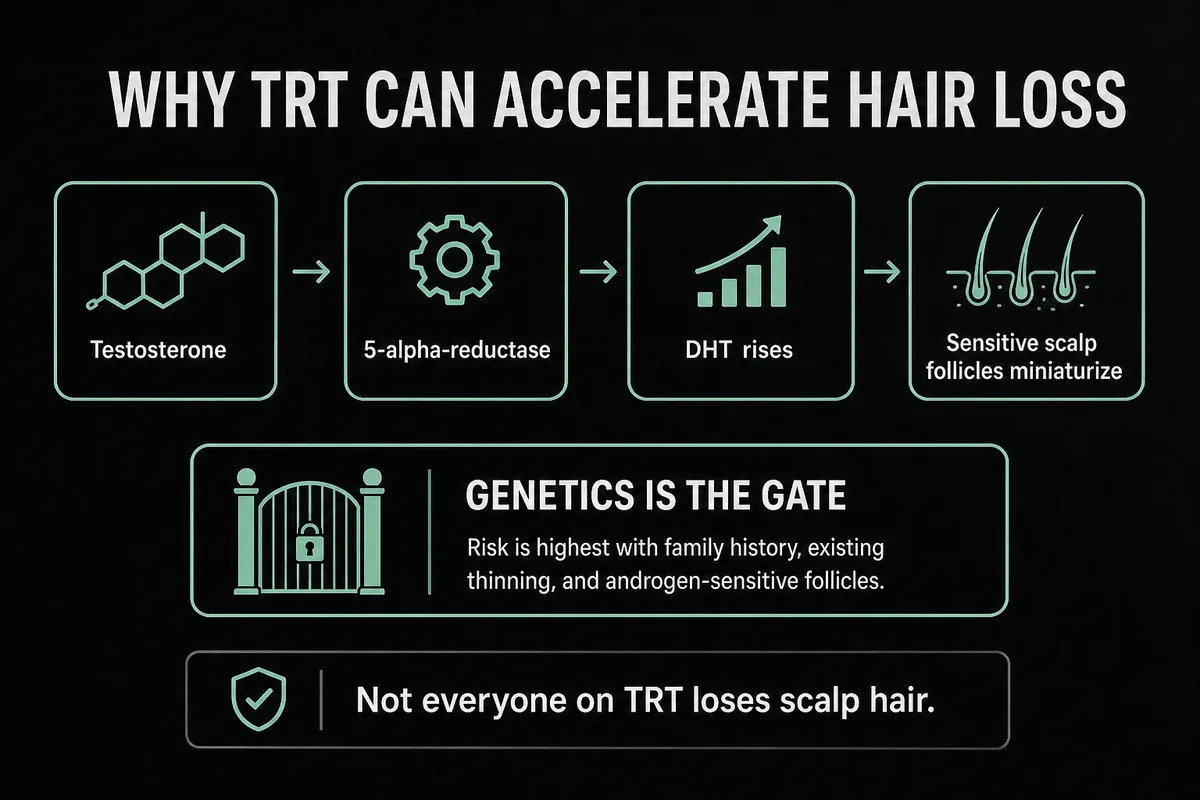
Testosterone itself is not the direct villain for scalp hair. Inside the skin and follicles, an enzyme called 5-alpha-reductase converts a portion of testosterone into dihydrotestosterone, or DHT. The Cleveland Clinic notes that roughly 10 percent of the body's testosterone is converted to DHT daily 4. DHT is a far stronger androgen at the follicle: it binds the androgen receptor with roughly five times the affinity of testosterone 8. In genetically susceptible scalp follicles, that strong binding gradually shrinks the follicle in a process called miniaturization, so each hair grows back finer, shorter, and lighter until the follicle effectively stops producing a visible hair 58.
Because TRT raises testosterone, it also raises DHT. The FDA prescribing information for testosterone gel documents that DHT rises in parallel with testosterone during therapy 3. Clinically, blood DHT commonly climbs to something in the range of two to three times where it started once testosterone is replaced, which is why men prone to pattern loss can see it speed up. Notably, the AndroGel label lists male-pattern baldness and hirsutism (excess body hair) among reported adverse reactions, so this is a labeled, recognized effect rather than a rumor 3.
Why only some men lose hair on TRT
Here is the part the scare stories miss: everyone on TRT makes more DHT, but only some men lose scalp hair. The difference is genetics. Whether a follicle miniaturizes in response to DHT depends on inherited androgen-receptor sensitivity in that follicle, which is why pattern baldness clusters in families and why it hits the crown and hairline (androgen-sensitive zones) while sparing the back and sides 45. Cleveland Clinic data show male pattern baldness is extremely common on its own: about 25 percent of affected men notice signs before age 21 and roughly half by age 50 5. TRT does not create this sensitivity. It just supplies more of the hormone that acts on it. If you did not inherit susceptible follicles, more DHT does not translate into scalp loss.
Does the TRT formulation matter?
Somewhat, and it is one of the few levers you can adjust. Different delivery methods raise DHT to different degrees, because skin is rich in 5-alpha-reductase. Transdermal gels and patches, applied to the skin, tend to push DHT higher than intramuscular injections do 3. That does not make gels "bad," but for a man with a strong family history, formulation is a reasonable conversation to have with a prescriber. Our guide to the types of TRT covers how each route works in more detail.
Table 2. DHT change by TRT formulation (general tendency, individualized and physician-monitored)
| Formulation | Typical effect on DHT | Note |
|---|---|---|
| Intramuscular or subcutaneous injection | Rises with testosterone, commonly around two to three times baseline | Often a lower-DHT route relative to skin gels |
| Transdermal gel or patch | Tends to spike DHT higher than injections | Skin is rich in 5-alpha-reductase |
| Pellets | Sustained elevation over the implant's life | Steady, longer exposure |
| Nasal gel | Shorter, lower peaks | Brief dosing pattern |
These are general tendencies, not promises. Your own DHT response is individual and is something your clinician can measure and monitor.
Does TRT cause baldness or make you go bald?
This is where precision matters. TRT does not create a new disease or a new kind of baldness. In a susceptible man, it accelerates the androgenetic alopecia he was genetically going to experience anyway, showing up as the familiar pattern (a receding hairline and thinning crown) rather than diffuse, all-over loss 5. So "does TRT make you go bald" is best answered this way: it can bring forward or intensify male pattern baldness in men predisposed to it, but it will not turn a man with no genetic susceptibility into a bald one. If you were never going to develop pattern balding, TRT is very unlikely to cause it. If you were, TRT may get you there sooner unless you take preventive steps. This is also a good place to separate medical TRT from anabolic-steroid abuse, which involves far higher androgen loads; see is TRT a steroid for that distinction.
Is TRT hair loss reversible?
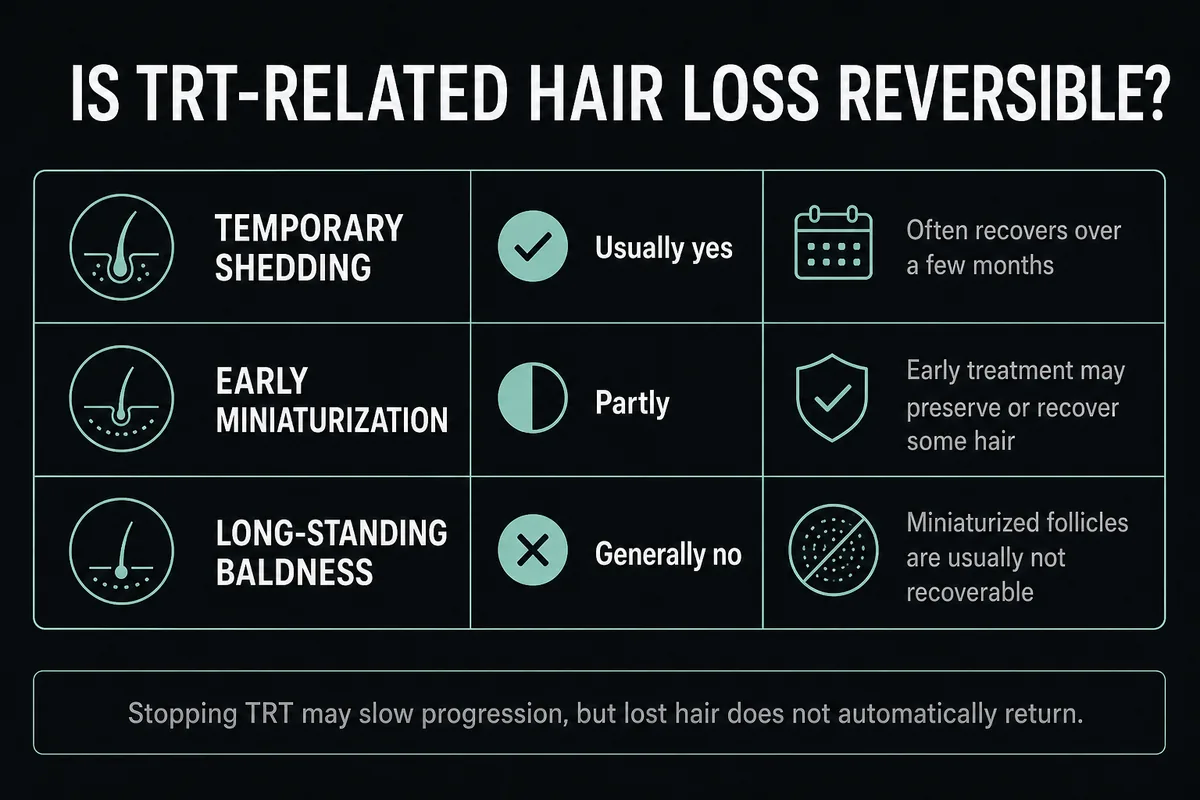
It depends entirely on what is happening in the follicle, and this is the single most misunderstood part of the topic. Some TRT-related hair changes bounce back and some do not. Temporary shedding shortly after starting therapy, a stress-and-shift response called telogen effluvium, usually recovers on its own over a few months. Early follicle miniaturization can partly respond if it is treated promptly with DHT blockers or minoxidil. But once follicles have been miniaturized for a long time, they are generally not recoverable, and no amount of adjusting TRT will bring them back 78. Stopping TRT lowers DHT again, but it does not by itself regrow hair that genetic loss has already claimed.
Table 3. Is TRT hair loss reversible?
| Situation | Reversible? | What to expect |
|---|---|---|
| Temporary shedding / telogen effluvium after starting | Usually yes | Recovers over a few months as the cycle resets |
| Early follicle miniaturization | Partly, if treated promptly | Prompt DHT-blocker or minoxidil use can preserve or partially recover it |
| Long-standing pattern baldness | Generally no | Miniaturized follicles are usually not recoverable 8 |
| Finasteride or dutasteride sexual side effects | Usually resolve on stopping; rarely persistent | Most reverse; a minority report lasting effects 7 |
| Stopping TRT | DHT normalizes, but genetic loss does not self-reverse | Progression may slow; lost hair does not automatically return |
The practical lesson is that timing beats regret. Acting early, while follicles are still producing hair, protects far more than trying to reverse loss after the fact.
How to prevent hair loss on TRT
The good news for at-risk men is that this is one of the more preventable TRT side effects, as long as you act early and work with your prescriber. Prevention is most effective when it starts at or near the beginning of therapy in men with a family history, rather than after visible loss. Every option below is physician-directed: finasteride, dutasteride, and prescription-strength choices are clinical decisions, not something to self-start, and they interact with your other goals such as fertility. See our broader TRT side effects hub for how these fit into monitoring.
Table 4. Prevention and treatment options (all physician-directed)
| Option | How it works | Approximate effect | Route | Key caveats |
|---|---|---|---|---|
| Oral finasteride | Blocks type II 5-alpha-reductase | Reduces scalp DHT substantially (commonly cited around 65 to 70 percent) | Oral | Sexual side effects possible, usually reversible, rarely persistent 7 |
| Oral dutasteride | Blocks type I and type II 5-alpha-reductase | More potent DHT reduction than finasteride | Oral | Off-label for hair, same side-effect class, more potent |
| Topical finasteride | Localized 5-alpha-reductase block | Lowers scalp DHT with less systemic exposure | Topical | Newer option, still under clinician guidance |
| Minoxidil | Extends the hair growth (anagen) phase; not a DHT blocker | Supports growth independent of DHT | Topical or oral | Must be continued to maintain benefit 7 |
| Microneedling | Adjunct that may boost topical response | Enhancer, not a standalone fix | In-office or at-home device | Used alongside other treatments |
| Formulation or dose adjustment | Limits DHT spikes from delivery route | May lower DHT exposure | Via prescriber | Individualized, requires monitoring |
| Ketoconazole shampoo | Mild anti-androgen and scalp effect | Modest adjunct | Topical | Supporting role only |
DHT blockers: finasteride and dutasteride
Finasteride is the most established preventive. It blocks the type II form of 5-alpha-reductase, lowering the DHT that drives miniaturization; Harvard Health notes it typically takes about four to six months to see an effect and must be continued indefinitely to keep the benefit, since stopping lets DHT and loss resume 7. Dutasteride blocks both type I and type II 5-alpha-reductase, so it lowers DHT more, but it is used off-label for hair and carries the same class of considerations. Both can cause sexual side effects such as lowered libido, erectile difficulty, or ejaculation changes; these usually resolve after stopping and only rarely persist 7. Because DHT blockers touch the same androgen pathways involved in sperm production, they are worth discussing alongside TRT and fertility if you plan to conceive. Topical finasteride is an emerging lower-systemic-exposure option some clinicians prefer for exactly that reason.
Minoxidil, microneedling, and formulation adjustment
Not every tool is a DHT blocker. Minoxidil works on a different axis, extending the growth phase of the hair cycle, which is why it is often paired with a DHT blocker rather than used instead of one; like finasteride, it must be continued to maintain results 7. Microneedling is an adjunct that may improve how well topical treatments absorb and work. And the formulation lever from Table 2 belongs here too: for a man with strong genetic risk, a prescriber may favor a lower-DHT delivery route or fine-tune the dose to limit DHT spikes. None of these should be self-started; they are chosen and monitored with your clinician.
Does TRT help with hair loss?
No, and this is the myth worth correcting directly. TRT is not a hair-loss treatment, and it does not regrow scalp hair. In men with androgen-sensitive follicles it does the opposite, accelerating loss by raising DHT 38. You will sometimes see the idea that boosting testosterone "fixes" thinning hair; it does not, and chasing higher testosterone for that reason is both ineffective and, in prone men, counterproductive. If your goal is protecting or restoring hair, the evidence-based path is the DHT-lowering and growth-supporting tools above, not testosterone itself. TRT is a treatment for diagnosed low testosterone, evaluated against benefits and risks with your clinician 126, not a cosmetic hair therapy.
TRT, body hair, and facial hair: the DHT paradox
Here is the twist that confuses so many men, and that almost no scalp-loss article addresses: the very same DHT that thins the scalp thickens hair almost everywhere else. On the face and body, androgen-sensitive follicles respond to more DHT by growing thicker, coarser, darker terminal hairs. So on TRT, many men notice a fuller beard and more chest, back, arm, and leg hair even as the crown thins 12. It feels contradictory, but it is the same hormone acting on follicles that are wired to respond in opposite directions. The AndroGel label lists hirsutism (excess hair growth) right alongside male-pattern baldness for this reason 3, and MedlinePlus notes changes in scalp and body hair among testosterone's effects 11.
Table 5. Scalp versus body and facial hair on TRT
| Area | Effect of TRT and DHT | Why |
|---|---|---|
| Scalp (crown and hairline) | Thinning or loss in susceptible men | DHT miniaturizes genetically sensitive follicles 58 |
| Beard and face | Increased density and coarseness | DHT stimulates terminal-hair growth in facial follicles 12 |
| Chest, back, arms, legs | Increased growth, coarser texture | Same androgenic stimulation of body-hair follicles 1112 |
If unwanted body hair becomes bothersome, laser or other hair-removal methods are options to discuss; there is nothing you need to buy to understand the effect itself.
Hair loss and testosterone therapy in women
Women prescribed testosterone, whether for specific medical indications or as part of masculinizing therapy, can experience the same two-sided pattern: unwanted scalp thinning together with increased facial and body hair, driven by the same androgen-to-DHT pathway 1112. Because women's dosing targets and monitoring differ substantially from men's, any use is physician-directed, and hair changes are one of the effects a clinician watches and adjusts for. Our TRT for women guide covers that context in full.
Frequently Asked Questions
With physician-directed treatment started early: DHT blockers such as finasteride or dutasteride, minoxidil to support growth, possible microneedling, and sometimes a lower-DHT formulation or dose adjustment 7. These are clinical decisions to make with your prescriber, not self-started medications.
References
- Bhasin S, et al. Testosterone Therapy in Men With Hypogonadism: An Endocrine Society Clinical Practice Guideline. J Clin Endocrinol Metab. 2018;103(5):1715-1744.
- Mulhall JP, et al. Evaluation and Management of Testosterone Deficiency: AUA Guideline. American Urological Association, 2018.
- U.S. Food and Drug Administration. AndroGel (testosterone gel) Prescribing Information. 2019.
- Cleveland Clinic. DHT (Dihydrotestosterone): What It Is, Side Effects & Levels. Accessed 2026.
- Cleveland Clinic. Male Pattern Baldness (Androgenic Alopecia): Stages, Treatment. Accessed 2026.
- Mayo Clinic. Testosterone therapy: Potential benefits and risks as you age. Accessed 2026.
- Harvard Health Publishing. Treating hair loss in men: What works? Accessed 2026.
- Nassar S, et al. Hair loss with testosterone use in males: a narrative review. 2025 (PMC11931090).
- Bertoli MJ, et al. Androgenetic alopecia among transgender and gender-diverse patients on masculinizing hormone therapy (PMC7876619).
- Androgenetic alopecia incidence in transgender and gender-diverse populations: a retrospective comparative cohort study. J Am Acad Dermatol. 2023 (PMID 36780950).
- MedlinePlus. Testosterone Topical. U.S. National Library of Medicine. Accessed 2026.
- Folx Health. How Testosterone Impacts Hair Growth and Loss: Facial, Body and More. Accessed 2026.
The information in this article is for educational purposes only and does not constitute medical advice. Always consult a healthcare professional before starting any new supplement or compound. Results vary by individual.