Most testosterone peptides never touched a testosterone test. Of the names that show up on every "best peptides" list, only three have human data showing your own testosterone going up: kisspeptin, hCG and gonadorelin. This guide ranks the testosterone peptides by the number that matters, the blood result, and shows you the catch attached to each one.
🔑 Key Takeaways
- The peptide with the best testosterone numbers isn't the one most people buy first
- Kisspeptin works, but the way it was given in every study is not the way people use it at home
- One cheap blood test tells you whether any of these peptides can work for you at all
- The famous growth hormone peptides have a surprising gap in their testosterone data
- A single dosing mistake with gonadorelin can push testosterone down instead of up
You already know the feeling that sends people here. Less drive, slower recovery, a flat afternoon that used to be your best hours. You want your own testosterone back, not a lifetime of weekly shots. Peptides promise exactly that. Some of them deliver it, and the evidence tells you which.
Do Peptides Actually Increase Testosterone?
Some do. Most don't.
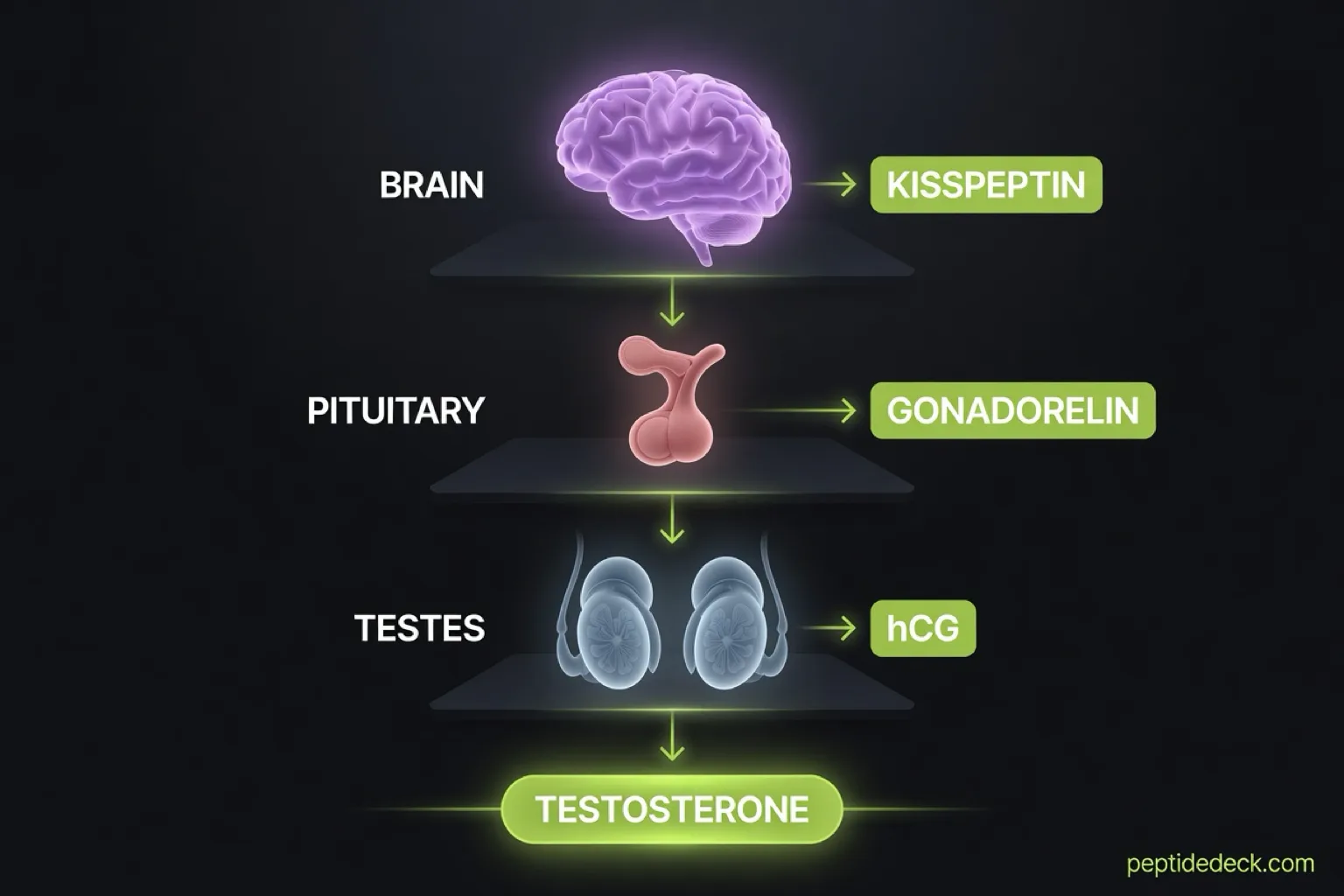
Your testosterone is made at the end of a chain. Your brain releases a hormone called GnRH in short pulses, roughly one every 60 to 120 minutes. Each pulse tells your pituitary gland to release LH (luteinizing hormone). LH travels to your testes and tells the Leydig cells to make testosterone. When levels get high enough, testosterone signals back up the chain to slow things down.
A peptide can only raise testosterone if it pushes on one of those links. So the real peptides to increase testosterone are the ones that act on this chain, and that leaves three candidates:
- Kisspeptin sits at the very top. It switches on the GnRH neurons in your brain.
- Gonadorelin is a copy of GnRH itself. It acts one step lower, on the pituitary.
- hCG skips the brain and pituitary. It looks enough like LH to hit the testes directly.
Everything else sold as testosterone boosting peptides works somewhere else. Growth hormone peptides act on a separate chain. PT-141 acts on desire in the brain. Neither has a trial showing your testosterone number going up. We'll get to them, because that gap is the most useful thing on this page.
Testosterone Peptides Ranked by What Human Studies Measured
Here is the scoreboard. Most lists of the best peptides to increase testosterone rank by popularity. This one is ranked by one thing: what happened to testosterone in people.
Notice what's missing. Nothing on this list has a long-term, placebo-controlled trial of daily at-home use in men with low testosterone. The best data are short, small and done in hospitals. That doesn't make these peptides useless. It means you should know which kind of evidence you're buying into.
1. hCG: The Strongest Numbers, With a Prescription Attached
hCG is the heavyweight here.
It's a hormone, not a small peptide, but it gets filed with the testosterone peptides because it does the same job from a lower rung. It binds the LH receptor on your testes and tells them to make testosterone, no brain signal required. The FDA label for Novarel lists hypogonadotropic hypogonadism in men as an approved use, with regimens from 500 to 1,000 units three times a week up to 4,000 units three times a week for six to nine months.
In men who use it on its own, the numbers are real. A case series of 20 men with low-testosterone symptoms saw average testosterone climb from 362 to 520 ng/dL, a 49.9% rise, over a median of 8 months. Half of them said their symptoms improved.
So why isn't everyone on it?
Two reasons. First, the evidence for hCG alone is still small and uncontrolled; that series had no placebo group. Second, access got harder. On March 23, 2020, hCG was reclassified as a biologic, which pushed compounding pharmacies out and left the brand-name vials. You need a prescription and a prescriber who will write it. Our hCG peptide guide covers dosing and side effects in full.
hCG side effects on the label: headache, irritability, restlessness, depression, fatigue, fluid retention, breast tissue growth (gynecomastia) and injection-site pain. Breast growth ties back to estradiol, which rises as testosterone does, so get estradiol checked on follow-up labs.
2. Kisspeptin: The Best Peptide for Testosterone Without a Prescription
Kisspeptin is the master switch.
It sits above GnRH, so when it works, the whole chain works: GnRH, then LH, then testosterone, the way your body does it naturally. That's why it is the name serious users keep landing on. And the human data are clean, if short.
- Healthy men, kisspeptin-10: in a 2011 Edinburgh study, a 22.5-hour IV infusion took testosterone from 16.6 to 24.0 nmol/L. That's about 479 to 692 ng/dL, a 45% jump. LH nearly quadrupled.
- Men with type 2 diabetes and low testosterone: in five men averaging a BMI of 40.6, an 11-hour infusion lifted testosterone from 8.5 to 11.4 nmol/L (about 245 to 329 ng/dL). Small, but it's a group many men with low testosterone resemble.
- Kisspeptin-54: a 90-minute infusion in six men raised testosterone over saline and measured its half-life at 27.6 minutes.
One more finding matters if you're dosing. In the 2011 study, a 1 mcg/kg IV dose gave the biggest LH response. Tripling it to 3 mcg/kg gave a smaller one. More kisspeptin is not more testosterone.
The catch nobody lists: the pulse problem
Look at how those results were produced. Every testosterone rise above came from a drip running for hours. Nobody in those studies got a single morning shot.
That matters because your brain responds to rhythm, not to a constant flood. When women with low reproductive hormones took twice-daily kisspeptin-54 injections, their LH response on day one averaged a 24.0 IU/L rise. By day 14 it was down to 2.5. The receptor had stopped listening.
The first good news for men arrived in August 2026. An Imperial College London team gave kisspeptin-10 under the skin to healthy men in two patterns. Running it nonstop for five days, testosterone stayed up but LH fell back to placebo levels. Running it 8 hours on and 16 hours off, LH stayed elevated for all 12 days, and the kisspeptin receptor still responded at the end.
The lesson for you: breaks in the dosing schedule seem to keep kisspeptin working. Twelve days is also the longest anyone has shown it working in men. Anything beyond that is uncharted.
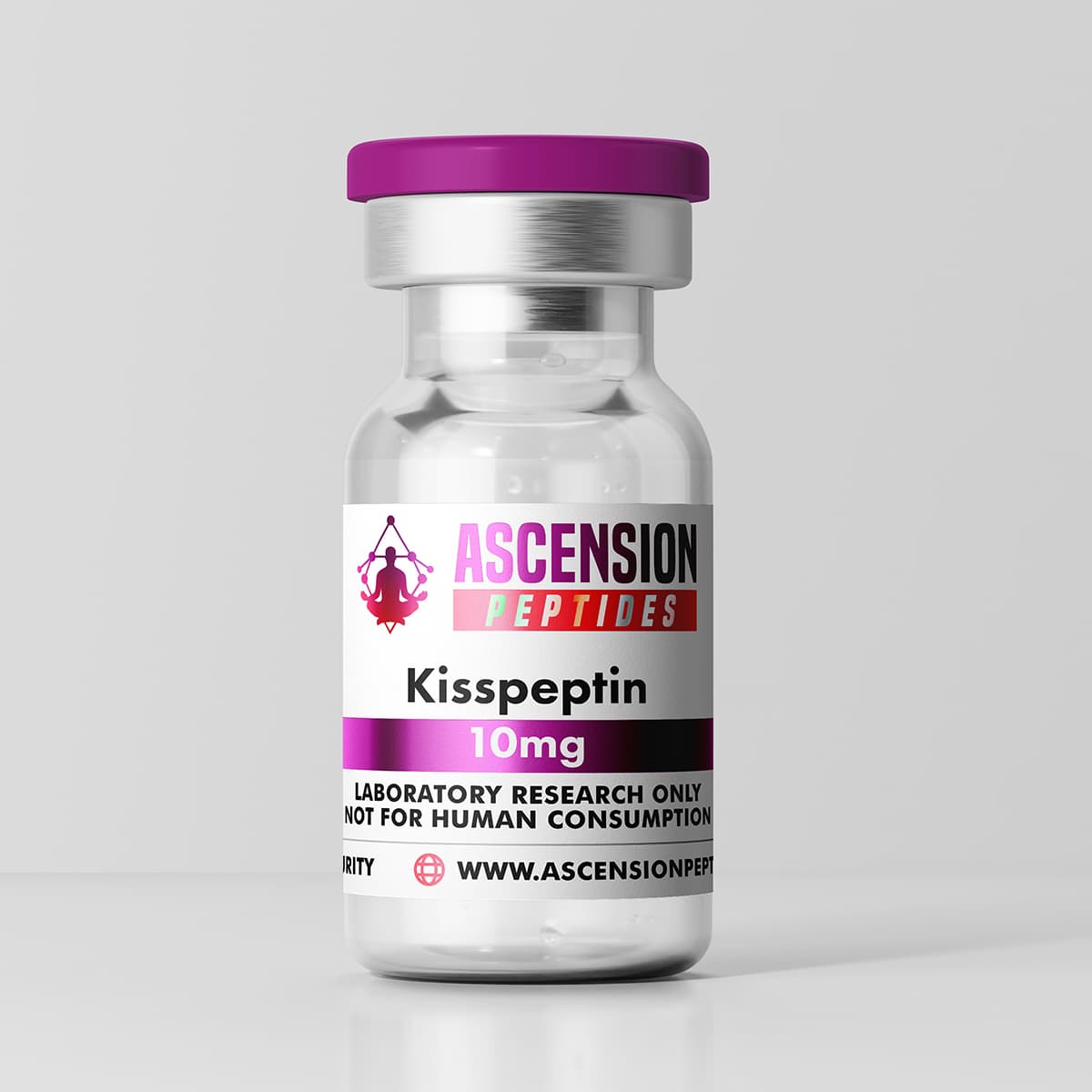
Kisspeptin has no approved product in the US or anywhere else, so almost everyone gets it as a lyophilized vial from a peptide vendor. If you are comparing kisspeptin for sale, a 10 mg vial runs about $60 to $75, and the batch certificate should show identity by mass spec, purity above 98% and an endotoxin result. Practical schedules are in our kisspeptin dosage chart, and the full profile is in the kisspeptin peptide guide.
3. Gonadorelin: Works in a Pump, Unproven as a Shot
Gonadorelin is GnRH itself.
On paper that makes it perfect. In practice, it has the shortest leash of anything here. Natural GnRH lasts minutes in your blood, and your pituitary only responds to it in pulses. Feed the pituitary a constant GnRH signal and it shuts down. That is exactly how leuprolide, a long-acting GnRH drug, is used to drive testosterone down in prostate cancer.
The strongest gonadorelin data come from men born with a GnRH defect. In a study of 30 men, a pump delivering a small dose every 90 minutes restored normal LH and FSH in 2 to 3 weeks and normal testosterone in 8 to 10 weeks. Their wives conceived. The same study also tested twice-daily 500 mcg injections. The pump won on hormones, sperm and pregnancies.
That's the problem with how most men use gonadorelin today: once or twice a day, under the skin, often on TRT to keep the testes from shrinking. No published trial shows that pattern holds testicular size or sperm on TRT the way hCG does. Both US brands, Factrel and Lutrepulse, are listed as discontinued, so what you get now is compounded. We compare the two head to head in gonadorelin vs hCG.
The Peptides That Get Called Testosterone Peptides (But Aren't)
This is where most lists of peptides that boost testosterone pad their numbers.
CJC-1295, ipamorelin and sermorelin
These raise growth hormone. They are good at it: in the main CJC-1295 trial, one shot lifted GH 2 to 10 times for six days or more and IGF-1 1.5 to 3 times. But the outcomes measured were GH and IGF-1. Testosterone wasn't one of them.
Could better sleep and less belly fat nudge your testosterone up over months? Plausibly. Fat tissue converts testosterone to estradiol, and poor sleep lowers morning testosterone. But that's an indirect effect you'd get from any fat loss, and no trial has put a number on it for these peptides. If body composition is your real goal, they're worth a look; see what CJC-1295 does to testosterone for the detail.
Testagen
Testagen is sold as a testes-targeting bioregulator. The claim rests on cell-culture work and studies in animals. No human has been given it in a published study, let alone had testosterone measured; the Testagen guide walks through what does exist.
PT-141
PT-141 (bremelanotide) acts on melanocortin receptors in the brain that drive desire. It was approved in June 2019 as Vyleesi for low desire in premenopausal women. It does nothing to your testosterone. If low libido is the real complaint, though, it may solve the problem you actually came here with. Our kisspeptin vs PT-141 comparison helps you pick.
The honest outsider: enclomiphene
Enclomiphene is a pill, not a peptide, but it answers the same wish: your own testosterone, fertility intact. In two phase III trials of overweight men with low testosterone, 16 weeks of enclomiphene raised testosterone, LH and FSH and kept sperm counts normal, while testosterone gel cut them. That's more controlled evidence than any peptide on this page has. See the enclomiphene guide.
Check This One Lab Before You Pick Any Peptide
Your LH result decides everything.
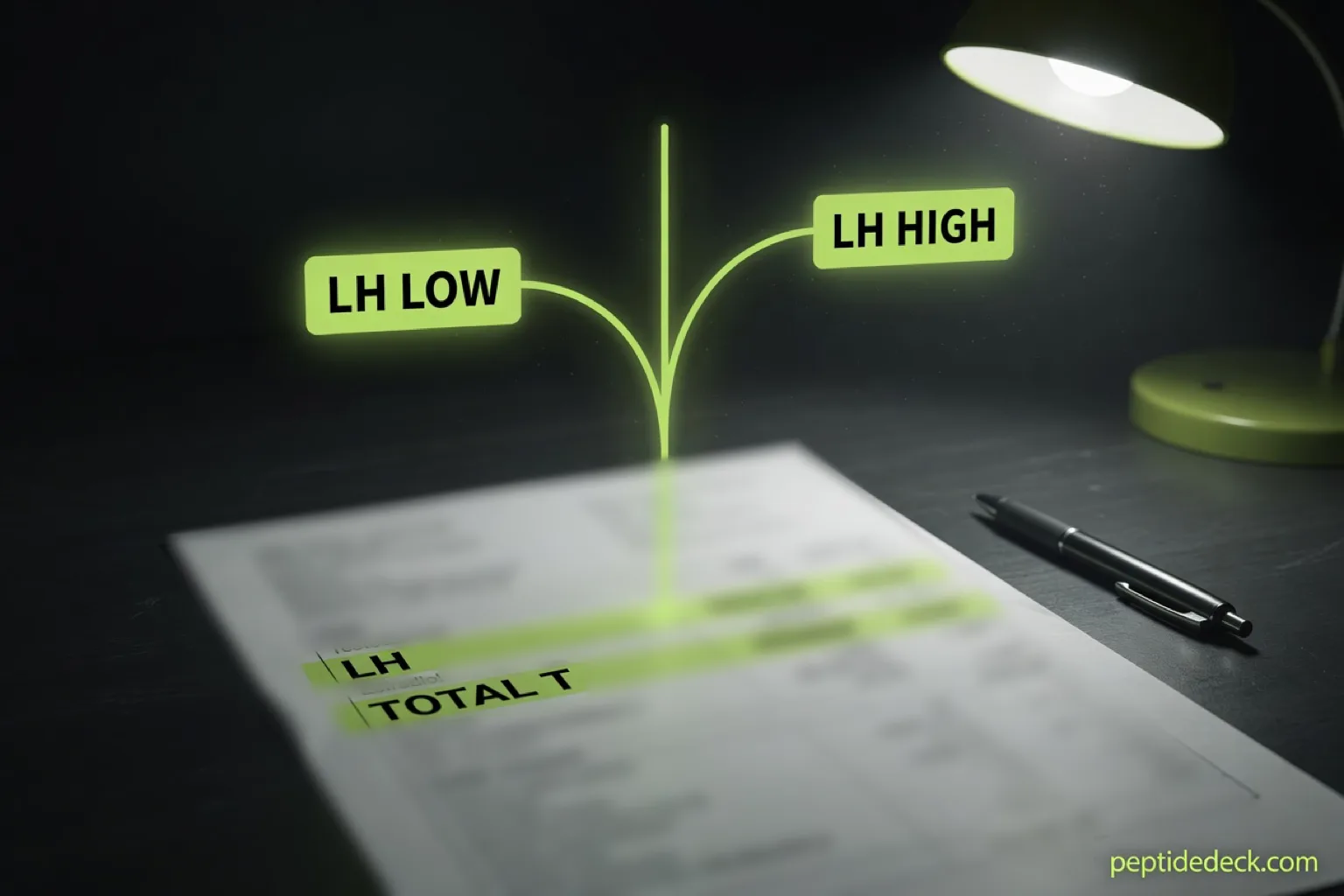
Every one of the peptides that increase testosterone works by making your body send more LH, or by acting like LH. That only helps if your testes can still answer. So look at LH next to your testosterone:
- Low testosterone with low or normal LH (secondary hypogonadism): the signal from your brain is weak. This is the pattern in obesity, type 2 diabetes, heavy stress and past steroid use. Kisspeptin, gonadorelin and hCG all have a job to do here.
- Low testosterone with high LH (primary hypogonadism): your brain is already shouting and your testes aren't answering. Turning up the signal won't help. Testosterone therapy is the realistic route.
The baseline panel to get before you start
- Total testosterone, fasting, before 10 a.m., on two separate mornings (the Endocrine Society requires two low readings to diagnose low testosterone)
- Free testosterone and SHBG
- LH and FSH
- Estradiol (sensitive assay)
- Prolactin, if LH is low (a raised prolactin can point to a pituitary problem)
- Hematocrit and PSA, as a reference point
Retest the same panel 4 to 6 weeks after starting. If LH rose and testosterone didn't, the peptide is doing its part and your testes aren't. If neither moved, your schedule or your vial is the suspect.
Peptides and Testosterone Stack: Using Them Alongside TRT
Short version: one pairing has data.
Testosterone injections shut down your own LH. In a study of 29 healthy men on 200 mg of testosterone enanthate a week, testosterone inside the testes fell 94%. Adding 250 units of hCG every other day kept it within 7% of baseline; 500 units put it 26% above. That's the evidence behind hCG on TRT, and why it's the standard way to protect fertility on TRT.
Gonadorelin on TRT is the popular substitute with no equivalent trial. Kisspeptin on TRT hasn't been tested at all. And stacking a GH peptide on top adds GH effects, not more testosterone. If you're weighing TRT against a peptide-only route, our TRT alternatives guide lays out the options, and testosterone boosters vs peptides covers the supplement side.
How Fast Each One Works
The timelines are very different.
- Kisspeptin: LH rises within 30 minutes of a dose. Testosterone followed within hours in the infusion studies. Past 12 days, nobody has measured it in men.
- hCG: acts directly on the testes, so testosterone moves within days. The 20-man series judged results over months, with a median of 8.
- Gonadorelin by pump: normal LH in 2 to 3 weeks, normal testosterone in 8 to 10 weeks, in men with a GnRH defect.
- GH peptides: GH and IGF-1 move within days. Any testosterone effect would ride on fat loss and sleep, over months.
If you feel nothing by week three, don't raise the dose on instinct. Get the labs. The kisspeptin data show that bigger doses can blunt the response.
Side Effects and the Honest Limits
None of these are free rides.
With hCG, watch estradiol and breast tenderness. With kisspeptin, the real risk is less about side effects, which were minimal in the short studies, and more about the unknown: nobody has published what happens over months of home use. With gonadorelin, the risk is using a pattern that does little, or, if dosed too often, one that can quiet the pituitary instead of waking it.
Then there's the vial. Vendor peptides aren't made under drug-grade rules, so the certificate of analysis is your only check on identity, dose and endotoxin. Reconstitute with bacteriostatic water and sterile technique; our reconstitution guide covers it step by step.
And if your testosterone is truly low, with symptoms, two low morning tests and a high LH, a peptide isn't the answer. A doctor-supervised plan is. Start with how to get TRT the legitimate way.
Frequently Asked Questions
If growth hormone, recovery and body composition are part of what you want, see our guide to the best peptides for men.
Medical Disclaimer: This article is for informational purposes only and does not constitute medical advice. hCG is a prescription drug in the US, and kisspeptin and gonadorelin sold as vials are not approved medicines. Hormone changes can affect fertility, mood, blood counts and the prostate. Talk to your doctor and get baseline labs before you start any peptide to change your testosterone.