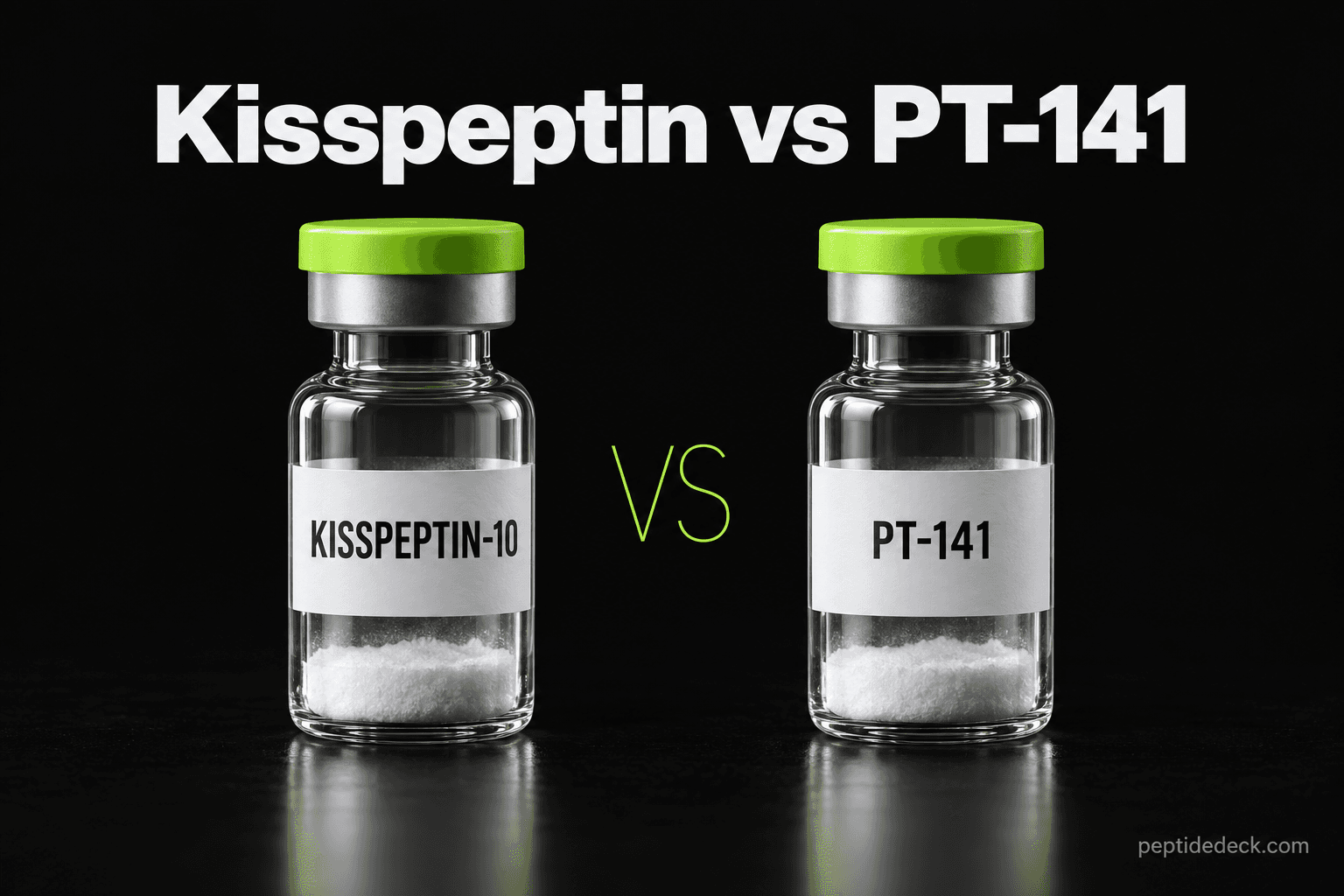
One works in 45 minutes. The other works in weeks.
Kisspeptin vs PT-141 gets framed as a libido comparison, and both peptides do show up in that conversation. But they solve different problems. PT-141 flips a switch in the brain for a single evening. Kisspeptin sits at the very top of the hormone chain that decides how much testosterone or estrogen you make every day. If you pick the wrong one, it is not that it will not work. It is that it will not do the thing you were hoping for.
🔑 Key Takeaways
- PT-141 acts on melanocortin receptors in the brain and produces arousal on demand. Kisspeptin acts on the hypothalamus and raises the hormones that produce desire over time.
- Kisspeptin is upstream of everything. GnRH, LH, FSH, testosterone and estrogen all sit below it in the chain.
- PT-141 has phase 3 trials and an approved product. Kisspeptin has small but well-designed academic trials and no approved product.
- Nausea is the PT-141 tax. Kisspeptin's trials reported almost no side effects, which is unusual and worth understanding.
- Most people asking this question actually want one of them. Which one depends on whether the problem is tonight or the last six months.
For the single-compound guides, see the kisspeptin peptide guide and the PT-141 dosage guide. This page covers the comparison.
Kisspeptin vs PT-141 at a Glance
If PT-141 is the one you want, where to buy PT-141 lists the price, the COA and the cost per use.
How Kisspeptin Works
Everything hormonal starts here.
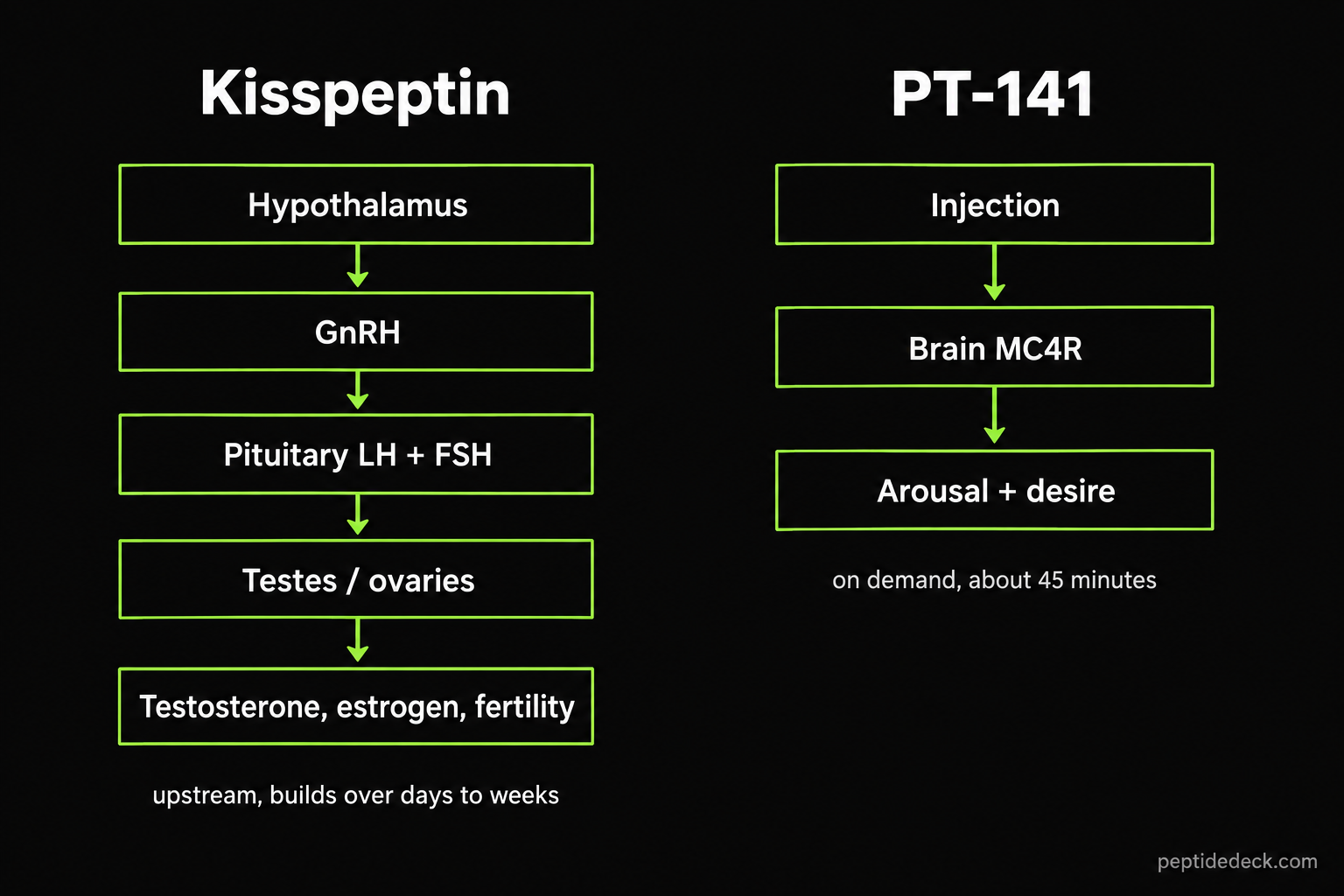
Kisspeptin is a neuropeptide produced in the hypothalamus. It binds to KISS1R on GnRH neurons and tells them to fire. GnRH then tells the pituitary to release LH and FSH. LH tells the testes to make testosterone, or the ovaries to ovulate. FSH drives sperm production and follicle development. Every step below kisspeptin is downstream of it, which is why people who study it call it the master regulator of the reproductive axis.
That position is what makes it interesting for men with low testosterone who do not want to shut their own production down. Testosterone replacement works by supplying the end product, and the body responds by switching off the upstream signal. Kisspeptin works by turning the upstream signal up, so the testes keep doing the work themselves. The TRT alternatives guide covers where it fits in that landscape.
The link to desire runs through the same chain and through the brain directly. In 2017, a group at Imperial College London gave healthy men a kisspeptin infusion and imaged their brains while they viewed sexual and romantic images. Kisspeptin enhanced activity in limbic regions tied to sexual arousal and reward. In 2023 the same group published two placebo-controlled crossover trials in JAMA Network Open: 32 men and 40 women with hypoactive sexual desire disorder. Kisspeptin improved sexual brain processing in both, and in men it also improved penile tumescence in response to erotic stimuli. Side effects were essentially absent.
Two forms circulate. Kisspeptin-54 is the full-length hormone with a half-life around 28 minutes. Kisspeptin-10 is the shortest active fragment, with a half-life of about 4 minutes. Kisspeptin-10 is what almost everyone buys, and its short half-life is why community protocols dose it several times a week rather than once.
How PT-141 Works
Skip the hormones. Go straight to the brain.
PT-141, or bremelanotide, is a melanocortin agonist. It binds MC4R and MC3R in the central nervous system and produces arousal directly, without changing testosterone, LH or anything else in the hormonal cascade. Your levels the morning after are the same as the morning before. That is a feature. It means PT-141 works in people whose hormones are already fine but whose desire is not, which describes a large share of the people looking for help.
It is also why it is fast. A subcutaneous dose of 1.75 mg takes effect in about 45 minutes and lasts several hours. It does nothing for blood flow, so it is not a substitute for a PDE5 inhibitor in someone with a purely vascular problem. It is a desire drug, and the FDA approved it as one in 2019 for premenopausal women with hypoactive sexual desire disorder.
The cost of acting on melanocortin receptors is nausea. About 40% of women in the phase 3 trials reported it, most often mild and short-lived. There is also a temporary rise in blood pressure, roughly 6 mmHg systolic, for up to 12 hours. The PT-141 side effects guide goes through management in detail. If you are also weighing PT-141 against its parent compound, that is covered in PT-141 vs Melanotan 2.
Kisspeptin vs PT-141 for Libido
Both help. They help different people.
PT-141 is the answer when desire is the bottleneck and you want it solved for a specific occasion. It is the only one of the two you can take today and feel tonight. Its trial data measured exactly this outcome, satisfying sexual events and desire scores, in over a thousand people.
Kisspeptin is the answer when low desire is a symptom of a sluggish axis: low-normal testosterone, poor morning energy, a libido that faded gradually rather than disappearing one day. Its trials showed brain-level improvements in sexual processing within hours of an infusion, but the practical appeal is what happens over weeks when LH and testosterone are being nudged up consistently. It does not give you an evening. It gives you a baseline.
The trap is expecting one to behave like the other. Kisspeptin taken an hour before sex does very little you would notice. PT-141 taken three times a week for a month does nothing for your testosterone.
Kisspeptin vs PT-141 for Testosterone and Fertility
This is not a comparison. Only one of them plays.
PT-141 has no effect on testosterone, LH, FSH or sperm. Kisspeptin raises all of them, because that is its job. In clinical studies, single doses of kisspeptin raised LH within 30 to 60 minutes and testosterone over the following hours. Repeated dosing in men with hypogonadotropic hypogonadism restored pulsatile LH secretion. That is why kisspeptin gets discussed alongside gonadorelin and HCG as a way to keep the testes working, or to restart them after suppression.
One caveat that separates kisspeptin from HCG. Continuous, high-level exposure to kisspeptin can desensitise KISS1R and suppress the axis instead of stimulating it. That effect has been studied deliberately as a possible contraceptive approach. In practice it means pulsatile dosing, several injections a week rather than a constant-release approach, and it means more is not better.
Dosage Compared
Read the units twice.
Kisspeptin-10 is dosed in micrograms. Community protocols run around 100 mcg subcutaneously, daily or several times a week, often timed before bed or before training. Clinical studies used weight-based doses in a similar range. A 10 mg vial reconstituted with 2 mL of bacteriostatic water gives 5 mg/mL, so 100 mcg is 2 units on a U-100 syringe. Cycles of 8 to 12 weeks are typical, with a break, partly because of the desensitisation point above.
PT-141 is dosed in milligrams. The approved dose is 1.75 mg subcutaneously about 45 minutes before activity, no more than once in 24 hours and no more than 8 times a month. Most people starting from a vial begin at 0.5 to 1 mg to find their nausea threshold. At 5 mg/mL, 1 mg is 20 units.
The difference is roughly seventeen-fold. Anyone moving from one to the other with the same syringe habit is going to get it badly wrong in one direction.
Side Effects Compared
Kisspeptin's clean profile is the surprising part.
Across the Imperial College trials, kisspeptin infusions and injections produced almost no adverse events. No nausea signal, no blood pressure effect, no pigmentation. The cautions are theoretical: axis desensitisation with continuous exposure, and the general uncertainty that comes with a compound that has never been through a large safety programme.
PT-141's profile is well characterised because it went through phase 3. Nausea in about 40%, flushing in about 20%, headache in about 11%, a brief blood pressure rise, and focal hyperpigmentation in about 1% at approved dosing. None of these are dangerous for most people. All of them are more noticeable than anything kisspeptin does.
Which One Should You Choose?
Ask what the problem is, and when.
Choose PT-141 if you want arousal for a specific occasion, your hormones are already in range, you are fine with occasional nausea, or you want the option with an approved product and a prescription pathway.
Choose kisspeptin if the goal is raising your own testosterone or supporting fertility, you want to avoid TRT-style suppression, you are treating a gradual decline rather than an acute problem, or you have found PT-141's side effects intolerable.
Using both is reasonable in principle because the mechanisms do not overlap. Kisspeptin for the baseline over weeks, PT-141 for the occasion. There is no trial of the combination, so treat it as two separate decisions rather than a stack with its own evidence.
Frequently Asked Questions
The Verdict
PT-141 is for tonight. Kisspeptin is for the next three months.
If you are choosing between them for desire, the honest answer is that the on-demand problem belongs to PT-141 and the gradual-decline problem belongs to kisspeptin. If you are choosing between them for testosterone or fertility, there is no choice. Only kisspeptin touches that system. The mistake people make is buying the fast one to fix a slow problem, then concluding that peptides do not work.
References
- Comninos AN, et al. Kisspeptin modulates sexual and emotional brain processing in humans. J Clin Invest 2017;127(2):709-719. PubMed
- Mills EG, et al. Effects of kisspeptin on sexual brain processing and penile tumescence in men with hypoactive sexual desire disorder: a randomized clinical trial. JAMA Netw Open 2023;6(2):e2254313. PubMed
- Thurston L, et al. Effects of kisspeptin administration in women with hypoactive sexual desire disorder: a randomized clinical trial. JAMA Netw Open 2022;5(10):e2236131. PubMed
- Dhillo WS, et al. Kisspeptin-54 stimulates the hypothalamic-pituitary gonadal axis in human males. J Clin Endocrinol Metab 2005;90(12):6609-15. PubMed
- Jayasena CN, et al. Subcutaneous injection of kisspeptin-54 acutely stimulates gonadotropin secretion in women with hypothalamic amenorrhea, but chronic administration causes tachyphylaxis. J Clin Endocrinol Metab 2009;94(11):4315-23. PubMed
- Kingsberg SA, et al. Bremelanotide for the treatment of hypoactive sexual desire disorder: two randomized phase 3 trials. Obstet Gynecol 2019;134(5):899-908. PubMed
- Vyleesi (bremelanotide injection) prescribing information. FDA, June 2019.
Medical Disclaimer: This content is for informational purposes only and does not constitute medical advice. Always consult a qualified healthcare provider before starting any new supplement, medication, or treatment. PeptideDeck may earn a commission from affiliate links at no additional cost to you.