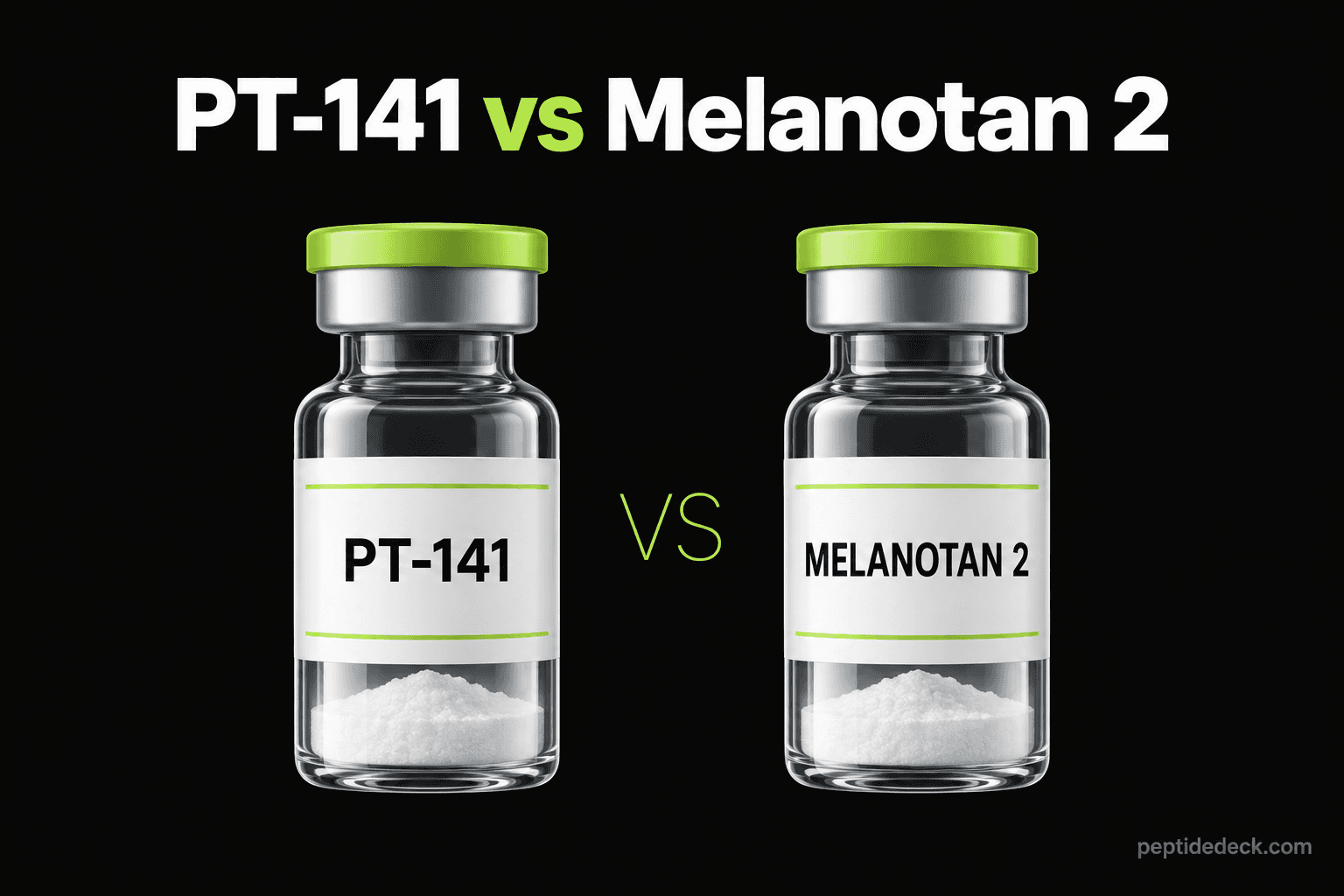

One of them is the other one's leftover.
PT-141 vs Melanotan 2 looks like a choice between two different peptides. It is closer to a choice between a compound and its own metabolite. Melanotan 2 came first. When the body breaks it down, one of the fragments it leaves behind is bremelanotide, which is PT-141. That single fact explains why they overlap so much, why they differ where they do, and why one of them ended up with FDA approval while the other never will.
🔑 Key Takeaways
- PT-141 is a metabolite of Melanotan 2. Same receptor family, narrower footprint.
- Melanotan 2 hits MC1R hard, which is where the tan comes from. PT-141 mostly skips it, which is why it does not tan you and why its pigment side effects are rarer.
- Both raise desire through MC4R in the brain. Only one of them has a placebo-controlled trial programme behind that claim.
- The nausea is the same nausea. It comes from the same receptor. Dose timing changes how bad it gets more than which peptide you pick.
- What decides the choice is what you want from it. The section on who each one suits is the one to read if you skip everything else.
This guide is the head-to-head. For the deep dives on each side, see the full Melanotan 2 guide and the PT-141 dosage guide.
PT-141 vs Melanotan 2 at a Glance
Choosing PT-141 over Melanotan 2? See where to buy PT-141 for price per vial, purity and the current batch certificate.
Where PT-141 Came From
It started as a tanning study.
In the 1990s, a team at the University of Arizona was testing Melanotan 2 as a sunless tanning agent. Male volunteers kept reporting an unexpected effect: spontaneous erections. That observation led to a metabolite of Melanotan 2 being isolated and developed on its own as a sexual-function drug. It was named bremelanotide, and later PT-141.
Chemically, Melanotan 2 ends in an amide group. Strip that amide off and you get bremelanotide. The change is small on paper. In the body it shifts the balance of which melanocortin receptors the molecule prefers, and that shift is the entire story of this comparison.
Bremelanotide went through a full development programme, first as a nasal spray for erectile dysfunction, then as an injection for low sexual desire in women. The FDA approved it as Vyleesi in June 2019. Melanotan 2 never went past early trials. Its development was abandoned, and every vial sold today comes from the grey market.
How Each One Works
Both talk to the same receptor family. They just do not say the same things.
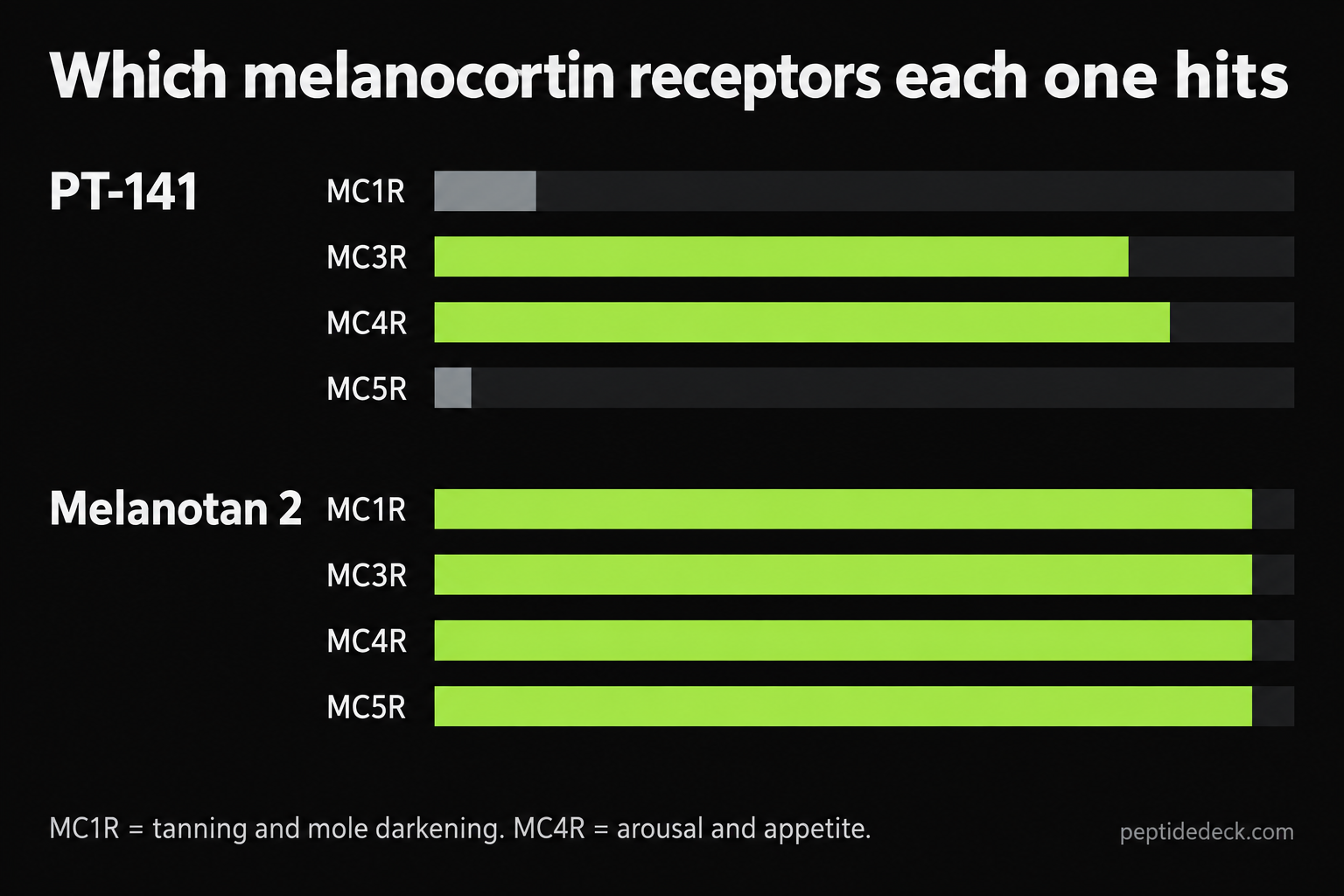
Alpha-MSH is a natural hormone that binds five melanocortin receptors, MC1R through MC5R. Each receptor does something different:
- MC1R sits on melanocytes in the skin. Activate it and you get eumelanin production, which is the tan.
- MC3R and MC4R sit in the brain. MC4R in particular drives sexual arousal and reduces appetite.
- MC5R is involved in sebaceous gland function and has minor effects most people never notice.
Melanotan 2 is a non-selective agonist. It activates all four of the relevant receptors with similar enthusiasm. That is why a single peptide produces tanning, suppressed appetite, a libido increase, and in some men spontaneous erections. You cannot pick which effects you get. They arrive together.
PT-141 keeps most of the MC4R and MC3R activity and loses much of the MC1R activity. In practice that means the arousal effect stays and the tanning effect largely goes. It is not zero. Vyleesi's label lists focal hyperpigmentation as a side effect, seen in about 1% of people at approved dosing and more often in those who used it daily. But it is a footnote for PT-141 and the headline for Melanotan 2.
Neither works on blood flow. That is the difference between both of these and sildenafil. A PDE5 inhibitor makes an erection mechanically easier once arousal exists. PT-141 and Melanotan 2 act upstream, on the desire itself. For someone whose problem is interest rather than plumbing, that distinction is the reason these peptides exist.
PT-141 vs Melanotan 2 for Libido
Here is where the honest answer gets uncomfortable for Melanotan 2.
The libido effect from Melanotan 2 is real and well reported. Many people using it for tanning notice it whether they wanted it or not. But there is no placebo-controlled trial programme measuring it, because the compound was never developed for that purpose. Everything you read about Melanotan 2 and desire is anecdote plus the small early studies from the 1990s.
PT-141 has the RECONNECT trials: two phase 3 studies in over 1,200 premenopausal women with hypoactive sexual desire disorder. The gains were statistically significant and, by the standards of desire drugs, modest. The point is not that PT-141 is dramatically stronger. The point is that its effect has been measured against placebo in a large population, and Melanotan 2's has not.
In men, both peptides produce erections in a meaningful share of users, and the early bremelanotide studies showed erectile responses in men with ED who had not responded to sildenafil. Off-label, the community consensus is that PT-141 gives a cleaner, more predictable arousal response with fewer side effects competing for your attention.
PT-141 vs Melanotan 2 for Tanning
This one is not close.
If you want a tan, PT-141 is the wrong tool. Its MC1R activity is too weak to produce meaningful pigmentation at any sensible dose, and pushing the dose to chase it just multiplies the nausea. Melanotan 2 is the tanning peptide. With UV exposure, most people see visible darkening at 2 to 3 weeks and the full effect at 6 to 8 weeks. Without UV exposure the effect is minimal, because the peptide primes melanocytes rather than replacing sunlight.
That same MC1R activity is what makes Melanotan 2 the higher-risk option for skin. New moles, darkened existing moles, and changes in freckles are common enough that anyone using it should be doing regular skin checks. The Melanotan side effects guide covers the monitoring routine and the case reports.
Dosage Compared
The dosing philosophies are opposites.
PT-141 is event-based. The approved dose is 1.75 mg subcutaneously, about 45 minutes before sexual activity, no more than once in 24 hours and no more than eight doses a month. People using vials rather than the autoinjector typically start at 0.5 to 1 mg to test tolerance, because nausea is dose-dependent and the first exposure tells you a lot. A nasal spray form exists off-label at 2 to 3 mg with a slower, less reliable onset.
Melanotan 2 is a course. The standard loading phase is 0.25 to 0.5 mg daily for one to two weeks alongside UV exposure, then 0.5 to 1 mg once or twice weekly to maintain the tan. There is no single-dose use case, because pigmentation builds over weeks. Going above 1 mg in the loading phase is the most common mistake and the main reason first-timers quit with nausea.
Both come as 10 mg lyophilised vials. Reconstituted with 2 mL of bacteriostatic water, that gives 5 mg/mL, so a 0.5 mg dose is 10 units on a U-100 syringe and 1.75 mg is 35 units.
Side Effects: Same Family, Different Emphasis
Nausea is the shared tax.
Roughly 40% of women in the PT-141 trials reported nausea, usually mild, peaking one to two hours after injection and fading within a few hours. Melanotan 2 users report the same thing, especially in the first week of loading. The nausea comes from central melanocortin activation, so it does not matter much which peptide triggered it. Injecting at night, eating beforehand, and starting low reduce it for both.
Where they diverge:
- Blood pressure. PT-141 raises systolic pressure by about 6 mmHg and diastolic by about 3 mmHg for up to 12 hours after a dose. The label advises against use in uncontrolled hypertension or known cardiovascular disease. Melanotan 2 has no equivalent data set, which is not the same as having no effect.
- Skin. Melanotan 2 darkens moles and can create new ones. PT-141 does this rarely and mostly with daily use, which is outside the approved schedule.
- Flushing and headache. Common to both, more prominent with PT-141 at the full 1.75 mg dose.
- Spontaneous erections. More often reported with Melanotan 2, and one of the reasons it fell out of favour as a tanning product.
- Appetite suppression. Noticeable with Melanotan 2 during loading. Present but milder with PT-141 because of the dosing pattern.
For a full breakdown of one side, see the PT-141 side effects guide.
Which One Should You Choose?
Decide by the outcome, not the peptide.
Choose PT-141 if the goal is desire or arousal on demand, you want the option that has been through controlled trials, you have any concern about moles or skin, or you would prefer an occasional dose over a daily course. It is also the only one of the two with a prescription route in the US.
Choose Melanotan 2 if the goal is a tan and the libido effect is a welcome extra, you are prepared to load daily for two weeks and monitor your skin, and you understand that the compound has no approval and no formal safety programme.
Do not stack them in the expectation of getting more arousal. They act on the same receptors, so the effects overlap rather than add, while the nausea stacks perfectly well.
If your interest is really the upstream hormonal side, testosterone and fertility rather than acute desire, neither is the right comparison. That is the kisspeptin vs PT-141 question.
Frequently Asked Questions
The Verdict
PT-141 is the refined version. Melanotan 2 is the original with everything left in.
If you came to this comparison wanting desire without a tan, PT-141 wins and it is not close. If you came wanting a tan, Melanotan 2 is the only option of the two, and the libido effect is something you will get whether you asked for it or not. The one thing not to do is treat them as interchangeable, because the receptor that separates them is also the receptor that carries most of the long-term skin risk.
References
- Kingsberg SA, et al. Bremelanotide for the treatment of hypoactive sexual desire disorder: two randomized phase 3 trials (RECONNECT). Obstet Gynecol 2019;134(5):899-908. PubMed
- Vyleesi (bremelanotide injection) prescribing information. FDA, June 2019.
- Dorr RT, et al. Evaluation of Melanotan-II, a superpotent cyclic melanotropic peptide in a pilot phase-I clinical study. Life Sci 1996;58(20):1777-84. PubMed
- Wessells H, et al. Synthetic melanotropic peptide initiates erections in men with psychogenic erectile dysfunction: double-blind, placebo controlled crossover study. J Urol 1998;160(2):389-93. PubMed
- Molinoff PB, et al. PT-141: a melanocortin agonist for the treatment of sexual dysfunction. Ann N Y Acad Sci 2003;994:96-102. PubMed
- Habbema L, et al. Risks of unregulated use of alpha-melanocyte-stimulating hormone analogues: a review. Int J Dermatol 2017;56(10):975-980. PubMed
Medical Disclaimer: This content is for informational purposes only and does not constitute medical advice. Always consult a qualified healthcare provider before starting any new supplement, medication, or treatment. PeptideDeck may earn a commission from affiliate links at no additional cost to you.