One of them replaced the other for the wrong reason.
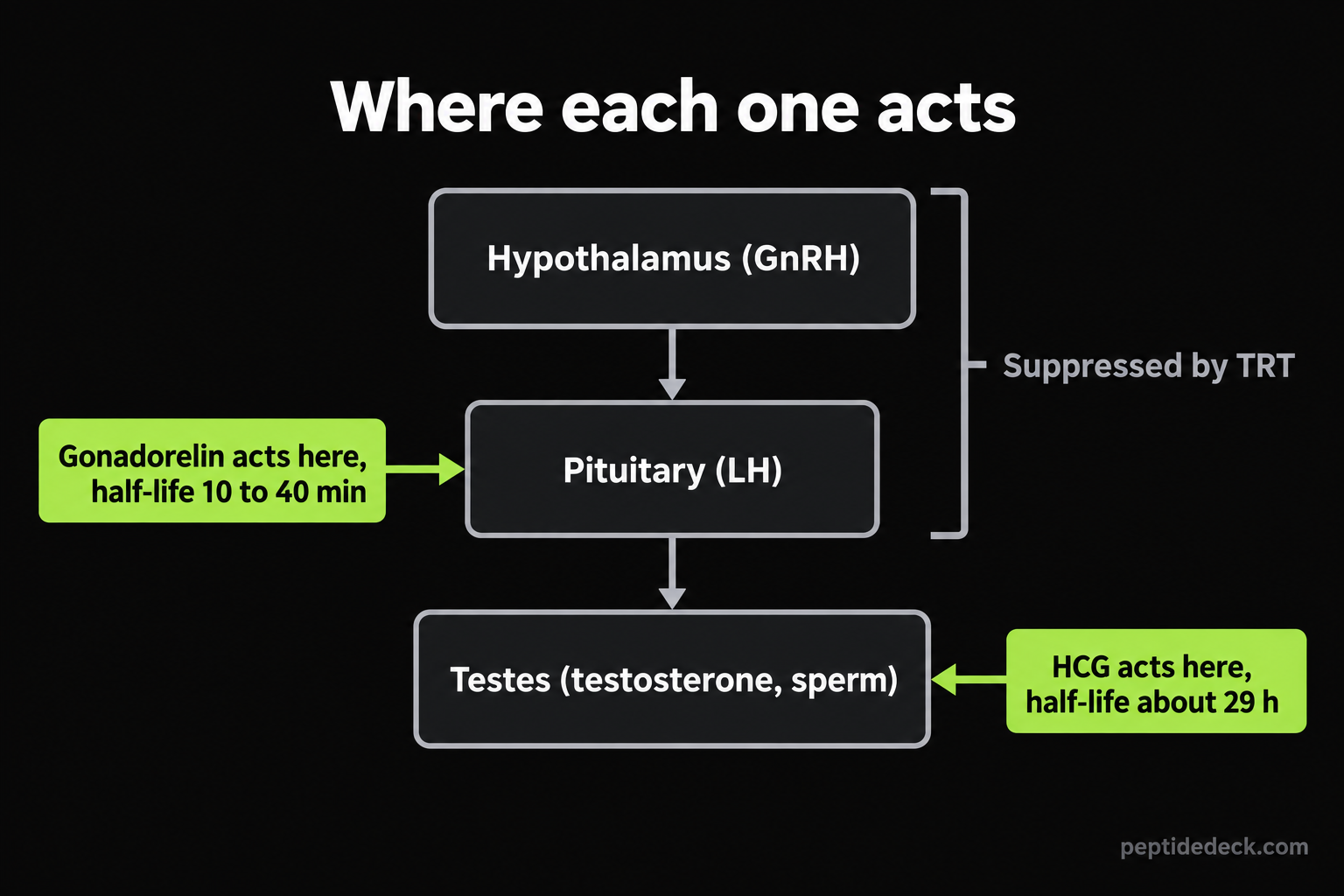
Gonadorelin vs HCG is the question every man on TRT ends up asking, usually after his clinic switched him from one to the other without much explanation. The switch happened because HCG became hard to get, not because gonadorelin works better. Understanding why requires knowing where each one acts in the chain that runs from your brain to your testes, because they act two steps apart, and TRT shuts down one of those steps.
🔑 Key Takeaways
- HCG mimics LH and acts directly on the testes. Gonadorelin is GnRH and acts on the pituitary, asking it to make LH.
- Testosterone therapy suppresses the pituitary. That is the step gonadorelin depends on and the step HCG skips.
- HCG has controlled data showing it preserves testicular function on TRT. Gonadorelin has almost none in that setting.
- Gonadorelin's short half-life means a twice-weekly injection gives the pituitary a brief nudge, not the pulsatile signal it needs.
- HCG raises estradiol more, and that is the one honest reason to prefer gonadorelin. The section on side effects explains when it applies.
For the single-compound guides, see the HCG guide and the gonadorelin guide. For HCG against the other common alternative, see enclomiphene vs HCG. For the therapy both sit alongside, see the TRT hub.
Gonadorelin vs HCG at a Glance
The Chain Both Are Trying to Keep Alive
Three glands, two signals, one problem.
The hypothalamus releases GnRH in pulses, roughly every 90 to 120 minutes. Each pulse tells the pituitary to release LH and FSH. LH tells the Leydig cells in the testes to make testosterone. FSH tells the Sertoli cells to support sperm production. The testosterone produced feeds back to the brain and says "enough", which keeps the whole loop in balance.
Testosterone replacement breaks the loop at the top. Injected testosterone tells the hypothalamus and pituitary that there is plenty, so GnRH and LH fall to near zero. The testes, hearing nothing, stop producing testosterone and sperm and, over months, shrink. That is the problem both compounds exist to solve.
HCG solves it by impersonating LH. It binds the same receptor on Leydig cells and tells them to keep working regardless of what the pituitary is doing. Intratesticular testosterone stays up, sperm production continues, size is maintained.
Gonadorelin is GnRH. It solves it by asking the pituitary to release LH. That works only if the pituitary is willing to answer, and it works properly only if the asking is done in pulses, the way the hypothalamus does it. A steady, continuous GnRH signal does the opposite: it desensitises the pituitary and shuts LH down. That is the mechanism behind leuprolide, a GnRH agonist used precisely to suppress testosterone in prostate cancer.
What the Evidence Says About Each on TRT
This is where the comparison stops being close.
HCG has controlled data for exactly this use. In 2005, Coviello and colleagues gave men on testosterone enanthate either placebo or HCG at 125, 250 or 500 IU every other day and measured intratesticular testosterone by aspiration. Testosterone alone dropped it by 94%. The 250 IU dose limited the drop to 25%, and 500 IU maintained it at baseline. In 2013, Hsieh and colleagues followed men on TRT with 500 IU HCG every other day and found no significant change in semen parameters over more than a year, with no azoospermia. Those two studies are why 250 to 500 IU two or three times a week became the standard.
Gonadorelin has a long history in fertility medicine, where it is delivered by a pump that mimics natural pulses every 90 minutes and restores fertility in men with hypothalamic failure. That is a very different use. There is almost no published data on gonadorelin injected two or three times a week in men on testosterone. The mechanistic problem is obvious once you see the half-life: a compound that clears in 10 to 40 minutes, injected on Monday and Thursday, gives the pituitary two brief nudges a week. The pituitary of a man on TRT is also being told constantly by his testosterone level not to respond. Some men report maintained testicular size on gonadorelin. Many report it does less than the HCG they were switched from. Neither report has a trial behind it.
So why did clinics switch? Availability. In March 2020, HCG was reclassified in the US from a drug to a biologic under the BPCIA transition. Biologics cannot be compounded the way drugs can, which cut off the compounded HCG that most TRT clinics dispensed. Supply tightened through 2023 and 2024. Gonadorelin, still compoundable, filled the gap. It was the available option, not the better one.
Gonadorelin vs HCG for Fertility
HCG, with a caveat about FSH.
For a man on TRT who wants to preserve or restore fertility, HCG is the compound with data. The Hsieh study is the reference. But HCG mimics LH only. It provides no FSH signal, and FSH is what drives sperm production directly. Men whose counts do not recover on HCG alone are often given FSH or an alternative that raises both gonadotropins. That is where enclomiphene enters, and it is covered in enclomiphene vs HCG. The TRT and fertility guide covers the full picture.
Gonadorelin in theory raises both LH and FSH, since it acts upstream of both. In practice, with twice-weekly injections into a suppressed axis, the signal is too brief and too infrequent to rely on for fertility. The pump protocols that do work for fertility are not what TRT clinics prescribe.
Dosage Compared
The units are not related. Do not convert.
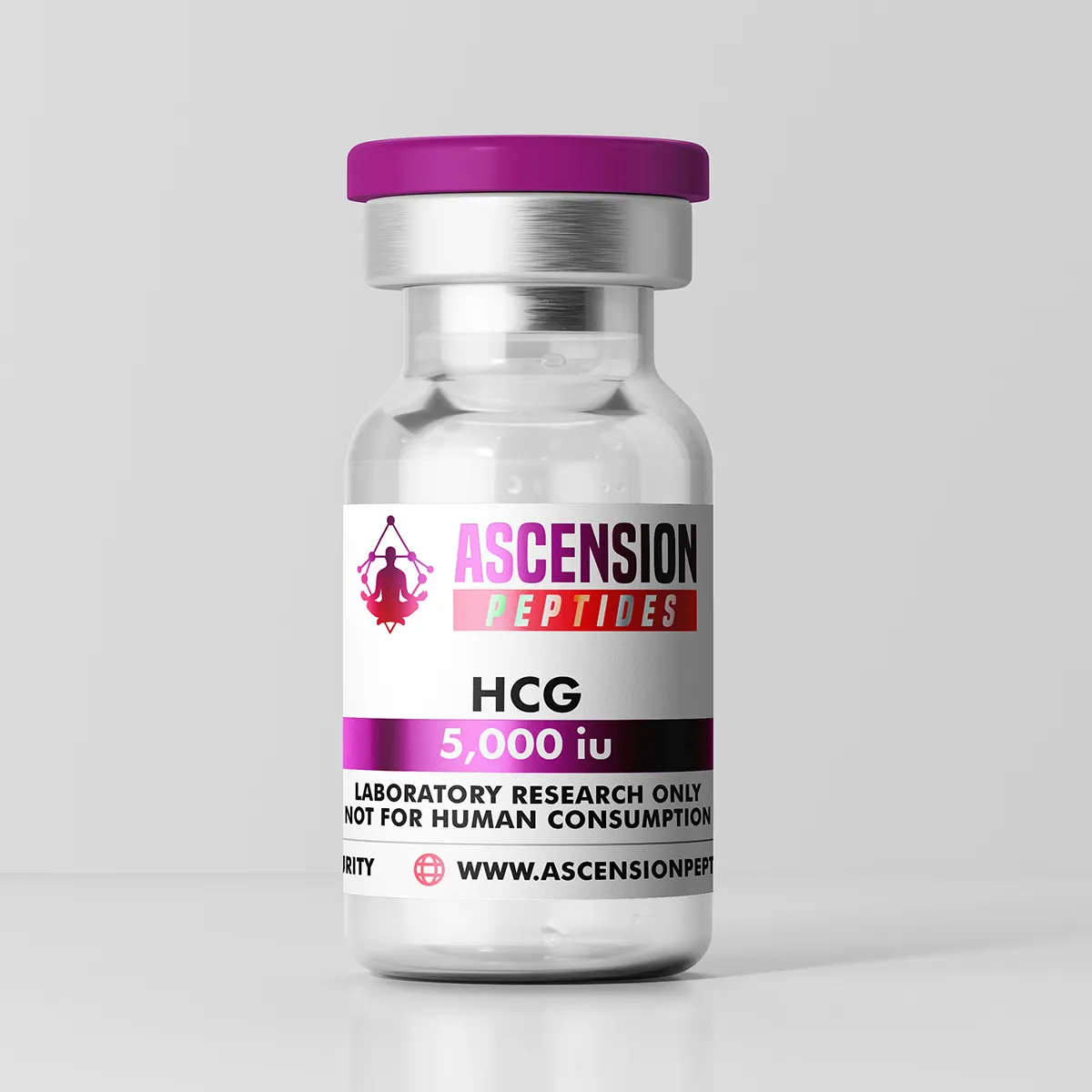
HCG is dosed in international units. On TRT, 250 to 500 IU subcutaneously two or three times a week, or every other day. Fertility protocols run higher, 1,000 to 2,000 IU two or three times weekly. A 5,000 IU vial reconstituted with 1 mL of bacteriostatic water gives 5,000 IU/mL, so 250 IU is 5 units on a U-100 syringe. HCG is stable in the fridge for about 30 to 60 days after reconstitution, depending on the product.
Gonadorelin is dosed in micrograms. TRT clinics typically prescribe 100 to 300 mcg subcutaneously two or three times a week, and some men dose daily or twice daily to get closer to a pulsatile pattern. A 2 mg vial reconstituted with 2 mL gives 1 mg/mL, so 100 mcg is 10 units. Because of the short half-life, timing relative to the testosterone injection makes little difference. The TRT dosage guide covers how either fits around a testosterone protocol.
Side Effects Compared
HCG's main side effect is the reason gonadorelin has a case at all.
HCG stimulates the testes directly, and the testes contain aromatase, the enzyme that converts testosterone to estradiol. HCG therefore raises estradiol more than the equivalent testosterone would, and it does so inside the testis where an aromatase inhibitor reaches less effectively. For men who are already estrogen-sensitive on TRT, gynecomastia, water retention and mood effects, adding HCG can make it worse. Other reported effects: injection-site reactions, acne, and occasionally headache or mood changes. The TRT side effects guide covers estradiol management.
Gonadorelin has a mild profile: injection-site irritation, flushing, headache, occasional nausea. Because it works through the pituitary, whatever LH it produces is physiological in pattern and the estradiol response is much smaller. That is a genuine advantage. It is smaller partly because the whole effect is smaller, which is the trade.
Which One Should You Choose?
Choose HCG unless you have a specific reason not to.
Choose HCG if the goal is preserving testicular size, intratesticular testosterone or fertility on TRT. It is the compound with controlled data for that job, and it works regardless of how suppressed your pituitary is.
Choose gonadorelin if HCG is unavailable to you, or if you have tried HCG and could not manage the estradiol rise even with dose reduction. Go in expecting a weaker effect and consider dosing more often than twice a week, since the half-life is the limiting factor.
Do not choose gonadorelin because a clinic told you it is the modern replacement for HCG. It replaced HCG on formularies for regulatory reasons. Nothing in the evidence says it replaced it in effect.
If you are trying to raise your own testosterone rather than support the testes during TRT, the comparison changes. Kisspeptin, enclomiphene and HCG each have a case there, covered in the TRT alternatives guide.
Frequently Asked Questions
The Verdict
HCG does the job. Gonadorelin asks someone else to.
The entire difference comes down to where each acts. HCG talks to the testes directly and has the data to show they listen. Gonadorelin talks to a pituitary that TRT has already told to be quiet, and does so for a few minutes twice a week. It is a reasonable fallback when HCG is unavailable or estradiol is unmanageable. It is not the upgrade the switch implied, and men who felt a difference when their clinic changed them over were not imagining it.
References
- Coviello AD, et al. Low-dose human chorionic gonadotropin maintains intratesticular testosterone in normal men with testosterone-induced gonadotropin suppression. J Clin Endocrinol Metab 2005;90(5):2595-602. PubMed
- Hsieh TC, et al. Concomitant intramuscular human chorionic gonadotropin preserves spermatogenesis in men undergoing testosterone replacement therapy. J Urol 2013;189(2):647-50. PubMed
- Pitteloud N, et al. Predictors of outcome of long-term GnRH therapy in men with idiopathic hypogonadotropic hypogonadism. J Clin Endocrinol Metab 2002;87(9):4128-36. PubMed
- Belchetz PE, et al. Hypophysial responses to continuous and intermittent delivery of hypothalamic gonadotropin-releasing hormone. Science 1978;202(4368):631-3. PubMed
- US Food and Drug Administration. Transition of certain biological products approved under the FD&C Act to the PHS Act, March 2020.
- Gonadorelin hydrochloride prescribing information. Drugs.com monograph.
Medical Disclaimer: This content is for informational purposes only and does not constitute medical advice. Always consult a qualified healthcare provider before starting any new supplement, medication, or treatment. PeptideDeck may earn a commission from affiliate links at no additional cost to you.