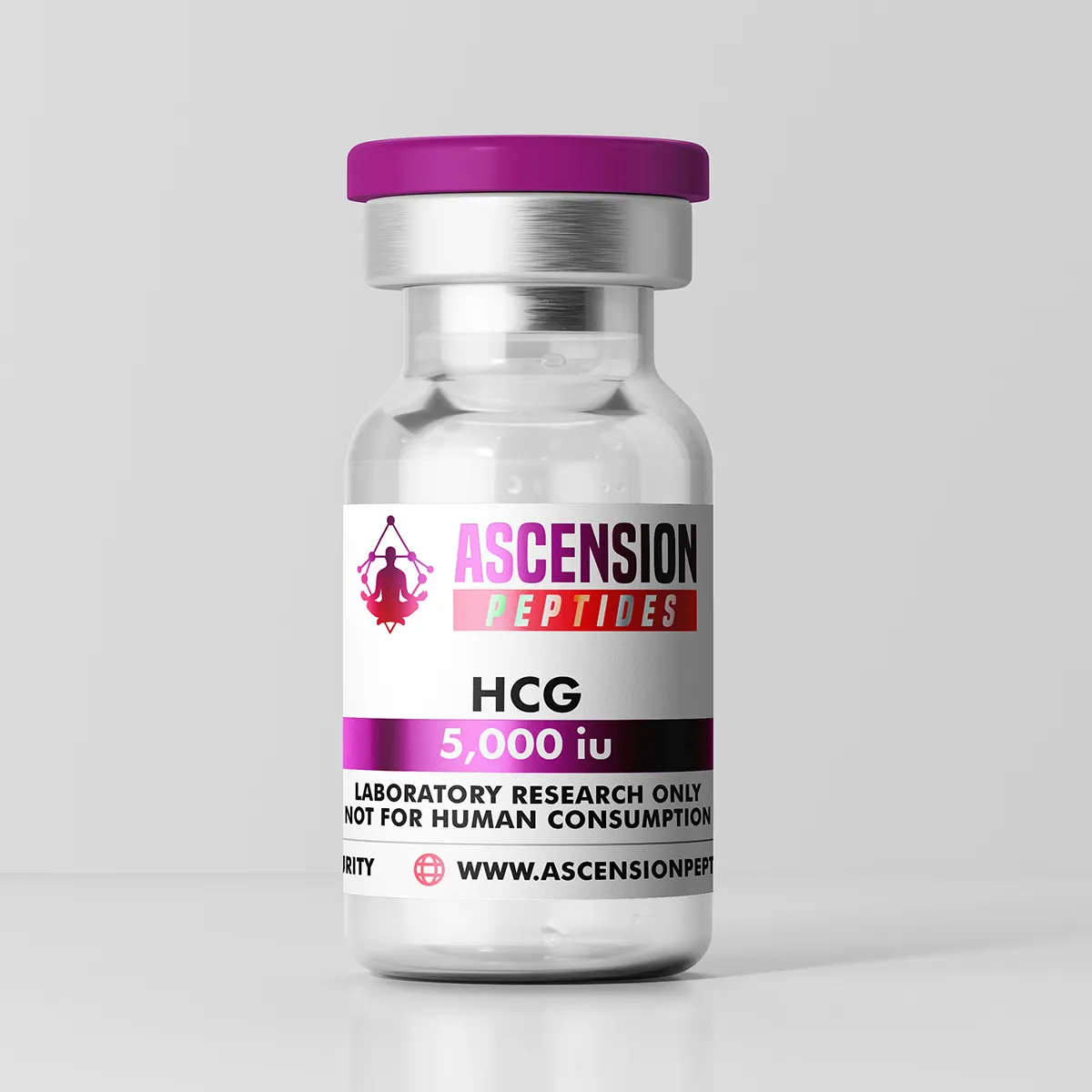
Gonadorelin is GnRH, made identical.
It's a synthetic copy of the gonadotropin-releasing hormone your hypothalamus already produces, used clinically to test pituitary function and induce ovulation, and used off-label by TRT clinics to keep the testes signaling while testosterone is being injected. Most men searching for it today aren't ovulation patients, they're TRT users looking for the HCG replacement their clinic now prescribes. Below is exactly what gonadorelin does, the dosing protocols clinics actually use, the bloodwork you should be tracking, the real-world testicular timeline, and the honest take on whether it works as well as HCG.
🔑 Key Takeaways
- Gonadorelin is the same molecule as GnRH. Not a structural mimic. The pituitary can't tell them apart.
- It works one step upstream of HCG. HCG hits the testes directly. Gonadorelin hits the pituitary, which then signals the testes. That extra step matters more than it sounds.
- Short half-life means frequent dosing. The 10 to 40 minute clearance is why TRT protocols are 2 to 3 injections per week minimum, often more.
- It became the default after HCG got restricted. Compounding pharmacies pulled most HCG in 2024. Gonadorelin filled the gap, not because it's better, but because it was still available.
- Real-world results are mixed. Some TRT users keep full testicular size. Others see less response than they got from HCG, even at higher doses. Plan to track size and labs for the first 3 months before deciding it's working.
What Is Gonadorelin?
Gonadorelin is a synthetic decapeptide identical in structure to gonadotropin-releasing hormone (GnRH), the hormone your hypothalamus releases to control the entire reproductive system. Brand names you might see on a prescription include Factrel, Lutrepulse, Cryptocur, and Fertagyl. In TRT contexts it's usually called by its generic name, often delivered through compounding pharmacies as a bacteriostatic-water-reconstituted vial.
It was first approved by the FDA in 1978 for two narrow medical uses: testing whether your pituitary gland responds to GnRH (a diagnostic for hypogonadism), and inducing ovulation in women whose hypothalamic signaling is absent. Everything beyond those two indications, including every TRT clinic protocol, is off-label use.
A Brief History of the Molecule
GnRH was first isolated and sequenced in 1971 by Andrew Schally and Roger Guillemin, work that earned them the Nobel Prize in Physiology or Medicine in 1977. Within a year of the Nobel, the synthetic version (gonadorelin) was approved by the FDA under the brand name Factrel for diagnostic use. The pulsatile pump formulation (Lutrepulse) followed in the 1980s for fertility specialists treating hypothalamic amenorrhea. For most of the next 30 years, gonadorelin lived in fertility and endocrinology clinics with relatively low patient volume.
That changed sharply in 2024, when FDA enforcement actions on compounding pharmacies made HCG much harder to obtain through the channels TRT clinics had been using for two decades. Most clinics replaced HCG in their protocols within weeks, and gonadorelin was the closest available alternative. By 2026, gonadorelin is the standard testicular preservation add-on at most US telehealth TRT clinics, even though HCG is still the more established option clinically.
How Gonadorelin Works
The hypothalamic-pituitary-gonadal axis is a three-step signaling cascade. Gonadorelin plugs into the top.
- Hypothalamus releases GnRH in pulses every 90 to 120 minutes.
- Pituitary gland sees the pulse and releases luteinizing hormone (LH) and follicle-stimulating hormone (FSH).
- Testes (in men) or ovaries (in women) respond to LH and FSH by producing testosterone and sperm (or estrogen and eggs).
When you inject exogenous testosterone for TRT, the hypothalamus senses high circulating testosterone and stops releasing GnRH. Without GnRH pulses, the pituitary stops releasing LH and FSH. Without LH and FSH, the testes shrink and sperm production stalls. This is why testicular atrophy is one of the predictable side effects of TRT and why men want a workaround.
Gonadorelin replaces the missing GnRH pulse. The pituitary releases LH and FSH again, the testes get signaled, and testicular volume and Leydig cell activity stay closer to baseline. The catch is the pulsatile requirement: continuous GnRH exposure desensitizes the pituitary receptors, so dosing has to be intermittent, not steady-state.
Approved Uses vs Off-Label TRT Use
Gonadorelin for TRT: What Most People Are Actually Searching For
Compounded HCG used to be the standard TRT add-on. Then in 2024 the FDA cracked down on compounding pharmacies producing HCG, and most clinics had to switch protocols within weeks. Gonadorelin was the closest available substitute, so it became the new default. That's the only reason most TRT patients are now on gonadorelin instead of HCG, not because the medical evidence shifted in its favor.
What gonadorelin does on a TRT protocol:
- Keeps testicular size closer to baseline. Probably the most reliable effect. Men report restored scrotal fullness within 2 to 6 weeks of starting.
- Maintains some intratesticular testosterone. The level of LH stimulation is enough to keep Leydig cells partially active, though not at pre-TRT output.
- Supports (but doesn't reliably preserve) sperm production. This is where the comparison to HCG matters most. Gonadorelin's pulsatile, short-duration action is generally weaker than HCG for preserving spermatogenesis.
- Reduces some psychological side effects of TRT. Some men report better mood and libido on gonadorelin compared to TRT alone, likely from the residual endogenous signaling.
If fertility is your priority, ask your clinic about HCG specifically.
HCG directly stimulates the testes, has a longer half-life, and has stronger published evidence for preserving sperm count on TRT. Gonadorelin works one step upstream and depends on a responsive pituitary, which means individual results vary more. Switching back to HCG is worth the conversation with your prescriber if fertility is a near-term goal.
When to Inject Gonadorelin Relative to Testosterone
If you're on weekly or twice-weekly testosterone injections, the most common gonadorelin schedule is one injection on each TRT shot day plus a third stand-alone day mid-week. Example for a Monday-Thursday testosterone schedule:
- Monday: Testosterone injection + 100-200 mcg gonadorelin SC
- Wednesday: 100-200 mcg gonadorelin SC (no T)
- Thursday: Testosterone injection + 100-200 mcg gonadorelin SC
The principle is simple: keep the GnRH signal arriving roughly every 2 to 3 days, which is enough to maintain meaningful LH/FSH release without driving the pituitary into desensitization. Some clinics use daily microdosing (50-100 mcg every day) for men who respond poorly to the 2-3×/week schedule. Both approaches work; the daily route is more injections but more closely mimics endogenous pulsing.
Bloodwork to Track While on Gonadorelin
If you're on TRT with a gonadorelin add-on, the labs that actually tell you whether the protocol is working are:
The single most informative lab for "is the gonadorelin working" is detectable LH on a draw taken several hours after a recent dose. Zero LH on gonadorelin almost always means the pituitary isn't responding (try a higher dose or switch to HCG). Some LH plus restored testicular size is the win condition.
Real-World Testicular Timeline
Most men want to know what they'll actually notice and when. Here's the realistic timeline reported across TRT clinic experiences:
Gonadorelin Dosage and Administration
There's no single dose that fits every protocol because the right number depends on what you're trying to accomplish. Here's how the common targets break down.
The injection itself is subcutaneous into abdominal fat. Use an insulin syringe, 0.25 to 0.5 mL volume, rotate sites between injections. Most compounding pharmacies dispense gonadorelin already reconstituted at a known concentration; if your clinic gives you a lyophilized vial, you'll reconstitute with bacteriostatic water exactly like any other peptide. Our peptide reconstitution calculator handles the syringe-unit math automatically.
How to Reconstitute Gonadorelin
- Wash hands. Swab the bacteriostatic water vial and the gonadorelin vial stopper with isopropyl alcohol.
- Draw 2 mL of bacteriostatic water into an insulin syringe.
- Inject slowly down the inside wall of the gonadorelin vial. Don't blast the powder.
- Swirl gently. Don't shake. Wait 2 to 3 minutes for full dissolution. Solution should be clear.
- For a 2 mg (2000 mcg) vial reconstituted with 2 mL: each 10-unit mark on a U-100 insulin syringe equals 100 mcg of gonadorelin.
- Label the vial with reconstitution date. Refrigerate. Use within 30 days.
Gonadorelin vs HCG: The Comparison That Actually Matters
These two medications get used for the same goal but work through completely different mechanisms. The choice between them is mostly about access and fertility goals.
Plain-English version: HCG is the more proven option for fertility and reliable testicular preservation, but it's harder to get and more expensive. Gonadorelin is cheaper, more available, and works for most men chasing size and comfort, but its TRT track record is shorter and individual response is less predictable. If your clinic offers both, choose based on whether you want fertility insurance (HCG) or you just don't want shrinkage (gonadorelin works for most).
What About Clomid, Enclomiphene, and Kisspeptin?
These are the other axis-stimulating options TRT patients ask about, and they're not interchangeable with gonadorelin.
- Enclomiphene (and Clomid) blocks estrogen receptors in the hypothalamus, which tricks the brain into releasing more GnRH. Useful for men who want to boost endogenous testosterone instead of TRT, less useful as an add-on once you're already shut down on injectable testosterone.
- Kisspeptin is one step further upstream than gonadorelin. It signals the hypothalamus itself to release GnRH. Promising research molecule for fertility and HPG-axis restoration, but it's not standard at TRT clinics yet.
- Gonadorelin sits between the brain and the testes. It's the right tool when you need pituitary stimulation while continuing TRT.
Side Effects and What to Watch For
Gonadorelin is generally well tolerated. Most reported side effects are mild and resolve within hours of dosing. The ones to know:
- Headache. The most commonly reported effect, usually within the first hour after injection. Typically settles within a day.
- Nausea or stomach discomfort. Mild, transient. Splitting the dose AM/PM can help.
- Flushing or warmth. Vasomotor response. Lasts a few minutes.
- Lightheadedness. Especially in the first 1 to 2 weeks. Stay hydrated.
- Injection site irritation. Redness, mild swelling, itching at the SC site. Rotate sites and use a fresh needle.
- Allergic or hypersensitivity reactions. Rare but possible with any peptide. Stop and call a clinician if you get hives, throat tightness, or breathing difficulty.
- Hormonal imbalance. Less common but possible if dosing is too aggressive. Bloodwork should monitor testosterone, estradiol, LH, and FSH every 8 to 12 weeks while you're on a protocol.

Brand Names and Where to Get Gonadorelin
Three sourcing routes exist in the US in 2026. They are not all the same.
- Compounding pharmacy through a TRT clinic (best option). Most legitimate telehealth TRT clinics now prescribe gonadorelin alongside testosterone. The pharmacy reconstitutes or ships lyophilized vials, the cost is usually $15 to 40 per month, and you have a prescriber overseeing labs.
- Endocrinologist or men's health clinic. In-person, prescription-based, often integrated with bloodwork and dose adjustments. Slightly more expensive than telehealth but higher continuity of care.
- Unregulated peptide vendors (gray market). Sold without a prescription, no clinical oversight, variable purity, and no guarantee on dosing accuracy. The legal status is murky in the US, and quality varies widely between sellers.
If you're starting from scratch, the right move is option 1 or 2. The savings on option 3 disappear the first time you have a side effect with no one to call.
Brand names you may see on the prescription label or product insert: Factrel (the original US brand, hydrochloride salt), Lutrepulse (pulsatile pump formulation), Cryptocur, Fertagyl, HRF, Relefact, Cystorelin. Many additional brand names exist for veterinary use, which is why some search results pull up cattle and equine products.
Who Should and Shouldn't Use Gonadorelin
Gonadorelin makes sense if you:
- Are on TRT and want to prevent or reverse testicular shrinkage
- Have a clinic that prefers it over HCG, or HCG is unavailable
- Aren't actively trying to conceive in the next 6 to 12 months (HCG is the better fertility option)
- Want a lower-cost option without skipping testicular signaling entirely
- Tolerated other peptides well, including any past GnRH-axis treatments
Skip gonadorelin if you:
- Have an active fertility goal in the short term (use HCG instead)
- Have a history of pituitary tumors or hypopituitarism without endocrinology supervision
- Are female and trying to conceive without a fertility specialist (the pump protocols are highly specialized)
- Have known hypersensitivity to GnRH analogs or peptides in general
- Are pregnant or breastfeeding (use is not established as safe)
Related comparison: gonadorelin vs HCG.
Frequently Asked Questions
Medical disclaimer: This article is for educational purposes only and is not medical advice. Gonadorelin is a prescription medication in the United States and many other countries. Use it only under the supervision of a licensed healthcare provider with regular bloodwork monitoring. Talk to your clinician before starting, stopping, or adjusting any peptide or hormonal protocol, especially if you have a history of pituitary disorders, hormone-sensitive cancers, fertility concerns, or you're pregnant or breastfeeding.