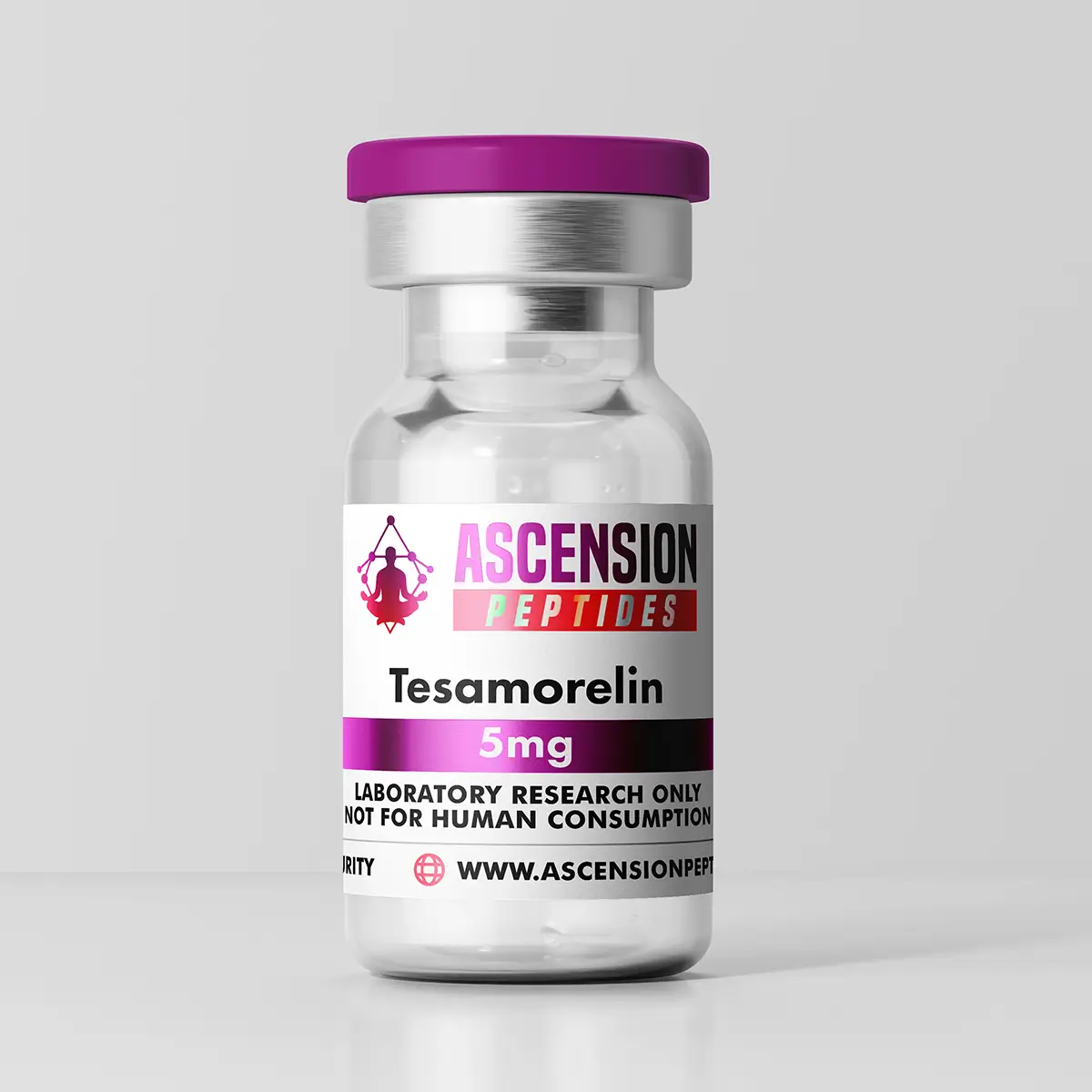
It's the only FDA-approved GHRH peptide in existence. That alone makes tesamorelin worth understanding — but what makes it genuinely interesting is what it actually does: reduce visceral fat by up to 18% without touching diet, while restoring growth hormone pulses to levels most people haven't seen since their twenties.
🔑 Key Takeaways
- Tesamorelin is a synthetic GHRH analog — it tells your pituitary to release more growth hormone, rather than injecting GH directly
- It's the only GHRH peptide with FDA approval, granted for HIV-associated lipodystrophy under the brand name Egrifta
- Clinical trials showed 15–18% reduction in visceral adipose tissue (VAT) — the deep abdominal fat tied to metabolic disease
- GH is released in natural pulses, preserving the body's feedback mechanisms and avoiding the side effects of exogenous GH
- Standard protocol is 1–2mg subcutaneous daily, typically in the morning on an empty stomach
- Side effects are milder than direct GH — primarily injection site reactions, water retention, and transient joint discomfort
- Often stacked with ipamorelin or CJC-1295 to amplify GH output via a complementary receptor pathway
If you've been exploring growth hormone peptides, you've probably come across sermorelin, CJC-1295, and ipamorelin. Tesamorelin operates in the same GHRH category — but it's the one that went through full Phase III clinical trials and earned an FDA approval. That changes what we actually know about it. This guide covers the mechanism, the clinical trial data, dosage, what to expect, and how it compares to the other GH peptides worth considering.
Branded Egrifta runs into the thousands per month; research-grade tesamorelin from Ascension is the same 44-amino-acid molecule at a fraction of it.
What Is Tesamorelin?
Tesamorelin is a 44-amino acid synthetic peptide. It's an analog of growth hormone-releasing hormone (GHRH) — the signal your hypothalamus naturally sends to your pituitary gland to trigger GH secretion. The modification that makes tesamorelin different from native GHRH is a trans-3-hexenoic acid group attached to the N-terminus, which increases its stability and resistance to enzymatic degradation in plasma. Native GHRH breaks down in minutes. Tesamorelin survives long enough to produce meaningful pituitary stimulation.
The result: when you inject tesamorelin, your pituitary gland releases growth hormone in a pattern that closely resembles natural GH secretion — pulsatile, regulated by your body's feedback loops, not a flat pharmacological flood.
GHRH vs Direct GH: Why the Distinction Matters
Injecting exogenous HGH (human growth hormone) bypasses your pituitary entirely. It raises IGF-1 continuously, which can suppress your body's own GH production over time and carries risks tied to supraphysiological IGF-1 levels. Tesamorelin works upstream — it tells the pituitary to do its job, which means your body still regulates the output. GH is released in pulses, IGF-1 rises moderately, and the negative feedback system remains intact. This is a fundamentally different risk profile.
How Tesamorelin Works
After subcutaneous injection, tesamorelin binds to GHRH receptors on somatotroph cells in the anterior pituitary. This triggers a calcium-mediated signaling cascade that stimulates GH synthesis and release within minutes. The GH pulse then travels through the bloodstream to the liver, where it stimulates IGF-1 production — the downstream anabolic and lipolytic mediator that drives most of tesamorelin's practical effects.
The three main downstream effects:
- Lipolysis in visceral fat: IGF-1 and GH directly activate fat breakdown in adipose tissue, with a particularly strong effect on the visceral depot — the metabolically active fat surrounding the organs. This is why visceral fat reduction is the primary clinical endpoint in tesamorelin trials.
- Anabolic signaling: Elevated IGF-1 supports protein synthesis in muscle tissue, lean mass preservation, and connective tissue repair — the same reasons GH peptides attract interest beyond clinical use.
- Metabolic normalization: Restoring GH pulsatility has downstream effects on insulin sensitivity, lipid profiles, and body composition metrics that go beyond fat loss alone.
Tesamorelin Benefits: What the Evidence Shows
Because tesamorelin has Phase III trial data, we don't have to speculate. Here's what the clinical record actually supports.
Visceral Fat Reduction
The LIPO trials — the pivotal studies behind tesamorelin's FDA approval — enrolled HIV-positive adults with excess visceral adiposity. At 1mg/day over 26 weeks:
- Average visceral adipose tissue (VAT) reduction: 15–18%
- Trunk fat reduction was significant vs placebo in every measure
- Effects were sustained at 52 weeks with continued dosing
- On discontinuation, visceral fat returned toward baseline within 26 weeks — consistent with other GH-axis interventions
For context: 15–18% reduction in VAT is clinically meaningful. Visceral fat is not cosmetic — it's the metabolically active fat linked to insulin resistance, cardiovascular risk, and systemic inflammation. Reducing it by that margin moves measurable metabolic markers.
GH Axis Restoration
GH secretion declines with age — roughly 14% per decade after age 30. Tesamorelin restores pulsatile GH release in a dose-dependent manner, raising mean GH area-under-the-curve and IGF-1 to levels more consistent with younger physiology. This is the primary mechanism behind its effects on body composition, recovery, and the other benefits reported by users outside the HIV context.
Cognitive Function
A smaller but well-designed trial published in JAMA Neurology (Baker et al., 2012) found that tesamorelin improved verbal memory and executive function in older adults with mild cognitive impairment — outperforming placebo on multiple cognitive assessments over 20 weeks. GH receptors are expressed in the hippocampus and prefrontal cortex; IGF-1 has established neuroprotective and neuroplasticity roles. This is an area of ongoing interest and among the most surprising findings in the tesamorelin literature.
Lipid Profile Improvements
The LIPO trials also showed reductions in triglycerides and improvements in the triglyceride-to-HDL ratio — both markers associated with cardiovascular and metabolic risk. These effects appear to be secondary to the visceral fat reduction and GH restoration rather than direct drug effects on lipid metabolism.
What Tesamorelin Won't Do
Tesamorelin does not produce dramatic subcutaneous fat loss. The visceral fat effect is specific and real; the cosmetic "lean look" effect some users expect from GH protocols is more modest with tesamorelin alone than with direct GH or higher-output stacks. If subcutaneous fat loss is the primary goal, a combined protocol — tesamorelin + a GHRP like ipamorelin — produces better overall body composition results than either alone.
Tesamorelin Dosage
The FDA-approved dose for Egrifta is 1mg subcutaneous daily. Most protocols in the non-clinical context run 1–2mg per day, with 2mg used by those targeting more aggressive GH output or body composition goals.
Timing matters. Tesamorelin (like all GHRH analogs) is most effective when insulin is low — typically first thing in the morning before eating, or at least 2 hours after the last meal. Elevated insulin blunts GH release by acting on hypothalamic somatostatin, which counteracts the GHRH signal. Injecting into a fed state significantly reduces the GH pulse amplitude.
Cycle length. Most protocols run 12–26 weeks, mirroring the trial durations. Continuous long-term use is possible — the LIPO trials ran 52 weeks — but many users cycle 12 weeks on, 4–8 weeks off to preserve pituitary sensitivity and manage cost.
Side Effects
Tesamorelin's side effect profile is meaningfully milder than exogenous HGH. The pulsatile, regulated GH output means IGF-1 doesn't climb as sharply as with direct GH injections, which removes many of the risks associated with HGH — acromegaly signals, carpal tunnel, organ growth — from the equation at normal doses.
Common side effects:
- Injection site reactions — redness, mild swelling, itching at the injection point; most common early and fades with site rotation
- Water retention / peripheral edema — particularly in the first 4–6 weeks; usually resolves with dose stability or reducing carbohydrate intake
- Joint discomfort — aching in wrists, knees, or ankles; dose-dependent and usually temporary
- Transient numbness or tingling — related to fluid retention affecting nerves; typically mild
Less common but documented:
- Transient glucose elevation — GH has anti-insulin effects; fasting glucose may rise modestly, especially at 2mg/day. Those with pre-existing insulin resistance should monitor.
- Night sweats during the first few weeks of use
- Headache, particularly early in a protocol
What to watch for: If joint pain is severe or persistent, reduce dose before stopping entirely. If glucose readings are significantly elevated (fasting >110 mg/dL consistently), consult a provider before continuing.
Tesamorelin vs Other GH Peptides
Understanding where tesamorelin sits relative to the other GHRH peptides clarifies when it's the right choice.
Tesamorelin's advantage is clinical validation — the only GHRH peptide with Phase III data on visceral fat. Sermorelin is a shorter fragment of GHRH (amino acids 1–29 vs tesamorelin's full 44-aa analog) with lower potency and shorter receptor residence time. CJC-1295 with DAC produces a sustained GH "bleed" rather than pulses, which can suppress natural GH rhythms over time. For preserving pulsatility while still getting meaningful GH elevation, tesamorelin is the most defensible option in the GHRH class.
Stacking Tesamorelin
GHRH peptides (like tesamorelin) and GHRPs (like ipamorelin) work on different receptor systems and are synergistic. GHRH stimulates the pituitary directly; GHRPs suppress somatostatin (the GH-inhibiting signal) while also stimulating ghrelin receptors. Combined, they produce a GH pulse roughly 3–5x larger than either alone.
Most Common Tesamorelin Stack
Tesamorelin 1mg + Ipamorelin 200–300mcg, injected together subcutaneously in the morning fasted. This is the most widely used GHRH/GHRP combination for body composition — tesamorelin drives the GHRH signal, ipamorelin amplifies it via somatostatin suppression without the hunger side effects of GHRP-2 or GHRP-6. For a deeper look at how they compare, see our sermorelin vs tesamorelin guide.
What to Expect Week by Week
Weeks 1–3: Injection site reactions most likely here. Some water retention as GH-mediated fluid shifts occur. Sleep quality often improves — one of the earliest reported changes. Scale weight may tick up 1–2 lbs from water; this normalizes.
Weeks 4–8: Water retention typically resolves. Body composition changes start to become measurable — not dramatic yet, but waist measurements often start moving before the scale does. Recovery between training sessions begins to feel noticeably better.
Weeks 8–16: The window where most users report the clearest fat loss effect, particularly around the midsection. Visceral fat reduction is not visible in the mirror early — it's deep fat. But waist circumference, inflammation markers, and how you feel after eating all reflect the change.
Weeks 16–26: Results accumulate. The 26-week mark matches the primary endpoint of the LIPO trials — this is when 15–18% VAT reduction was measured. Users who stack with ipamorelin typically report faster and more visible results in this window than tesamorelin alone.