Enclomiphene and HCG both raise testosterone without you injecting testosterone. That shared headline is where the similarity ends. One works by leaning on your pituitary harder; the other works by going around it entirely. That single structural difference explains why they produce different fertility outcomes, different estradiol behaviour, and why the right answer depends heavily on whether you are already on TRT.
🔑 Quick Decision
- Choose enclomiphene if: your pituitary still works and you want both LH and FSH to rise — FSH is what drives sperm production
- Choose HCG if: you are already on TRT and need to keep the testes working while suppressed, or your pituitary itself is the problem
- Enclomiphene raises LH and FSH. HCG raises neither — it substitutes for LH downstream and produces no FSH signal at all
- HCG drives a disproportionate estradiol rise through intratesticular aromatase; at fertility-range doses E2 can peak above 4x baseline within 24 hours
- Neither is a straight TRT replacement for everyone. Enclomiphene needs a functioning HPG axis. HCG is the one that still works when that axis is shut down
Enclomiphene vs HCG: At a Glance
The Mechanism Difference That Drives Everything Else
Your testes take orders from the pituitary through two hormones. Luteinising hormone tells Leydig cells to make testosterone. Follicle-stimulating hormone tells Sertoli cells to support sperm production. You need both for full function; testosterone alone does not make sperm.
Enclomiphene: Pushing the Pituitary Harder
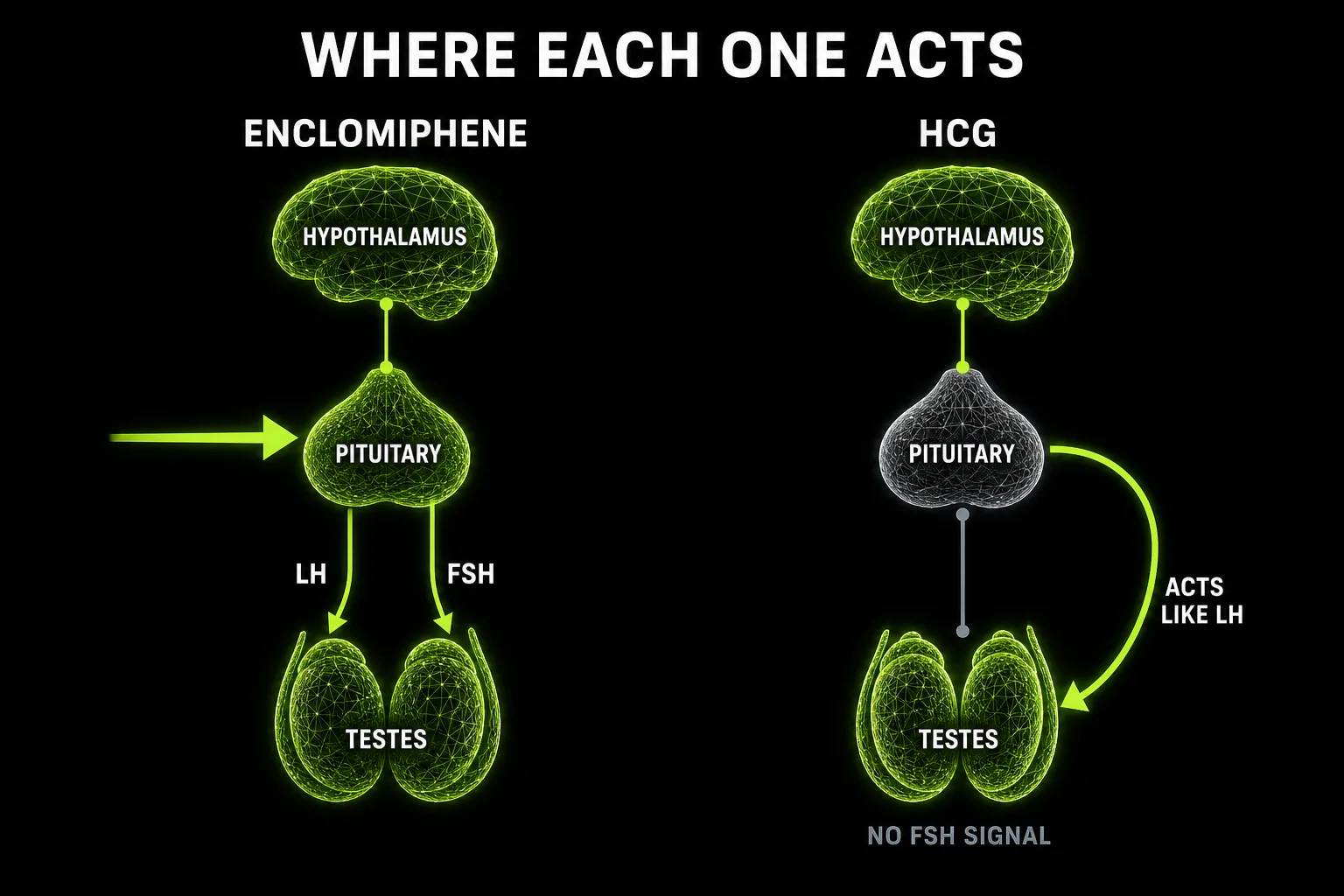
Enclomiphene is the trans-isomer of clomiphene, isolated because it carries the useful effect without the estrogenic baggage of the zuclomiphene isomer. It works by blocking estrogen receptors at the hypothalamus and pituitary. Your brain reads the resulting low estrogen signal as "testosterone is too low," and responds by increasing GnRH, and therefore both LH and FSH.
The important consequence: because the signal originates upstream, both gonadotropins rise. FSH goes up alongside LH, which is why enclomiphene preserves spermatogenesis rather than merely tolerating it.
Phase III data put numbers on this. Mean testosterone rose from roughly 205 ng/dL at baseline to the 413-446 ng/dL range, statistically significant against placebo. More tellingly, sperm concentration increased 12-15% in the enclomiphene arms while the testosterone gel comparator arms fell 33-57%. A 2025 systematic review and meta-analysis of SERMs in male hypogonadism found significantly improved total testosterone versus placebo, with no significant difference between SERM therapy and testosterone gel.
The catch is structural: enclomiphene requires a working hypothalamic-pituitary-gonadal axis. If you have been on TRT long enough to suppress that axis, or your hypogonadism is pituitary in origin, pushing harder on a switch that is disconnected does nothing. Our enclomiphene guide covers who is and is not a candidate.
HCG: Impersonating LH Downstream
Human chorionic gonadotropin is structurally similar enough to LH that it binds and activates the same receptor on Leydig cells. It does not ask the pituitary for anything. It walks past it and gives the testes the instruction directly.
That is exactly why it works in the situation enclomiphene cannot touch. A man on TRT has a suppressed pituitary by design — exogenous testosterone shuts down LH and FSH, intratesticular testosterone collapses, and testicular atrophy and impaired sperm production follow. HCG restores the LH signal downstream of the shutdown, maintaining intratesticular testosterone and testicular volume while TRT continues.
It also inherits a limitation from the same design. Because HCG bypasses the pituitary, it produces no FSH whatsoever. For a man with severely suppressed spermatogenesis, HCG alone maintains intratesticular testosterone but cannot fully restore sperm production without FSH — which is why fertility protocols often add an FSH source or a SERM rather than running HCG alone. See our HCG, TRT and fertility guide for how those combinations are structured.
Hormone Response Compared
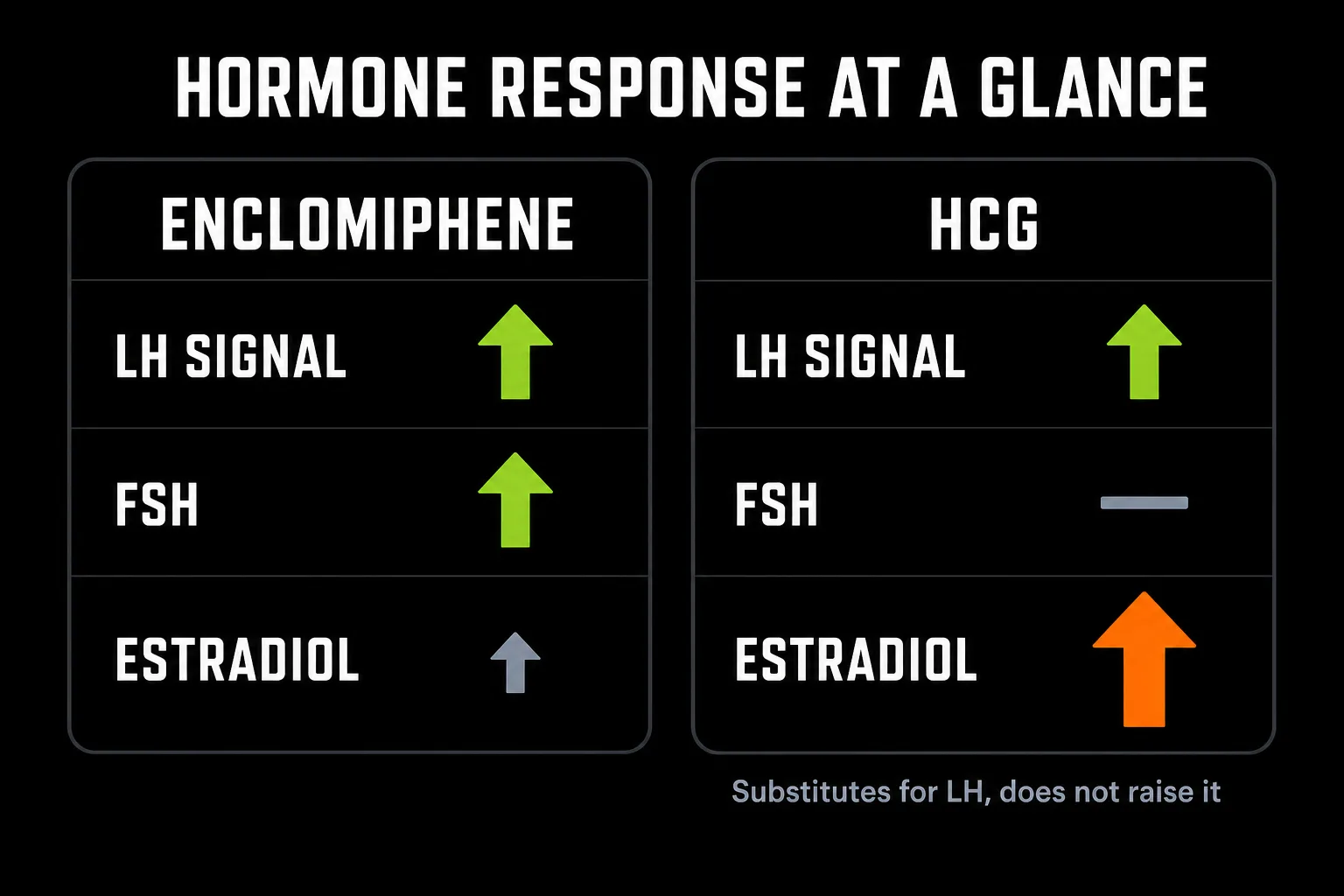
The estradiol difference deserves more attention than it usually gets. HCG stimulates intratesticular aromatase directly, and the resulting estradiol rise is out of proportion to the testosterone rise — at fertility-range doses, estradiol can peak at more than four times baseline within 24 hours. That is the mechanism behind the moodiness, water retention and nipple sensitivity that some men report on HCG, and the reason HCG protocols more often end up needing an aromatase inhibitor alongside.
Enclomiphene produces a more proportionate estradiol rise, secondary to the increase in testosterone production rather than driven by a separate aromatase stimulus. It is not estradiol-neutral, but it is better behaved.
What About Men Already on TRT?
This is where the comparison is most often asked and most often answered badly.
If you are on TRT and want to preserve fertility and testicular volume while staying on it, HCG is the tool that works. Enclomiphene cannot help, because the axis it acts on is suppressed by the testosterone you are taking.
If you are coming off TRT and trying to restart your own production, the calculus changes. HCG is typically used first to wake the testes up, and a SERM is introduced to restart the pituitary side. Enclomiphene has a role here, but as part of a sequence rather than a straight substitute. Our guides on TRT and fertility and coming off TRT cover the sequencing.
Worth being honest about the evidence limit: there is no strong modern head-to-head randomised trial showing enclomiphene is clinically superior to HCG for men prioritising fertility, particularly men already suppressed on TRT. What the literature does show is that total testosterone was significantly higher with SERM therapy, and with SERM plus HCG combined, than with HCG alone. The combination outperforming either alone is a more defensible reading than either compound "winning."
Side Effects Compared
Full detail on the SERM side is in enclomiphene side effects and safety.
Regulatory Status
HCG is an approved drug with established indications, including hypogonadotropic hypogonadism in men. Using it to preserve fertility alongside TRT is common clinical practice but sits off-label. It is prescribable, and it is also widely sold as a research compound.
Enclomiphene has never obtained FDA approval — the Androxal program did not get there. It reaches patients through compounding pharmacies and telehealth clinics rather than as an approved product, which means quality varies by source and the legal footing is different from a prescription for an approved drug. The British Society of Sexual Medicine has published a position statement on its potential use in male hypogonadism, which is a reasonable indicator of where mainstream opinion is heading, but a position statement is not an approval.
If you are sourcing either, where to buy enclomiphene covers the legal routes for the SERM side.
Which Should You Choose?
For the wider set of options, including where TRT itself fits, see sermorelin vs TRT, MK-677 and enclomiphene. If a clinic route is what you are after, best TRT online covers how to pick one. Gonadorelin is worth knowing about too — it is increasingly used in place of HCG for the same job.
Related comparison: gonadorelin vs HCG.
Frequently Asked Questions
This article is educational and not medical advice. Both compounds affect the endocrine system in ways that warrant bloodwork and physician oversight, and enclomiphene is not an FDA-approved product. Discuss any protocol with a qualified clinician.