🔑 Key Takeaways
- CJC-1295 + Ipamorelin remains the gold standard GH stack for men — it elevates growth hormone 2–3x more than either peptide alone
- Kisspeptin and Gonadorelin support natural testosterone production without shutting down the HPG axis
- PT-141 (Bremelanotide) works through brain-level arousal — mechanistically different from Viagra/Cialis
- BPC-157 and TB-500 are the go-to healing peptides for tendon, ligament, and joint recovery
- Start with one peptide, get baseline bloodwork, and build from there — don't stack everything on day one
Men make up the largest demographic of peptide users, and honestly, that makes sense. The things peptides address — declining growth hormone, stubborn visceral fat, slower recovery, flagging libido, nagging injuries that won't heal — are basically the highlight reel of what happens to men after 30.
But the peptide landscape has gotten overwhelming. Dozens of compounds, each claiming to be the answer. Forums filled with conflicting anecdotes. It's hard to separate what actually works from what's marketing dressed up as science.
This guide cuts through that noise. I've organized the best peptides for men by specific goals — muscle growth, fat loss, testosterone optimization, sexual health, injury recovery, anti-aging, and cognition — with honest assessment of the evidence behind each one. No hype. No "this will change your life" claims. Just biology, data, and practical guidance.
How Peptides Work Differently Than Hormones
A critical distinction most guides gloss over: peptides aren't hormones. They're signaling molecules. Most peptides work by telling your body to produce more of something it already makes — growth hormone, testosterone, BDNF, whatever the target is. They work with your existing biology rather than overriding it.
This matters for two reasons:
- Feedback loops stay intact. Unlike injecting testosterone directly (which suppresses natural production), peptides like kisspeptin stimulate your body to make its own. The pituitary still regulates output.
- Side effect profiles are generally milder. You're augmenting a system, not replacing it. The body has built-in brakes that prevent runaway hormone levels.
That said, peptides aren't magic. They work best when your foundation is solid: training, nutrition, sleep, stress management. Think of them as amplifiers, not substitutes. For an honest comparison of peptides versus direct testosterone therapy, see our testosterone boosters vs peptides guide.
Best Peptides for Muscle Growth and Strength
For men focused on body composition and performance, growth hormone secretagogues (GHS) are the most extensively studied peptide class. They stimulate the pituitary gland to produce more GH naturally, supporting muscle protein synthesis without directly introducing exogenous hormones.
Lean Mass
GH peptides promote protein synthesis and nitrogen retention for lean muscle development without water retention.
Recovery
Elevated GH accelerates tissue repair between training sessions — the practical bottleneck for most serious lifters.
Body Recomposition
GH secretagogues improve muscle-to-fat ratio through lipolytic effects on visceral adipose tissue.
CJC-1295 + Ipamorelin: The Classic Stack
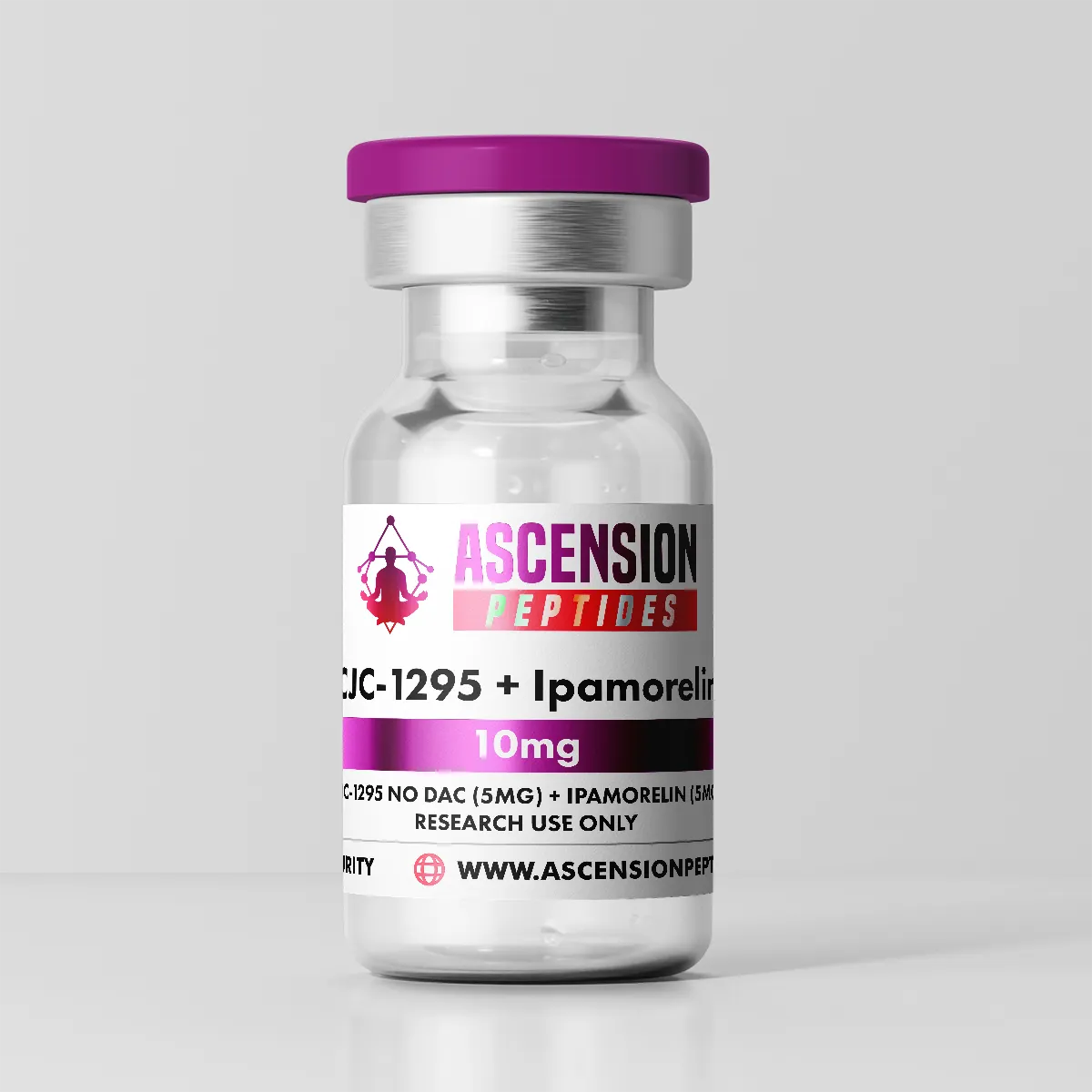
This remains the gold standard GH combination for men. CJC-1295 is a GHRH analog that extends the duration of GH release, while Ipamorelin is a selective ghrelin mimetic that triggers GH pulses with minimal cortisol or prolactin spillover.
Together, they create genuine synergy — CJC-1295 amplifies the pulse that Ipamorelin initiates, resulting in GH elevations 2–3x greater than either alone. Users typically notice improved sleep quality within the first week, with body composition changes becoming visible at 6–12 weeks.
💡 Pro Tip
Administer CJC-1295 + Ipamorelin 30–60 minutes before bed on an empty stomach. This aligns with natural GH secretion patterns that peak during deep sleep. Avoid eating 2 hours before dosing — insulin directly blunts GH release, which is the most common mistake that undermines results.
MK-677 (Ibutamoren): The Oral Option
Technically a non-peptide GH secretagogue, but it dominates men's peptide conversations so it belongs here. Its advantage is oral bioavailability — no injections. Studies show MK-677 increases IGF-1 levels by 40–60% over 2-month periods (Murphy et al., JCEM, 1998). It also improves sleep quality and bone mineral density. The trade-off: increased appetite and potential water retention.
Follistatin-344: Myostatin Inhibition
A completely different approach — rather than boosting GH, Follistatin binds and neutralizes myostatin, the protein that limits muscle growth. By reducing myostatin signaling, it raises the ceiling on how much muscle tissue your body allows you to build. Particularly interesting for men who've hit legitimate plateaus despite optimized training and nutrition.
Best Peptides for Fat Loss and Body Recomposition
Men carry visceral fat differently than women, and the peptides that target abdominal adiposity are particularly relevant here.
Tesamorelin: FDA-Approved for Visceral Fat
One of the few peptides with actual FDA approval — specifically for reducing excess abdominal fat. It's a GHRH analog that stimulates GH release, driving lipolysis in visceral fat depots. Clinical trials showed trunk fat reduction of 15–18% over 26 weeks while preserving lean mass (Falutz et al., JAMA, 2007). For men carrying stubborn midsection weight, it's the most evidence-backed option.
AOD-9604: Targeted Fat Fragment
A modified fragment of the growth hormone molecule (amino acids 177–191) that retains GH's fat-burning properties without its growth-promoting effects. It stimulates fat breakdown while inhibiting new fat creation — a dual mechanism particularly effective for recomposition. Good for men who want metabolic benefits without the full spectrum of GH effects.
Semaglutide and Retatrutide: The GLP-1 Revolution
Semaglutide has become the most talked-about peptide in weight management, with clinical trials demonstrating 15–20% body weight reduction over 68 weeks. Retatrutide — the next-generation triple agonist (GLP-1/GIP/glucagon) — shows even more dramatic results in trials, with up to 24.2% body weight reduction. These work through appetite suppression, delayed gastric emptying, and central satiety signaling.
Best Peptides for Testosterone and Hormonal Optimization
Testosterone declines approximately 1–2% per year after age 30. By 50, many men are operating at 60–70% of their peak levels. While peptides don't replace testosterone directly, several work upstream to support the hormonal axis naturally.
Kisspeptin: The Master Hormonal Switch
Kisspeptin sits at the very top of the hypothalamic-pituitary-gonadal (HPG) axis. It stimulates GnRH release, which drives LH and FSH secretion, ultimately increasing endogenous testosterone production. Studies in men with functional hypogonadism show kisspeptin-54 administration significantly increases LH and testosterone levels (Dhillo et al., JCEM, 2005).
What makes kisspeptin special: it works with the body's feedback mechanisms rather than overriding them. The response is physiologically regulated — you can't overshoot into supraphysiological territory.
Gonadorelin: Direct GnRH Stimulation
A synthetic form of GnRH that directly stimulates the pituitary to release LH and FSH. Frequently used in fertility protocols and as an adjunct to TRT to maintain testicular function. For men on testosterone therapy who want to preserve fertility and prevent testicular atrophy, gonadorelin provides the pulsatile GnRH stimulation that exogenous testosterone suppresses.
Best Peptides for Sexual Health and Libido
Sexual health is a major quality-of-life issue that most men are uncomfortable discussing with their doctors. Peptides offer mechanistically distinct approaches compared to traditional PDE5 inhibitors like sildenafil.
PT-141 (Bremelanotide): Brain-Level Arousal
PT-141 is FDA-approved (as Vyleesi) and works through an entirely different mechanism than Viagra. Rather than acting on blood flow, PT-141 activates melanocortin receptors (MC3R and MC4R) in the brain, directly stimulating sexual desire at the central nervous system level. For detailed protocols, see our PT-141 dosage guide.
This makes it effective for men who don't respond well to PDE5 inhibitors or who experience desire-related dysfunction rather than purely vascular issues. Clinical trials showed significant improvement in erectile function scores compared to placebo (Diamond et al., Int J Impot Res, 2006).
Melanotan II: Dual Tanning and Libido
A broader melanocortin agonist that produces skin tanning and increased sexual arousal simultaneously. PT-141 was actually developed from Melanotan II specifically to isolate the sexual function pathway. Some men prefer Melanotan II for the combination effect.
For the full sexual health peptide landscape, check our best peptides for libido guide.
Best Peptides for Injury Recovery and Joint Health

Men in their 30s and beyond deal with accumulated wear from training, sports, and physical labor. These peptides address tissue repair at the cellular level.
BPC-157: The Healing Workhorse
Over 100 published studies demonstrating tissue-protective and healing effects across tendons, ligaments, muscles, and gut tissue. BPC-157 promotes angiogenesis (new blood vessel formation), modulates multiple growth factors, and enhances collagen organization in healing tissue. It's typically the first peptide considered for any soft tissue injury.
Bonus: BPC-157 shows oral bioavailability — rare for a peptide — making it accessible for gut healing applications as well.
TB-500 (Thymosin Beta-4): Systemic Repair
Complements BPC-157 through different mechanisms: upregulates actin, promotes cell migration to injury sites, and reduces inflammation systemically. Where BPC-157 excels at localized tissue repair, TB-500 distributes broadly throughout the body. The BPC-157 + TB-500 stack is the most popular healing combination in peptide use.
GHK-Cu: Copper Peptide for Joint and Connective Tissue
A naturally occurring copper peptide that declines sharply with age. Stimulates collagen and glycosaminoglycan synthesis, promotes wound healing, and modulates over 4,000 genes involved in tissue repair and inflammation. For men with chronic joint or connective tissue degradation, GHK-Cu offers regenerative support at the extracellular matrix level.
Best Anti-Aging Peptides for Men
Age-related decline hits men in specific ways: reduced GH output, declining testosterone, increased visceral fat, slower recovery, and cognitive changes. These peptides target the biological mechanisms driving that decline.
Epithalon: Telomere Protection
A synthetic tetrapeptide that activates telomerase — the enzyme responsible for maintaining telomere length. Telomeres shorten with each cell division, and their length is one of the most reliable biomarkers of biological aging. Research demonstrated that epithalon extends telomeres and increases maximum lifespan in models by 13–15% (Anisimov et al., 2003).
MOTS-c: Mitochondrial Optimization
A mitochondria-derived peptide that enhances cellular energy production and insulin sensitivity. Since mitochondrial dysfunction is a hallmark of aging, MOTS-c addresses it at the metabolic engine level. Men with declining energy, exercise tolerance, or metabolic health find this particularly relevant.
SS-31 (Elamipretide): Mitochondrial Membrane Repair
Targets the inner mitochondrial membrane directly, stabilizing cardiolipin and restoring electron transport chain efficiency. In clinical trials for age-related mitochondrial conditions, showing promise for improving exercise capacity and cardiac function — concerns that disproportionately affect aging men.
Best Nootropic Peptides for Men
Cognitive performance is increasingly recognized as critical to men's health optimization, especially for those in demanding professional roles.
Semax: Focus and Neuroprotection
A synthetic analog of ACTH(4-10) that enhances BDNF expression, supports neuroplasticity, and improves cognitive function under stress. Administered as a nasal spray, making it one of the most accessible nootropic peptides. Approved as a prescription medication in Russia for neuroprotection.
Selank: Anxiety and Cognitive Balance
The anxiolytic counterpart to Semax — developed from the immune peptide tuftsin, it modulates GABA signaling while enhancing cognitive function. For men dealing with high-stress environments or anxiety-driven cognitive impairment, Selank provides calming effects without sedation or cognitive blunting.
For Sermorelin — another popular growth hormone peptide with specific benefits for men's health including sleep quality, recovery, and body composition — we have a dedicated guide covering male-specific protocols.
Peptide Recommendations by Experience Level
Practical Tips for Men Using Peptides
Timing and Food Interactions
Most GH-releasing peptides need an empty stomach — insulin competes with GH signaling. The ideal window is 30–60 minutes before meals or 2+ hours after eating. Evening dosing before bed aligns with natural GH patterns.
Stacking Safely
Men tend to be more aggressive with multi-peptide protocols. Key principles:
- Don't stack peptides with overlapping mechanisms (e.g., two GHRP compounds)
- Introduce one new peptide at a time, minimum 2 weeks between additions
- Keep a log: date, dose, time, subjective effects, any sides
Bloodwork Is Non-Negotiable
At minimum, get baseline labs for: GH, IGF-1, testosterone (total and free), fasting insulin, fasting glucose, CBC, metabolic panel. Retest at 4–6 weeks. This is the only way to objectively assess whether a protocol works — and to catch metabolic changes early.
Reconstitution and Storage
If you're new to injectable peptides, technique matters. Improper reconstitution is the #1 reason people think peptides "don't work." Get this right from the start.
Common Mistakes Men Make With Peptides
Starting Too Many Compounds at Once
The temptation to stack everything simultaneously is strong, especially after reading forum posts. Resist it. When you start five peptides at once and feel different, you have no idea which one caused what. If you get a side effect, you have to drop everything instead of one compound.
Skipping Bloodwork
"I feel great" isn't data. Elevated IGF-1, altered insulin sensitivity, or suppressed HPG function don't always have obvious symptoms. Bloodwork is the only objective measure. It's also the only way to prove to yourself (and your doctor) that something is actually working.
Neglecting the Foundation
Peptides amplify your biology. If your biology is running on 5 hours of sleep, processed food, and no exercise, there's not much to amplify. The men who get the best results from peptides are already doing the basics well — then using peptides to push past the ceiling.
Ignoring Injection Technique
Contamination, improper reconstitution, and storage mistakes can render expensive peptides inactive. Subcutaneous injection technique is simple but must be done correctly. Always use bacteriostatic water, never shake vials, and keep reconstituted peptides refrigerated.