How to get TRT the legitimate way comes down to one gate that every real provider uses: recognize the symptoms, get two separate early-morning testosterone blood tests, receive a clinical diagnosis of hypogonadism, and only then start a prescription that is monitored with follow-up labs. Testosterone is a prescription-only, Schedule III controlled substance, so there is no way to get real TRT over the counter or "for sale" from a retail shelf 6. What you are really buying is medical access: an evaluation with a licensed clinician who can order the labs, confirm the diagnosis, and manage your dose safely. This guide walks the full pathway step by step, compares the in-person and online routes, shows you how to tell a legitimate TRT provider from a red flag, and explains why the grey-market "buy TRT" tail is a trap you should avoid.
| How to get TRT | In one line |
|---|---|
| Step 1 | Track symptoms of low testosterone |
| Step 2 | Two morning (7 to 10 am) total testosterone labs |
| Step 3 | Clinical diagnosis of hypogonadism (symptoms plus low labs) 12 |
| Step 4 | Prescription and choice of delivery form (injection, gel, pellet) 9 |
| Step 5 | Ongoing monitoring labs and dose adjustment 1 |
| Legal status | Schedule III controlled substance, prescription only, not OTC 6 |
Key Takeaways
- TRT is a prescription, not a purchase. Testosterone is a Schedule III controlled substance, so you cannot buy real TRT over the counter or online without a diagnosis and a licensed prescriber 69.
- Two morning blood tests plus symptoms are the diagnostic gate. Guidelines call for at least two early-morning total testosterone measurements, with symptoms, before anyone prescribes TRT 123.
- You can go in person or online. Primary care doctors, endocrinologists, urologists, and men's-health clinics prescribe TRT in person, while licensed telehealth clinics can now prescribe it by video visit under the 2026 telemedicine rules 78.
- A legitimate provider always tests first. Any service that ships testosterone without bloodwork and a real diagnosis is a red flag, not a shortcut 12.
- Skip the grey market. "TRT for sale" and underground-lab testosterone carry legal risk, contamination risk, and zero monitoring 614.
- Anastrozole is a clinician's decision, not a default add-on. It is used only when estradiol is genuinely high and causing symptoms, and many properly dosed men never need it 13.
What "Getting TRT" Actually Means (and What It Is Not)
Before the how-to, it helps to be clear about what you are getting. TRT (testosterone replacement therapy) is a medically supervised treatment that restores testosterone to a normal range in men diagnosed with hypogonadism, the medical term for a body that does not make enough testosterone 9. It is approved for low testosterone caused by a medical problem, not for the slow decline that comes with normal aging or for building muscle 410. On safety, the large 2023 TRAVERSE trial found that testosterone gel did not raise the rate of major cardiac events compared with placebo in hypogonadal men who already had cardiovascular risk, which is reassuring, though it is not a reason for men with normal levels to start 11. You can read the full background on our pillar guide to testosterone replacement therapy.
A few things TRT is not:
- It is not available over the counter. Real testosterone is a Schedule III controlled substance 6. When people search "over the counter TRT" or "can you get TRT over the counter," the honest answer is no. The pills and powders sold as "testosterone boosters" on store shelves are supplements, not testosterone, and they are not TRT.
- It is not a bodybuilding shortcut. Searches like "how to get TRT for bodybuilding" or "trt steroids for sale" describe a different thing entirely. Using testosterone at supraphysiologic doses for physique or performance, without a diagnosis, is anabolic-steroid use, not replacement therapy, and it is illegal without a prescription. TRT restores a normal level; it does not push you above it. See our explainer on whether TRT is a steroid.
- It is not something you can safely self-source. "Buy TRT," "where to buy trt," and "trt for sale" queries almost always lead to either legitimate clinics (which still require a diagnosis) or grey-market sellers (which you should avoid, covered below).
So "how to get TRT" is really a question about how to get diagnosed and prescribed by someone licensed to do it. Here is that pathway.
How to Get TRT: The 5-Step Pathway
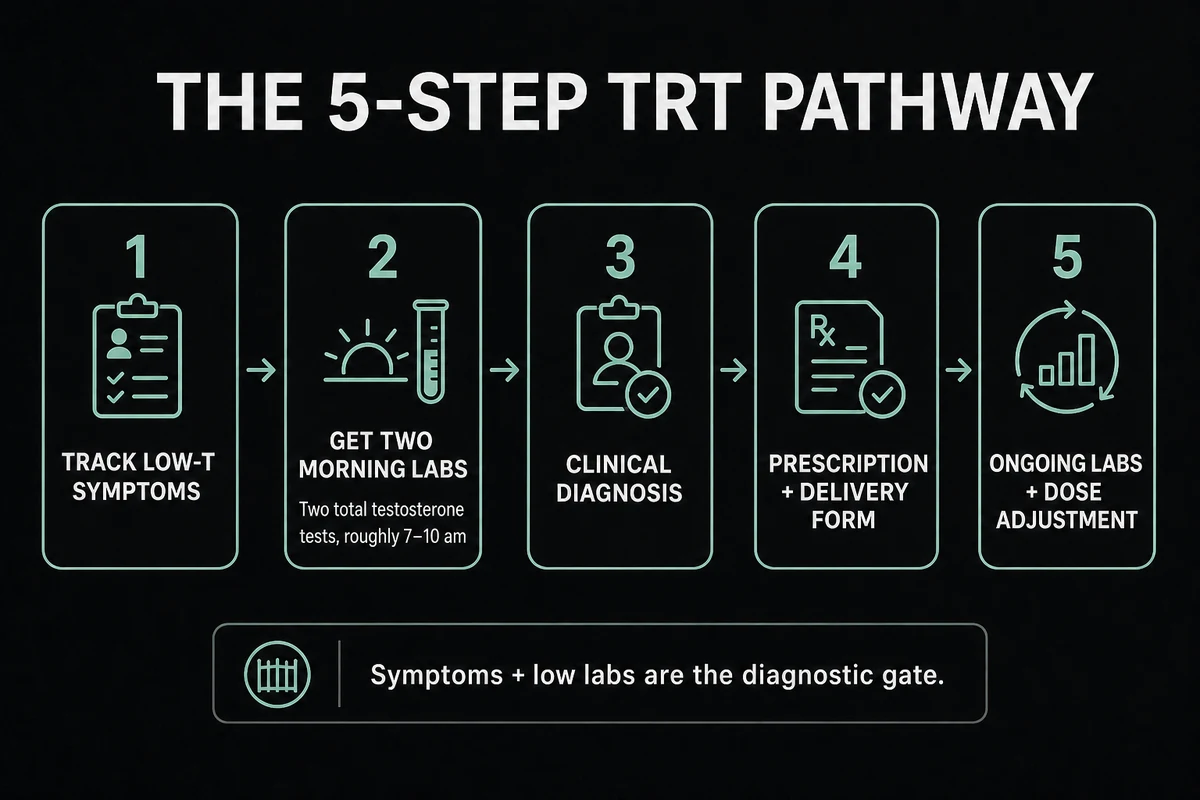
Step 1: Recognize the Symptoms of Low Testosterone
TRT is only appropriate when you have symptoms of testosterone deficiency, not low numbers alone. Guidelines are explicit that a diagnosis requires both symptoms and low labs together 13. Common symptoms include low sex drive, erectile difficulty, fatigue and low energy, loss of muscle mass, increased body fat, depressed mood, poor concentration, and reduced morning erections 39. None of these is specific to low testosterone on its own, which is exactly why testing matters. If you are asking "should I take TRT" or "do I need TRT," the starting point is an honest symptom review with a clinician, not a self-diagnosis.
Step 2: Get Two Morning Total Testosterone Blood Tests
This is the step that separates real medicine from grey-market shortcuts. Testosterone follows a daily rhythm and peaks in the morning, so guidelines call for a fasting total testosterone measurement drawn early, roughly between 7 and 10 am, and then confirmed with a second early-morning test on a different day before any diagnosis is made 123. A single low reading is not enough, because levels swing with sleep, illness, and even a bad week.
On the numbers, the two main US guidelines differ slightly. The Endocrine Society uses a threshold around 264 ng/dL, while the American Urological Association uses 300 ng/dL as its cutoff for testosterone deficiency 12. Normal adult male total testosterone generally falls somewhere in the range of about 300 to 1,000 ng/dL depending on the lab and your age 3. A good clinician also orders supporting labs at this stage, such as LH, FSH, prolactin, SHBG, a complete blood count (to check baseline hematocrit), and often estradiol and PSA, because those results shape both the diagnosis and the monitoring plan 1. A good clinician interprets these numbers in context rather than reacting to a single figure.
Step 3: Get a Clinical Diagnosis of Hypogonadism
With symptoms and two low morning readings in hand, a clinician makes the actual diagnosis: hypogonadism. This is more than reading a number off a page. A thorough evaluation also looks for reversible causes first, such as significant obesity, poorly controlled thyroid disease, obstructive sleep apnea, certain medications, or heavy alcohol use, because fixing those can sometimes raise testosterone without lifelong therapy 310. The clinician will also screen for reasons not to start TRT, including known or suspected prostate or breast cancer, untreated severe sleep apnea, a very high red blood cell count, or active plans to conceive in the near future, since testosterone suppresses sperm production 310. This diagnostic step is precisely what a legitimate provider will not skip, and it is the single best test of whether a service is real.
Step 4: Get Your TRT Prescription and Choose a Delivery Form
Once hypogonadism is diagnosed, your clinician writes the prescription and helps you pick a delivery method. The main FDA-approved forms are injectable testosterone (cypionate or enanthate, given weekly or every two weeks), transdermal gels and solutions applied daily, skin patches, subcutaneous pellets implanted every few months, and buccal or nasal formulations 5912. Injections are the most common option in the United States because they are effective and inexpensive, while gels are the most popular non-injectable choice 9. There is no single best form for everyone; the right pick depends on your labs, lifestyle, insurance, and preferences, which is a conversation worth having rather than a default.
Step 5: Stay on a Monitoring Schedule
Getting the prescription is the beginning, not the end. Because testosterone can raise your hematocrit (red blood cell concentration), shift your estradiol, and affect the prostate, guidelines call for follow-up bloodwork on a schedule, commonly around 3 to 6 months after starting and then periodically, checking testosterone, hematocrit, PSA where appropriate, and estradiol as needed 19. Your dose gets adjusted based on how you feel and what the labs show. A provider that never re-tests you is not doing TRT correctly. This ongoing loop of labs and adjustment is a core reason TRT is a medical relationship rather than a one-time transaction.
Where to Get TRT: In-Person vs Online Routes
There are two legitimate ways to actually get on TRT, and both end at the same diagnostic gate. The difference is convenience, cost structure, and how hands-on the care feels.
The in-person route means seeing a clinician face to face: your primary care physician, an endocrinologist (a hormone specialist), a urologist (often the go-to for men's testosterone and fertility), or a dedicated men's-health or low-T clinic. This route shines if you have a complex history, want a specialist, or plan to use insurance, since a diagnosed medical hypogonadism is often covered 9.
The online route means a licensed telehealth clinic. Under the current federal rules, a DEA-registered clinician can prescribe a Schedule II to V controlled substance, which includes testosterone, by a real-time audio-video telemedicine visit without a prior in-person exam. This flexibility was extended through December 31, 2026 by the DEA and HHS, subject to your state's own laws 78. Note that the audio-only pathway is reserved for a specific opioid-use-disorder medication and does not apply to testosterone, so expect a video visit and real lab work, either at a local draw site or through an at-home kit. Telehealth clinics you may come across include Hims, Henry Meds, Hone Health, and TRT Nation, among others; we name them only as examples of the category, not as endorsements. Compare telehealth options in our guide to online TRT, or find a face-to-face option with TRT near me.
| Feature | In-person clinic | Online (telehealth) |
|---|---|---|
| Who prescribes | PCP, endocrinologist, urologist, men's clinic | US-licensed clinician by video visit 78 |
| Diagnosis required | Yes, symptoms plus two morning labs 12 | Yes, same standard 12 |
| Lab testing | On-site or local lab order | Local draw site or at-home kit |
| Insurance | Often billable for diagnosed hypogonadism 9 | Frequently cash or membership; some bill insurance |
| Convenience | Office visits, in-person feel | Visits from home, medication mailed |
| Best for | Complex cases, specialist care, insurance use | Straightforward cases, privacy, speed |
| Cost signal | Varies widely by clinic and insurance | Often flat monthly cash models |
Cost varies a lot between these routes and between clinics, so we keep this guide focused on the pathway and cover the numbers separately in our full breakdown of how much TRT costs. Whichever route you choose, the sidebar on this page points to a licensed online clinic if you want to start with an evaluation.
How to Choose a Legitimate TRT Provider
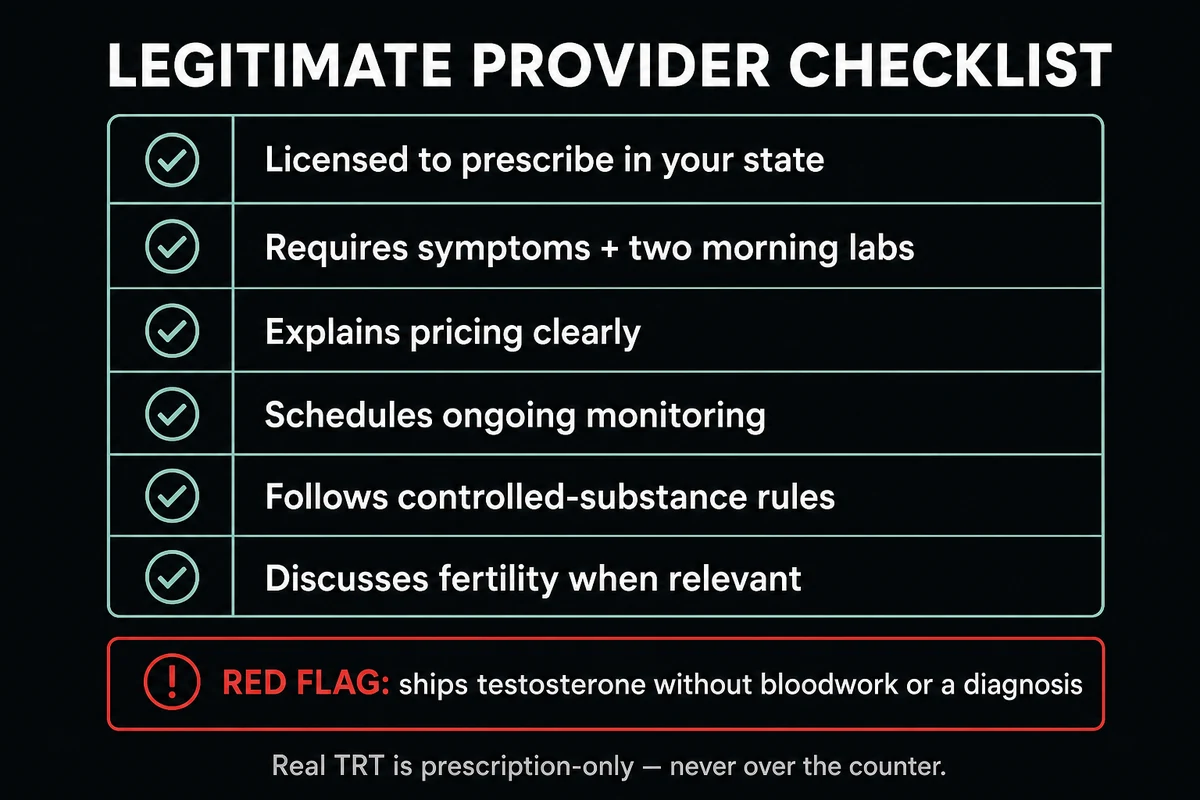
Not every service that will sell you testosterone is practicing real medicine. Use these criteria to separate a legitimate provider from a red flag, no matter whether they are down the street or on a screen.
- US-licensed clinicians who can prescribe in your state. Prescribing controlled substances is regulated at both the federal and state level, so a real provider is licensed where you live 78.
- Lab-based diagnosis, always. A legitimate provider requires two low morning total testosterone readings plus symptoms before prescribing 12. Anyone who ships testosterone without bloodwork is the clearest red flag there is.
- Transparent pricing. You should be able to see what the medication, the labs, and the visits cost before you commit, with no surprise fees.
- Ongoing monitoring built in. Look for scheduled follow-up labs (testosterone, hematocrit, PSA, estradiol) and a clinician who adjusts your dose over time, not a set-and-forget refill 19.
- Controlled-substance compliance. Because testosterone is Schedule III, a legitimate provider follows DEA and telehealth prescribing rules rather than working around them 67.
- Fertility counseling when it matters. If you may want children, a good provider raises this early, because TRT suppresses sperm production, and discusses options like hCG or enclomiphene 1. See our guide on TRT and fertility.
If a service fails on lab-based diagnosis or monitoring, it does not matter how convenient or cheap it is. Those two pillars are the difference between medicine and a liability.
What to Expect After Starting TRT
A common question once the prescription is in hand is simple: how long does it take for TRT to start working, and what does it feel like? Different effects arrive on different timelines. Sexual interest and morning erections often begin to improve within the first few weeks, energy and mood tend to shift over the first one to three months, and changes in body composition, muscle, and red blood cell counts build more gradually over three to six months and beyond 910. Many men describe the early change as feeling "normal again" rather than a sudden surge. If you feel nothing after several weeks, that is information for your clinician, not a reason to raise your own dose. We track this timeline in detail in how long TRT takes to work.
Two practical notes people search for often. First, "does TRT need to be refrigerated" comes up a lot: injectable testosterone is generally stored at controlled room temperature, away from heat and moisture, not in the refrigerator, and if a vial gets cold and looks cloudy the crystals usually redissolve when it returns to room temperature; always follow your specific product label and pharmacist's instructions 12. Second, TRT is a commitment. Testosterone from an outside source signals your body to slow its own production, so stopping is a clinical decision, not something to do abruptly, which we cover under getting off TRT below.
Anastrozole and TRT: Estrogen Control Is a Clinician's Call
A large part of this topic cluster asks about anastrozole with TRT, and it deserves a careful answer. Anastrozole is an aromatase inhibitor, a drug that lowers estrogen by blocking the enzyme that converts testosterone into estradiol. It is FDA-approved to treat certain breast cancers, and when it is used alongside TRT to manage estradiol in men, that is an off-label use 13.
Here is the responsible framing. Some testosterone naturally converts to estradiol, and a healthy amount of estradiol is good for men; it supports bone density, libido, and mood. Most men on a sensible, properly dosed TRT protocol never need an aromatase inhibitor at all. Anastrozole is considered only when a man has genuinely elevated estradiol together with symptoms, and even then it is prescribed and titrated by a clinician using your lab results, because over-suppressing estrogen causes its own problems, including joint pain, low libido, and bone loss over time 113. This is why we do not, and you should not, treat "how much anastrozole should I take on TRT" as a do-it-yourself dosing question. The correct dose is the one your prescriber sets from your bloodwork, and for many men that dose is none. If estradiol management comes up, it is a reason to work with a monitoring provider, not to self-medicate.
The Grey Market: Why "TRT for Sale" and Underground Testosterone Are a Bad Idea
Search "trt for sale," "buy trt," or "where to buy trt without prescription" and you will eventually find sellers offering testosterone with no doctor involved, often mislabeled for non-medical use or shipped from overseas. Avoid them. There are three concrete problems.
First, it is illegal. Testosterone is a Schedule III controlled substance in the United States, so possessing or buying it without a valid prescription is a federal offense, not a loophole 6. Second, there is no quality control. Underground-lab and grey-market vials are not FDA-regulated, and the FDA warns that medicines from unverified online sellers can be counterfeit, contaminated, under- or over-dosed, or not what the label claims 14. You genuinely do not know what is in the vial or how it was made. Third, there is no monitoring. The entire point of TRT is the loop of diagnosis, labs, and dose adjustment. Self-sourced testosterone skips all of it, which is how men end up with dangerously high hematocrit, unmanaged estradiol, or suppressed fertility they did not plan for 19.
The reframe is worth saying plainly: the thing you actually want from "buy TRT" queries is safe, legal access to real testosterone, and the way to get that is a diagnosis and a prescription, not a sketchy checkout page. It ends up cheaper too once you count the labs and the risk. For more on the legal side, see is TRT legal.
Getting Off TRT and Protecting Fertility
Some readers arrive here already on TRT and searching "how to get off TRT" or "how to restart testosterone production after TRT." The same principle applies in reverse: this is a supervised medical process. Because outside testosterone suppresses your body's own production, stopping cold can leave you with low levels and symptoms until, and if, your natural production recovers, which is not guaranteed, especially after long-term use 1. Clinicians manage a taper or a restart protocol, sometimes using medications like hCG or enclomiphene to stimulate the testes, based on your goals and labs. Fertility is the most time-sensitive piece: TRT suppresses sperm, so if you want children, that conversation should happen before or during therapy, not after. Our guide to TRT and fertility covers the options in depth.
Frequently Asked Questions
You get a TRT prescription by seeing a licensed clinician, reporting symptoms of low testosterone, completing two early-morning total testosterone blood tests, and receiving a diagnosis of hypogonadism 12. Only after that diagnosis will a legitimate provider, in person or by telehealth, write the prescription and set up monitoring.
No. Real TRT uses testosterone, which is a Schedule III controlled substance available by prescription only, so there is no legitimate over-the-counter or "for sale" retail version 6. Products sold over the counter as "testosterone boosters" are supplements, not testosterone, and do not treat diagnosed low testosterone.
It varies by effect. Libido and morning erections often improve within a few weeks, energy and mood over one to three months, and body composition and blood count changes over three to six months or longer 910. If you feel no change after several weeks, tell your clinician rather than adjusting the dose yourself.
Yes. Testosterone products are FDA approved to treat hypogonadism caused by a medical condition, and multiple delivery forms carry FDA-approved labeling 45. They are not approved for age-related low testosterone alone or for athletic performance, and testosterone therapy still requires a diagnosis and prescription.
Usually not. Anastrozole is an off-label aromatase inhibitor used only when a man on TRT has genuinely elevated estradiol with symptoms, and it must be dosed by a clinician from lab results, because over-suppressing estrogen causes joint pain, low libido, and bone loss 113. Many men on a properly dosed protocol never need it.
Generally no. Injectable testosterone is typically stored at controlled room temperature, away from heat and moisture, and gels and patches follow their own label instructions 12. If a vial gets cold and looks cloudy, the crystals usually redissolve at room temperature. Always follow your specific product label and pharmacist guidance.
References
- Bhasin S, et al. Testosterone Therapy in Men With Hypogonadism: An Endocrine Society Clinical Practice Guideline. J Clin Endocrinol Metab, 2018.
- American Urological Association. Evaluation and Management of Testosterone Deficiency: AUA Guideline, 2018 (amended 2023).
- Endocrine Society. Hypogonadism in Men (patient resource).
- U.S. Food and Drug Administration. FDA issues class-wide labeling changes for testosterone products.
- U.S. Food and Drug Administration. AndroGel (testosterone gel) 1.62% Prescribing Information, 2019.
- U.S. Drug Enforcement Administration, Diversion Control Division. Controlled Substances (alphabetical order).
- DEA and HHS. Fourth Temporary Extension of COVID-19 Telemedicine Flexibilities for Prescription of Controlled Medications. Federal Register, Dec 31, 2025.
- U.S. Health Resources and Services Administration. Prescribing controlled substances via telehealth.
- Cleveland Clinic. Testosterone Replacement Therapy (TRT): What It Is.
- Mayo Clinic. Testosterone therapy: Potential benefits and risks as you age.
- Lincoff AM, et al. Cardiovascular Safety of Testosterone-Replacement Therapy (TRAVERSE). N Engl J Med, 2023;389:107-117.
- MedlinePlus. Testosterone Injection (drug information).
- MedlinePlus. Anastrozole (drug information).
- U.S. Food and Drug Administration. BeSafeRx: Your Source for Online Pharmacy Information.
The information in this article is for educational purposes only and does not constitute medical advice. Always consult a healthcare professional before starting any new supplement or compound. Results vary by individual.