
Is TRT legal? In the United States, yes: testosterone replacement therapy is legal when a licensed clinician prescribes it for a diagnosed medical condition. Testosterone is a Schedule III controlled substance under federal law, so obtaining or possessing it without a prescription is a federal crime 1. That is the short answer, but it is only a quarter of the real question. The rules change again in drug-tested sports (where exogenous testosterone is banned at all times), in the military (where joining on TRT and staying on TRT follow very different standards), and on drug tests (most workplace panels never look for it). This guide walks through all four rule sets.
Key Takeaways
- TRT is legal with a prescription. A licensed clinician can lawfully prescribe FDA-approved testosterone for diagnosed testosterone deficiency (hypogonadism) [3, 16].
- Testosterone is a Schedule III controlled substance. Possessing or distributing it without a prescription is a federal offense under the Anabolic Steroids Control Act of 1990 [1, 2].
- A real diagnosis is the legal gate. Guidelines require low morning testosterone confirmed on repeat testing plus symptoms, not just "wanting higher T" [5, 6].
- TRT is banned in drug-tested sports. WADA lists exogenous testosterone as an S1 anabolic agent, prohibited at all times; a Therapeutic Use Exemption is possible but rarely granted for TRT [7, 8, 9].
- Military rules split by status. A history of hypogonadism is generally disqualifying for enlistment, while already-serving members can often continue TRT with documentation 13.
- Standard drug tests do not detect TRT. The federal DOT 5-panel screens five street-drug classes and does not include testosterone or other anabolic steroids 14.
Is TRT Legal in the US?
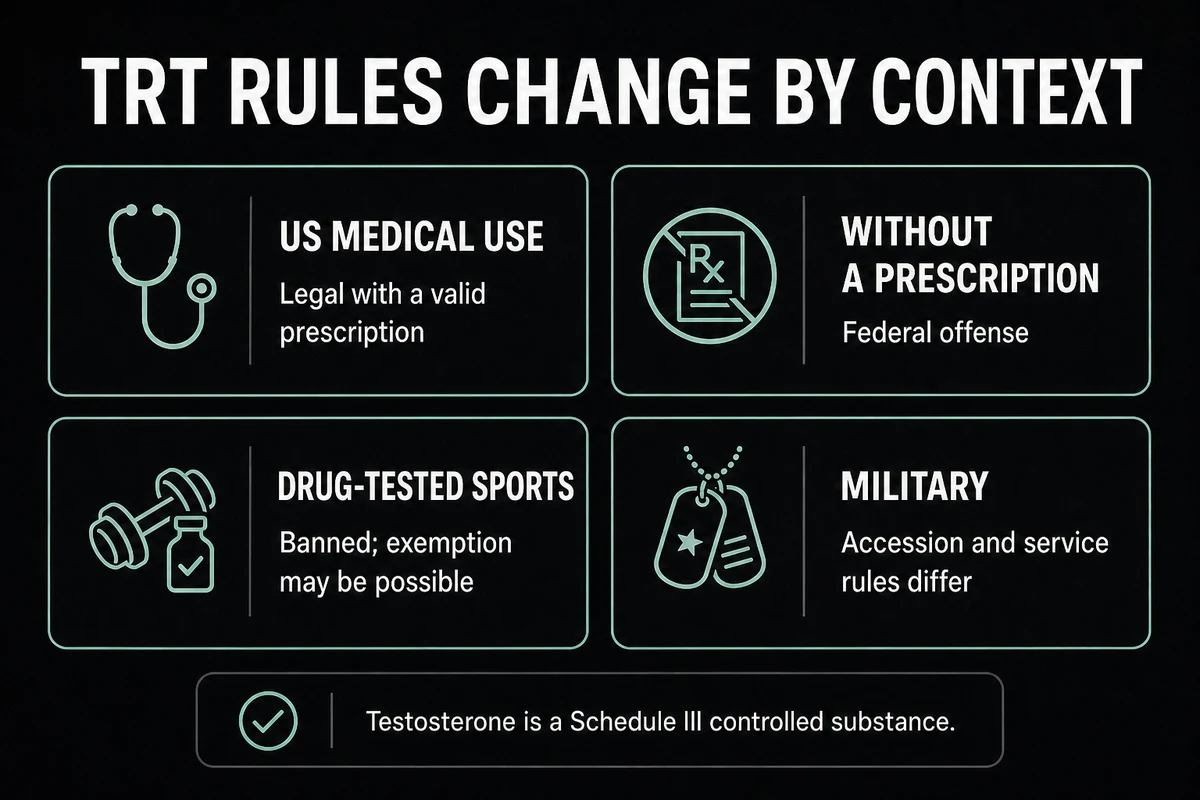
Yes. TRT is legal throughout the United States when it is prescribed by a licensed clinician for a legitimate medical purpose, in practice a documented diagnosis of testosterone deficiency (hypogonadism) [5, 16]. Every FDA-approved testosterone product, from injections to gels to pellets, is a prescription-only medication labeled CIII, meaning Schedule III controlled substance [3, 4].
The flip side is equally clear: because testosterone sits on Schedule III of the Controlled Substances Act, buying it from a friend, a gym contact, an overseas pharmacy, or an unregulated website without a valid prescription is illegal at the federal level, and every state follows the federal scheduling [1, 2]. There is no US state where non-prescription testosterone is lawful.
Why is TRT a controlled substance?
Congress placed anabolic steroids, defined as substances chemically and pharmacologically related to testosterone that promote muscle growth, into Schedule III with the Anabolic Steroids Control Act of 1990, largely in response to non-medical use in sports 2. Schedule III means the drug has accepted medical uses but also recognized abuse potential, so the law requires a prescription, limits refills, and criminalizes unauthorized possession and distribution [1, 17]. The FDA labels for testosterone products carry an abuse and dependence section noting misuse at higher-than-prescribed doses by athletes and bodybuilders, which is exactly the pattern the scheduling was designed to police 4. If you are wondering how a legitimate medicine and a banned doping agent can be the same molecule, that tension is the whole story: see our explainer on whether TRT is a steroid.
The diagnosis that makes TRT legal to prescribe
Legal TRT flows from a real diagnosis, not from a preference for higher testosterone. The American Urological Association guideline tells clinicians to diagnose testosterone deficiency only after two separate early-morning total testosterone measurements below 300 ng/dL, taken together with symptoms or signs 5. The Endocrine Society similarly recommends diagnosing hypogonadism only in men who have both consistent symptoms and unequivocally, consistently low morning testosterone, and it recommends against population-wide screening 6. Mayo Clinic draws the same line for patients: testosterone therapy is for diagnosed hypogonadism, not for reversing normal aging 18.
This diagnostic gate is what separates lawful medicine from the gray zone. A prescriber who hands out testosterone without documented low levels and a clinical indication is practicing outside the guidelines, and a patient without a valid prescription is outside the law. For what a proper workup looks like, start with our testosterone replacement therapy overview and the deep dive on testosterone levels on TRT.
Is TRT legal via telehealth?
Mostly yes, with an important legal backdrop. The Ryan Haight Act of 2008 sets the federal default that a controlled substance may only be prescribed online after at least one in-person medical evaluation 12. During COVID, the DEA waived that in-person requirement, and those telemedicine flexibilities have been repeatedly extended, currently through the end of 2026, while the DEA finalizes a permanent special-registration framework for telemedicine prescribing of controlled substances 11.
Practically, that means legitimate online TRT clinics can operate today, but they must still verify identity, order real laboratory testing, and conduct a genuine evaluation before prescribing. An online seller that ships testosterone with no labs, no clinician evaluation, and no prescription is not a telehealth clinic; it is an illegal distributor.
Is TRT Illegal Without a Prescription?
Yes. Possessing testosterone without a valid prescription is a federal crime, and distributing it is a more serious one 1. This covers the common workarounds people ask about: underground lab products sold through gyms or social media, unregulated websites selling mislabeled testosterone or its esters under non-medical disclaimers, and personal importation from overseas pharmacies. All of these put you on the wrong side of a Schedule III statute.
The health risk travels with the legal risk. Unregulated products are not manufactured under FDA oversight, so contamination, inaccurate dosing, and counterfeit ingredients are real possibilities, with none of the monitoring (hematocrit, PSA, blood pressure, estradiol) that makes prescribed therapy defensible [4, 16]. This is risk education, not a sourcing guide: if you cannot qualify for a prescription, the lawful path is to address the reasons why, not to buy around the system.
If your levels are borderline or you want to preserve fertility, there are legal, clinician-managed routes worth discussing before (or instead of) testosterone itself. See TRT alternatives, our enclomiphene guide, and the comparison of testosterone boosters vs peptides.
Is TRT Legal in Sports? Is TRT Banned in Sports?
Here the answer flips. Prescribed TRT that is perfectly legal at your pharmacy is still a doping violation in drug-tested sport unless you hold an approved exemption. The table below summarizes where major organizations stand.
| Organization | Testosterone status | Exemption available? | How it is tested |
|---|---|---|---|
| WADA / Olympic sport | Banned at all times (S1 anabolic agent) | TUE for organic hypogonadism only | T/E ratio screen + IRMS confirmation |
| USADA (US Olympic and pro athletes) | Banned | TUE, rarely approved for TRT | T/E ratio screen + IRMS confirmation |
| NCAA | Banned (anabolic agents class) | Medical exception, must be pre-approved | Urine testing plus medical review |
| Natural bodybuilding federations | Banned, often with multi-year lookback | No | Urine testing, polygraph varies by federation |
| Untested leagues and federations | Permitted | Not applicable | Not tested |
WADA, USADA, and NCAA rules on testosterone
The World Anti-Doping Agency's Prohibited List places testosterone and its esters in class S1, anabolic agents, which are prohibited at all times, both in competition and out of competition 7. There is no "natural because my doctor prescribed it" carve-out: exogenous testosterone is exogenous testosterone, whatever the paperwork. USADA applies the WADA framework to US athletes 9, and the NCAA bans anabolic agents under its own list, with testosterone requiring a pre-approved medical exception based on a documented, irreversible cause before the athlete competes 10.
Can you compete on TRT with a Therapeutic Use Exemption (TUE)?
In theory yes, in practice rarely. WADA's physician guidelines for male hypogonadism limit testosterone TUEs to genuine organic hypogonadism, meaning a diagnosable disease of the testes, pituitary, or hypothalamus (for example Klinefelter syndrome, pituitary tumors, or damage from chemotherapy) 8. Functional or age-related low testosterone does not qualify, and neither does hypogonadism caused by prior anabolic steroid use 8. USADA's TUE process requires detailed endocrine records, and approvals for testosterone are uncommon and evidence-heavy 9. If you compete in tested sport and have real organic hypogonadism, the right move is to file the TUE before starting therapy, with your endocrinologist's full workup attached.
Can You Be on TRT in the Military?
This is the question the internet answers worst, because the honest answer depends on which side of the recruiting office you are standing on. The key distinction is accession (joining) versus retention (already serving).
| Situation | General rule | Exception / notes |
|---|---|---|
| Joining (accession) while on TRT | Generally disqualifying if hypogonadism is unexplained or untreated | Waiver considered case by case; documentation of cause and stability helps, but approval is not assured |
| Already serving with a documented diagnosis | Often retainable with proper medical documentation | May limit deployability and certain assignments |
| Deploying while on TRT | Requires a reliable medication supply and monitoring plan | Subject to command and medical approval for the specific theater |
Joining the military on TRT (accession standards)
Accession medical standards are set by DoD Instruction 6130.03, Volume 1, which lists the conditions that disqualify applicants for appointment, enlistment, or induction. A history of hypogonadism that is unexplained or untreated falls under those endocrine standards, so presenting at MEPS on TRT is generally disqualifying on the initial screen 13. That is not always the end of the road: each service can grant medical waivers case by case, and an applicant with a clearly documented cause, stable treatment, and normal function has a better argument than one with an unexplained prescription from a low-T clinic. But anyone planning to enlist should treat TRT as a significant hurdle and talk to a recruiter and physician before assuming a waiver will come through 13.
Staying on TRT while serving (retention and deployability)
For members already in uniform, the calculus is different. Service members who develop diagnosed hypogonadism can often continue serving on TRT, provided the condition is documented, the treatment is stable, and routine monitoring is in place 13. The practical constraints show up around deployability: an injectable Schedule III medication that needs refrigeration-free storage, scheduled administration, and periodic labs can limit which assignments and theaters are available, and individual commands and medical departments make those calls. If you are active duty and starting TRT, loop in your military treatment facility early and keep your documentation current; the paperwork is what protects both your prescription and your career.
Does TRT Show Up on a Drug Test?
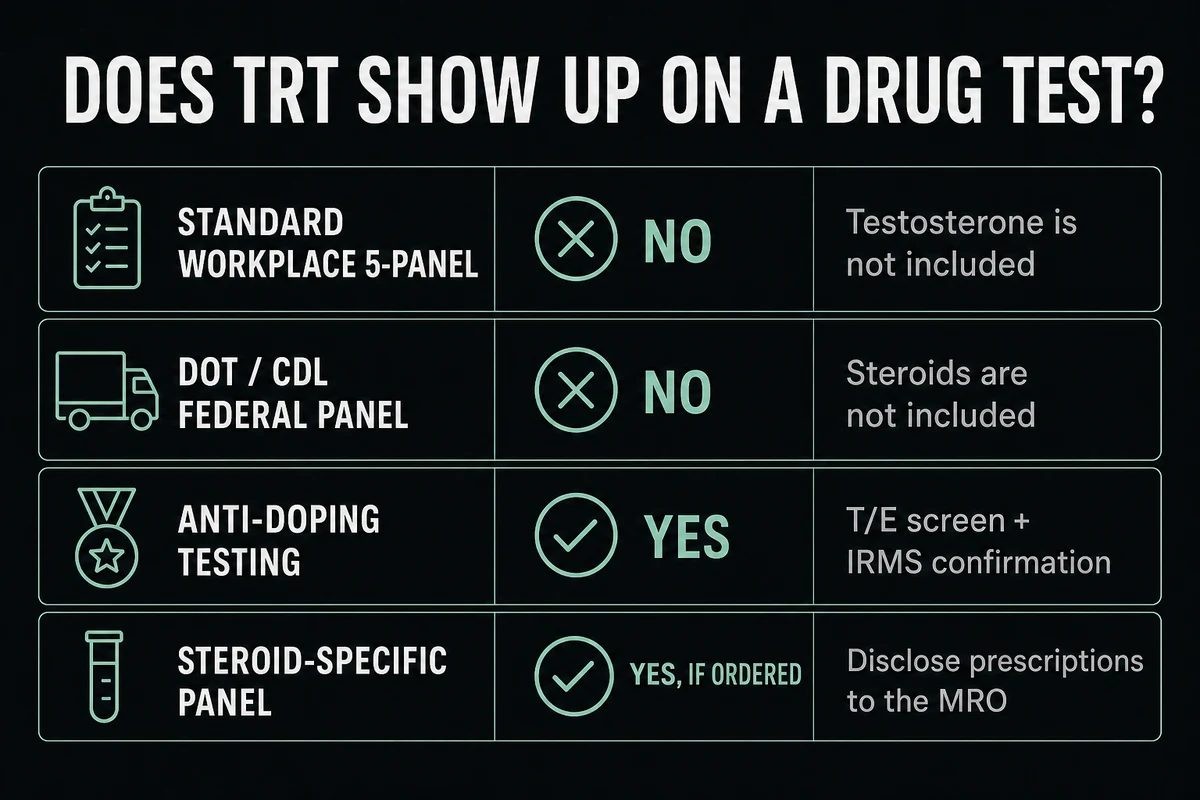
Usually not, and the confusion here is worth clearing up, because half the internet says yes and half says no. Both halves are describing different tests.
| Test type | Detects TRT / testosterone? | Notes |
|---|---|---|
| Standard workplace 5-panel | No | Screens five street-drug classes only |
| DOT / CDL federal panel | No | Same five classes; steroids are not included |
| Anti-doping (WADA, USADA, NCAA) | Yes | T/E ratio screen with IRMS confirmation |
| Steroid-specific or probation panel | Yes, if specifically ordered | Disclose your prescription to the MRO |
Standard workplace and DOT drug tests
The federal drug-testing panel used for DOT-regulated jobs (truck drivers, pilots, railroad workers) screens exactly five drug classes: marijuana, cocaine, amphetamines, opioids, and phencyclidine (PCP) 14. Testosterone and other anabolic steroids are not on the panel, and most private employers use the same or similar panels. A routine pre-employment urine test or a DOT/CDL screen will not flag TRT, because it never looks for it 14.
Athletic and anti-doping testing
Sport testing is a different machine. Anti-doping laboratories first screen urine for the ratio of testosterone to epitestosterone (the T/E ratio); an elevated ratio triggers confirmation by carbon-isotope-ratio mass spectrometry (IRMS), which can distinguish pharmaceutical testosterone from what your body makes 7. That is why prescribed TRT, invisible to a workplace panel, reliably produces an adverse finding in tested sport unless the athlete holds an approved TUE.
Disclosing your prescription to a Medical Review Officer (MRO)
Some specialized panels do include anabolic steroids: certain law-enforcement agencies, probation programs, and employers with steroid-specific policies order them. If you test positive on a panel that legitimately includes testosterone, a valid prescription disclosed to the Medical Review Officer documents a legitimate medical explanation. Keep a copy of your prescription and your prescribing clinician's contact information, and disclose the medication when the MRO calls rather than waiting for a dispute.
How to Get TRT Legally
The lawful pathway is not complicated, it is just deliberately gated:
- See a licensed clinician. A primary care physician, urologist, endocrinologist, or a legitimate telehealth clinic that orders labs and performs a real evaluation 16.
- Confirm the diagnosis with two morning labs. Guidelines call for two separate early-morning total testosterone measurements, generally below 300 ng/dL, plus consistent symptoms, before a diagnosis is made [5, 6].
- Get a prescription for an FDA-approved product. Injections, transdermal gels, patches, nasal gel, oral capsules, or pellets, dispensed by a licensed pharmacy with the refill limits that apply to Schedule III drugs [3, 16, 17]. Our guides to the types of TRT and TRT dosage cover what clinicians typically prescribe and why.
- Stay in monitoring. Legal TRT is ongoing care: your clinician will recheck testosterone levels, hematocrit, PSA, and blood pressure on a schedule, and adjust or stop therapy if problems appear [16, 18].
One freshness note worth knowing in 2026: in early 2025 the FDA ordered class-wide labeling changes for testosterone products, removing the boxed-warning language about heart attack and stroke risk after the TRAVERSE trial and adding a warning about increased blood pressure 15. The legal status did not change (testosterone remains Schedule III and prescription-only), but the risk conversation your clinician walks you through has been updated. We cover the details in TRT and heart health and TRT and blood pressure.
Frequently Asked Questions
Yes. TRT is legal in all 50 states when prescribed by a licensed clinician for a diagnosed condition such as hypogonadism. Testosterone is a Schedule III controlled substance, so it always requires a prescription [1, 16].
Yes. Possessing or buying testosterone without a valid prescription is a federal crime under the Controlled Substances Act, and distributing it carries heavier penalties. Underground lab products, "research" site purchases, and personal importation all fall under this prohibition [1, 2].
Yes, in drug-tested sport. WADA classifies exogenous testosterone as an S1 anabolic agent, prohibited at all times, and USADA and the NCAA follow suit [7, 9, 10]. Competing on TRT requires a Therapeutic Use Exemption, which is granted only for documented organic hypogonadism and is rarely approved 8.
Often yes, if you are already serving: members with a documented diagnosis and stable treatment can generally continue TRT, though it may affect deployability 13. Joining the military while on TRT is much harder, since a history of unexplained or untreated hypogonadism is generally disqualifying at accession, with waivers decided case by case 13.
TRT is not illegal for service members; it is a legitimate prescribed medication when ordered through military or civilian clinicians and documented in your health record. The constraints are administrative rather than criminal: accession standards, deployability rules, and command approval for certain assignments 13.
References
- U.S. Drug Enforcement Administration, Diversion Control Division. Anabolic Steroids Drug Fact Sheet.
- Anabolic Steroids Control Act of 1990 (legal history overview).
- U.S. FDA. AndroGel (testosterone gel) Prescribing Information, 2019.
- U.S. FDA. Testosterone Cypionate Injection Prescribing Information, 2022.
- American Urological Association. Testosterone Deficiency: AUA Guideline.
- Endocrine Society. Testosterone Therapy in Men With Hypogonadism: Clinical Practice Guideline, 2018.
- World Anti-Doping Agency. The Prohibited List.
- World Anti-Doping Agency. TUE Physician Guidelines: Male Hypogonadism.
- U.S. Anti-Doping Agency. Apply for a Therapeutic Use Exemption.
- NCAA. FAQs About NCAA Banned Substances and Medical Exceptions Procedures, 2024.
- DEA/HHS. Special Registrations for Telemedicine (proposed rule). Federal Register, 2025.
- American Psychiatric Association. The Ryan Haight Online Pharmacy Consumer Protection Act (explainer).
- U.S. Department of Defense. DoDI 6130.03, Volume 1: Medical Standards for Military Service (Accession).
- U.S. Department of Transportation, ODAPC. DOT 5-Panel Notice, 2018.
- U.S. FDA. FDA Issues Class-Wide Labeling Changes for Testosterone Products, 2025.
- Cleveland Clinic. Testosterone Replacement Therapy (TRT).
- MedlinePlus, National Library of Medicine. Testosterone Injection.
- Mayo Clinic. Testosterone Therapy: Potential Benefits and Risks as You Age.
The information in this article is for educational purposes only and does not constitute medical advice. Always consult a healthcare professional before starting any new supplement or compound. Results vary by individual.