CJC-1295 doesn't put testosterone in your bloodstream — but it sets up the hormonal conditions where your body produces more of its own. That's not a small distinction.
🔑 At a Glance
- Direct effect on testosterone? No — CJC-1295 targets growth hormone, not the HPG axis
- Indirect effect? Yes — via IGF-1, body composition, and improved sleep quality
- Best for: GH optimization, body recomposition, recovery — not testosterone replacement
- With ipamorelin: Creates a stronger, cleaner GH pulse with no cortisol spike (cortisol suppresses testosterone)
- Want direct testosterone support? Enclomiphene or gonadorelin are purpose-built for that
- Stack verdict: CJC-1295 + ipamorelin can support the hormonal environment where testosterone thrives — just don't expect it to replace TRT
Most people asking "does CJC-1295 increase testosterone" are really asking something more nuanced: will this help with the symptoms — low energy, slower recovery, reduced libido, stubborn body fat? The answer to that is more interesting than a flat yes or no. Let's break it down properly.
How CJC-1295 Actually Works
CJC-1295 is a synthetic analog of growth hormone-releasing hormone (GHRH). When you inject it, it binds to GHRH receptors on the pituitary gland and triggers a cascade:
- GHRH receptor activation → pituitary releases GH in pulses
- GH hits the liver → liver produces IGF-1 (insulin-like growth factor 1)
- GH + IGF-1 circulate → drive protein synthesis, fat oxidation, cellular repair
That's the whole mechanism. CJC-1295 amplifies your natural GH output — it doesn't inject synthetic HGH, and it doesn't touch testosterone synthesis directly. The Leydig cells in your testes that make testosterone aren't responding to GH signals; they respond to LH (luteinizing hormone) from the pituitary, which is regulated by a completely separate axis (HPG axis, not GH axis).
So if someone tells you CJC-1295 will "spike your testosterone" the way gonadorelin or enclomiphene does — they're wrong. But the story doesn't end there.
The GH → IGF-1 → Testosterone Connection (It's Real, It's Just Indirect)
GH and testosterone aren't independent systems. They talk to each other — and the conversation matters.
IGF-1 and Leydig Cell Support
IGF-1 — the main downstream mediator of CJC-1295's effects — has receptors on testicular Leydig cells. Several preclinical studies show IGF-1 enhances Leydig cell responsiveness to LH, meaning the same LH signal produces more testosterone when IGF-1 is optimal. It's like turning up the gain on an amplifier. The signal (LH) is the same; the output (testosterone) is louder.
This isn't theoretical. In animal models, IGF-1 deficiency correlates directly with impaired testicular testosterone production — and IGF-1 restoration partly reverses it. In humans, the data is less clean (we don't have controlled CJC-1295 + testosterone trials), but the mechanistic plausibility is solid.
Body Composition Changes Shift the Testosterone Balance
Here's a piece most people miss: adipose tissue (body fat) contains aromatase, the enzyme that converts testosterone to estrogen. More fat → more aromatase → more testosterone conversion → lower free testosterone. It's not a small effect — significantly overweight men can have testosterone levels 30–40% lower than lean men of the same age, partly due to this conversion.
CJC-1295 is clinically documented to reduce body fat while preserving lean mass. If it drives meaningful fat loss — and it does in clinical trials — that reduction in aromatase activity alone can meaningfully shift your testosterone-to-estrogen ratio in the right direction. Not by making more testosterone. By losing less of it to conversion.
Sleep Quality — The Underrated Link
Testosterone production peaks during deep sleep (slow-wave sleep, specifically). GH is also released primarily during deep sleep stages. People on CJC-1295 consistently report deeper, more restorative sleep — that's a real GH effect. Better deep sleep → better testosterone synthesis during those same nighttime hours. These systems are co-located temporally; optimize one and you support the other.
What the Research Actually Shows
Honest assessment: there are no controlled human trials measuring CJC-1295's direct impact on testosterone as a primary endpoint. The clinical literature on CJC-1295 has focused on GH/IGF-1 elevation, body composition, and metabolic markers. Testosterone is rarely even measured as a secondary endpoint.
What we do have:
- Teichman et al. (2006) — The landmark CJC-1295 trial. Showed 200–1000% increases in GH (dose-dependent) and sustained IGF-1 elevation for 28+ days. Body composition and testosterone not measured as endpoints.
- GH deficiency research — Patients with adult-onset GH deficiency treated with GH replacement show improvements in testicular function and sometimes modest testosterone elevations. This supports the mechanistic link but doesn't directly validate CJC-1295's effect.
- IGF-1 and gonadal function — Multiple in vitro studies confirm IGF-1 receptor expression in Leydig cells and IGF-1's role in modulating testosterone synthesis. The mechanistic link is established; the clinical magnitude in peptide users is unknown.
The honest answer: the indirect mechanisms are real and scientifically supported. The magnitude in real-world users is genuinely unclear because no one has run the right trial. Anecdotally, many CJC-1295 users report improved libido and energy — whether that's testosterone, GH, better sleep, or body composition improvements is impossible to attribute cleanly.
CJC-1295 vs Direct Testosterone Support Options
If your primary goal is actually raising testosterone — especially if you have labs showing clinically low levels — CJC-1295 is not the right tool. Here's where it sits against options purpose-built for testosterone:
Gonadorelin works by pulsatile GnRH signaling — it drives LH and FSH release, which directly stimulates testicular testosterone production. Enclomiphene blocks estrogen's negative feedback at the hypothalamus, causing the brain to secrete more GnRH → more LH → more testosterone. Both of these work on the testosterone axis. CJC-1295 works adjacent to it.
They're not mutually exclusive. Some hormone optimization protocols run CJC-1295 alongside gonadorelin or enclomiphene — each handles a different system, and the combination can address both GH deficiency and low testosterone simultaneously without the suppressive effects of TRT.
Stacking CJC-1295 with Ipamorelin: The GH Pulse Approach
CJC-1295 alone amplifies GHRH signaling. Ipamorelin acts on a completely separate receptor — the ghrelin/GHS-R1a receptor — to trigger GH release through a different pathway. When you combine them, you get what's sometimes called a "dual-pathway GH pulse."
Why does this matter for the testosterone conversation? Because ipamorelin is notably selective. Unlike GHRP-2 or GHRP-6, ipamorelin doesn't significantly increase cortisol or prolactin. That matters because:
- Cortisol is catabolic and testosterone-suppressive — chronic cortisol elevation directly inhibits testosterone synthesis in the testes
- Prolactin elevation suppresses LH — and LH is what drives testosterone production
So the CJC-1295 + ipamorelin combination maximizes GH output without the hormonal collateral damage that would actively undercut testosterone. It's probably the cleanest GH optimization stack available, and it's why this combination has become essentially standard practice in peptide-forward hormone clinics.
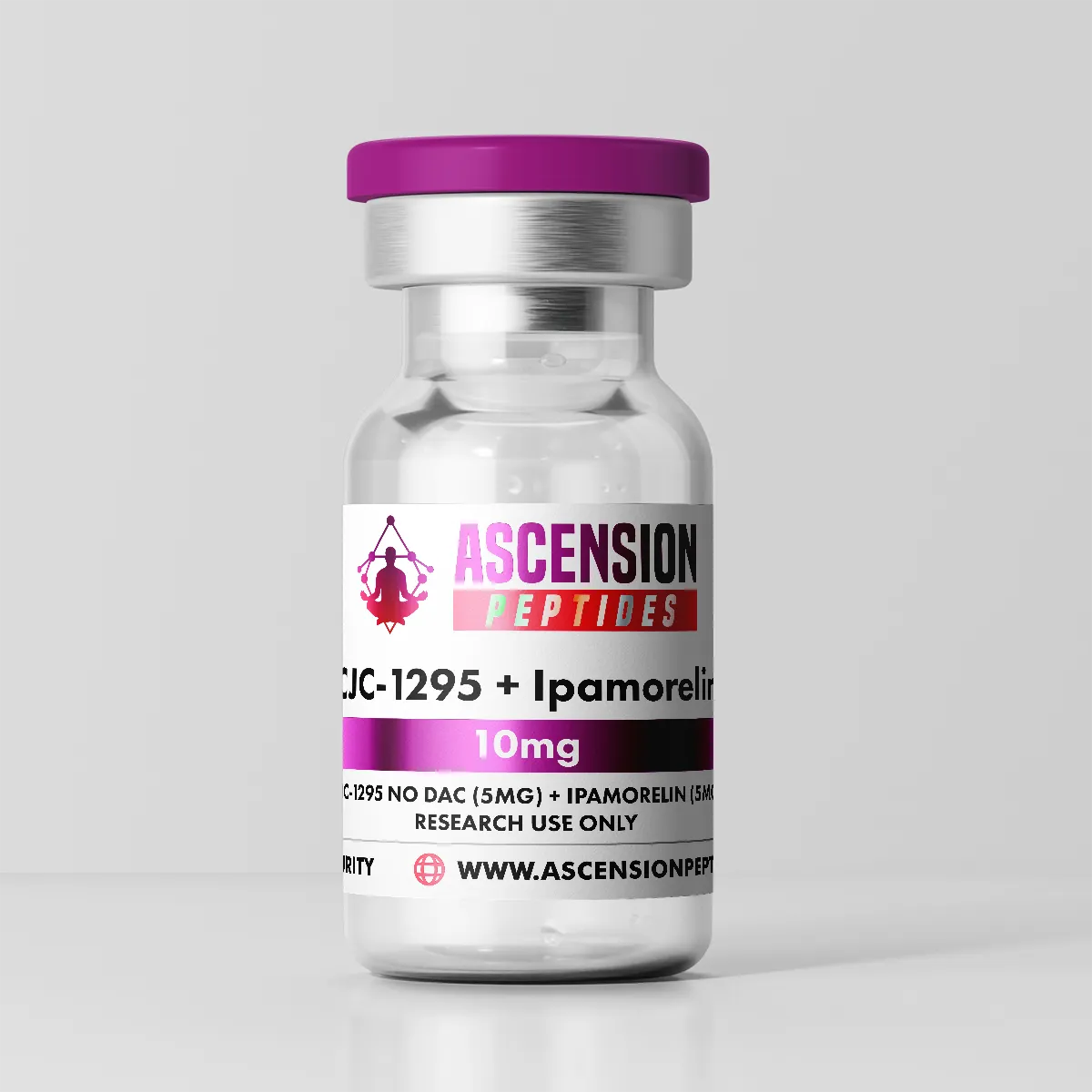
The FIT Stack from Ascension Peptides comes pre-packaged as CJC-1295 (no DAC) + Ipamorelin — exactly this combination, ready to go. It's the most practical way to run this protocol without sourcing each peptide separately.
🔬 FIT Stack — CJC-1295 + Ipamorelin
The dual-pathway GH optimization combo. CJC-1295 (no DAC) for pulsatile GHRH stimulation + Ipamorelin for selective ghrelin receptor activation — no cortisol spike, no prolactin elevation. Available from Ascension Peptides.
Who Should Actually Use CJC-1295 for Hormone Optimization?

There's a specific profile where CJC-1295 makes the most sense in the context of testosterone and male hormone health:
- GH/IGF-1 is low, testosterone is borderline — CJC-1295 addresses the GH side; the testosterone may self-correct as body composition improves
- On TRT and want to preserve body composition/recovery — CJC-1295 + ipamorelin complements TRT without interfering with it
- Want to optimize hormones without suppressing the HPG axis — CJC-1295 doesn't suppress natural testosterone production; it's one of the few interventions that can genuinely be called "non-suppressive"
- Age 35+ with declining GH and subclinical testosterone drop — both decline together with age; addressing GH first can sometimes lift the hormonal floor
If your testosterone is below 300 ng/dL and you have clinical symptoms of hypogonadism — CJC-1295 is not going to fix that. Get labs, work with a doctor, and discuss TRT, enclomiphene, or gonadorelin. CJC-1295 can be part of a protocol, but not the centerpiece.
Frequently Asked Questions
Where to Get the FIT Stack
For the CJC-1295 + ipamorelin combo, Ascension Peptides' FIT Stack bundles both peptides together. It's a clean research-grade formulation — they third-party test their peptides, which matters when you're dealing with compounds that interact with your endocrine system. Cutting corners on purity here isn't smart.
For direct testosterone support (gonadorelin, enclomiphene), those require a prescription in most countries. Work with a hormone specialist or TRT clinic — not a peptide supplier.
Internal reference: CJC-1295 complete guide | Ipamorelin overview | Gonadorelin for testosterone support