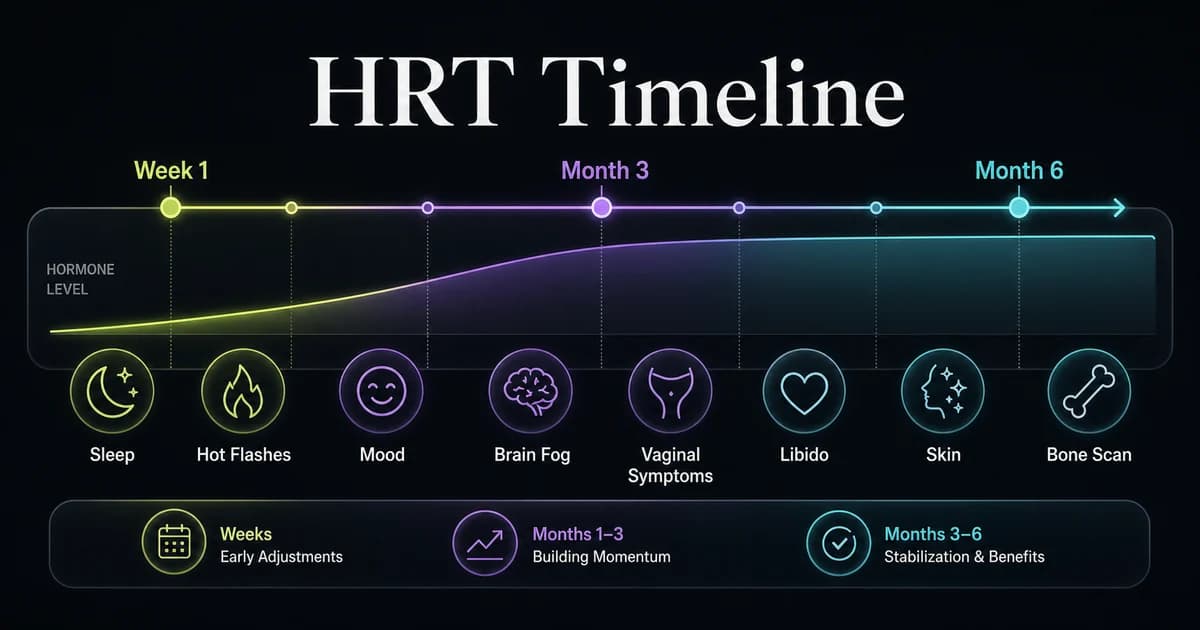

How long does HRT take to work? Most women notice the first improvements within 2 to 4 weeks of starting menopausal hormone therapy (MHT), and the full effect builds over about 3 months, but each symptom moves on its own clock [1][2]. Sleep and hot flashes tend to shift first, while brain fog, libido, and skin changes take longer. This guide walks through a week by week timeline, a symptom by symptom table, what changes when you use a patch instead of a pill, the signs your dose is working, and how long for HRT to work before it is fair to judge it. For the full overview, see our complete guide to HRT for women. If you have not started yet, the do I need HRT quiz can help you frame the conversation with a clinician.
| Milestone | Typical timing |
|---|---|
| First noticeable changes | 1 to 4 weeks [1] |
| Hot flash relief | 2 to 4 weeks, near full by about 12 weeks [3] |
| Full effect for most symptoms | About 3 months [1][2] |
| First formal dose review | 8 to 12 weeks [2] |
🔑 Key Takeaways
- Sleep often shifts first, sometimes within the first week if you take oral micronized progesterone at bedtime, because it has a mild sedative effect and cuts down night sweats [4].
- Hot flashes usually ease within 2 to 4 weeks and reach near maximum relief by about 12 weeks; a Cochrane review found roughly 75% fewer hot flushes on hormone therapy versus placebo [3].
- Mood and brain fog are slower, typically 4 to 16 weeks, and cognitive improvement often tracks better sleep rather than a direct drug effect [4][5].
- Week 2 is too early to judge anything but sleep. The earliest fair checkpoint is 4 to 6 weeks, and most prescribers do a formal review at 8 to 12 weeks [2].
- If little has changed by 3 months, the dose, type, or route can be adjusted, which is standard practice rather than a sign HRT has failed [1][2].
How Quickly Does HRT Work? The Short Answer
How quickly does HRT work depends on which symptom you are asking about, but the general answer is that it is gradual, not instant. The NHS notes that menopausal symptoms often begin improving within a few weeks of starting HRT, with the full benefit building over several months [1]. So when women ask how long does it take for HRT to work, or when does HRT start working, the honest answer is that the medicine reaches steady levels in your blood within days, but your tissues respond at very different speeds.
That gap is the key to understanding the timeline. Transdermal estradiol (a patch or gel) reaches a steady blood level within a few days, yet the brain thermostat that drives hot flashes, the vaginal tissue that has to physically rebuild, and the mood circuits that steady out over weeks are all working on separate schedules [4][5]. The hormone gets there quickly; the body catches up slowly. That is why how long for HRT to work is a range, not a single date, and why patience through the first month matters.
HRT Timeline by Symptom: What Improves When
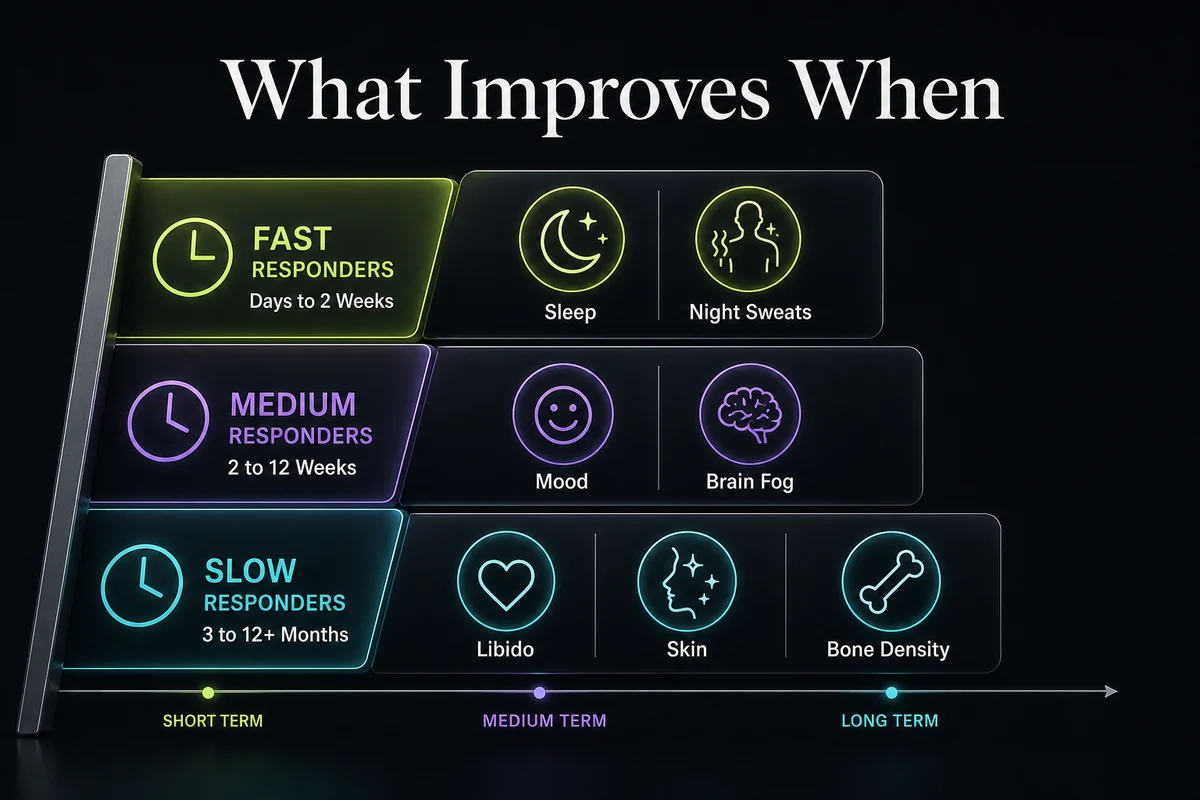
The table below maps the usual timeline for each menopausal symptom. Treat every figure as a range drawn from guideline statements and trial data, not a guarantee; real people fall on either side of these windows depending on their dose, delivery method, age, and starting symptoms [2][5].
| Symptom | First noticeable change | Substantial improvement | Full effect |
|---|---|---|---|
| Sleep (with bedtime oral progesterone) | Days to 2 weeks | 2 to 6 weeks | About 3 months |
| Hot flashes and night sweats | 2 to 4 weeks | 6 to 8 weeks | About 12 weeks |
| Mood and irritability | 2 to 4 weeks | 4 to 8 weeks | About 3 months |
| Brain fog and clarity | 4 to 8 weeks | 8 to 12 weeks | 8 to 16 weeks |
| Vaginal dryness (local estrogen) | About 2 weeks | 4 to 8 weeks | 8 to 12 weeks |
| Vaginal dryness (systemic only) | 4 to 6 weeks | 8 to 12 weeks | Up to 3 months |
| Libido | 6 to 12 weeks | About 3 months | 3 to 6 months |
| Skin and hair | 4 to 12 weeks | 3 to 6 months | 6 months or more |
| Joint aches | 4 to 8 weeks | 8 to 12 weeks | About 3 months |
| Bone density | Not felt | Measurable on a DEXA scan at about 12 months | Continues while on therapy |
Timelines drawn from NHS and Menopause Society guidance and the Cochrane hot flush review [1][2][3].
Hot flashes and night sweats
Hot flashes and night sweats are usually the fastest of the classic symptoms to respond. Most women see the frequency drop first, within 2 to 4 weeks, then the intensity fades, with substantial relief by 6 to 8 weeks and maximum benefit by about 12 weeks [1][4]. The evidence base here is strong: a Cochrane review of estrogen and combined estrogen plus progestogen therapy found roughly 75% fewer hot flushes compared with placebo [3]. If your night sweats are still soaking the sheets at 8 weeks on a stable dose, that is a reasonable prompt to talk to your clinician about the dose.
How Long Before HRT Helps Sleep?
How long before HRT helps sleep is one of the most common questions, and sleep is often one of the earliest wins. There are two mechanisms working on different clocks. First, fewer night sweats mean fewer wakings, so this part of sleep improvement follows the hot flash curve and builds over 2 to 6 weeks. Second, oral micronized progesterone taken at bedtime has a mild sedative-like effect that some women notice within the first few nights, because it is metabolized into calming compounds that act on the brain [4]. If sleep is your main complaint, mention it to your clinician, since the type and timing of progesterone can be chosen with sleep in mind.
Mood, anxiety, and brain fog
Mood tends to lift a little later than hot flashes, often around 4 to 8 weeks, while word-finding, focus, and mental clarity usually take longer, in the range of 8 to 16 weeks [4][5]. It is worth being careful with cognitive expectations. The evidence on HRT and memory or brain fog is mixed, and much of the improvement women report seems to track their improved sleep and reduced hot flashes rather than a direct effect on cognition [2][5]. HRT is not prescribed as a treatment for dementia, and current guidelines do not support starting it for cognitive protection [2]. If your mood is not steadying by around 8 to 12 weeks, that is a fair point to review.
Skin, hair, and body changes
Estrogen influences skin collagen, thickness, and hydration, and many women notice skin feeling less dry and more comfortable over time, but visible changes are gradual, measured in months rather than weeks [5]. Expect the first subtle differences somewhere between 4 and 12 weeks and any fuller effect over 3 to 6 months or longer, with no dramatic before-and-after promises. Body composition and weight tend to stabilize over roughly 3 to 6 months as sleep, energy, and activity improve, though HRT is not a weight-loss treatment; our guide on whether HRT causes weight gain covers that in depth.
Vaginal dryness and libido
Vaginal dryness and libido are the slowest systemic responders. On systemic HRT alone, vaginal tissue often takes 6 to 12 weeks to rebuild comfort, and libido can take 3 to 6 months to shift, partly because desire depends on sleep, mood, and comfort all improving together [1][5]. Local vaginal estrogen works faster and more directly for dryness and urinary comfort, with many women feeling better within about 2 weeks and full benefit by 8 to 12 weeks; it can be combined with systemic HRT when needed [1][4]. Our guide on whether HRT helps with libido goes deeper on this.
Bone density
Bone is the one benefit you will never feel. HRT slows the bone loss that accelerates after menopause, but the change is silent and only shows up as a measurement on a DEXA scan, typically around 12 months in [2]. The protection lasts only while you stay on therapy and begins to fade once you stop, which is one of the factors your clinician weighs when discussing how long to continue [2].
How Long After Starting HRT Do You Feel a Difference? Week by Week
How long after starting HRT do you feel a difference is best answered in phases. Here is how long before HRT starts to work laid out week by week, so you know what is normal at each stage and when a change is worth mentioning.
Weeks 1 and 2: adjustment period
In the first two weeks your hormone levels are still stabilizing. A transdermal patch reaches a steady estradiol level within a few days (often by about day 3 or 4), but your body is only starting to adjust [4]. Early on you may notice slightly better sleep, and you may also get some settling-in effects: breast tenderness (which affects roughly one in three women), light spotting, mild nausea, or headaches, and hot flashes can even briefly fluctuate before they improve [1][4]. This is the stage where people wrongly conclude it is not working. The key message for how long does it take for HRT to start working is simple: week 2 is too early to judge anything except, sometimes, sleep.
Weeks 3 to 6: the first real improvements
Weeks 3 to 6 are usually when the first real improvements arrive, and this is the window most people mean when they ask how long before HRT starts working. Hot flash frequency drops first, then intensity softens, and night sweats often settle noticeably by around week 6. Mood tends to start lifting around week 4. This is also the earliest reasonable point for a dose conversation: if your symptoms are severe and nothing at all has shifted, many menopause clinicians will consider an adjustment at 4 to 6 weeks rather than making you wait the full quarter [2].
Weeks 8 to 12: the first formal review
Most prescribers schedule the first formal check-in at 8 to 12 weeks, and this is where the picture consolidates [2]. By 12 weeks, hot flashes should be at or near their full response, sleep should be steadier, and any early bleeding or spotting patterns are usually settling down. Bring a short symptom diary to this visit; it makes the conversation about whether your dose is right much more concrete. If a symptom that mattered to you has not moved by this review, it is the natural moment to discuss options.
Months 3 to 6 and beyond
From 3 to 6 months, the slower symptoms keep improving: brain fog, libido, joint comfort, and skin all continue to catch up as you reach a steady state [4][5]. If little or nothing has improved by 3 months on a stable, adequate dose, the guideline advice is to adjust the dose, switch the type or route, or refer to a menopause specialist, not to conclude that HRT has failed [1][2]. Most non-responses turn out to be a dosing or absorption issue rather than the therapy being wrong for you.
Does the Type of HRT Change How Fast It Works?
Yes, a little, though the differences are smaller than most people expect. The route mostly affects how steadily the hormone arrives and its safety profile, not the final destination. The table below compares the common delivery methods.
| Form | Time to steady hormone levels | First symptom effects | Notes for the timeline |
|---|---|---|---|
| Patch (transdermal estradiol) | Within a few days | Often 1 to 2 weeks | Steady day-to-day levels; avoids the small extra clot risk seen with tablets [1][2] |
| Gel or spray (transdermal) | Within days | 1 to 2 weeks | Daily application; dose is easy to fine-tune |
| Oral tablets | Within days, with more day-to-day swing | 2 to 4 weeks | Passes through the liver first, which carries a small added clot risk [1][2] |
| Vaginal estrogen (local) | Local effect within about 2 weeks | Comfort by about 2 weeks, full by 8 to 12 weeks | Treats dryness and urinary symptoms only, not hot flashes [1] |
| Oral micronized progesterone (add-on) | Taken nightly | Mild sedative effect some notice within days | Protects the uterine lining; bedtime dosing can aid sleep [4] |
The practical takeaways: patches and gels hold steady levels and avoid the small clot risk that oral tablets carry (because tablets pass through the liver first), while vaginal estrogen is the fastest option for dryness but does nothing for hot flashes [1][2]. The bottom line: by 3 months, most routes deliver similar symptom relief, so the choice of route is really about safety profile and personal preference, not speed. Your clinician can walk you through HRT patches and the broader menu of types of HRT to match the method to your needs.
Signs HRT Is Working (and Signs It Is Not)
Once you are a few weeks in, it helps to know what how long until HRT works actually looks and feels like day to day. The signs are often subtle at first, which is exactly why a symptom diary is worth keeping for your follow-up visit.
Signs it is working:
- Hot flashes are less frequent and less intense than before. - You are sleeping through more of the night and waking less drenched. - Your mood feels steadier, with fewer sharp irritability spikes. - You have fewer daytime energy crashes and a bit more clarity.
Signs it may need a review:
- No change in your main symptom by 8 to 12 weeks on a stable dose [2]. - Side effects that are getting worse rather than better after week 6. - Symptoms that are worsening week over week rather than easing.
When not to wait for the 12-week review: Some symptoms are not part of the normal settling-in period and need prompt medical attention. See a clinician urgently if you have heavy or persistent vaginal bleeding, chest pain, pain or swelling in one calf, a sudden severe headache or change in vision, or a new breast lump. These are not typical HRT side effects and should be checked without waiting for a scheduled visit [1][5].
How Long Do HRT Side Effects Last?
How long do HRT side effects last is a fair worry, especially when the first weeks feel bumpy. The reassuring pattern is that most early side effects are temporary. Breast tenderness, nausea, bloating, headaches, and a bit of mood wobble typically settle within the first 3 months, and often much sooner, as your body adjusts to steady hormone levels [1][4].
Progestogen-related effects, such as low mood or morning grogginess from oral micronized progesterone, usually improve within a few weeks; menopause specialists often suggest taking the dose a little earlier in the evening if grogginess lingers into the morning. Unscheduled spotting or light bleeding is common in the first 3 to 6 months while your body adapts, and it usually settles on its own. It is worth getting checked if bleeding is heavy, painful, or still happening after 6 months.
This is a summary; for the full picture, see our full guide to HRT side effects and our detailed guide to bleeding on HRT, which cover management and what is and is not normal in far more depth than we can here.
When to Ask About a Dose Change
The general rule is to wait at least 4 to 6 weeks before judging effectiveness, unless side effects are severe, and to expect a formal review at 8 to 12 weeks [2]. For most symptom-guided adjustments, blood tests are not required; your symptoms lead the decision, though some clinicians check levels in specific situations, which our guide to estradiol levels on HRT explains.
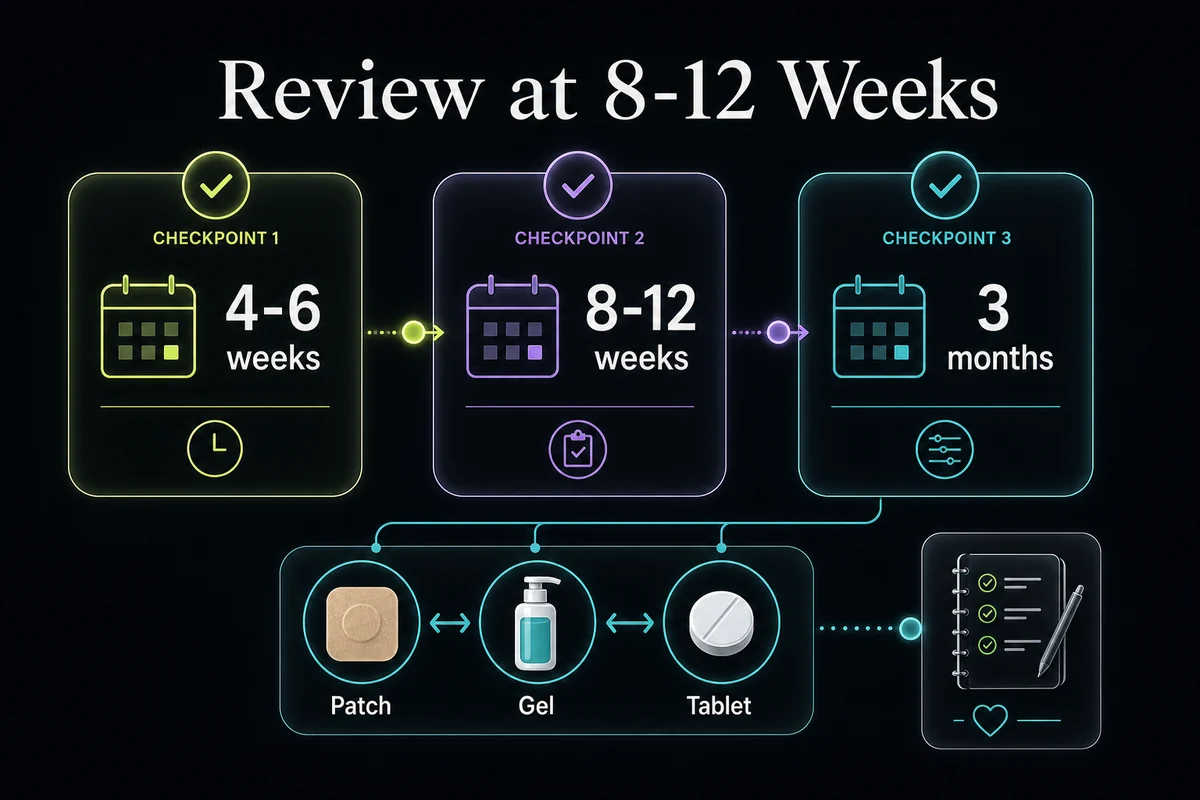
If you are under-responding at the review, the usual options are to raise the dose, switch the route (for example from an oral tablet to a transdermal patch for steadier levels or a better safety profile), change the progestogen, or add a non-hormonal option such as fezolinetant, which is discussed with your clinician rather than self-started. Our HRT dosage chart shows how doses are typically stepped. If cost is part of the decision when switching products or routes, our guide to HRT cost breaks down what to expect. And if your current prescriber will not review a dose that clearly is not working, the best online HRT providers offer menopause-focused reviews that can be easier to access than a general practice.
How Long Can You Be on HRT?
How long can you be on HRT is one of the most searched questions, and the modern answer has changed. There is no fixed stop date. The Menopause Society 2022 position statement supports individualizing the duration of therapy with a periodic (usually annual) review of the benefits and risks, rather than an arbitrary cutoff, which means the old "stop at 5 years" rule is outdated [2]. The NHS similarly notes that while many women take HRT for a few years, there is no blanket time limit, and the balance of benefits and risks shifts with your age and how long it has been since menopause [1]. So how long can you take HRT, how long should you take HRT, and how long to stay on HRT are all decisions you and your clinician revisit over time, not a countdown clock.
On risk and duration: combined estrogen plus progestogen HRT is linked to a small increase in breast cancer risk that grows the longer it is used, while estrogen-only HRT (used by women without a uterus) carries little or no added risk in the same way [1][2][6]. The increase for combined therapy is small in absolute terms, and it is one of the specific things your annual review is designed to weigh against your symptom relief and other benefits [2]. This is a conversation about your individual picture, not a reason to stop abruptly.
Two more practical notes on how long do you take HRT. First, symptoms can return after stopping, sometimes within weeks, so many clinicians suggest tapering the dose down gradually rather than quitting cold; our guide on what happens when you stop HRT covers tapering and how to do it. Second, the risk and benefit math shifts with age, which is why our guide to the benefits of HRT after 65 looks specifically at continuing therapy later in life. If you started in perimenopause, the timing window is a little different, and our guide to HRT for perimenopause explains why.
Frequently Asked Questions
References
- NHS. Hormone replacement therapy (HRT). Accessed 2026. https://www.nhs.uk/medicines/hormone-replacement-therapy-hrt/
- The 2022 Hormone Therapy Position Statement of The North American Menopause Society. Menopause. 2022;29(7):767-794. https://pubmed.ncbi.nlm.nih.gov/35797481/
- MacLennan AH, Broadbent JL, Lester S, Moore V. Oral oestrogen and combined oestrogen/progestogen therapy versus placebo for hot flushes. Cochrane Database of Systematic Reviews, 2004;(4):CD002978. https://pubmed.ncbi.nlm.nih.gov/15495039/
- Cleveland Clinic. Hormone Therapy for Menopause Symptoms. Accessed 2026. https://my.clevelandclinic.org/health/treatments/15245-hormone-therapy-for-menopause-symptoms
- Mayo Clinic. Hormone therapy: Is it right for you? Accessed 2026. https://www.mayoclinic.org/diseases-conditions/menopause/in-depth/hormone-therapy/art-20046372
- American College of Obstetricians and Gynecologists (ACOG). Hormone Therapy for Menopause. Accessed 2026. https://www.acog.org/womens-health/faqs/hormone-therapy-for-menopause
Disclosure: this article contains affiliate links to Gala Health. If you start care through them, we may earn a commission at no extra cost to you.