
The best online HRT providers in 2026 make menopause hormone therapy something you can start from home, but they are not interchangeable, and the right pick depends mostly on how you plan to pay. For cash-pay simplicity, Gala Health is our top overall pick this year. If you want to run treatment through insurance, Midi Health is the standout because it bills insurers directly. Below we compare seven telehealth options (five women's menopause platforms plus two men's testosterone services people often confuse with menopause care), with a master comparison table, honest Alloy and Fountain reviews, and guideline-anchored safety notes so you can choose with your eyes open.
*Disclosure: PeptideDeck may earn a commission if you sign up through links on this page, at no extra cost to you. This does not affect how we rank providers.*
Gala Health is our top online HRT pick for 2026. Check availability and current pricing on their site. Visit Gala Health
Not sure whether hormone therapy is even right for you? Not sure if you need HRT? Take our quiz before you shop for a provider.
🔑 Key Takeaways
- Gala Health is our top overall pick for straightforward cash-pay telehealth HRT in 2026, priced from $79 per month per Gala, prescribing compounded estradiol and progesterone. Exact state availability is confirmed at signup.
- Midi Health is the pick if you want to use insurance. It is the one major provider here that bills insurance directly, which can make it the cheapest real cost for people with good coverage.
- Alloy publishes per-product medication pricing for FDA-approved menopause products before you sign up, which is unusual and useful if you like to see costs upfront.
- Fountain and Hone are men's testosterone (TRT) platforms, not menopause care. If you are a woman searching for menopause HRT, these are the wrong product type.
- Always confirm a provider prescribes in your state and, if you have a uterus, that any estrogen comes paired with a progestogen [2][5].
Quick stats
| Detail | What we found |
|---|---|
| Providers compared | 7 (5 women's menopause platforms, 2 men's TRT platforms) |
| Typical self-pay cost | Most programs run about $100 to $200 per month (medication may be separate) |
| States covered | Varies by provider; always confirm your state |
| Hormones commonly offered | Estrogen, progesterone, and in some cases testosterone |
| Insurance | Mostly cash-pay; Midi Health bills insurance directly |
The 5 Best Online HRT Providers Compared
Here is the short version before we go provider by provider. Every price below should be treated as a starting point, not a quote: telehealth pricing changes often, and medication costs are frequently billed on top of any membership or visit fee. Use this table to shortlist, then confirm the details that matter to you on each provider's own site.
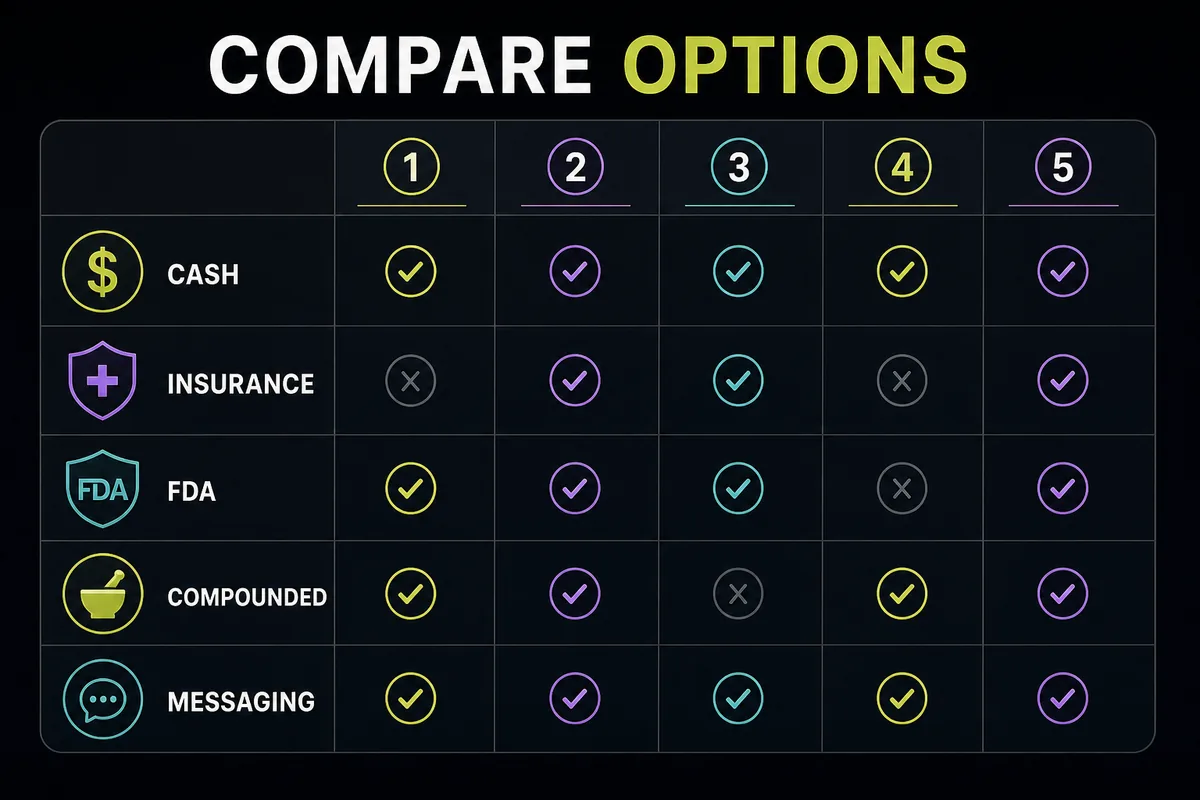
| Provider | Best for | Starting price | Hormones offered | Insurance accepted | States | Labs required to start |
|---|---|---|---|---|---|---|
| Gala Health | Cash-pay simplicity (our #1) | From $79/mo (per Gala) [12] | Estradiol (pill or patch), progesterone, vaginal estradiol; compounded, no testosterone [12] | No (cash-pay) | Gala states all 50; confirm at signup [12] | Online intake and provider review; confirm at signup |
| Winona | Compounded cream options | Medication from about $39/mo per hormone [14] | Estrogen, progesterone, testosterone (compounded) | No (cash-pay; HSA/FSA) | See site | Not required to start [14] |
| Alloy | FDA-approved menopause products | Medication from about $75/mo plus a one-time consult fee [15] | FDA-approved estrogen, progesterone, vaginal products, testosterone | No (HSA/FSA often accepted) | See site | Not required to start [15] |
| Midi Health | Using insurance | About $250 self-pay first visit; bills insurance [16] | FDA-approved estrogen, progesterone, testosterone | Yes (bills insurance) | All 50 states (per Midi) [16] | May order baseline labs |
| Evernow | Low-cost membership | From $49/mo membership (about $29/mo on the annual plan) [17] | Estrogen, progesterone, nonhormonal options | No (cash membership; HSA/FSA) | See site | Not required to start [17] |
Gala Health cells reflect Gala's own published materials [12][13]; because Gala prices are brand-stated, we phrase them as "per Gala." Competitor figures come from each provider's pricing pages and dated 2026 reviews as cited. Telehealth pricing changes often and medication is frequently billed on top of any membership or visit fee, so check current pricing, state coverage, and lab policies on each provider's site before you enroll.
Which provider fits your situation
If a full table is more than you need, find the row that sounds like you and start there.
| If you want to... | Start with | Why |
|---|---|---|
| Keep it simple and pay cash | Gala Health | Straightforward cash-pay telehealth menopause care (our #1) |
| Use your insurance | Midi Health | The one provider here that bills insurance directly |
| See medication prices before you commit | Alloy | Publishes per-product FDA-approved pricing upfront |
| Choose compounded creams or custom formats | Winona | Cash-pay service centered on compounded bioidenticals |
| Pay the lowest recurring membership | Evernow | Low monthly membership plus nonhormonal options |
| Get testosterone therapy as a man | A men's TRT service | Fountain and Hone are for men, not menopause care |
How We Picked the Best Online HRT Clinic for Each Situation
There is no single best online HRT clinic for everyone, so we scored providers the way you would actually shop, on the factors that change your cost, your safety, and whether you can even use the service where you live.
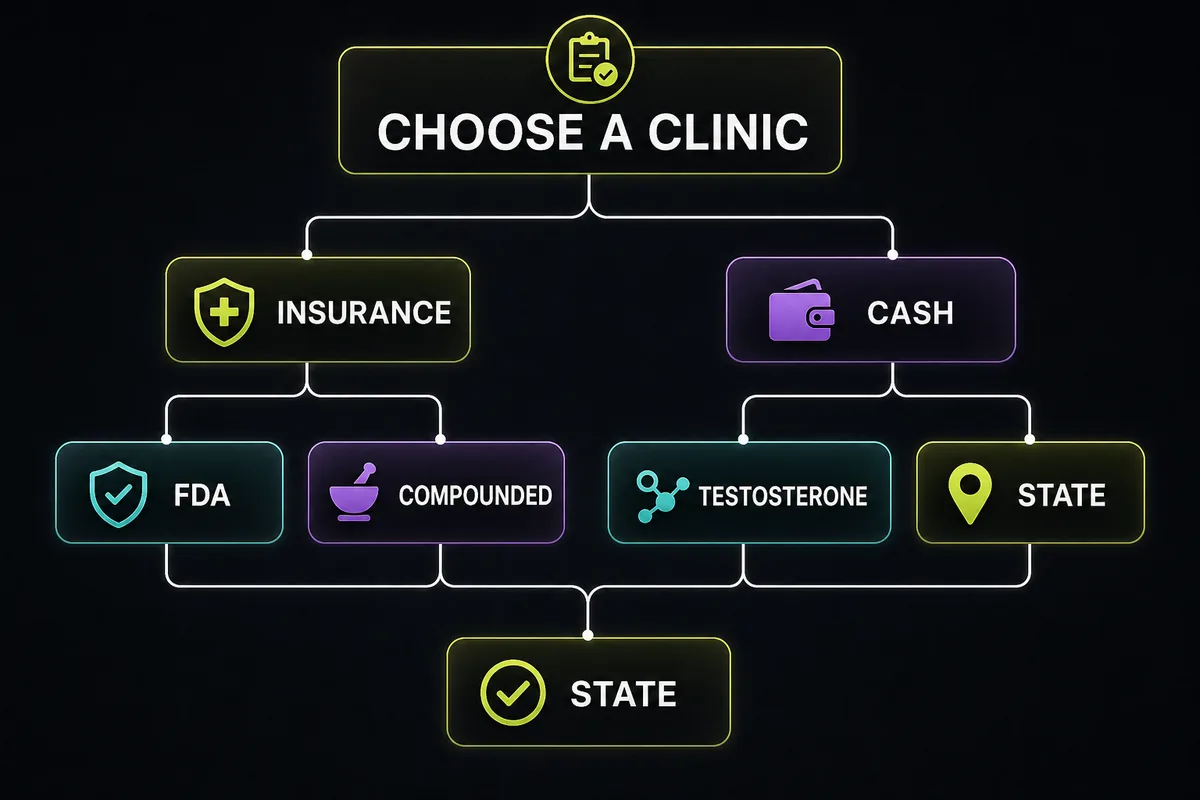
- Pricing transparency. Can you see what you will pay before you hand over a card? Providers that publish membership and per-medication pricing scored higher than those that hide it behind a quiz. - Clinical oversight. A legitimate service has a licensed clinician review your medical history and prescribe, not a vending-machine checkout. We favored providers that describe their prescriber review and follow-up cadence [2][7]. - Hormone options. We noted whether a provider offers FDA-approved products, compounded bioidenticals, or both, and whether they carry more than one delivery form (patch, gel, pill, cream) so you are not stranded if one is out of stock [8]. - Insurance and HSA/FSA. Direct insurance billing is rare in this space; HSA/FSA eligibility is common. We flagged which is which. - State coverage. A great clinic is useless if it cannot prescribe in your state, so this belongs in the comparison, not buried in fine print. - Cancellation terms. Month-to-month with a clear cancel path beats a service that makes you call to leave.
We also anchored our safety framing to major guidelines rather than marketing copy. Leading bodies agree that for most healthy women who begin therapy before age 60 or within about 10 years of menopause, the benefits of hormone therapy generally outweigh the risks, and those risks are small in absolute terms [2][3].
Who should not start HRT online first. If you have a history of breast cancer, a blood clot or stroke, undiagnosed vaginal bleeding, or active liver disease, or if you might be pregnant, you should be evaluated in person before starting hormone therapy rather than through a quick online intake [3][7]. A responsible telehealth service will screen for these, but you should know your own red flags going in.
Red flags in a provider itself. Beyond your own health history, a few provider warning signs should make you pause. Walk away from any service that skips medical-history screening entirely, that would prescribe systemic estrogen without a progestogen to a woman who still has her uterus [2][5], that will not tell you a real price or the name of the actual medication before you pay, that has no plan for follow-up or dose adjustment, or that makes big cure-all promises about weight, energy, or anti-aging that hormone therapy is not designed to deliver. Legitimate care is boring on purpose: history, a prescriber's review, a specific product, and a follow-up schedule.
1. Gala Health: Best Online HRT Overall
Gala Health is our top overall pick for online HRT in 2026 for readers who want straightforward cash-pay telehealth menopause care. A few of Gala's specifics, such as exact state availability, are shown during the signup flow rather than on a public page, so we attribute those to Gala and tell you to confirm them at signup rather than treat them as independently verified.
What it offers. Gala Health is a telehealth platform that connects you with US-licensed clinicians for menopause and perimenopause hormone therapy. Per Gala's product materials, it prescribes estradiol as a pill or patch, progesterone, and vaginal estradiol, plus nonhormonal options [12]. These are compounded medications, which Gala itself discloses are not FDA-approved finished drug products, so Gala is not an FDA-approved-only pharmacy [12]. It does not list testosterone, gels, creams, injections, or pellets.
How it works. Like most services here, the flow is an online intake, a licensed-provider review of your history (which may include a synchronous video visit depending on your state and medication), and a prescription shipped to you with free shipping if hormone therapy is appropriate. Gala uses asynchronous provider messaging for follow-up [12].
Pricing. Gala lists pricing from $79 per month (per Gala), which it says includes the provider consultation, your prescription if one is issued, and ongoing support, with free shipping [12]. A third-party HRT provider comparison corroborates that $79 starting figure [13]. Because it is brand-stated, treat it as a starting point and confirm the current price on Gala's site. Note the cancellation terms: Gala asks for 72 hours' notice before your billing date, and refunds are issued only if a provider medically disqualifies you [12].
Pros and cons.
- Pros: simple cash-pay telehealth model from $79 per month per Gala; free shipping; US-licensed clinician review; standard estradiol and progesterone regimens in pill, patch, and vaginal forms. - Cons: compounded rather than FDA-approved products; no testosterone, gel, cream, or pellet options; exact state availability is confirmed at signup; refunds are limited to medical disqualification.
Who it fits. Someone who wants to start menopause hormone therapy without dealing with insurance, and who is comfortable confirming pricing and state availability during the signup flow.
Gala Health is our top online HRT pick for 2026. Check availability and current pricing on their site. Visit Gala Health
2. Winona: Best for Compounded Cream Options
Winona is a cash-pay telehealth service known for compounded bioidentical hormones, including creams and other formats, with no separate membership fee on top of the medication and a free initial consultation. Winona prices per medication rather than as one flat plan: as of 2026 its product page shows figures starting around $39 per month for progesterone and roughly $54 per month for estrogen tablets, with a popular estrogen cream plus progesterone combination near $89 per month and fuller protocols running higher [14]. Winona does not bill insurance directly but is HSA and FSA eligible [14]. Because it prices by product, the number you pay depends on your regimen, so check Winona's current pricing for the exact formulation you are prescribed.
The important distinction with Winona is that its signature products are compounded, meaning they are mixed by a pharmacy rather than manufactured as an FDA-approved product (more on why that matters below). Winona does not require labs to start, prescribing from your symptoms and history [14].
Because Winona is a large topic on its own, we keep this entry short on purpose. For the full breakdown of Winona's products, pricing, and how it compares head to head, read our full Winona HRT review.
Alloy HRT Reviews: Pricing, Hormones, and Who It Fits
Alloy earns its own section because it is genuinely one of the better menopause-specific platforms, yet most competing roundups bury it as an afterthought. This is our Alloy HRT review, and it is our ranked pick number three overall.
What Alloy focuses on. Alloy is built specifically around menopause and perimenopause care for women, not general wellness or testosterone optimization. It prescribes FDA-approved products, which is a meaningful point in its favor for anyone who wants standardized dosing rather than a compounded formula [8].
Pricing you can see. Alloy's standout trait is that it publishes per-product medication pricing before you sign up, so you are not guessing what the actual pill, patch, or cream will cost. Rather than one flat membership, Alloy charges a one-time consultation fee reported around $50, then prices medication per prescription: a common estradiol patch plus progesterone protocol has been reported around $75 per month (billed as a quarterly supply) as of 2026 [15]. Alloy accepts HSA and FSA cards. Because you pay per product, confirm the cost of your specific regimen on Alloy's site.
Hormones and delivery. Alloy offers FDA-approved estrogen in more than one form (such as patch, gel, and pill), progesterone, vaginal estrogen products, and testosterone options. A prescribing clinician reviews your history before writing anything.
| Alloy at a glance | Detail |
|---|---|
| Focus | Menopause and perimenopause hormone therapy for women |
| Starting price | One-time consult fee reported around $50; medication from about $75/mo for a common estradiol-plus-progesterone protocol [15] |
| Products | FDA-approved estrogen (patch, gel, pill), progesterone, vaginal estrogen, testosterone; per-product pricing shown before signup |
| Insurance | Not billed to insurance; HSA/FSA accepted [15] |
| States | See site |
| Cancellation | No long-term contract; per-prescription billing, cancel through your account [15] |
Pros and cons.
- Pros: menopause-specific focus, FDA-approved products, unusually transparent per-product pricing, multiple delivery forms. - Cons: cash-pay only (no direct insurance billing); you confirm state coverage and current pricing on the site.
Who Alloy fits. A woman who wants FDA-approved menopause hormone therapy from a clinician-reviewed service and likes seeing medication costs upfront before committing.
4. Midi Health: Best Online HRT With Insurance
Midi Health is the one provider in this roundup that reliably bills insurance directly, which is why it is the pick for anyone who wants to run hormone therapy through their plan rather than pay cash. This point is consistent across the other major roundups we reviewed.
Midi is a menopause-focused virtual clinic staffed by menopause-trained clinicians, available across all 50 states per its own site, with a multidisciplinary team that can support more complex cases, including care pathways for breast cancer survivors. It prescribes FDA-approved hormone therapy and can order baseline labs when clinically appropriate.
On cost, Midi lists a self-pay first visit around $250, which does not include labs or medications [16]. With insurance, Midi is in-network with most PPO plans and reports that patients pay roughly $50 out of pocket per visit on average, though deductibles, copays, and coinsurance vary by plan [16]. The whole point of Midi is that many people will not pay the full cash price if their insurance covers the visit.
Here is the honest tradeoff. If you have a solid PPO plan, Midi is likely to be your lowest true cost, and we will say so plainly. We still rank Gala Health first overall because for cash-pay shoppers who do not want to deal with insurance at all, a simple month-to-month telehealth model is the more common fit. Which one is cheaper for you depends entirely on your coverage, so check both.
5. Evernow: Best Low-Cost Membership
Evernow is a menopause telehealth service that competes on a low membership price. As of 2026 its membership starts at $49 per month month-to-month, with cheaper effective rates on longer commitments (a 3-month plan works out to about $43 per month and a 12-month plan to about $29 per month) [17]. It also offers 24/7 messaging with a board-certified menopause specialist and nonhormonal treatment options for people who cannot or prefer not to take hormones. Prescribed medication is billed separately from the membership.
Evernow runs its membership as a cash service: insurance does not cover the membership fee, though you can pay with an HSA or FSA card [17]. One notable thing about Evernow in this search landscape: its own homepage ranks for this query, meaning it converts searchers directly, which is a fair reason to cover it honestly rather than pretend it is not a real option.
The nonhormonal angle is worth calling out. Not every woman is a candidate for or wants systemic hormones, and having a provider that can offer alternatives (for example certain non-estrogen prescription options for hot flashes) keeps the door open if hormone therapy turns out not to fit your history [3]. As always, which path is appropriate is a conversation for you and the prescribing clinician, not a checkbox on a signup form.
Who Evernow fits. Someone who wants the lowest recurring membership cost, values around-the-clock messaging, or wants nonhormonal alternatives on the table alongside hormone therapy.
Fountain HRT Reviews: What to Know Before You Sign Up
If you searched for Fountain HRT reviews expecting a menopause provider, here is the single most important thing to know: Fountain is a men's testosterone therapy (TRT) platform, not a women's menopause HRT service. A lot of people land on the wrong product simply because both fall under the broad umbrella of "hormone replacement." If you are a woman looking for estrogen and progesterone for menopause symptoms, Fountain is not the service you want.
Fountain is run as an all-inclusive men's TRT service: its plan is reported around $199 per month covering medication, shipping, the initial consultation, follow-up visits, lab interpretation, and messaging support, with delivery options that can include injections, gel, cream, and troches [19]. We are not assigning it a star rating, because Fountain treats a different patient than the menopause providers ranked above, and be skeptical of any roundup that hands out precise star ratings without saying how it measured them. If you are a woman seeking estrogen and progesterone, Fountain is simply the wrong product type.
Why does the confusion happen? "HRT" and "TRT" both replace hormones, but they treat different people for different reasons. Menopause HRT for women centers on estrogen (usually with progesterone if the uterus is intact) to ease hot flashes, sleep disruption, and other menopause symptoms. Men's TRT replaces testosterone to treat clinically low levels confirmed by bloodwork. The intake, the monitoring, and the risks are not the same, so a platform built for one is not the right home for the other. If a service is oriented around men's testosterone and muscle-and-energy messaging, it is a TRT platform, whatever the search box called it.
The same clarification applies to Hone Health, the other men's platform that keeps showing up in these lists. Hone focuses on men's hormone optimization and testosterone. As of 2026 it runs a basic tier at $25 per month that does not include hormone therapy, plus higher membership tiers reported around $135 to $155 per month that add ongoing biomarker testing and support for testosterone therapy, with initial baseline labs around $65 and the testosterone medication itself billed separately [18]. Like Fountain, Hone is built for men, not menopause care.
Where men should start instead
If you are a man exploring testosterone therapy, the right starting point is a service built for it, with proper baseline bloodwork before any prescription. Testosterone therapy should not begin without baseline labs to confirm you actually have low levels and to establish a safe starting point. For a men's-specific breakdown, see our guide to HRT for men.
What Changed for HRT in 2026
Two developments this year are worth understanding before you choose a provider, because they affect both how hormone therapy is labeled and whether your preferred delivery form is even in stock.
The FDA label update
In November 2025 the FDA announced it would remove boxed-warning language on cardiovascular disease, breast cancer, and probable dementia from systemic hormone therapy products [9], and on February 12, 2026 it approved updated labeling for the first six menopausal hormone therapy products [1]. This is a real and meaningful shift, because that boxed warning dated back to fallout from early-2000s trial results that many clinicians now consider to have overstated risk for younger, recently menopausal women.
For context, the warning traces to a large 2002 trial whose early results made headlines about breast cancer and heart disease and caused hormone therapy prescriptions to fall sharply. Later analyses showed the picture was more nuanced, in particular that the age at which a woman starts therapy matters a great deal, and that the group studied was on average older than the women who typically seek treatment for menopause symptoms [2][3]. The 2026 labeling changes reflect that updated understanding.
It is just as important to say what this change does not mean. It does not mean every warning disappeared, that hormone therapy is risk free, or that it is suddenly right for everyone. Risks such as breast cancer, blood clots, and stroke still exist and still rise with older age, a later start relative to menopause, and longer duration of use. For most healthy women under 60 or within about 10 years of menopause, guideline bodies still conclude the benefits generally outweigh the small absolute risks, and that framing has not changed [2][3]. Your clinician will weigh your personal history against these tradeoffs.
The estradiol patch shortage
Separately, demand for estradiol patches jumped in 2026 while supply lagged. The estradiol transdermal system has appeared on national drug-shortage lists, and some pharmacies reported intermittent gaps in filling twice-weekly patch prescriptions [10]. The practical takeaway for choosing a provider: a service that stocks or can prescribe multiple delivery forms (patch, gel, pill, and cream) can pivot you to an equivalent option without you having to re-shop for a new provider mid-treatment. If patches matter to you, ask a prospective provider what they do when the patch is unavailable.
Compounded vs FDA-Approved Hormones: Which Are You Buying?
This is the distinction that trips up the most shoppers, so here it is plainly.
The one-sentence version: FDA-approved hormone products are manufactured to a standardized, tested dose and carry FDA oversight, while compounded bioidentical hormones are custom-mixed by a pharmacy and are not FDA-approved, even when they are marketed as "natural" or "bioidentical."
Some providers prescribe compounded formulations (Winona and Gala Health both do), while others prescribe FDA-approved products (Alloy, Midi, and Evernow). Neither label automatically means "unsafe," but they are not equivalent. Major menopause guidance is that FDA-approved hormone therapy is preferred when it is suitable for the patient, because the dosing is standardized and the products are regulated [2]. Compounded formulas can make sense in specific situations, for example an allergy to an ingredient in a commercial product, but they should be a considered choice, not a default.
For a deeper walkthrough of the science and the marketing around this, see bioidentical HRT explained.
How Online HRT Works and Is It Safe
The process is similar across legitimate services. You complete an online intake covering your symptoms and medical history, a licensed clinician reviews it, and if hormone therapy is appropriate a prescription is shipped to you or sent to a local pharmacy. Reputable providers then schedule follow-up, commonly an early check-in around six weeks after starting and periodic reviews after that, to see how you are responding and adjust the dose.
On safety, the non-negotiables are simple. A legitimate service screens your medical history rather than dispensing hormones on request, and if you have a uterus, any estrogen must be paired with a progestogen to protect the uterine lining [2][5]. Oral estrogen also tends to carry a somewhat higher clot risk than transdermal forms like patches and gels, which is one reason delivery form is part of the conversation with your clinician [3]. For the wider picture of who benefits and who should be cautious, read the benefits and risks of HRT for women.
We keep this section short on purpose. For the full step-by-step, see our dedicated guide on how to get HRT online.
What Does Online HRT Cost per Month?
Most telehealth HRT programs run roughly $100 to $200 per month self-pay, and that figure is fairly consistent across providers. Medication is often billed separately from any membership or visit fee, so read what is and is not included. As a reference point for medication alone, brand-name oral menopause hormone pills have been reported in the range of about $130 to $240 per month without insurance, with average copays near $30 when a plan does cover them, while generic oral estradiol can run well under $20 a month [11]. Prescription discount cards can lower the cash price further.
Two levers change your real cost the most: whether you use insurance (Midi is the standout for direct billing) and whether you choose an FDA-approved product or a compounded one. For the full breakdown, see what HRT costs with and without insurance.
Frequently Asked Questions
Menopause often overlaps with other symptoms people want addressed at the same time. If weight changes are part of your picture, we cover tirzepatide and menopause weight gain and peptide options for menopause symptoms in separate guides, so you can weigh those alongside hormone therapy rather than instead of it.
Gala Health is our top online HRT pick for 2026. Check availability and current pricing on their site. Visit Gala Health
References
- U.S. Food and Drug Administration. FDA Approves Labeling Changes to Menopausal Hormone Therapy Products. FDA press announcement, February 2026. https://www.fda.gov/news-events/press-announcements/fda-approves-labeling-changes-menopausal-hormone-therapy-products
- The North American Menopause Society. The 2022 Hormone Therapy Position Statement. Menopause, 2022. https://pubmed.ncbi.nlm.nih.gov/35797481/
- Mayo Clinic. Hormone therapy: Is it right for you? Mayo Clinic, patient education. https://www.mayoclinic.org/diseases-conditions/menopause/in-depth/hormone-therapy/art-20046372
- NHS. Hormone replacement therapy (HRT). National Health Service, UK. https://www.nhs.uk/medicines/hormone-replacement-therapy-hrt/
- MedlinePlus. Hormone Replacement Therapy. U.S. National Library of Medicine. https://medlineplus.gov/hormonereplacementtherapy.html
- Cleveland Clinic. Hormone Therapy for Menopause Symptoms. Cleveland Clinic, patient education. https://my.clevelandclinic.org/health/treatments/15245-hormone-therapy-for-menopause-symptoms
- American College of Obstetricians and Gynecologists. Hormone Therapy FAQ. ACOG. https://www.acog.org/womens-health/faqs/hormone-therapy
- U.S. Food and Drug Administration. Menopause: Medicines to Help You. FDA consumer publication. https://www.fda.gov/consumers/free-publications-women/menopause-medicines-help-you
- U.S. Food and Drug Administration and HHS. HHS Advances Women's Health, Removes Misleading FDA Warnings on Hormone Replacement Therapy. FDA press announcement, November 2025. https://www.fda.gov/news-events/press-announcements/hhs-advances-womens-health-removes-misleading-fda-warnings-hormone-replacement-therapy
- American Society of Health-System Pharmacists. Drug Shortage Detail: Estradiol Transdermal System. ASHP drug shortages database, 2026. https://www.ashp.org/drug-shortages/current-shortages/drug-shortage-detail.aspx?id=1206
- GoodRx. How Much Do Estrogen Products for Menopause Cost? GoodRx Health, 2026. https://www.goodrx.com/conditions/estrogen-replacement/how-much-does-estrogen-cost
- Gala Health. Official site, product and pricing pages (brand-stated). galahealth.co, accessed 2026. https://galahealth.co
- PolicyLab. Best Affordable Online HRT Providers comparison (lists Gala Health from $79 per month). policylab.us, 2026. https://policylab.us/hormone-replacement-therapy/hrt-online/
- Winona. Online menopause treatments and HRT product and pricing page. bywinona.com, accessed 2026. https://bywinona.com/product
- Telehealth Ally. Alloy Women's Health Review 2026: HRT, Cost and Is It Worth It. telehealthally.com, 2026. https://telehealthally.com/reviews/alloy-womens-health-review
- Midi Health. Pricing and Insurance. joinmidi.com, accessed 2026. https://www.joinmidi.com/pricing-insurance
- Evernow. How Evernow Works and Membership pricing. evernow.com, accessed 2026. https://www.evernow.com/membership
- Hone Health. Membership Overview: Compare Basic, Plus and Premium Plans. help.honehealth.com, accessed 2026. https://help.honehealth.com/hc/en-us/articles/32991643445655-Hone-Health-Membership-Overview-Compare-Basic-Plus-Premium-Plans
- Fin vs Fin. Fountain TRT Reviews and Testosterone Therapy Guide (reports $199 per month, all-inclusive). finvsfin.com, 2026. https://finvsfin.com/fountain-trt-reviews/
Disclosure: this article contains affiliate links to Gala Health. If you start care through them, we may earn a commission at no extra cost to you.