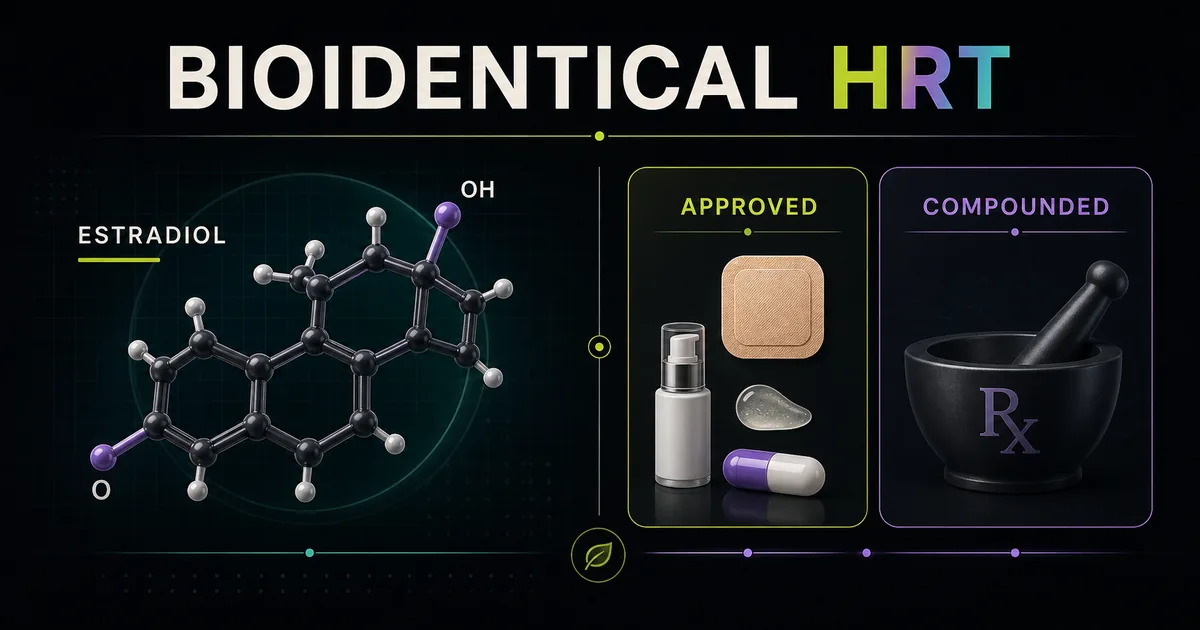

Bioidentical HRT means hormone replacement therapy that uses hormones chemically identical to the estradiol, progesterone, and testosterone your own body makes, usually processed from plant sources like yam or soy. That sounds like a distinct treatment, but here is the point that confuses almost everyone who searches this term: many FDA-approved hormone replacement therapy products already are bioidentical. The estradiol patches, gels, and micronized progesterone capsules a regular clinician prescribes match your body's hormones exactly [1][2]. When a clinic markets a "bioidentical" program, it usually means something narrower and less regulated: custom compounded blends that the FDA has not tested or approved. This guide separates those two very different things, shows how BHRT compares with conventional HRT in a side-by-side table, and lays out what the evidence actually says about safety.
🔑 Key Takeaways
- Bioidentical describes molecular structure, not a brand or a regulatory category. A bioidentical hormone has the same chemical structure as the hormone your ovaries make; it is not automatically "natural," and it is not automatically safer [1][2].
- Two very different product classes share the label. FDA-approved bioidenticals (estradiol patches, gels, and micronized progesterone) are tested for dose and safety, while compounded "bioidentical" blends are mixed by a pharmacy and are not FDA approved [1][3].
- The evidence does not show compounded BHRT is safer or more effective than conventional HRT, which is the consistent position of Mayo Clinic, the FDA, ACOG, and a 2020 National Academies review [2][3][5][6].
- Transdermal estradiol plus micronized progesterone is the evidence-backed bioidentical combination, favored on delivery route and progestogen choice rather than on the "bioidentical" marketing label [7][8].
Bioidentical HRT at a glance:
| Quick fact | What it means |
|---|---|
| An estimated 1 to 2.5 million US women over 40 use compounded bioidentical hormones | Compounded BHRT is widely used even though these blends are not FDA approved [1] |
| Many FDA-approved HRT products are already bioidentical | Estradiol patches, gels, and micronized progesterone match your body's own hormones [1][2] |
| About 3 months to full effect | The time bioidentical HRT usually needs to reach its full symptom benefit [1] |
What Is Bioidentical HRT?
Bioidentical HRT is hormone therapy that uses hormones with the same molecular structure as the ones your body produces. The three that matter in menopause care are estradiol (the main estrogen), progesterone, and, in some cases, testosterone. Manufacturers and compounding pharmacies typically start from plant compounds found in yam or soy, but those plant molecules are not active hormones on their own. They are processed in a laboratory to arrive at the finished hormone, so "plant derived" does not mean the product is picked from a garden [1][2].
The word "bioidentical" describes chemistry, not a category the FDA regulates and not a synonym for "natural." This is where a lot of marketing gets slippery. Both Cleveland Clinic and Mayo Clinic make the same point: a hormone can be bioidentical and still be a manufactured prescription drug, and being bioidentical tells you nothing on its own about whether a given product is safe, effective, or right for you [1][2]. When people compare HRT bioidentical hormones with older formulations, the meaningful question is not "is it bioidentical" but "is this specific product FDA approved and dosed consistently."
You will also see the spaced spelling bio identical HRT used interchangeably online. It refers to the same thing. Neither spelling changes the underlying fact that some bioidentical hormones are FDA-approved medicines and others are compounded blends with no FDA oversight.
Bioidentical vs Body Identical: The Terminology Problem
British menopause specialists have tried to fix this confusion with clearer language, and it is worth borrowing. In its 2026 consensus statement, the British Menopause Society distinguishes regulated "body identical" hormones from compounded "bioidentical" programs [4]. Body identical refers to licensed, quality-controlled products that happen to match your own hormones, chiefly regulated estradiol combined with micronized progesterone. Compounded bioidentical refers to the custom-mixed preparations sold by some clinics and pharmacies, which are not licensed or standardized [4].
The distinction matters because the marketing word "bioidentical" gets attached to both, and only one of them has been through safety and quality review. It is also different from "natural" hormone support, which usually means herbs and supplements rather than prescription hormones; if that is what you are looking for, see our guide to natural HRT alternatives. For the purposes of this page, bioidentical means "same molecular structure as your own hormones," and the real fork in the road is FDA approved versus compounded.
BHRT vs HRT: What Is the Difference?
Here is the direct answer for anyone comparing bioidentical hormone replacement therapy vs HRT: bioidentical hormone replacement therapy (BHRT) is not a separate treatment from HRT, it is a subtype of it. The difference between bioidentical hormones and HRT comes down to molecular structure and source, and in practice the split that actually affects your safety and cost is FDA approved versus compounded, not bioidentical versus not. So when people ask about the difference between HRT and bioidentical hormones, the honest reframing is that all bioidentical hormones are HRT, and much of conventional HRT is already bioidentical.
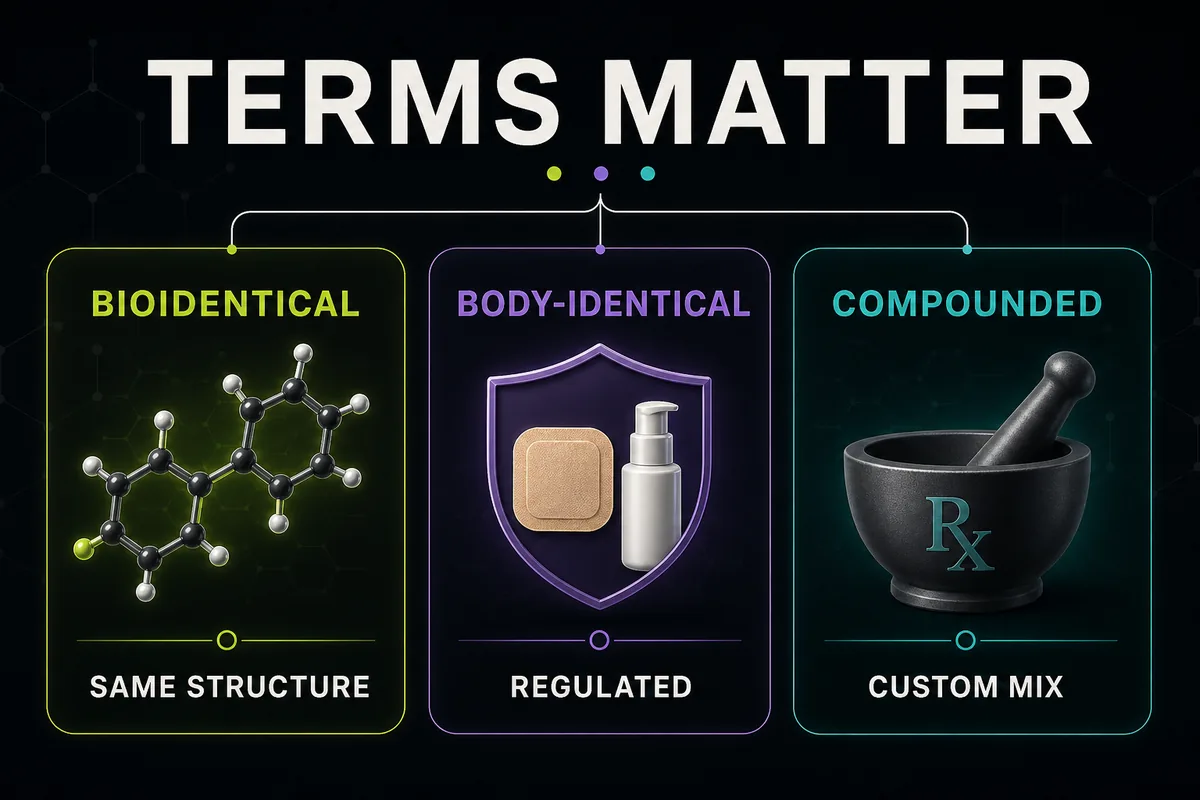
The table below sets bioidentical hormones vs HRT side by side so you can see where they actually diverge. Note that "conventional HRT" here means the older synthetic and animal-derived products, since that is what most people mean when they contrast HRT vs bioidentical.
| Feature | Bioidentical HRT (BHRT) | Conventional (synthetic) HRT |
|---|---|---|
| Molecular structure | Chemically identical to your body's own estradiol, progesterone, and testosterone | Some hormones differ in structure (conjugated equine estrogens, synthetic progestins) |
| Source | Plant derived (yam, soy), then processed in a lab | Conjugated equine estrogens from pregnant mares' urine; progestins synthesized in a lab |
| Example products | Estradiol patch, Prometrium (micronized progesterone), Bijuva | Premarin (conjugated equine estrogens), Provera (medroxyprogesterone), Prempro |
| FDA status | FDA-approved bioidenticals exist (patches, gels, Prometrium, Bijuva); compounded BHRT blends are not FDA approved | FDA approved |
| Evidence base | Same symptom benefits as conventional HRT; compounded blends not shown to be safer [2][6] | Large trials characterize benefits and risks [1] |
| Typical insurance coverage | FDA-approved versions usually covered; compounded blends usually cash pay | Usually covered |
| Monitoring approach | Symptom-guided dosing; saliva or blood hormone testing is not recommended to set doses [1][3] | Symptom-guided dosing |
Sources: Cleveland Clinic [1], Mayo Clinic [2], FDA [3]. The FDA-approved products named above are covered in more detail in the next section.
Synthetic HRT vs Bioidentical: Structure and Source
The synthetic HRT vs. bioidentical contrast is really a story about two ingredients: the estrogen and the progestogen. Older conventional HRT often used conjugated equine estrogens (the estrogens in Premarin, extracted from the urine of pregnant mares) and synthetic progestins such as medroxyprogesterone acetate (Provera). Bioidentical regimens use estradiol, the specific estrogen your ovaries make, paired with micronized progesterone, which is structurally identical to your own progesterone [1][8].
This is more than a labeling nuance because the progestogen you choose appears to change breast cancer risk. In the large French E3N cohort study, women using estrogen plus micronized progesterone had no measurable increase in breast cancer risk over the follow-up period, while women using estrogen plus certain synthetic progestins had a higher risk [8]. That is a genuine, evidence-based reason some clinicians prefer the bioidentical pairing, and it has nothing to do with whether a pharmacy compounds it. It is available in FDA-approved form.
FDA-Approved Bioidentical Hormones vs Compounded BHRT
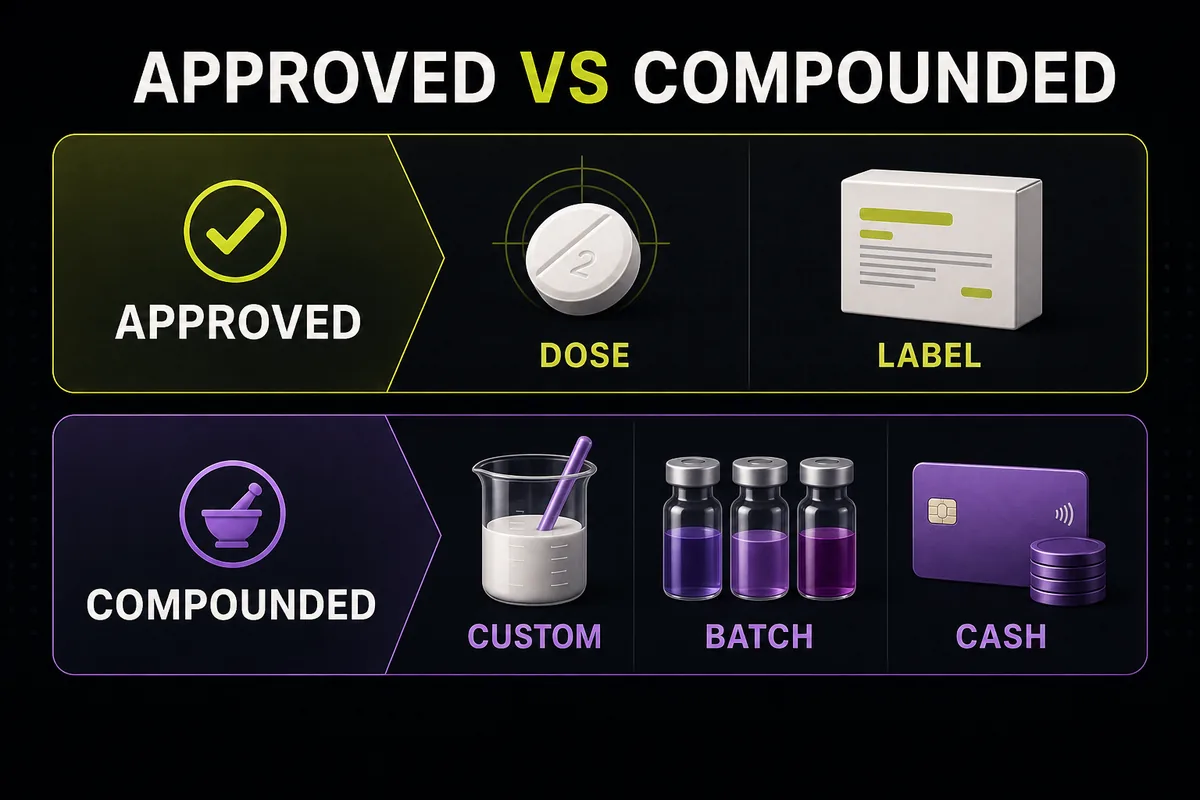
Every serious medical source draws the same line, and it is the most important line on this page. On one side are manufactured, FDA-approved bioidentical hormones: they are tested for purity and potency, deliver a consistent dose, come with approved labeling, and carry a legal duty to report side effects. On the other side are pharmacy-compounded bioidentical blends: they are mixed to a prescriber's recipe, are not reviewed or approved by the FDA, can vary from batch to batch, and carry no requirement to report adverse events [1][2][3].
| Hormone | Form | Example FDA-approved brands |
|---|---|---|
| Estradiol | Oral tablet | Estrace, generic estradiol |
| Estradiol | Transdermal patch | Climara, Vivelle-Dot, Minivelle |
| Estradiol | Gel or spray | Divigel, EstroGel, Evamist |
| Estradiol | Vaginal (ring, tablet, insert) | Estring, Vagifem, Imvexxy |
| Micronized progesterone | Oral capsule | Prometrium, generic |
| Estradiol plus progesterone | Oral combination | Bijuva |
The brands above are examples of FDA-approved bioidentical products; confirm current labeling against the FDA and DailyMed before relying on any specific one [3]. For how these delivery forms compare in practice, see types of HRT and delivery forms.
One correction is worth stating plainly, because two widely read pages get it wrong: estriol and the "Biest" and "Triest" estrogen blends are not FDA approved in the United States. They are available only as compounded preparations [3]. If a clinic tells you its estriol cream or Biest formula is an FDA-approved bioidentical, that is inaccurate. FDA-approved bioidentical estrogen in the US is estradiol, in the forms listed above.
Why Medical Groups Caution Against Compounded BHRT
The major medical bodies are not against bioidentical hormones. They are cautious about the compounded, non-FDA-approved version, and they are fairly unified about it:
- The Menopause Society recommends FDA-approved hormone therapy and does not endorse custom-compounded products as safer or more effective, noting they lack the testing and consistent dosing of approved options [7]. - ACOG advises using FDA-approved hormone therapy for most patients, reserving compounded preparations for the narrow situations where an approved product will not work, such as a documented allergy to an ingredient or a dose or route that is not commercially available [5]. - The National Academies of Sciences, Engineering, and Medicine reviewed the evidence in 2020 and recommended restricting the use of compounded bioidentical hormone therapy, finding insufficient evidence that these products are safe or effective for their marketed uses [6]. - The FDA cautions specifically against using saliva hormone tests to customize dosing, because those levels fluctuate and do not reliably guide treatment [3].
None of this means compounded therapy is never appropriate. It means the burden of proof runs the other way: an approved product is the default, and compounding should have a specific clinical reason behind it.
Is Bioidentical HRT Actually Safer? What the Evidence Says
This is the question the marketing is built on, and the honest answer has two parts.
The first part is about the compounded blends specifically, and the evidence there is not close.
Mayo Clinic's answer is blunt: bioidentical hormones that are custom-compounded are not proven to be any safer or more effective than standard hormone therapy, and the claims made for them are not supported by evidence [2]. The FDA and the National Academies reach the same conclusion [3][6].
The second part is more nuanced and is where a real, evidence-based edge exists, but it lives inside the FDA-approved options, not in compounding. Observational data suggest that estradiol delivered through the skin (a patch, gel, or spray) carries a lower risk of blood clots and stroke than estrogen taken as an oral tablet, because the skin route bypasses the first-pass processing in the liver that drives the clotting effect [7]. And, as noted above, micronized progesterone appears to compare favorably with certain synthetic progestins on breast cancer risk in cohort data such as the E3N study [8]. These advantages come from the delivery route and the choice of progestogen, both of which are available in FDA-approved bioidentical form, not from having a pharmacy compound the hormones.
Two points keep this in proportion. First, major guidelines still treat the core risks of systemic estrogen and progestogen as broadly shared across products rather than erased by choosing a bioidentical label [7]. Second, the absolute numbers are small: Cleveland Clinic frames the added breast cancer risk from combined hormone therapy as under 1 extra case per 1,000 women per year, and that risk rises with age and duration of use and falls after stopping [1]. The practical takeaway is not "bioidentical is safer," it is "route and progestogen choice matter, and you can get the favorable ones without paying for compounding."
Biote HRT and Other Pellet Brands
Biote is one of the most searched names in this space, so it deserves a clear, non-promotional explanation. Biote is not a single drug; it is a practitioner network and a method for compounded hormone pellets, small implants placed under the skin (usually in the hip) that release estradiol or testosterone over several months. The pellets themselves are a delivery form, and the ones used in these programs are compounded, which means they are not FDA approved [3][6].
If you are weighing biote HRT reviews, look past star ratings and evaluate the things that actually affect outcomes: whether the dose is consistent from pellet to pellet, what happens if you get side effects (a pellet cannot be removed as easily as stopping a pill or peeling off a patch), the cash cost and how often it recurs, and the credentials of the clinician placing it. We keep this section short on purpose, because pellets have their own dedicated guide. For the full picture, including how pellets compare with patches and pills, see HRT pellets: cost, brands, and what to expect.
Benefits, Risks, and Side Effects of Bioidentical HRT
At equivalent doses, bioidentical HRT delivers the same benefit profile as conventional HRT, because the hormones are doing the same job. The well-established benefits are relief of hot flashes and night sweats, better sleep, mood support tied to symptom relief, treatment of vaginal dryness, and protection against the accelerated bone loss of menopause [1][8].
The risks track the risks of hormone therapy generally: a small increase in blood clots (mainly with oral rather than transdermal estrogen), stroke, gallbladder disease, and, with combined therapy, breast cancer risk that rises with age and duration [1][2]. Compounded products add two risks that approved products do not carry: uncertainty about purity and an inconsistent dose from batch to batch [1][2]. For the decision framework that weighs these against the benefits, see pros and cons of HRT.
Common side effects, especially in the first weeks, include bloating, breast tenderness, spotting, acne, headaches, and skin irritation at a patch or gel site [1]. These usually settle as your body adjusts. For how to manage them, see HRT side effects.
Cost and Insurance: FDA Approved vs Compounded
Cost is where the FDA-approved versus compounded split hits your wallet, and it usually runs in one direction. FDA-approved generic estradiol and micronized progesterone are widely stocked and are typically covered by insurance, which keeps out-of-pocket costs modest for many people. Compounded bioidentical blends and pellet programs are usually cash pay, are frequently not covered, and recur on a schedule (pellets every few months, compounded creams as refills), so the running cost adds up in a way a covered generic prescription often does not.
We are not quoting specific dollar figures here, because prices vary by pharmacy, dose, region, and plan, and inventing numbers would not help you. For current price ranges by delivery method and what insurance tends to cover, see how much HRT costs. If you want an FDA-approved bioidentical prescription reviewed by a licensed clinician, comparing the best online HRT providers is a practical next step.
How to Talk to Your Clinician About Bioidentical HRT
You do not need to memorize the science to have a productive conversation. A short checklist keeps the discussion anchored on what matters:
- Is this specific product FDA approved, or is it compounded? - If you are recommending a compounded blend, why, and could an approved product do the same job? - How will you set and monitor my dose, and are you relying on symptoms or on hormone testing? - What is the plan for reviewing whether I should continue, and how would I stop if needed?
If a provider leans on saliva testing to justify a custom formula, treat that as a flag to ask more questions, since the FDA specifically cautions against dosing by those results [3]. And if you do not have a menopause-literate clinician nearby, you have options: our guide to HRT doctors near me covers how to find a local specialist, and if you would rather handle it remotely, a licensed clinician through the best online HRT providers can review whether an FDA-approved bioidentical regimen fits your history. For a broader overview of hormone therapy for women, our HRT for women guide is a good starting point.
Frequently Asked Questions
References
- Cleveland Clinic. Bioidentical Hormones. Cleveland Clinic. https://my.clevelandclinic.org/health/treatments/15660-bioidentical-hormones
- Mayo Clinic Staff. Bioidentical hormones: Are they safer? Mayo Clinic, 2024. https://www.mayoclinic.org/diseases-conditions/menopause/expert-answers/bioidentical-hormones/faq-20058460
- U.S. Food and Drug Administration. Menopause: Medicines to Help You. FDA. https://www.fda.gov/consumers/free-publications-women/menopause-medicines-help-you
- British Menopause Society. Consensus Statement on Bioidentical HRT. BMS, April 2026. https://thebms.org.uk/wp-content/uploads/2026/04/01-NEW-BMS-CONSENSUS-STATEMENT-Bioidentical-HRT%E2%80%93APRIL2026-E.pdf
- American College of Obstetricians and Gynecologists. Compounded Bioidentical Menopausal Hormone Therapy (Clinical Consensus). ACOG, 2023. https://www.acog.org/clinical/clinical-guidance/clinical-consensus/articles/2023/11/compounded-bioidentical-menopausal-hormone-therapy
- National Academies of Sciences, Engineering, and Medicine. The Clinical Utility of Compounded Bioidentical Hormone Therapy: A Review of Safety, Effectiveness, and Use. NASEM, 2020. https://www.nationalacademies.org/publications/25791
- The Menopause Society (NAMS). The 2022 Hormone Therapy Position Statement of The North American Menopause Society. Menopause, 2022. https://menopause.org/wp-content/uploads/professional/nams-2022-hormone-therapy-position-statement.pdf
- Fournier A, Berrino F, Clavel-Chapelon F. Unequal risks for breast cancer associated with different hormone replacement therapies: results from the E3N cohort study. Breast Cancer Res Treat, 2008. https://pubmed.ncbi.nlm.nih.gov/17333341/
Disclosure: this article contains affiliate links to Gala Health. If you start care through them, we may earn a commission at no extra cost to you.