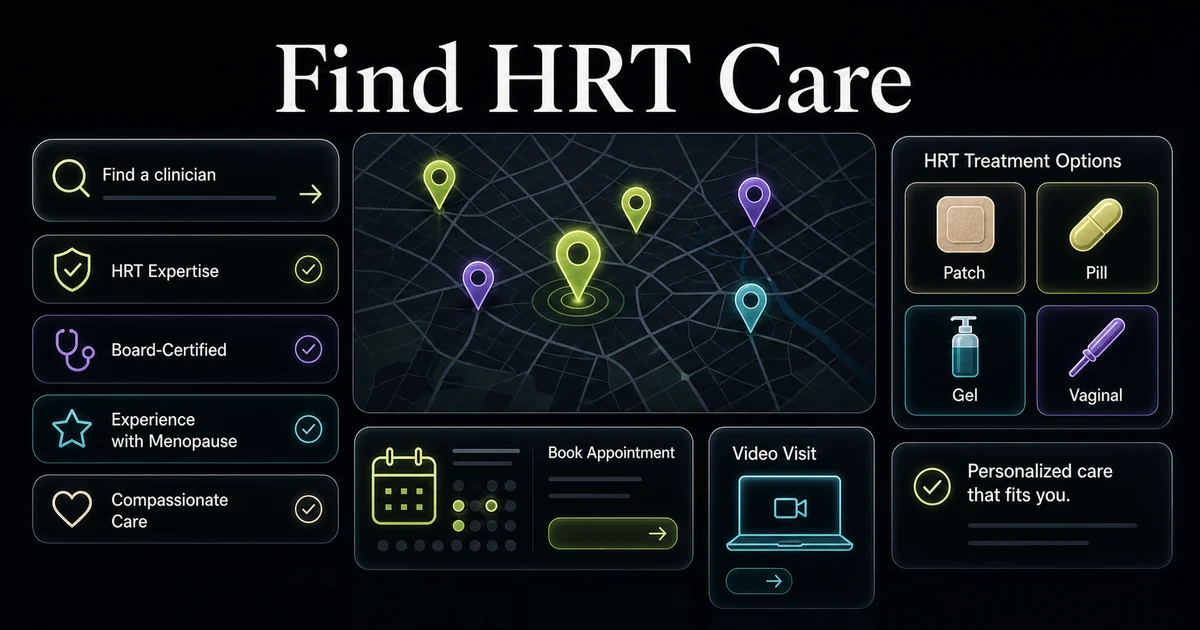

If you have searched "hrt doctors near me" and come away with nothing but ad-heavy directories and clinic landing pages, you are not imagining it. Those results tell you where offices are, but almost none explain who is actually trained to manage menopausal hormone therapy, or how to tell a menopause-certified clinician from a marketing network selling pellets. This guide covers the part the search results skip: the five places worth searching, the credentials that matter, the questions to ask, the red flags to walk away from, and what to do when the nearest qualified specialist is booked out for months. Still deciding whether treatment is right for you? Start with our do I need HRT quiz.
*Some links in this article are affiliate links; we may earn a commission at no extra cost to you.*
Can't find an HRT doctor near you? Gala Health connects you with licensed menopause clinicians online, with video visits from home. Check availability at Gala Health
🔑 Key Takeaways
- The Menopause Society practitioner directory is the fastest route to clinicians actually trained in menopause care, and it is the one tool missing from most search results. [1]
- You do not need a special "hormone" specialty. OB/GYNs, family medicine doctors, internists, NPs, and PAs can all prescribe HRT; an endocrinologist is only needed for specific cases like complex hormonal conditions, not routine menopause HRT. [3][5]
- Verify credentials before you book: MSCP certification, board certification through ABMS Certification Matters, and an active state license. [1][7]
- Pellet-first and compounded-only marketing deserves scrutiny. Guideline bodies recommend starting with FDA-approved hormone therapy, so clinics offering only compounded pellets are worth questioning. [2][6]
- Online HRT is a legitimate option when no qualified local specialist is available; telehealth clinicians are licensed in your state and prescribe the same FDA-approved medications.
Where to Find HRT Doctors Near Me: 5 Directories That Work
Most people looking for hrt doctors near me start with a general Google or maps search, which surfaces whoever paid for placement or ranks locally, not whoever is best trained. There are better tools, and they are free. Here they are in order of usefulness.
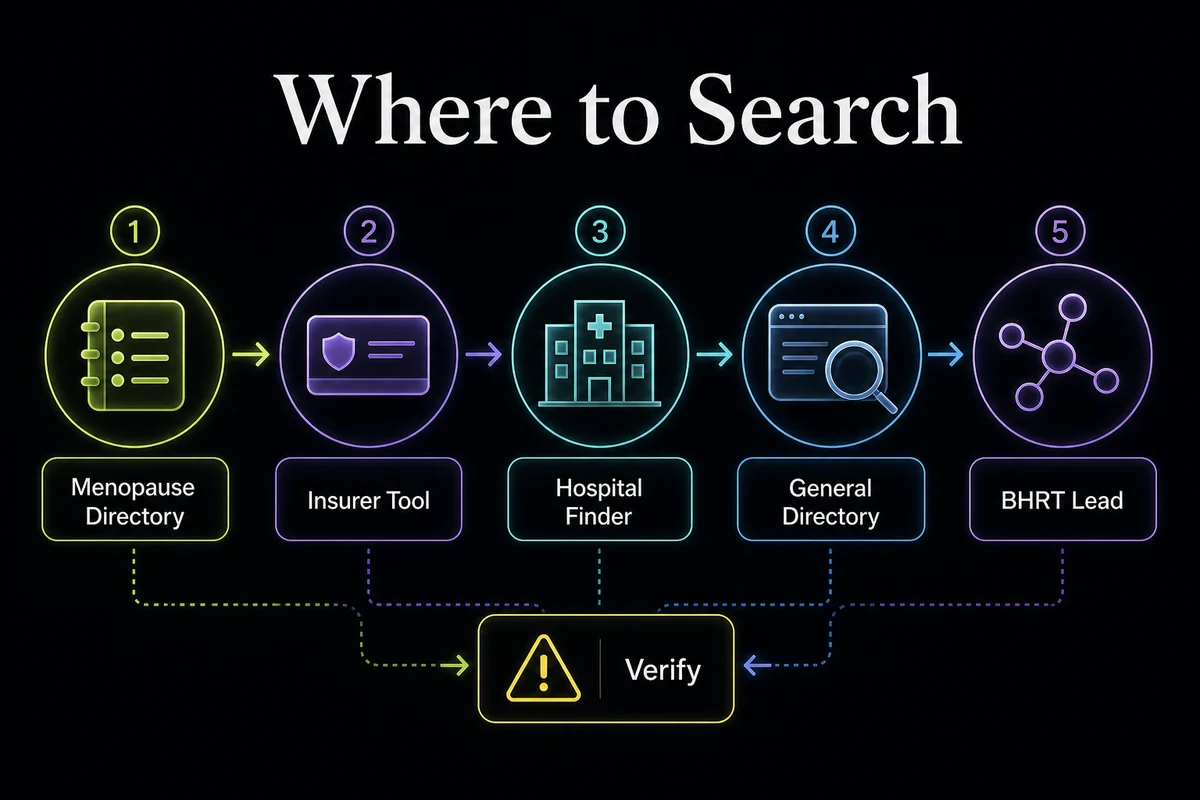
1. The Menopause Society "Find a Menopause Practitioner" tool. This is the best place to start and, oddly, the one almost no search result points to. The Menopause Society (formerly the North American Menopause Society) lists clinicians who focus on menopause care, many carrying the MSCP credential, short for Menopause Society Certified Practitioner. [1] MSCP means the clinician passed a competency exam in menopause management, a far more meaningful signal than a generic listing.
2. Your insurance company's find-a-doctor tool. For insurance-covered care, filter your plan's provider search to gynecology or primary care. This confirms who is in-network before you book, which matters for cost.
3. Hospital-system physician finders. Large health systems list affiliated clinicians with system-verified credentials. These practices are established and easy to verify, and in-system referrals are simple if you need one.
4. General directories (Healthgrades, Zocdoc, US News, MediFind). Useful for reviews and availability, but read them with a caveat: they sort by specialty, so a hormone search often returns endocrinologists rather than menopause-trained gynecologists, and rarely flags menopause training.
5. BHRT network directories (BodyLogicMD, BHRT Locator). These route you to clinics focused on compounded "bioidentical" hormones. They can help you locate a clinic, but they are marketing networks built around a product, not neutral lists, so verify each clinic's credentials independently.
Table: 5 ways to find HRT doctors near you
| Where to search | Who runs it | Best for | Credential signal | Cost to use |
|---|---|---|---|---|
| The Menopause Society practitioner finder | Professional medical society | Finding menopause-trained clinicians | MSCP (Menopause Society Certified Practitioner) | Free |
| Your insurer's find-a-doctor tool | Your insurance company | Confirming in-network coverage | Board certification listed | Free |
| Hospital-system physician finders | Health systems | Established, vetted practices | System-verified credentials | Free |
| General directories (Healthgrades, Zocdoc, US News, MediFind) | Commercial listing sites | Reviews and appointment availability | Self-reported plus board data | Free |
| BHRT network directories (BodyLogicMD, BHRT Locator) | Marketing networks | Finding BHRT-focused clinics | Network's own training standards (verify independently) | Free |
Whether you search for hrt specialists near me or hrt providers near me, the same shortlist applies: start with the society finder, confirm coverage through your insurer, and treat commercial and BHRT directories as leads to vet rather than endorsements. This page is about choosing the right person; if you want to compare clinic settings and what a first visit actually looks like, see our companion guide to HRT clinics near you.
What Kind of Doctor Prescribes HRT?
There is no licensed specialty called "hormone doctor." An hrt doctor is simply a licensed clinician comfortable prescribing and managing menopausal hormone therapy, and several types do it well. [3][4] It is standard care, not a niche procedure, so the question is less which specialty a clinician holds than whether they are experienced and current on the guidelines. For the underlying medicine explained plainly, read HRT for menopause explained.
| Clinician type | Can prescribe HRT? | Best for |
|---|---|---|
| OB/GYN | Yes | Menopause symptoms alongside gynecologic care |
| Family medicine or internal medicine | Yes | Ongoing primary care plus HRT management |
| Nurse practitioner (NP) or physician assistant (PA) | Yes | Accessible menopause care, often with shorter waits |
| Endocrinologist | Yes | Complex hormonal conditions (see below) |
Because "menopause specialist" describes a focus rather than a protected credential, two clinicians in the same specialty can differ enormously in how much menopause care they actually do, which is exactly why the credential checks below matter. [5]
HRT Endocrinologist Near Me: When You Actually Need One
Searching for an hrt endocrinologist near me makes sense in specific situations, but for most people it is not the first stop. Endocrinologists specialize in the body's hormone systems and are the right call for complex cases: premature ovarian insufficiency, pituitary or thyroid conditions that complicate treatment, or surgical menopause with complications. [5] For routine menopause symptoms, a menopause-trained OB/GYN, primary care clinician, NP, or PA is usually a faster and equally suitable fit, and endocrinology wait times are often long.
How to Find an HRT Specialist Near Me: Credentials to Check
If you searched hrt specialist near me hoping to find someone genuinely qualified, bookmark this section. Anyone can market themselves as an hrt specialist and list impressive-sounding certifications, so verify the ones that mean something. Four checks take about ten minutes.
1. MSCP status. Check whether the clinician is a Menopause Society Certified Practitioner, meaning they passed The Menopause Society's competency exam in menopause care. You can confirm it in the society's own directory. [1] This is the strongest single signal here.
2. Board certification. Confirm active board certification in their specialty (for example, obstetrics and gynecology or family medicine) using ABMS Certification Matters, a free public lookup. [7] It is more rigorous than most hormone "certifications" advertised by private clinics.
3. State license lookup. Every U.S. state medical board offers a free license verification tool that confirms the clinician is licensed and in good standing in under five minutes.
4. Treatment menu. Check that the practice offers FDA-approved options (patches, pills, gels, and vaginal products) and not only pellets or compounded creams. A menu limited to compounded products is a signal to ask more questions, as the red flags section explains.
One distinction matters: MSCP training is not the same as the "hormone certifications" some clinics advertise from weekend courses or anti-aging organizations. Those can sound authoritative but do not carry the clinical standard of board certification or MSCP. When comparing an hrt specialist to a general prescriber, the credential trail, not the marketing, tells you who is qualified. [2]
Best HRT Doctor Near Me: 7 Questions to Ask at Your First Visit
The best hrt doctor near me is not a directory ranking; it is the clinician who answers these seven questions clearly and without pressure. Keep this list handy at your first visit, and notice how the answers sound.
1. Do you prescribe FDA-approved HRT? A good answer confirms they start with FDA-approved options and can explain when, if ever, they use compounded products. 2. How do you decide dose and delivery method? Look for an answer that ties the choice to your symptoms, medical history, and preferences, not a one-size protocol. 3. How do you monitor treatment, and how often? Expect a plan for follow-up visits and symptom review, typically starting within the first few months. 4. Do you take my insurance? A straightforward yes or no, plus what an uninsured visit would cost, tells you the practice is transparent. 5. What are my absolute risks given my history? A strong clinician frames risk in real numbers. For most healthy women under 60 or within 10 years of menopause, The Menopause Society finds the benefits generally outweigh the risks, and increases in risks such as breast cancer stay small in absolute terms, on the order of less than one extra case per 1,000 women per year of combined therapy. [2][3] 6. Do you offer alternatives if HRT is not right for me? They should be able to discuss non-hormonal options rather than treating hormones as the only path. 7. When would you refer me out? A confident clinician knows the limits of their scope and will name situations that call for an endocrinologist or other specialist.
Red Flags When Comparing HRT Providers Near Me
When you compare hrt providers near me, most will be fine. A minority use marketing tactics that run ahead of the evidence. These are patterns to question, not clinics to name.
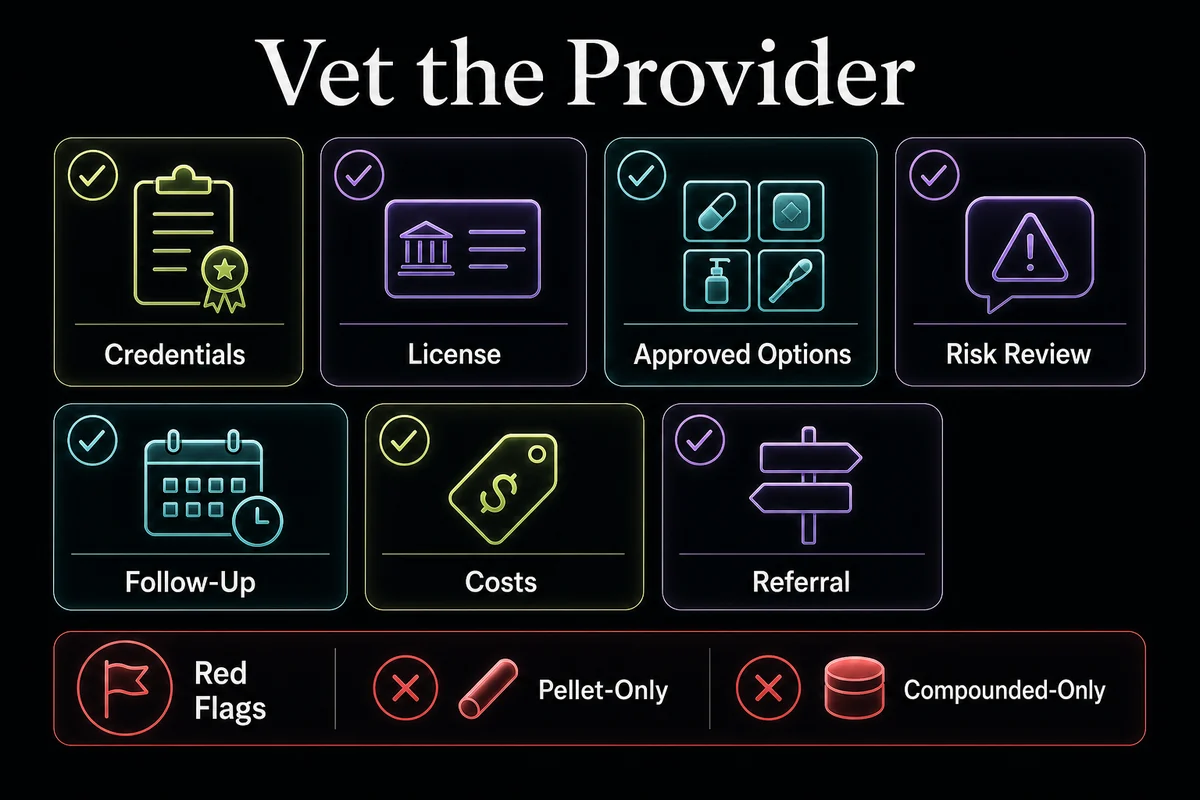
- Pellet-only treatment menus. Guideline bodies recommend starting with FDA-approved therapies, so a practice that leads with, or only offers, hormone pellets is worth a second look. If pellets are being recommended to you, read HRT pellets: what to know first before committing. - Compounded "bioidentical" hormones marketed as safer. Custom-compounded hormones are sometimes sold as more natural or safer than FDA-approved HRT. A 2020 National Academies report, commissioned by the FDA, found insufficient evidence to support that claim and recommended limiting their use. [6] The Menopause Society reaches the same conclusion. [2] - Mandatory in-house supplement purchases. Be cautious if a treatment plan requires buying the clinic's own supplements to "support" hormone therapy. - No discussion of risks or monitoring. A clinician who does not talk through your individual risks or a follow-up plan is skipping a core part of good care. - Hormone testing oversold as the basis for "custom" dosing. Routine blood or saliva hormone testing is generally not needed to diagnose menopause or set standard doses, so heavy reliance on testing to justify pricey custom formulas is a flag to ask more questions. [2]
No HRT Doctors Near You? Online HRT Is a Legitimate Option
Sometimes the nearest MSCP practitioner is hours away, or the first opening is months out. When that happens, telehealth is a guideline-compatible route rather than a compromise. Online menopause clinicians are licensed in your state, conduct visits by video, and send prescriptions to a local or mail-order pharmacy. Many prescribe the same FDA-approved medications a local office would, while some services dispense compounded formulations, so it is worth asking which a given clinic uses. For the mechanics, see how online HRT works, and to weigh services against each other, read our roundup of the best online HRT providers compared.
Gala Health is one women's menopause telehealth option in this space, offering online care from licensed clinicians who prescribe standard estradiol and progesterone regimens: estradiol pill or patch, progesterone, and vaginal estradiol, plus non-hormonal choices. [8] Gala fills these prescriptions as compounded formulations, which it discloses are not FDA-approved finished drug products, so ask which options fit your history before you enroll. [9] If a local search has left you stuck, it is an accessible, transparently priced way to start.
Gala Health offers online menopause and HRT care from licensed clinicians, with video visits you can book from home. Check availability at Gala Health (Gala states it serves all 50 states and does not require insurance, and care starts from $79 per month per Gala. [8][10] Confirm your state and what your plan includes at signup.)
What Seeing an HRT Doctor Costs
Cost depends more on the practice model than the medicine. In-network visits with an OB/GYN or primary care clinician bill through insurance like any specialist appointment, so your share is usually a copay or coinsurance. [4] Cash-pay hormone clinics and membership practices set their own visit and program fees and do not bill insurance, while telehealth services price as a flat fee or subscription. Because the numbers vary widely, see what HRT costs with and without insurance for the full breakdown.
Frequently Asked Questions
For a broader look at the benefits and risks of treatment, our guide to HRT for women: benefits and risks covers the evidence in depth, and if you are exploring non-hormonal routes, see peptide options for menopause.
Prefer to skip the search entirely? Talk to a licensed HRT clinician from home with Gala Health. Check availability at Gala Health
References
- The Menopause Society. Find a Menopause Practitioner directory. https://portal.menopause.org/NAMS/NAMS/Directory/Menopause-Practitioner.aspx
- The 2022 hormone therapy position statement of The North American Menopause Society. Menopause, 2022. https://pubmed.ncbi.nlm.nih.gov/35797481/
- Mayo Clinic. Hormone therapy: Is it right for you? https://www.mayoclinic.org/diseases-conditions/menopause/in-depth/hormone-therapy/art-20046372
- Cleveland Clinic. Hormone Therapy for Menopause Symptoms. https://my.clevelandclinic.org/health/treatments/15245-hormone-therapy-for-menopause-symptoms
- MedlinePlus (U.S. National Library of Medicine). Hormone Replacement Therapy. https://medlineplus.gov/hormonereplacementtherapy.html
- National Academies of Sciences, Engineering, and Medicine. The Clinical Utility of Compounded Bioidentical Hormone Therapy, 2020. https://www.nationalacademies.org/publications/25791
- ABMS Certification Matters. Board certification lookup. https://www.certificationmatters.org/
- Gala Health. Official site (women's HRT program: estradiol pill or patch, progesterone, vaginal estradiol; all 50 states; no insurance required). https://galahealth.co
- Gala Health brand release (GlobeNewswire, 2026): compounded GLP-1 and hormone therapy support. https://www.globenewswire.com/news-release/2026/05/27/3302421/0/en/gala-health-high-quality-compounded-glp-1-weight-loss-hormone-therapy-hrt-support.html
- policylab.us. Online HRT provider comparison (lists Gala Health from $79/month), 2026. https://policylab.us/hormone-replacement-therapy/hrt-online/
Disclosure: this article contains affiliate links to Gala Health. If you start care through them, we may earn a commission at no extra cost to you.