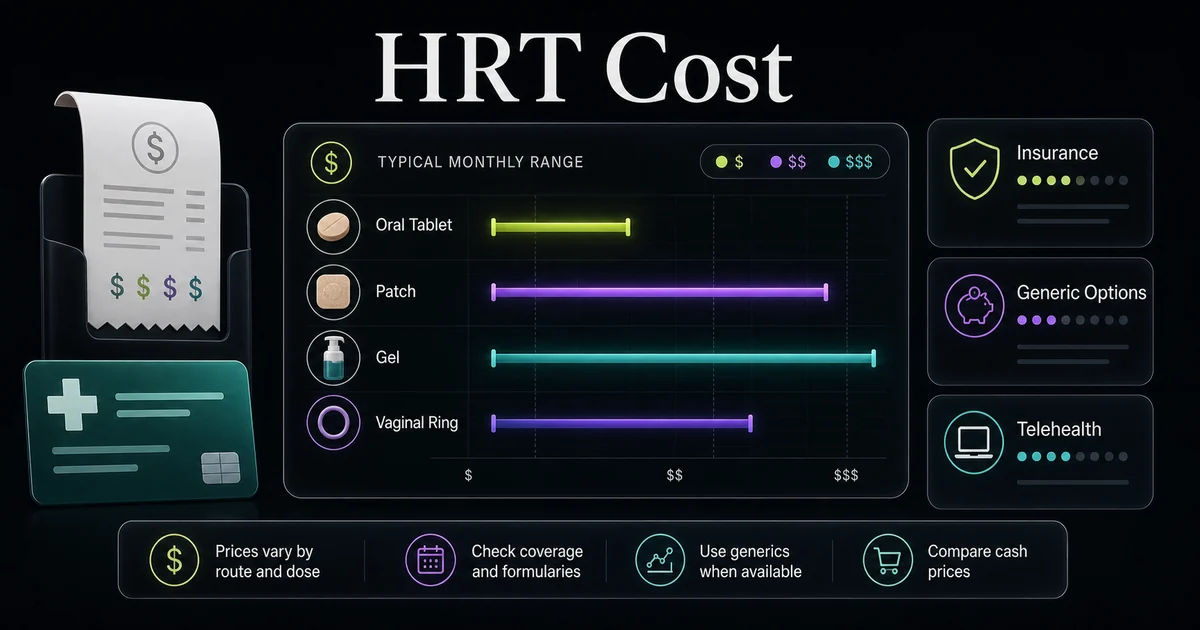

HRT cost ranges from about $10 to over $500 per month, and where you land depends almost entirely on one choice: whether you use generic hormones through insurance and a pharmacy discount card, or pay cash for brand-name products and concierge or pellet-based clinics. Generic estrogen and progesterone can run $10 to $30 a month, while brand-name products, hormone pellets, and cash-pay telehealth memberships can push past $500 a month. This guide breaks down what HRT costs per month by delivery method, whether HRT is covered by insurance, what you pay with and without insurance, and every practical way to lower the bill.
*Disclosure: this article contains affiliate links. If you start care through them we may earn a commission, at no extra cost to you.*
Gala Health offers online menopause care with licensed clinicians and transparent pricing from $79/month (per Gala), with HRT prescribed when appropriate. Check availability and pricing with Gala Health.
Quick Stats
| Value | What it means |
|---|---|
| ~$10 to $500+ per month | Full realistic spread of HRT costs, from generic-with-insurance to brand-name or pellet cash-pay [9] |
| $10 to $30 per month | Typical cost of generic estradiol plus micronized progesterone with insurance or a discount card |
| Insurance status | The single biggest variable in what you actually pay |
| $300 to $600 per insertion | Reported hormone pellet cost, lasting 3 to 6 months and rarely covered by insurance [9] |
🔑 Key Takeaways
- Generic is cheap, brand is not. Generic estradiol tablets can cost under $10 a month, while brand-name patches, gels, rings, and compounded products can be 5 to 50 times higher.
- Most plans cover FDA-approved HRT for menopause, but formulary tier, prior authorization, and compounded exclusions decide your real out-of-pocket cost.
- Pellets and compounded hormones are usually cash-pay because they are not FDA-approved, so insurance rarely covers the product itself.
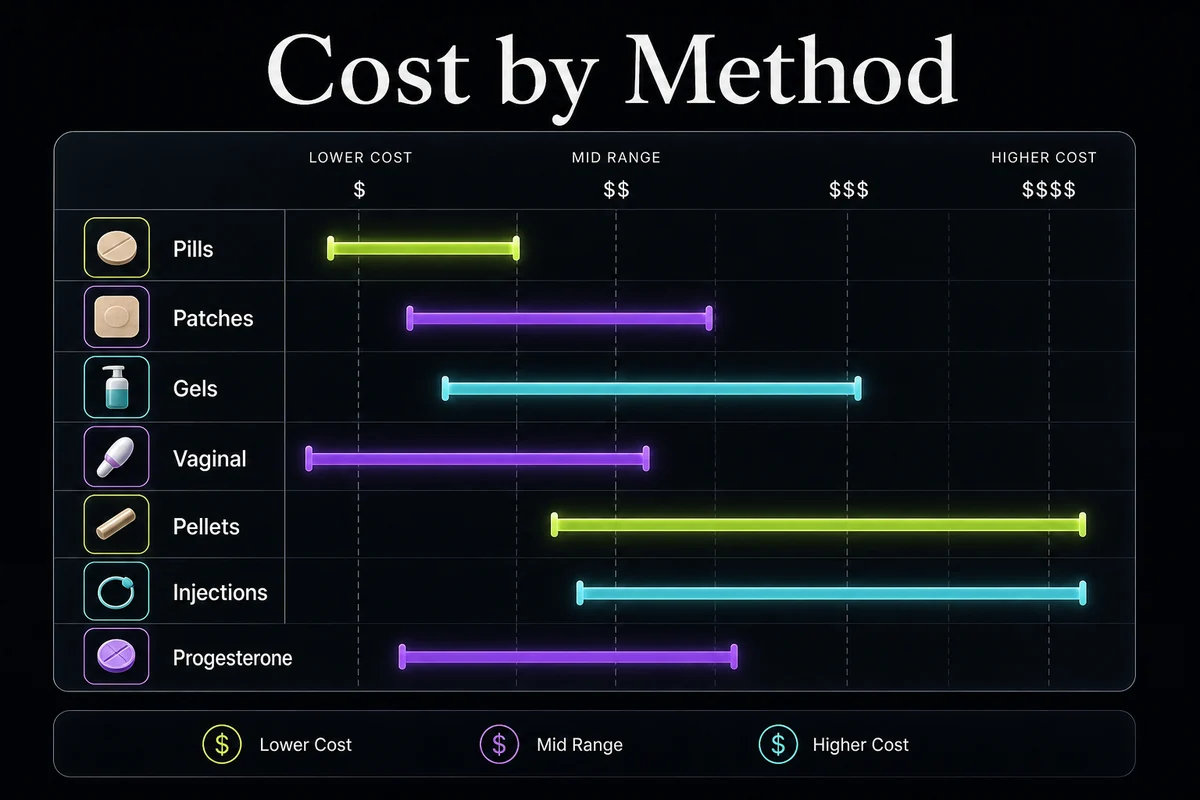
- Delivery method drives price: pills and patches are the most affordable, vaginal rings and pellets the most expensive.
- Total cost of care is more than the prescription. Budget for consults, labs, and monitoring on top of the medication.
- You can lower HRT costs with generics, discount cards, 90-day fills, HSA or FSA dollars, and sliding-scale clinics.
How Much Does HRT Cost Per Month?
The honest answer to how much is HRT: it depends on the hormone, the delivery method, and your insurance. Across the market, HRT costs run from roughly $10 a month for a generic estrogen tablet to more than $500 a month for a brand-name vaginal ring or a concierge program [9]. Most women on a standard estrogen-plus-progesterone regimen using generics land somewhere in the $10 to $80 per month range once insurance or a discount card is applied.
The table below is the piece missing from most HRT price guides: a single master view of the cost of HRT per month by delivery method, with an insurance column and a without-insurance column side by side, so you can compare paths at a glance. Before you read it, one framing note. HRT is a broad category, and the types of HRT you are prescribed change the math [4]. For what HRT actually is and its benefits and risks, see our guide to the benefits and risks of HRT for women.
| Delivery method | With insurance (monthly) | Without insurance (monthly) | Generic available | Usually covered |
|---|---|---|---|---|
| Estrogen pills (oral estradiol) | ~$0 to $30 copay | ~$4 to $30 generic | Yes | Yes |
| Estrogen patches | ~$10 to $50 copay | ~$20 to $90 generic, up to ~$170 brand | Yes | Yes or partial |
| Estrogen gels and sprays | ~$10 to $50 copay | ~$30 to $170 | Some | Partial |
| Vaginal estrogen creams and tablets | ~$0 to $45 copay | ~$15 to $210 | Some | Yes or partial |
| Vaginal estrogen rings | ~$30 to $60 copay | ~$200 to $900 per ring | Rare | Partial |
| Micronized progesterone | ~$0 to $25 copay | ~$10 to $25 generic, brand much higher | Yes | Yes |
| Combination estrogen-progestin products | ~$10 to $50 copay | ~$30 to $200 | Some | Yes or partial |
| Testosterone (compounded cream) | Usually not covered | ~$30 to $90 cash | No FDA product for women | Rare |
| Hormone pellets | Usually not covered | ~$300 to $600 per insertion (3 to 6 months) | No | Rare |
| Injections (estradiol or testosterone) | ~$0 to $40 copay | ~$20 to $100 | Some | Partial |
*These are reported ranges compiled from GoodRx and published pharmacy and telehealth pricing pages [9], and prices can change over time. Your actual HRT price depends on your plan's formulary, your pharmacy, and any discount card used.*
Three patterns stand out. First, the with-versus-without-insurance gap is widest on brand-name and specialty products: a generic tablet costs about the same either way, but a brand ring or a compounded product can swing by hundreds of dollars. Second, many clinicians favor transdermal estrogen (patches, gels) because it may carry a lower risk of blood clots than oral estrogen, so a slightly higher patch price can still be the recommended path [1][2]. Third, the generic-to-brand multiplier is the fastest lever on your bill: switching from a brand product to a therapeutic-equivalent generic often cuts the cost of HRT by the largest single amount.
HRT Cost by Delivery Method
HRT prices vary more by how the hormone is delivered than by any other factor. Here is what each route typically costs, with a generic and a brand example where one exists. Every dollar figure below is a reported range drawn from published pharmacy pricing [9], and your actual price depends on your pharmacy, plan, and any discount card.
Pills
Oral estradiol is the cheapest and most widely stocked option. Generic estradiol tablets are frequently under $10 a month at large pharmacies and $4 to $8 with a discount card, and they sit on the lowest formulary tiers, so insured copays are often $0 to $30 [9]. Brand oral estrogens cost substantially more.
Patches
Estrogen patches deliver hormone through the skin and are a common first choice. Generic patches are reported around $20 to $50 a month cash, while brand transdermal systems can reach roughly $90 to $170 depending on strength and pack size. Insured copays typically fall between $10 and $50. For how patches work and how to use them, see our guide to HRT patches.
Gels and sprays
Topical estradiol gels and sprays offer transdermal dosing without an adhesive patch. Cash prices are reported from about $30 for lower-cost generics up to $170 for brand gels. Coverage is more variable than for pills and patches, so this is a category where checking your formulary before you fill matters.
Vaginal estrogen (creams, tablets, rings)
Low-dose vaginal estrogen treats local symptoms such as dryness and painful sex and is dosed differently from systemic HRT [5]. Creams and tablets are reported from roughly $15 to $210 a month depending on generic availability, while vaginal rings are the most expensive single item on the list, reported from about $200 to more than $900 per ring, with each ring lasting up to about three months [9]. Some plans cover vaginal estrogen under a separate benefit from systemic HRT.
Pellets
Hormone pellets are implanted under the skin and release hormone over time. Across the market they are reported at roughly $300 to $600 per insertion, with each insertion lasting about 3 to 6 months, which works out to an effective cost of roughly $50 to $200 a month once you spread it out [9]. Because most pellets are compounded and not FDA-approved, insurance almost never covers the pellet itself. For how pellets work, dosing, and what to expect, see our full HRT pellets guide.
Injections
Injectable estradiol or testosterone is dosed weekly or biweekly and can be inexpensive when a generic vial is used, reported from about $20 to $100 a month cash depending on the drug and concentration. Testosterone for women is generally compounded and cash-pay because there is no FDA-approved female testosterone product, which raises its HRT therapy cost relative to estrogen.
Is HRT Covered by Insurance?
For most people the practical answer is yes: is HRT covered by insurance comes down to whether the specific product is FDA-approved, on your plan's formulary, and prescribed for menopause symptoms. Standard estrogen and progesterone products are covered by the large majority of commercial plans, Medicare Part D plans, and state Medicaid programs. What varies is the tier, the paperwork, and whether a compounded version is excluded. HRT insurance coverage is the difference between a $10 copay and a $200 cash bill for the same category of drug.
What plans typically cover
Knowing what insurance covers HRT starts with the formulary, the list of drugs your plan pays for and the tier each one sits on. Generic estradiol and micronized progesterone usually land on tiers 1 to 2 with the lowest copays. Brand-name and specialty products sit on tiers 3 to 4 and cost more, and some require you to try a generic first (step therapy) or get prior authorization [6]. Vaginal estrogen is sometimes covered under a separate benefit. Compounded hormones and pellets are the most common exclusion because they are not FDA-approved, which is also why so many pellet and bioidentical programs are cash-pay. For the difference between FDA-approved and compounded routes, see our guide to bioidentical and compounded HRT.
Employer plans, Medicare, and Medicaid
Employer-sponsored HMO and PPO plans generally cover FDA-approved HRT, with your copay set by the drug's tier and whether you have met your deductible. Medicare Part D covers most generic HRT at low tier copays, but federal rules prohibit manufacturer copay cards for people enrolled in Medicare, so that particular discount is off the table for Medicare beneficiaries [6]. Medicaid covers HRT in most states, though the exact products and quantities follow each state's formulary, so hrt insurance details differ from one state to the next.
Does Insurance Cover HRT Pellets?
This is the question almost no pricing page answers directly, so here it is plainly: does insurance cover HRT pellets is usually no. Most pellets are compounded and not FDA-approved, and insurers rarely pay for the pellet product itself. The insertion procedure is sometimes billable to insurance as an office procedure, but the hormone pellet is typically an out-of-pocket charge, which is why pellet programs quote a flat cash fee. Because plan rules differ, confirm with your own insurer rather than assuming any coverage.
How to check your coverage and appeal a denial
To see what you will actually pay, look up the specific drug on your plan's formulary (usually searchable on your insurer's website), note its tier and any prior-authorization or step-therapy flag, and ask the pharmacy to run it before you commit. If a needed product is denied, you have the right to appeal: request the plan's reason in writing, ask your clinician for a letter of medical necessity, and file an internal appeal, followed by an external review if needed [7]. MedlinePlus is a plain-language starting point for understanding your HRT options while you sort out coverage [3].
How Much Does HRT Cost Without Insurance?
Paying cash is more affordable than most people expect if you stick to generics. Here is realistic without-insurance math. Generic estradiol tablets can drop under $10 a month at big-box pharmacies and to a few dollars with a discount card [9]. Generic estrogen patches run roughly $20 to $50 a month. Micronized progesterone is roughly $10 to $25 a month generic. Put together, a standard patches-plus-progesterone regimen commonly lands near $30 to $80 a month cash [9]. So how much is HRT without insurance is often less than a single restaurant dinner per week, as long as you avoid brand-name and compounded products.
The levers that keep cash HRT affordable:
- Discount cards such as GoodRx or SingleCare, which often beat the cash register price and sometimes beat a copay. - 90-day fills, which lower the per-month price versus monthly refills. - Manufacturer savings cards for specific brand products (not available to Medicare enrollees). - Federally qualified health centers, which offer sliding-scale pricing based on income; find one at findahealthcenter.hrsa.gov [8]. - HSA or FSA dollars, which let you pay with pre-tax money and effectively discount the cost by your marginal tax rate [10].
How Much Does HRT Cost With Insurance?
With coverage, most people pay a copay rather than the retail price. How much is HRT with insurance depends on your drug's tier and your deductible: generics on tiers 1 to 2 commonly cost $10 to $50 a month, while brand-name products on higher tiers, or any fill before you have met your deductible, can run well above $100 [6]. This is why a neighbor might pay $10 for the same drug you pay $60 for: different plan, different tier placement, and different point in the deductible year. If you fill early in January before meeting your deductible, expect to pay more than you will later in the year.
Telehealth HRT Pricing Compared
Online menopause clinics bundle the visit, sometimes labs, and often the medication into one monthly or quarterly price, which can be a genuinely affordable HRT path once you account for consult and lab fees you would otherwise pay separately. The catch is that every brand compares only against itself. The neutral table below lines up several providers on the same columns so you can see what each price actually includes. Every third-party figure reflects each provider's published pricing as of July 2026 and can change, so confirm current rates on each provider's site.
| Provider | Monthly price | Visits | Labs | Meds | HSA/FSA or insurance | Notes |
|---|---|---|---|---|---|---|
| Gala Health | From $79/mo (per Gala) | Online intake plus provider review | Not specified | Compounded, included | Cash-pay, no insurance | Compounded hormones Gala discloses are not FDA-approved finished drugs; offers estradiol pill or patch, progesterone, and vaginal estradiol (no testosterone or pellets); free shipping; Gala states all 50 states, confirm at signup [11] |
| Hone Health | Membership ~$25/mo (Basic) to ~$155/mo (Premium); meds billed separately | Purchased separately | Included on membership | Separate | HSA/FSA | Launched women's menopause care in 2026; medication billed on top of membership [15] |
| Hers | Oral from ~$79/mo, patch from ~$134/mo on a 12-month plan | Yes | Varies | Included in plan | HSA/FSA | Price depends on plan length and product chosen [12] |
| Midi Health | Insurance-based; self-pay initial visit ~$250, follow-ups ~$150 | Yes | Ordered, often billed to insurance | Filled at your pharmacy | Accepts insurance plus HSA/FSA | Bills as a clinical practice rather than a flat membership; copays vary by plan [14] |
| Winona | Meds from ~$39/mo (progesterone) to ~$149/mo (patch); popular combo ~$89/mo | Included | Extra | Included | HSA/FSA, no insurance | Compounded bioidentical hormones; consults, messaging, and shipping included [13] |
| Local OB-GYN or clinic | Visit ~$100 to $400 cash, or a copay | Per visit | Billed to insurance | Filled at pharmacy | Insurance | In-person baseline |
*Provider figures reflect each brand's published pricing as of July 2026 and can change, so confirm current rates on each provider's site before you enroll. Gala Health pricing is brand-stated (from $79/month per Gala), and Gala uses compounded hormones rather than FDA-approved finished products.*
This section is cost-only on purpose. For full reviews of each service, ratings, and prescribing details, see our roundup of the best online HRT providers compared, and for how the whole process works from intake to delivery, see how online HRT works.
Gala Health offers online menopause care with licensed clinicians and transparent pricing from $79/month (per Gala), with HRT prescribed when appropriate. Check availability and pricing with Gala Health.
Hidden HRT Costs to Budget For
The prescription is only part of the bill. The costs below are easy to forget when you compare HRT prices, and they are the reason a $30-a-month regimen can still add up over a year.
| Cost item | Typical range | How often |
|---|---|---|
| Consult or office visit | $100 to $400 cash, or a copay | Initial, then periodic |
| Baseline and follow-up labs | $80 to $500 depending on panel and coverage | Baseline, then periodic |
| Annual monitoring visit | $100 to $250 cash, or a copay | Yearly |
| Mammogram or screening | Often covered as preventive; $0 to $350 if not | Per screening schedule |
| Compounding upcharge | $75 to $200 | Per fill, if compounded |
*Reported ranges compiled from published pharmacy and clinic pricing; actual costs vary by plan, panel, and location. Preventive screenings are frequently covered at no cost under standard plans; confirm with your insurer.*
First-year estimate: A common regimen of generic estradiol patches plus micronized progesterone, paid cash with a discount card, plus one consult and one baseline lab panel, can land near $400 to $1,200 for the first year. The same regimen through insurance with tier 1 to 2 copays can drop to roughly $200 to $600. A concierge or pellet-based cash-pay program can exceed $2,000 to $3,000. These are illustrative estimates, not quotes; your total depends on your plan, pharmacy, and clinician.
If you would rather handle consults and labs in person, our guide to find an HRT doctor near you covers how to price and book local care.
How to Save on HRT
Keeping HRT affordable is mostly about a few disciplined choices. Work down this checklist before you fill your first prescription:
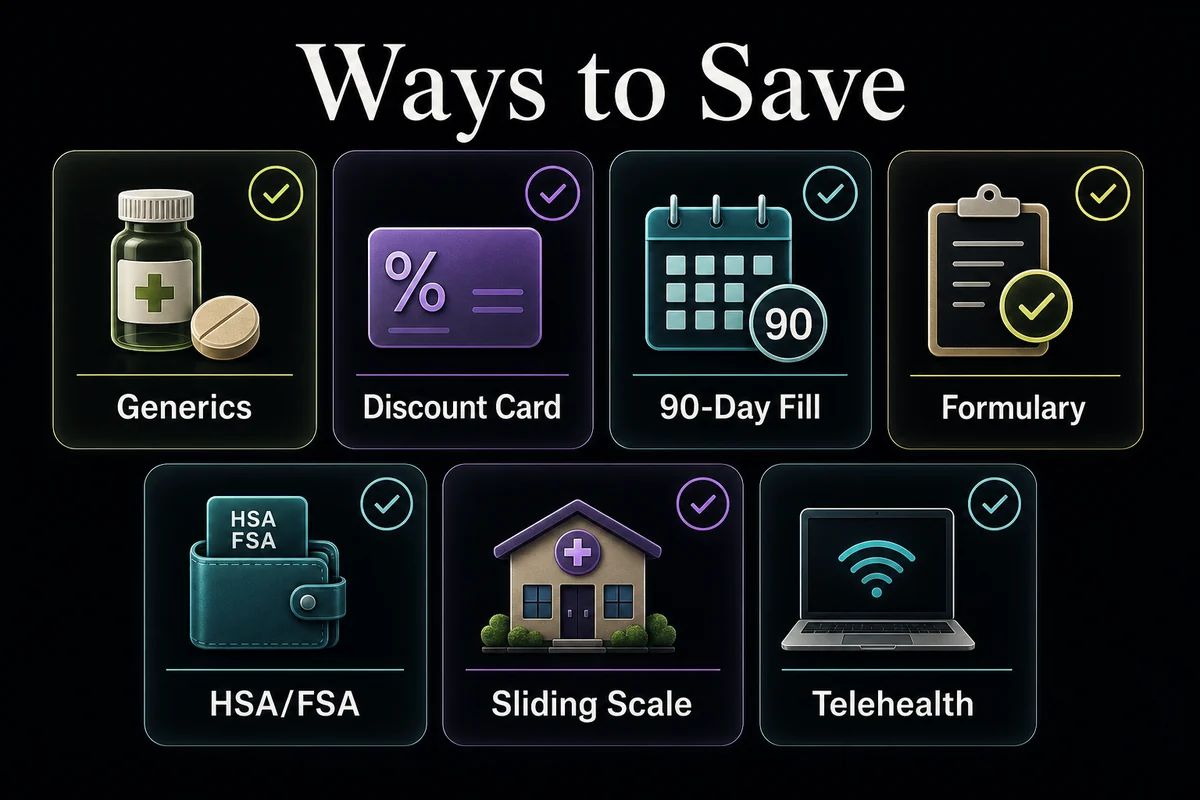
- Choose generics first. Ask your clinician whether a generic estradiol and micronized progesterone regimen fits your needs before agreeing to a brand product. - Price-check a discount card against your copay. GoodRx or SingleCare sometimes beats even an insured copay; run both numbers at the pharmacy [9]. - Fill a 90-day supply instead of monthly refills to lower the per-month price. - Ask about therapeutic alternatives on your formulary if your first choice sits on a high tier or needs prior authorization. - Use HSA or FSA dollars so you pay with pre-tax money [10]. - Check a sliding-scale clinic at findahealthcenter.hrsa.gov if you are uninsured or underinsured [8]. - Confirm what is bundled before joining a telehealth membership, so you are not paying separately for labs a plan already covers.
The bottom line: HRT is affordable for most people who start with generics and use insurance or a discount card, and it becomes expensive mainly when brand-name products, pellets, or concierge programs enter the picture. If you are weighing options beyond hormones, our guide to peptides for menopause symptoms covers non-hormonal approaches some people explore alongside or instead of HRT.
Frequently Asked Questions
Gala Health offers online menopause care with licensed clinicians and transparent pricing from $79/month (per Gala), with HRT prescribed when appropriate. Check availability and pricing with Gala Health.
References
- Mayo Clinic. Hormone therapy: Is it right for you? Mayo Clinic, 2024. https://www.mayoclinic.org/diseases-conditions/menopause/in-depth/hormone-therapy/art-20046372
- Cleveland Clinic. Hormone Therapy for Menopause Symptoms. Cleveland Clinic, 2023. https://my.clevelandclinic.org/health/treatments/15245-hormone-therapy-for-menopause-symptoms
- MedlinePlus. Hormone Replacement Therapy. U.S. National Library of Medicine. https://medlineplus.gov/hormonereplacementtherapy.html
- Harper-Harrison G, Shanahan MM. Hormone Replacement Therapy. StatPearls, NCBI Bookshelf. https://www.ncbi.nlm.nih.gov/books/NBK493191/
- PMC. Vaginal estrogen for genitourinary syndrome of menopause. PubMed Central. https://pmc.ncbi.nlm.nih.gov/articles/PMC11439571/
- Medicare.gov. How Part D drug plans and formulary tiers work. https://www.medicare.gov/health-drug-plans/part-d/what-drug-plans-cover/how-drug-plans-work
- HealthCare.gov. How to appeal an insurance company decision. https://www.healthcare.gov/appeal-insurance-company-decision/
- HRSA. Find a Health Center (sliding-scale clinics). https://findahealthcenter.hrsa.gov
- GoodRx. Hormone Replacement Therapy Costs. https://www.goodrx.com/conditions/estrogen-replacement/hrt-cost
- FSAFEDS. Explore Your FSA Options (pre-tax eligibility). https://www.fsafeds.gov/explore
- Gala Health. Online HRT product scope and pricing. galahealth.co, 2026 (brand-stated). https://galahealth.co
- Hers. Menopause treatment pricing and insurance. forhers.com, 2026. https://www.forhers.com/blog/does-insurance-cover-hrt
- Winona. Menopause HRT products and pricing. bywinona.com, 2026. https://bywinona.com/product
- Midi Health. Insurance-based menopause care and self-pay visit pricing. joinmidi.com, 2026. https://www.joinmidi.com/
- Hone Health. Women's menopause membership pricing. honehealth.com, 2026. https://honehealth.com/womens/menopause-treatment/
Disclosure: this article contains affiliate links to Gala Health. If you start care through them, we may earn a commission at no extra cost to you.