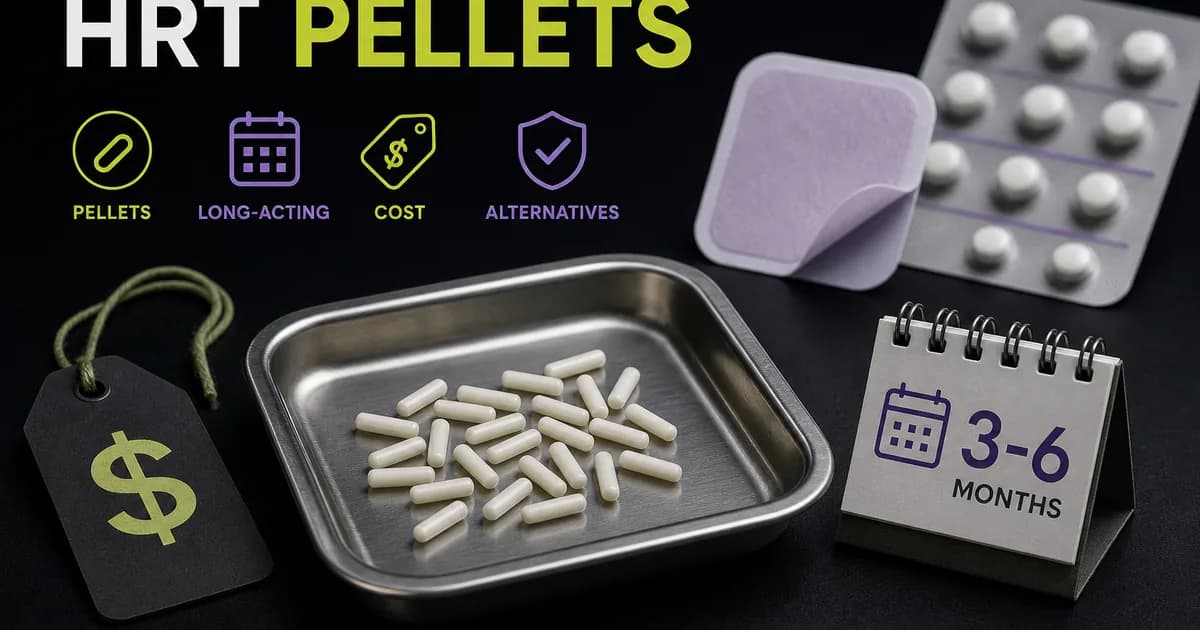

HRT pellets are rice-sized implants of compounded estrogen, and often testosterone, that a clinician places just under the skin every few months, and they have become one of the most heavily marketed forms of menopause hormone care. The appeal is genuine: no daily pill or patch to remember. But hrt pellet therapy is compounded rather than FDA approved, the dose cannot be changed once the pellet is in place, and both ACOG and The Menopause Society recommend trying FDA approved hormone therapy first [1][3]. This guide walks through what pellets are, what insertion and aftercare involve, what they actually cost, what patients report, and the evidence-backed alternative you can start online.
*Disclosure: this article contains affiliate links. If you start care through them we may earn a commission, at no extra cost to you.*
Prefer a pill or patch you can adjust or stop any day, without the pellet clinic? Gala Health connects you with licensed menopause clinicians online who prescribe estradiol and progesterone, shipped to your door, starting from $79 per month (per Gala) [11][12]. Check Gala Health availability
Quick Facts
| Stat | What it means |
|---|---|
| Lasts 3 to 6 months per insertion | Most women re-insert every 3 to 4 months, timed to when symptoms return |
| About $1,536 per year on average | Figure reported by Medical News Today; insurance rarely covers compounded pellets [9] |
| About 1% insertion-site complication rate in women | Rate seen in a published pellet cohort (bruising, infection, extrusion) [6] |
| 0 compounded pellet products are FDA approved | The hormones are the same molecules as approved drugs, but the pellet itself is not reviewed or dose-standardized [2] |
🔑 Key Takeaways
- What pellets are: compounded bioidentical estradiol, testosterone, and sometimes progesterone, pressed into rice-sized implants and placed under the skin of the hip.
- Not FDA approved, not adjustable: compounded pellets skip FDA review, and once one is inserted the dose cannot be lowered or stopped without a second minor procedure [2].
- Cost and insurance reality: average reported spend is around $1,536 per year, usually paid out of pocket because insurers rarely cover compounded products [9][2].
- What the guidelines say: ACOG, The Menopause Society, and the FDA-commissioned NASEM report all favor FDA approved hormone therapy over compounded pellets [1][2][3].
- The alternative is accessible: FDA approved transdermal (patch or gel) and oral HRT treat the same symptoms with adjustable, stoppable, regulated dosing, and can be prescribed through telehealth.
What Are HRT Pellets?
HRT pellets are small, rice-sized implants of compounded bioidentical hormones, most often estradiol and testosterone and occasionally progesterone. A clinician numbs a spot on the upper hip or buttock, makes a tiny incision, and slides one or more pellets into the fatty layer just under the skin, where they slowly dissolve and release hormone over 3 to 6 months [4]. Because a single hrt pellet keeps working for months, pellet HRT is marketed as a "set it and forget it" option for people who dislike daily dosing.
The important distinction is how these products are made. Pellets are compounded, meaning a specialty pharmacy mixes and presses them per prescription. Compounded products are not reviewed or approved by the FDA, so no compounded pellet has gone through the safety, dosing, and manufacturing checks that an approved patch or pill passes [2]. The hormones inside are the same molecules found in approved products; the pellet, its dose, and its release rate are what remain unregulated.
Bioidentical HRT Pellets vs Compounded: What the Words Mean
These two words get blurred in marketing, and the difference matters. "Bioidentical" describes the molecule: a hormone with the same chemical structure as the one your body makes, such as estradiol or micronized progesterone. Many FDA approved products are also bioidentical, so the term alone tells you nothing about safety or regulation. "Compounded" describes the manufacturing route: a pharmacy custom-mixing a product outside the FDA approval system. Bioidentical HRT pellets are therefore bioidentical in molecule but compounded in method, which is why guideline bodies treat them differently from an approved bioidentical patch. For the full science of bioidentical hormones, see our bioidentical HRT explained guide.
Biote HRT Pellets and Other Branded Systems
Biote is one of the most recognized names in this space. It operates as a provider-training and pellet-supply network rather than a single clinic, certifying practitioners who then insert pellets in their own offices. Biote HRT pellets are still compounded and still not FDA approved, and the Biote brand page does not publish pricing, side effect data, or FDA status. Other branded pellet systems work the same way. Naming a brand does not change the underlying category: these are compounded implants, dosed by the prescribing clinic rather than by a standardized label.
HRT Pellet Insertion: Procedure, Prep, and Aftercare
HRT pellet insertion is a brief in-office procedure. After cleaning the skin over the upper outer hip, the clinician injects a local anesthetic, makes a small incision (a few millimeters), and uses a trocar to place the pellet or pellets in the subcutaneous fat. The incision is closed with Steri-Strips rather than stitches, and the whole visit usually takes only a few minutes [4]. The pellets then release hormone continuously as they dissolve, and the process repeats every 3 to 6 months.
Before Your First Pellet: Labs and Prep
Reputable prescribers do not place a pellet blind. Clinicians often call this the HRT female pre pellet workup: a set of baseline blood tests and a symptom review done before your first insertion. Expect baseline hormone labs drawn from blood, because ACOG notes that salivary hormone testing is not accurate for guiding menopause therapy [3]. Your clinician will also review your full medication list, your history of blood clots, stroke, or hormone-sensitive cancers, and your goals, so the starting dose is matched to you rather than to a generic protocol.
Aftercare and Recovery Timeline
Aftercare is straightforward but has a few rules. Keep the Steri-Strips and bandage dry and in place for the window your clinician specifies, usually a few days. Avoid soaking the site (baths, pools, hot tubs) and skip strenuous glute or lower-body workouts for about 3 days so the incision can seal and the pellet stays put. Mild bruising, tenderness, or a small firm bump can linger for 2 to 3 weeks. Most clinics schedule follow-up labs around 4 weeks to check hormone levels before deciding on future dosing.
How Long Do HRT Pellets Last?
Most pellets last 3 to 6 months, and in practice most women re-insert every 3 to 4 months. The usual trigger for re-dosing is the return of symptoms such as hot flashes, poor sleep, or low energy as hormone levels taper toward the end of the cycle. Because the release is not perfectly linear, some people feel strong effects early and a dip before their next insertion is due.
HRT Pellets Pros and Cons
This is the framing most people search for, so here is a balanced view. The honest summary: pellets solve a convenience problem while creating a regulation, adjustability, and cost problem. The table below pairs each benefit against its trade-off.

| Pros | Cons |
|---|---|
| No daily pill or patch to remember; one procedure covers months | Compounded and not FDA approved, so the product skips FDA safety and dosing review [2] |
| Steady, continuous hormone release rather than daily peaks and dips | The dose cannot be lowered or stopped without a second procedure to remove the pellet |
| Testosterone can be blended into the same pellet | A minor in-office surgical insertion is repeated every 3 to 6 months |
| May suit frequent travelers or people who forget daily medication | Insertion-site issues occur in about 1% of women, including bruising, infection, or pellet extrusion [6] |
| The "set it and forget it" convenience many patients value | Cost is high and rarely insured, so out-of-pocket spend recurs 3 to 4 times a year [9] |
| Symptom relief is reported by many providers and patients | Evidence is limited; the NASEM report found no high-quality trials of compounded pellets [2] |
Benefits of HRT Pellets
To keep the benefits of HRT pellets in perspective, the upside is mostly practical rather than proven-superior. Convenience is the clearest advantage: one insertion replaces months of daily dosing, which genuinely helps adherence for some people. Steady release and the option to include testosterone are also cited by providers. The catch is the evidence tier. Claims that pellets relieve symptoms come from clinician experience and lower-quality studies, not from randomized controlled trials, and the NASEM review found no high-quality evidence that compounded pellets are safer or more effective than approved therapy [2][5]. In other words, the benefits are believable but modestly supported, not established over FDA approved options.
HRT Pellet Side Effects
The side effects of hrt pellets fall into two layers. The first layer is the systemic effects and risks shared by any estrogen-plus-progestogen therapy: breast tenderness, irregular bleeding or spotting, bloating, headaches, and nausea early on [8]. The more serious risks (blood clots, stroke, and breast cancer) are best understood in absolute terms rather than as scary percentages. For most healthy women in early menopause the added risk is small; for example, guideline reviews describe roughly a handful of extra breast cancer cases per 1,000 women over several years of combined therapy, and your personal risk depends on age, timing, and health history [1][8]. Your clinician weighs these against your symptoms before recommending any hormone route. For the fuller picture, see our HRT side effects guide.
The second layer is pellet-specific. Because compounded pellets are not dose-standardized, they can push hormone levels above the normal physiologic range (supraphysiologic dosing), which is documented in women using compounded subcutaneous pellets [7]. Comparative research has reported higher rates of side effects such as breakthrough bleeding with pellet therapy than with FDA approved HRT [5]. Insertion carries its own risks (bruising, infection, and pellet extrusion) at around a 1% complication rate [6]. When testosterone is included and levels run high, HRT pellets side effects can include acne, unwanted facial or body hair, and, rarely, voice changes, effects that do not simply reverse because the pellet keeps releasing until it dissolves.
HRT Pellets and Weight Loss
Marketing sometimes links pellets to weight loss, so here is the honest answer. There is no good evidence that HRT pellets and weight loss go together; pellets are not a weight-loss treatment. Hormone therapy overall has a roughly neutral effect on body weight, and if anything a dosing error that pushes hormones too high can cause fluid retention and a few pounds of temporary gain. If your primary concern is menopausal weight change, read does HRT cause weight gain first. If weight loss itself is the goal, the evidence-backed tools are different; see our overview of GLP-1 options for weight loss.
HRT Pellets Reviews: What Users Actually Report
No ranking page synthesizes what patients actually say, so here is a sourced summary. To be clear about method: the themes below come from published studies on pellet satisfaction and complications, plus patterns visible in public patient discussion characterized in aggregate. There are no invented quotes, testimonials, or star ratings here.
On the positive side, hrt pellets reviews and pellet hrt reviews commonly praise convenience (no daily dosing) and, for testosterone-inclusive pellets, improved energy and libido, which aligns with the satisfaction drivers seen in provider-run cohorts [5]. On the negative side, three themes recur. First, a bad dose cannot be undone for months, which patients describe as the hardest part when side effects appear. Second, cost creep frustrates people who did not expect to pay for insertions 3 to 4 times a year. Third, some report upsell pressure at pellet-focused clinics, a criticism that a ranking physician blog (restartmed.com) makes openly, noting that pellets can be a high-margin service line. Taken together, satisfaction tracks convenience and testosterone-driven energy, while regret tracks the inability to adjust the dose and the recurring out-of-pocket cost.
HRT Pellets vs Patch, Pills, and Gels
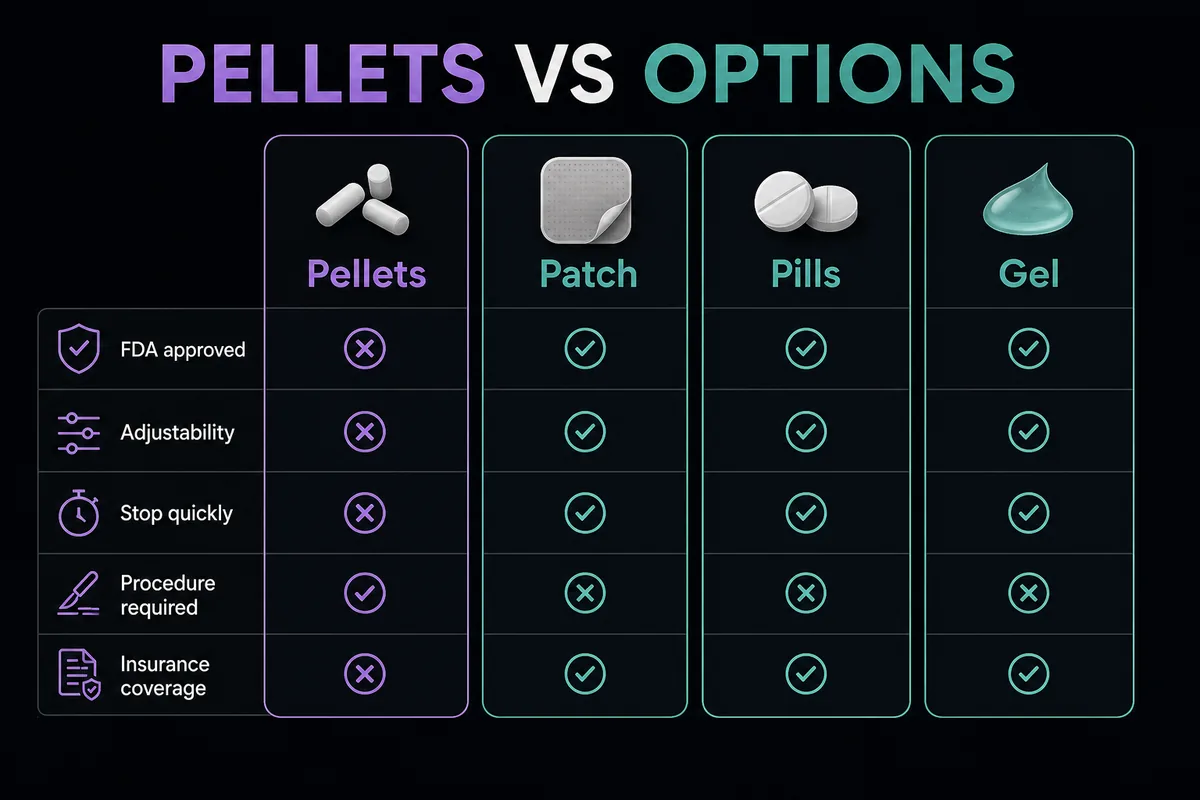
When you line up pellets, HRT patches, pills, and gels side by side, the trade-offs get clear fast. The table compares the four main delivery methods on the features that matter for a menopause decision.
| Feature | Pellets | Patch | Pills | Gel |
|---|---|---|---|---|
| FDA approved | No | Yes | Yes | Yes |
| Dosing adjustable after starting | No | Yes | Yes | Yes |
| How often | Procedure every 3 to 6 months | Apply 1 to 2 times weekly | Daily | Daily |
| Procedure required | Yes | No | No | No |
| Can stop quickly if side effects appear | No | Yes | Yes | Yes |
| Typical insurance coverage | Rare | Common | Common | Common |
| Evidence base | Limited, no RCTs | Extensive RCT and guideline support | Extensive RCT and guideline support | Extensive RCT and guideline support |
Sources for the FDA status and evidence rows: The Menopause Society 2022 position statement [1], the FDA-commissioned NASEM report [2], and StatPearls [4].
The bottom line under this table is consistent with every major guideline body: FDA approved products do the same job with adjustable, stoppable dosing, usually at lower cost and often covered by insurance. A patch or gel delivers estradiol through the skin much like a pellet does, but you can change or stop it the same day if something feels off. To go deeper, see how HRT patches work, all types of HRT compared, and what HRT costs with and without insurance.
What Experts and Guidelines Say About Pellet Therapy
The professional consensus on pellet therapy is unusually aligned. The Menopause Society (NAMS) 2022 position statement advises that compounded hormone therapy, including pellets, should not be used when an FDA approved option exists, citing concerns about dosing consistency, purity, and the lack of safety data [1]. ACOG reaches the same conclusion, recommending FDA approved hormone therapy over compounded bioidentical products for the general patient [3]. The FDA-commissioned NASEM report from 2020 found no high-quality evidence that compounded bioidentical hormones, pellets included, are safe or effective, and recommended restricting their use [2]. The Endocrine Society has likewise raised safety and quality concerns about compounded bioidentical hormone therapy in its position statement [10]. None of these bodies calls pellets uniquely dangerous; the shared message is that they are unregulated and unproven relative to approved alternatives, so approved therapy should come first.
Rather manage menopause care from home than in a pellet clinic? Gala Health connects you with licensed clinicians online who prescribe estradiol and progesterone as a pill or patch you can adjust or stop any day, with no quarterly procedure. Check Gala Health availability
The Evidence-Backed Alternative: Adjustable HRT Through Telehealth
If the goal is symptom relief without the regulatory and adjustability problems of pellets, transdermal estradiol (a patch or gel) paired with oral micronized progesterone is the guideline-preferred route. It treats the same hot flashes, sleep disruption, and vaginal symptoms, but the dose is adjustable, stoppable the same day, standardized on an approved label, and usually far cheaper because insurance commonly covers it [1][4]. Telehealth removes the friction of finding and revisiting a pellet clinic every quarter: you complete an intake, a licensed clinician reviews your history, and prescriptions are sent to a pharmacy. Gala Health is one accessible menopause telehealth service. After an online intake, its US-licensed clinicians can prescribe estradiol as a pill or patch, progesterone, or vaginal estradiol, and the medication ships to your door, with pricing that starts from $79 per month (per Gala) [11][12]. Gala uses compounded formulations, which it discloses are not FDA approved finished drug products, and it does not offer testosterone, gels, injections, or pellets [11][13]. If you specifically want an FDA approved finished product, ask the clinician what is available. Whatever the formulation, a pill or patch keeps the flexibility a pellet removes: you and your clinician can change or stop it any day, with no procedure. Gala states it serves all 50 states, though actual availability depends on provider licensure and your state's telehealth rules, so confirm your state when you sign up [11]. For the wider picture, see our full guide to HRT for women, plus getting HRT online and the best online HRT providers.
For women who cannot take hormones at all, non-hormonal prescription options now exist too, including the newer NK3 receptor blocker fezolinetant for hot flashes; your clinician can tell you if it fits, and our HRT for menopause overview covers where it sits. Some readers also ask about adjunct research compounds, which we cover in peptides for menopause.
Skip the quarterly incisions. With Gala Health, estradiol and progesterone come as a pill or patch you can adjust or stop any day, prescribed online by licensed clinicians with no pellet-clinic visit. See whether it fits your symptoms. Check Gala Health availability
Frequently Asked Questions
| Item | What is known | Source |
|---|---|---|
| Average annual cost | About $1,536 per year | Medical News Today reporting [9] |
| Per-insertion cost | Varies by clinic and dose; compounded pellets have no standardized list price | Pricing is not uniform across providers [9] |
| Insurance coverage | Rarely covers compounded pellets | FDA-commissioned NASEM report [2] |
References
- The Menopause Society (NAMS). The 2022 Hormone Therapy Position Statement of The North American Menopause Society. Menopause, 2022. https://menopause.org/wp-content/uploads/professional/nams-2022-hormone-therapy-position-statement.pdf
- U.S. Food and Drug Administration. National Academies of Sciences, Engineering, and Medicine (NASEM) Study on the Clinical Utility of Compounded Bioidentical Hormone Therapy, 2020. https://www.fda.gov/drugs/human-drug-compounding/national-academies-science-engineering-and-medicine-nasem-study-clinical-utility-treating-patients
- American College of Obstetricians and Gynecologists. Compounded Bioidentical Menopausal Hormone Therapy. Clinical Consensus, 2023. https://www.acog.org/clinical/clinical-guidance/clinical-consensus/articles/2023/11/compounded-bioidentical-menopausal-hormone-therapy
- StatPearls. Hormone Replacement Therapy. StatPearls Publishing, 2023. https://www.ncbi.nlm.nih.gov/books/NBK562865/
- Glaser R, et al. Comparative side effects and outcomes of pellet hormone therapy. PubMed, 2021. https://pubmed.ncbi.nlm.nih.gov/33973545/
- Insertion-site complication rates with subcutaneous hormone pellets in women. PMC, 2021. https://pmc.ncbi.nlm.nih.gov/articles/PMC8165877/
- Supraphysiologic hormone levels with compounded subcutaneous pellets. PubMed, 2010. https://pubmed.ncbi.nlm.nih.gov/20337216/
- National Health Service (NHS). Side effects of hormone replacement therapy (HRT). https://www.nhs.uk/medicines/hormone-replacement-therapy-hrt/side-effects-of-hormone-replacement-therapy-hrt/
- Medical News Today. Hormone pellet therapy for menopause: cost reporting. https://www.medicalnewstoday.com/articles/hormone-pellet-therapy-for-menopause
- Endocrine Society. Compounded Bioidentical Hormone Therapy Position Statement. https://www.endocrine.org/advocacy/position-statements/compounded-bioidentical-hormone-therapy
- Gala Health. Official site and product information (galahealth.co). Brand-published; pricing, hormones offered, and availability are stated by Gala. https://galahealth.co
- policylab.us. Best Affordable Online HRT Providers comparison, which lists Gala Health from $79/month, 2026. https://policylab.us/hormone-replacement-therapy/hrt-online/
- Gala Health. Brand release describing its compounded GLP-1 and hormone therapy programs (GlobeNewswire), 2026. https://www.globenewswire.com/news-release/2026/05/27/3302421/0/en/gala-health-high-quality-compounded-glp-1-weight-loss-hormone-therapy-hrt-support.html
Disclosure: this article contains affiliate links to Gala Health. If you start care through them, we may earn a commission at no extra cost to you.