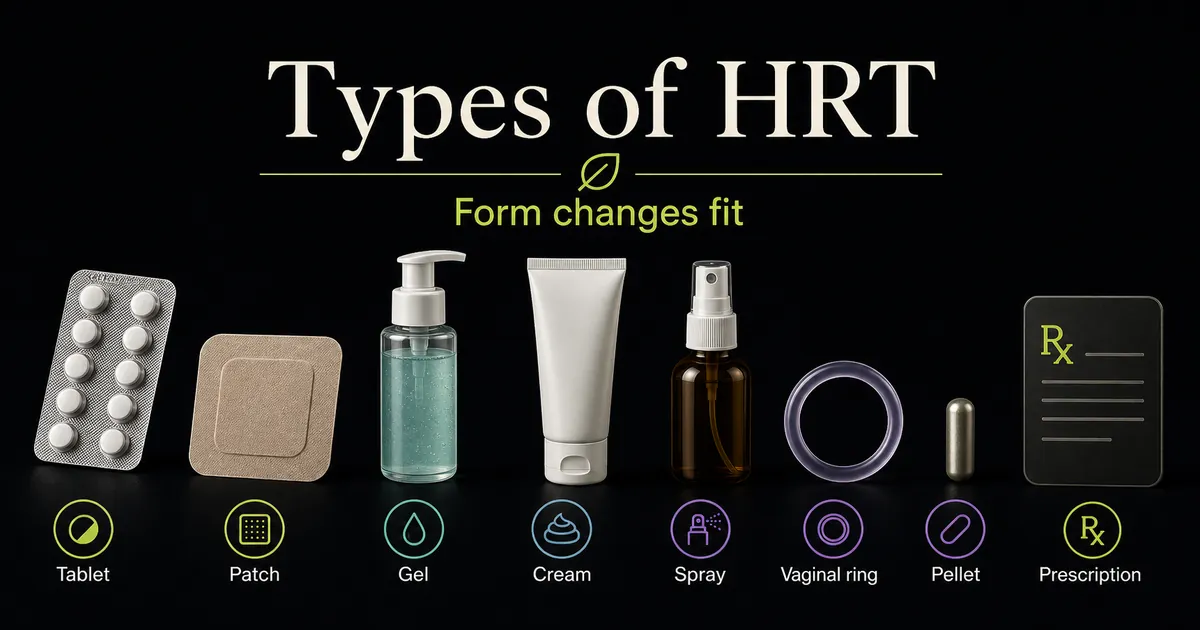

Types of HRT come down to three decisions: which hormones you take (estrogen only or combined), which routine you follow (cyclical or continuous), and which delivery form you use, from tablets and patches to gels, creams, sprays, injections, pellets, and vaginal estrogen. Choosing an HRT medication is really a set of these choices made with your clinician, matched to whether you have a uterus, where you are in menopause, your clot and migraine history, and how you prefer to take it. This guide compares the different types of HRT for a US reader, with US brand names, a nine-form comparison table, and honest pros and cons for each option. It covers forms that most pages skip, including injections and pellets, and it stays focused on menopause HRT rather than every use of hormones.
| Quick fact | What it means |
|---|---|
| 8 delivery forms covered | Tablets, patches, gel, cream, spray, injections, pellets, and vaginal estrogen [1] |
| 2 main hormone combinations | Estrogen only (after a hysterectomy) or combined estrogen plus progestogen (if you have a uterus) [2][5] |
| Systemic vs local | Systemic HRT treats whole-body symptoms like hot flashes; local vaginal estrogen treats only genital and urinary symptoms [1][2] |
| FDA approved vs compounded | Standard HRT products are FDA approved; compounded hormones and most pellets are not [3] |
🔑 Key Takeaways
- There is no single best type of HRT. The right combination of hormone, routine, and form depends on your body and history, and finding it often takes some adjustment [1][3].
- Estrogen only vs combined is decided by your uterus. Women who have had a hysterectomy can use estrogen alone; anyone with a uterus needs a progestogen too, to protect the womb lining [2][5].
- Cyclical suits perimenopause, continuous suits postmenopause. Cyclical (sequential) HRT gives a monthly bleed and fits women still having periods; continuous combined HRT aims for no bleed after 12 months without a period [1].
- Transdermal forms avoid the clot-risk bump of tablets. Oral estrogen is associated with a higher risk of venous blood clots, while patches, gels, and sprays were not in a large 2019 study [4].
- Vaginal estrogen is a class of its own. It treats only local symptoms, carries minimal systemic exposure, and does not require a progestogen even if you have a uterus [1].
The Two Main Types of HRT: Estrogen Only vs Combined HRT
Almost every HRT decision starts here. There are two main types of HRT drugs by hormone content: estrogen-only therapy and combined HRT, which pairs estrogen with a progestogen [2].
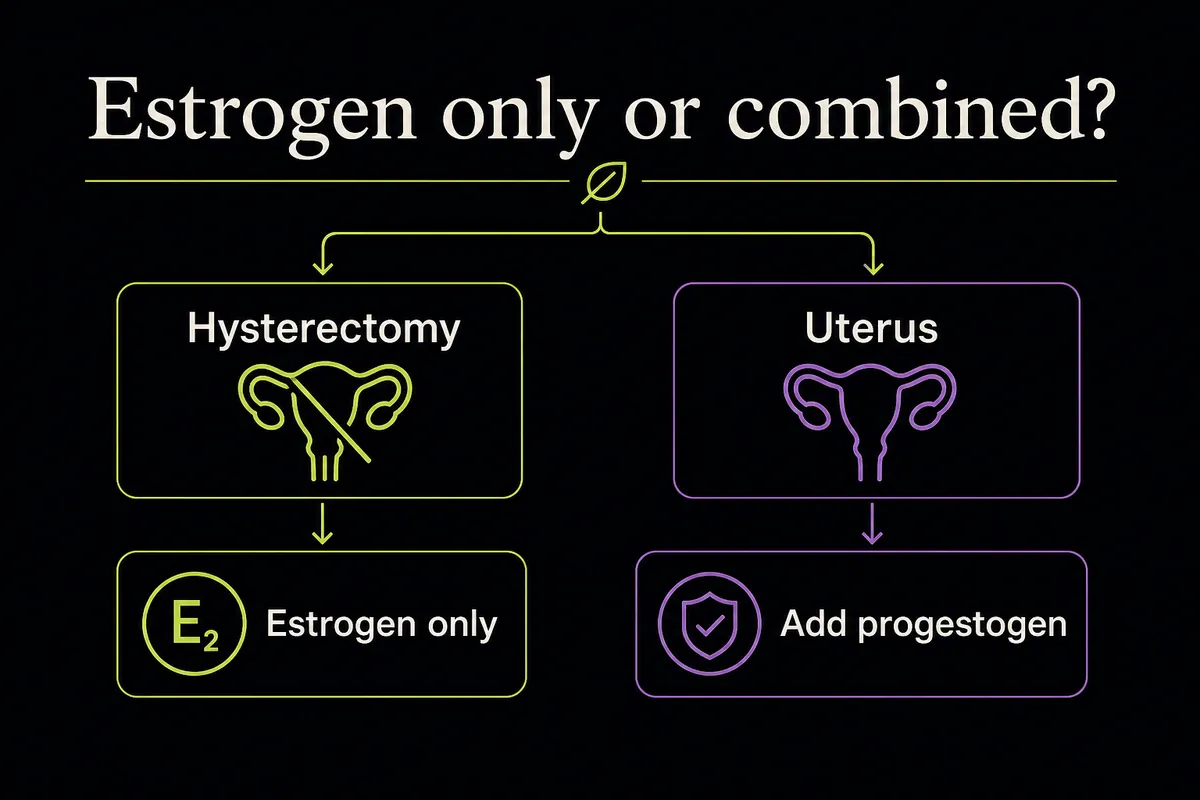
Estrogen is the hormone that actually treats menopause symptoms: hot flashes, night sweats, sleep and mood changes, and vaginal dryness. The standard estrogen in modern HRT is estradiol, the same molecule the ovaries make, although older products use conjugated estrogens (Premarin) [2]. On its own, though, estrogen thickens the lining of the uterus, and over time unopposed estrogen raises the risk of endometrial (womb) cancer [5]. That is the whole reason combined HRT exists.
Combined HRT adds a progestogen to protect the womb lining. The progestogen can be micronized progesterone, which is body-identical (Prometrium), or a synthetic progestin such as medroxyprogesterone or norethindrone [1][2]. So the rule most clinicians follow is simple: if you have had a hysterectomy, estrogen only is appropriate; if you still have a uterus, you need combined HRT or a separate progestogen [2][5].
Testosterone is sometimes added as a third hormone, off-label, mainly for low libido when standard HRT has not helped; it is covered lower down and, for the male context, in our HRT for men guide [1]. You may also see the terms bioidentical and compounded HRT; those describe how a hormone is made rather than a separate category, and we cover them in bioidentical HRT explained.
Cyclical vs Continuous Combined HRT
Once you know you need combined HRT, the next choice is the routine, and this is the part US pages almost always skip. There are two ways to take the progestogen [1].
Cyclical HRT (also called sequential) gives estrogen every day and adds the progestogen for only part of each cycle, usually 10 to 14 days. It produces a monthly withdrawal bleed similar to a light period, and it is the routine most women use in perimenopause while they are still having natural periods [1]. For where this fits in the menopause timeline, see HRT in perimenopause.
Continuous combined HRT gives both hormones every single day with no break, so there is no scheduled monthly bleed. It is designed for women who are postmenopausal, generally at least 12 months past their last period [1]. Some spotting is common in the first three to six months as the body settles, but persistent or new bleeding after that is the signal to call your clinician; see bleeding on HRT.
| Feature | Cyclical (sequential) HRT | Continuous combined HRT |
|---|---|---|
| Who it is for | Perimenopause, still having periods | Postmenopause, 12+ months since last period |
| How it is taken | Estrogen daily, progestogen 10 to 14 days per cycle | Both hormones every day, no break |
| Bleeding pattern | Planned monthly withdrawal bleed | Aim of no bleed after adjustment |
| When doctors switch you | Once you are clearly postmenopausal | Stays continuous long term |
Clinicians usually move you from cyclical to continuous once you are firmly postmenopausal, because a no-bleed routine is what most women prefer long term [1].
HRT Delivery Forms Compared
The third decision is the delivery form, and this is where the forms of HRT really diverge on convenience, side effects, and clot risk. The table below compares all nine forms in one place, the most complete comparison on this topic for a US reader. Details, brand names, and side effects for each form follow underneath.
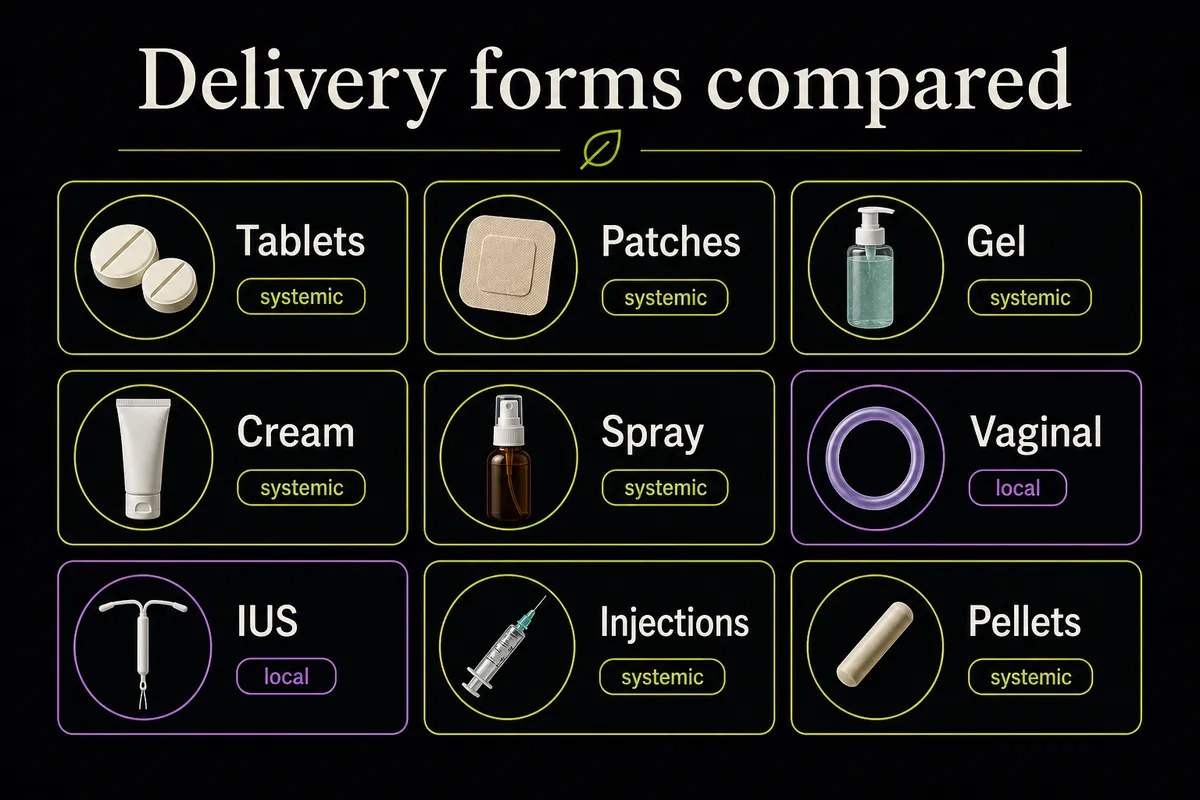
| Form | Hormones available | How often | Clot risk vs tablets | Best suited for | Watch-outs |
|---|---|---|---|---|---|
| Tablets | Estrogen only or combined | Once daily | Higher (reference) [4] | People who prefer a familiar, low-cost pill | First-pass liver, higher clot signal [4] |
| Patches | Estrogen only or combined | Change 1 to 2x weekly | No increase seen [4] | Steady levels, extra clot-risk factors | Skin irritation, adhesion [1] |
| Gel | Estrogen only (add progestogen if uterus) | Once daily | No increase seen [4] | Dose flexibility, no adhesive | Transfer to others, dry time [1][6] |
| Cream (transdermal) | Estrogen only | Once daily | No increase seen [4] | Skin-applied estrogen, alternative to gel | Less common in US, transfer risk [6] |
| Spray | Estrogen only (add progestogen if uterus) | Once daily | No increase seen [4] | Quick-drying skin option | Transfer, timing rules [6] |
| Vaginal estrogen (cream, tablet, ring) | Low-dose estrogen, local | Daily then 1 to 2x weekly, or ring every 90 days | Minimal systemic exposure [1] | Vaginal and urinary symptoms only | Does not treat hot flashes [1] |
| Hormonal IUS (progestogen arm) | Progestogen (levonorgestrel) | Replaced about every 5 years | Progestogen only, no added estrogen risk [1] | Endometrial protection plus contraception | Needs a separate estrogen source [1] |
| Injections | Estrogen (estradiol esters) | Every 3 to 4 weeks (IM) [7][8] | Not well quantified for menopause | Rare cases where other routes fail | Hormone peaks and troughs, minority choice |
| Pellets | Estrogen (and sometimes testosterone) | Implanted every 3 to 6 months | Not well quantified; often compounded | People wanting infrequent dosing | Compounded versions not FDA approved [3] |
The single most important row driver is the clot-risk column. Estrogen taken as a tablet passes through the liver first, which raises clotting factors, while estrogen absorbed through the skin does not. In a large 2019 study, oral estrogen was associated with a higher risk of venous blood clots, whereas transdermal forms (patch, gel, spray) were not associated with an increased risk [4]. That difference is why clinicians often steer women with extra clot risk toward a skin-based form [4].
HRT Tablets: Pros, Cons, and Common Names
HRT tablets are the oldest and most familiar form, taken once daily. They are the best-studied HRT medication, are usually the cheapest, and are simple to start and stop [2]. Those are real advantages. The trade-offs are that swallowed estrogen passes through the liver first, which is why oral HRT medications carry a higher blood clot signal than skin-based forms, and some people get nausea or other stomach side effects [4].
Common US HRT tablets names fall into three groups. This list of names of HRT tablets covers brands marketed in the US, and no doses are given here; your pharmacist or the current FDA label has the definitive strength and formulation for any given product.
- Estrogen-only tablets: Estrace (estradiol), Premarin (conjugated estrogens), Cenestin and Enjuvia (synthetic conjugated estrogens), Menest (esterified estrogens) - Combined tablets (estrogen plus progestogen): Prempro and Premphase (conjugated estrogens with medroxyprogesterone), Activella (estradiol with norethindrone), Angeliq (estradiol with drospirenone), Bijuva (estradiol with progesterone) - Progestogen tablets taken alongside estrogen: Prometrium (micronized progesterone), Provera (medroxyprogesterone)
We deliberately give no milligram figures here; for typical strengths by form, see our typical HRT doses by form.
HRT Patches
HRT patches are small adhesive squares that deliver estradiol through the skin, changed once or twice a week depending on the brand [1]. Because they are transdermal, they avoid the extra clot risk of tablets, which is a major reason clinicians choose them [4]. The most common complaints are skin irritation and patches not sticking well. US brands include Climara, Vivelle-Dot, Alora, and Minivelle (estrogen only), Combipatch and Climara Pro (combined), and Menostar (a low-dose patch used mainly for bone protection). Patches are their own large topic, so for placement, brands, and troubleshooting see our full guide to HRT patches.
HRT Gel: How It Works and Side Effects
HRT gel is estradiol in a clear gel that you rub into clean, dry skin on the arm or thigh once a day, letting it dry for a few minutes before dressing [1][6]. Like the patch, it is transdermal, so it bypasses the liver and does not carry the added clot risk of tablets [4]. Because it is estrogen only, anyone with a uterus needs a separate progestogen alongside it [1]. Gel appeals to people who want fine dose adjustments and dislike adhesives. US brands include EstroGel, Divigel, and Elestrin.
HRT gel side effects
The most common HRT gel side effects are mild: skin irritation at the application site, headache, and breast tenderness, especially in the first weeks [6]. The one that is specific to gel is transfer. Until it dries and absorbs, estradiol gel can rub off onto other people, so the label advice is to wash your hands after applying, let the area dry fully, and keep the site covered so children, partners, and pets do not touch it [6]. For how side effects differ across every form, see HRT side effects by type.
HRT Cream: What It Is and Where to Apply It
So what is HRT cream? The term is used for two very different products that searchers often mix up, and no ranking page separates them cleanly. The first is a transdermal estradiol cream or emulsion applied to the skin for whole-body symptoms, similar in purpose to a gel. The second, and far more common, meaning is a low-dose vaginal estrogen cream used only for local symptoms like dryness. HRT creams therefore split into systemic and local uses, and which one you mean changes everything about how it is applied and what it does.
Where to apply HRT cream
For a transdermal estradiol cream or emulsion, the product label directs application to clean, dry skin on the legs, and you should follow your specific product's instructions [6]. For a vaginal estrogen cream (such as Estrace cream or Premarin cream), the cream is placed inside the vagina using the applicator that comes with it, not rubbed on the outside for whole-body effect [1]. In every case, wash your hands afterward. We mirror the label here rather than inventing a routine, because creams differ; check the leaflet that comes with yours [6].
HRT cream side effects
Transdermal cream shares the side effects of gel: local skin irritation and the same transfer risk to other people until it absorbs [6]. Vaginal estrogen cream mostly causes local effects, such as mild irritation or discharge, and because very little is absorbed into the bloodstream it does not require a progestogen even if you have a uterus [1]. Any new vaginal bleeding while using it should still be reported to your clinician. For how HRT cream side effects sit alongside the other forms, see HRT side effects by type.
HRT Spray
HRT spray is a transdermal estradiol spray applied to the inner forearm, marketed in the US as Evamist. You use one to three sprays once a day, let the skin dry for a couple of minutes before covering it, and avoid washing the area for about an hour so the hormone can absorb [6]. Like gel, it is estrogen only, so a progestogen is needed if you have a uterus, and the same transfer precautions apply: let it dry and keep others from touching the site [6]. It suits people who want a fast-drying skin option without a patch or gel.
HRT Injections: Sites, Frequency, and How They Compare to Pills
HRT injections deliver estrogen as a long-acting estradiol ester given into muscle, most often estradiol valerate (Delestrogen) or estradiol cypionate (Depo-Estradiol), spaced roughly every three to four weeks for menopause use depending on the product [7][8]. In current US menopause practice an HRT injection is a minority choice, used far less often than transdermal or oral forms, and it is more common in other hormone contexts than in routine menopause care.
HRT injections vs pills
The honest comparison of HRT injections vs pills is a trade-off. Injections mean far fewer administration events and no daily pill to remember, which some people value. Against that, an injected dose produces a peak soon after the shot and a trough before the next one, so hormone levels swing more than with a daily tablet or a steady patch, you cannot stop quickly if a side effect appears, and there is injection discomfort. Guidelines favor the lowest effective dose in the least invasive form, which is why injections are not a first-line menopause option for most women [3].
HRT injection sites
Estradiol injections are given intramuscularly, into a large muscle such as the buttock or thigh, following the product label and only self-administered after proper training from a clinician. Because technique affects both safety and absorption, we do not publish an injection how-to here; your prescriber or nurse teaches the HRT injection sites and method if this route is right for you.
HRT Pellets
HRT pellets are small implants of estrogen (sometimes with testosterone) placed under the skin, usually in the hip, during a quick in-office procedure, releasing hormone for about three to six months. The appeal is infrequent dosing. The important caution is that most pellets are compounded rather than FDA approved, and major medical groups do not recommend routine use of compounded hormones because their dose and purity are not standardized [3]. A pellet's dose also cannot be adjusted or easily removed once implanted, so if levels run high or side effects appear, you cannot simply stop. For the full picture, see HRT pellets: what to know before an implant.
Vaginal Estrogen: Local HRT for Local Symptoms
Vaginal estrogen is a different category from all the systemic forms above. It uses a low dose of estrogen delivered right where it is needed to treat vaginal dryness, pain with sex, and some urinary symptoms, and it comes as creams (Estrace, Premarin), vaginal tablets or inserts (Vagifem, Imvexxy), and a vaginal ring (Estring) [1][2]. Two things make it distinct: it does not treat hot flashes or other whole-body symptoms, because it stays local, and because so little is absorbed it does not require a progestogen even if you have a uterus [1]. Many women use it on its own, and some use it alongside systemic HRT for symptoms a patch or pill does not fully settle.
Testosterone and HRT Cream for Men
For women, testosterone is an off-label add-on, not a standard part of HRT. It is used mainly for persistent low libido when estrogen-based HRT has not helped, and it is given in a small dose as a gel or cream applied to the skin [1]. There is no FDA-approved female testosterone product in the US, so a clinician prescribes it carefully and monitors levels; this is the context in which people search for a testosterone HRT cream for women.
An HRT cream for men means something else entirely. Male hormone therapy is testosterone replacement therapy (TRT), a separate treatment pathway for men with low testosterone, with its own gels, creams, injections, and monitoring. If that is what you are looking for, our HRT for men guide covers it properly; this page stays focused on menopause HRT and does not recommend specific products.
Which Type of HRT Is Right for You?
There is no universal best; the right type is the one that fits your body, symptoms, and history, and the different types of HRT are meant to be matched to you by a clinician, not self-selected from a list. Finding the right fit often takes a little trial and adjustment, and the NHS notes it can take up to three months to feel the full benefit of a given type and to know whether it needs tweaking [1].
Questions to bring to your clinician: - Have you had a hysterectomy? If yes, estrogen only may be enough; if not, you will need combined HRT or a progestogen [5]. - Are you still having periods? Still bleeding points toward cyclical; 12+ months without a period points toward continuous combined [1]. - Do you have a history of blood clots or migraine? A transdermal form (patch, gel, spray) is often favored over tablets [4]. - Are your symptoms only vaginal or urinary? Local vaginal estrogen alone may be all you need [1]. - Do you dislike daily dosing? A patch or a hormonal IUS reduces how often you have to think about it [1].
None of these replace a consultation; they are simply the questions a clinician weighs. If you want to see how the options line up on access and price, our guides to compare online HRT providers and what HRT costs by type cover the practical side, and if you would rather start in person, HRT doctors near you can help. For the broader background on symptoms and benefits, read our complete HRT for women guide, and if you are weighing non-hormonal options too, see our overview of peptide options for menopause.
Frequently Asked Questions
References
- NHS. Types of hormone replacement therapy (HRT). Accessed 2026. https://www.nhs.uk/medicines/hormone-replacement-therapy-hrt/types-of-hormone-replacement-therapy-hrt/
- Cleveland Clinic. Hormone Therapy for Menopause Symptoms. Accessed 2026. https://my.clevelandclinic.org/health/treatments/15245-hormone-therapy-for-menopause-symptoms
- Mayo Clinic. Hormone therapy: Is it right for you? Accessed 2026. https://www.mayoclinic.org/diseases-conditions/menopause/in-depth/hormone-therapy/art-20046372
- Vinogradova Y, Coupland C, Hippisley-Cox J. Use of hormone replacement therapy and risk of venous thromboembolism. BMJ, 2019;364:k4810. https://www.bmj.com/content/364/bmj.k4810
- National Cancer Institute. Menopausal Hormone Therapy and Cancer fact sheet. Accessed 2026. https://www.cancer.gov/about-cancer/causes-prevention/risk/hormones/mht-fact-sheet
- MedlinePlus. Estradiol Topical (gel, emulsion, spray). Accessed 2026. https://medlineplus.gov/druginfo/meds/a605041.html
- FDA. Delestrogen (estradiol valerate injection) prescribing information. Accessed 2026. https://www.accessdata.fda.gov/drugsatfda_docs/label/2024/009402s063lbl.pdf
- FDA. Depo-Estradiol (estradiol cypionate injection) prescribing information. Accessed 2026. https://www.accessdata.fda.gov/drugsatfda_docs/label/2005/085470s015lbl.pdf
Disclosure: this article contains affiliate links to Gala Health. If you start care through them, we may earn a commission at no extra cost to you.