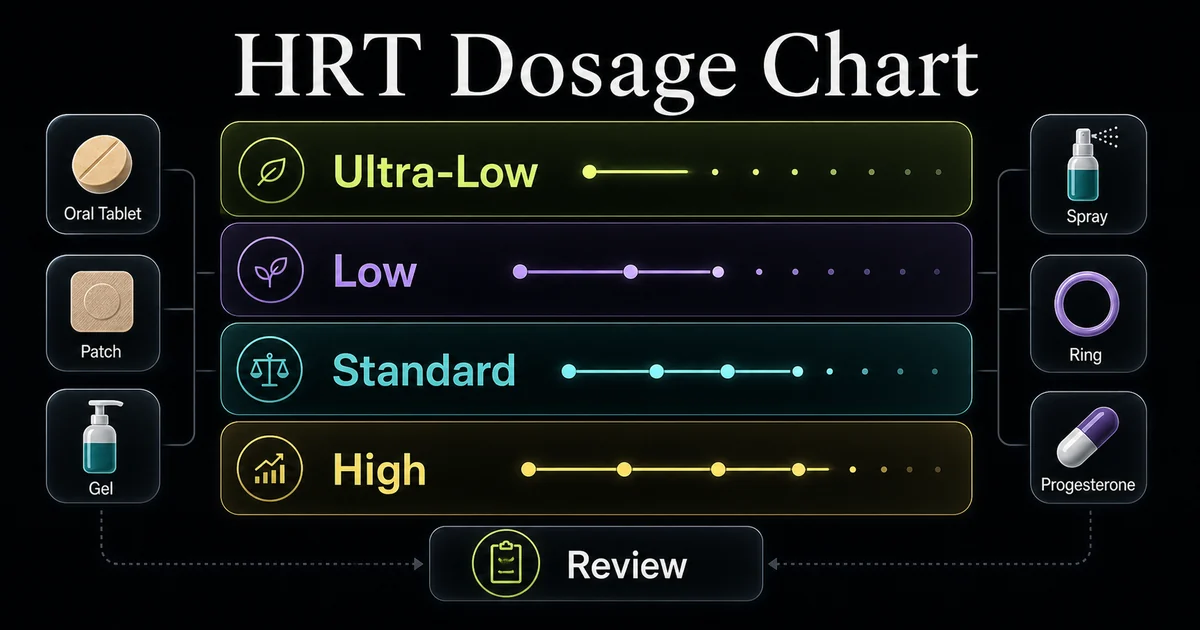

An HRT dosage chart maps the low, standard, and high doses of estradiol and progesterone used for menopause, so you can see at a glance how a pill, patch, or gel dose compares. A chart is a starting point, not a prescription. Real doses are individualized by a clinician based on your symptoms, your history, and whether you still have a uterus, and the guiding principle in every FDA label is the lowest dose that controls your symptoms [1][7]. This page pulls the FDA-label and menopause-guideline numbers into one place: a low-versus-high equivalence chart across routes, per-form estradiol tables, the lowest effective progesterone dose, and the signs clinicians use to raise or lower a dose. It stays menopause-focused throughout.
| Quick fact | What it means |
|---|---|
| Typical starting oral estradiol: 1 mg/day | The usual menopause starting tablet dose, adjusted up or down from there [1] |
| Typical starting patch: 0.025 to 0.05 mg/day | Low-to-standard transdermal start, changed once or twice weekly [1][3] |
| Standard micronized progesterone: 100 to 200 mg/night | 100 mg nightly continuous, or 200 mg for 12 to 14 nights in cyclic regimens, for anyone with a uterus [6][8] |
| Time before a dose review: 8 to 12 weeks | How long clinicians usually wait to judge a dose before changing it [7][8] |
🔑 Key Takeaways
- A chart shows ranges, not your dose. Doses are set and changed by a clinician using the lowest-effective-dose rule; never self-adjust hormone therapy [1][7].
- Routes are not linearly equivalent. Oral estradiol passes through the liver first, so 1 mg by mouth does not equal 1 mg through the skin; the equivalence chart below reflects that [2][7].
- 1 mg oral estradiol is standard, not low. Low dose is 0.5 mg oral or a 0.025 mg/day patch; standard is 1 to 2 mg oral or a 0.05 mg patch [1][2].
- The lowest standard progesterone dose is 100 mg micronized progesterone nightly for endometrial protection with continuous estrogen, or 200 mg for 12 to 14 days in cyclic regimens [6][8].
- Higher or lower is decided by symptoms and side effects, reviewed at 8 to 12 weeks, then titrated one increment at a time with your prescriber [7][8]. For the wider picture, see our HRT for women overview.
HRT Dosage Chart Menopause: Low, Standard, and High Doses
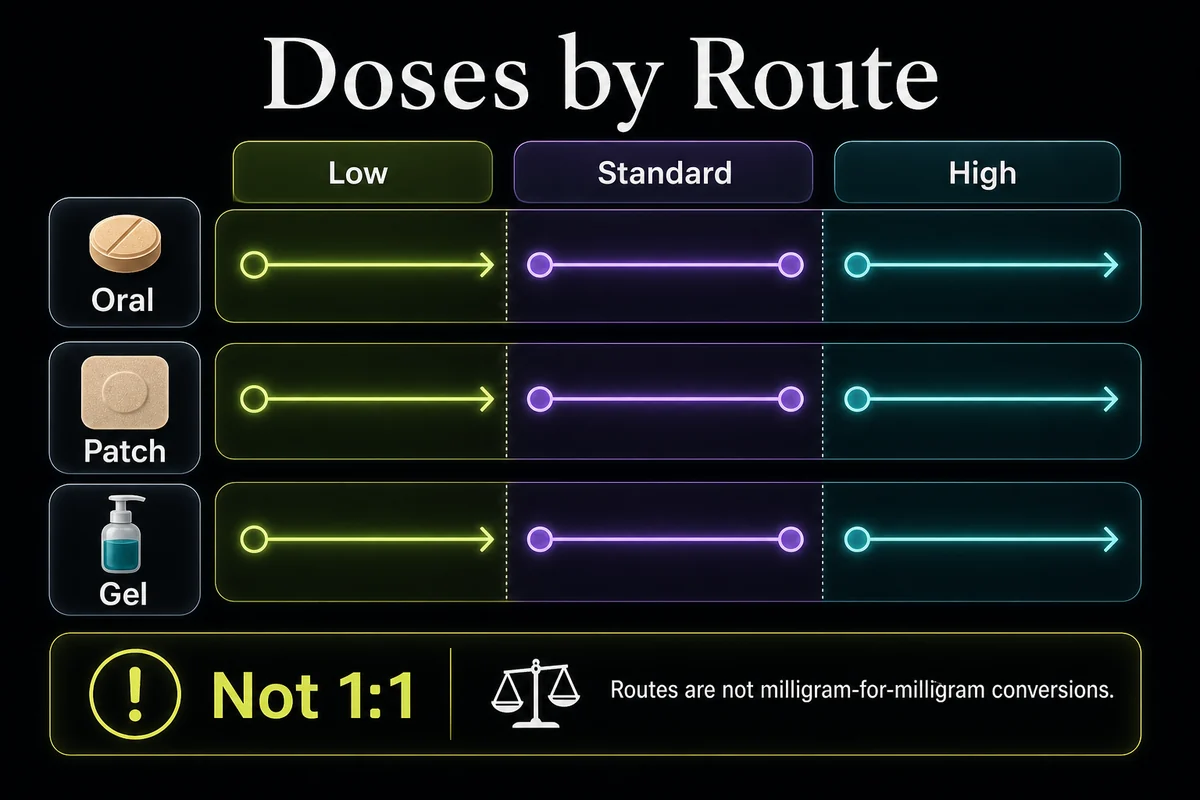
This is the core of any HRT dosage chart menopause guide: how the same effect is delivered at different strengths across the main routes. The table below lines up oral estradiol, the estradiol patch, and estradiol gel at four dose levels, from ultra-low (microdosing) up to the standard menopause ceiling. These are label ranges and published equivalence figures, not a formula to convert your own dose [1][2][3].
| Dose level | Oral estradiol (mg/day) | Estradiol patch (mg/day) | Estradiol gel (typical daily amount) | Notes |
|---|---|---|---|---|
| Ultra-low / micro | 0.5 | 0.014 to 0.025 | Divigel 0.25 mg | Menostar 0.014 mg patch is approved for bone protection, not hot flashes [1][3] |
| Low | 0.5 to 1 | 0.025 to 0.0375 | Estrogel about 0.5 mg (roughly 1 pump) | A common gentle start, especially early in the transition [2][3] |
| Standard | 1 to 2 | 0.05 | Estrogel 0.75 mg (1 pump), gel about 0.75 to 1 mg | The usual symptom-control range for most women [1][2] |
| High (menopause ceiling) | 2 | 0.075 to 0.1 | Divigel 1.25 mg, or 2 or more gel pumps | Top of standard menopause labeling; higher exists only outside menopause use [1] |
Sources: British Menopause Society low/medium/high equivalence [2], Menopause Matters HRT doses [3], FDA-label dosing via Drugs.com [1]. Gel amounts vary by product concentration, so read them as approximate cross-route anchors, not exact swaps.
What does "low dose" actually mean here? Low dose HRT means the bottom of the licensed range: 0.5 mg oral estradiol, a 0.025 mg/day patch, or a single small gel measure [1][2]. Low dose estrogen HRT is often where clinicians start, then step up only if symptoms are not controlled, which is exactly the lowest-effective-dose approach written into the labels [1][7]. When people ask what is low in HRT doses, this is the answer: not a special product, just the lowest strength of the ordinary ones.
Why are the routes not simply interchangeable milligram for milligram? Swallowed estradiol is absorbed through the gut and passes through the liver before it reaches the rest of the body, a step called first-pass metabolism that changes how much active hormone circulates and how the liver responds [7]. A patch or gel delivers estradiol through the skin straight into the bloodstream and skips that first pass, which is why a 0.05 mg patch is treated as broadly standard alongside a 1 mg tablet rather than matching it by number [2][7]. The transdermal route is also often preferred when someone has extra clot risk, because it does not raise liver clotting factors the way oral estrogen can [7][8]. None of this is a home conversion exercise; your clinician does the switch.
Estradiol Dosage by Form: Pills, Patches, Gels, Sprays, Rings
Estradiol is the estrogen used in almost all modern menopause HRT, and it comes in several forms with different strengths. The tables below list the common US products, their strengths, a usual starting point, and the label range for each route. For how the forms compare beyond dose, see our guide to the types of HRT.
Oral estradiol tablets
Oral estradiol is the most familiar form. Estrace and generic estradiol tablets come in three strengths, and the standard menopause start is 1 mg once daily, adjusted from there [1].
| Product | Strengths | Typical starting dose | Usual menopause range |
|---|---|---|---|
| Estradiol tablets (Estrace, generics) | 0.5, 1, 2 mg | 1 mg once daily | 0.5 to 2 mg/day [1] |
Anyone with a uterus taking oral estradiol also needs a progestogen to protect the womb lining; the progesterone options are covered further down [8].
Estradiol patches
Patches deliver estradiol through the skin and are changed once or twice weekly depending on the brand. Strengths run from the very low Menostar up to 0.1 mg/day. We keep patch detail at the table level here to avoid overlap; for placement, brands, and adhesion, see our HRT patches guide.
| Patch type | Example brands | Strengths (mg/day) | Change schedule |
|---|---|---|---|
| Twice-weekly | Vivelle-Dot, Alora, Minivelle, Dotti, Lyllana | 0.025 to 0.1 | Twice weekly [1][3] |
| Once-weekly | Climara | 0.025 to 0.1 | Once weekly [1][3] |
| Ultra-low weekly | Menostar | 0.014 | Once weekly, approved for bone protection [1] |
Gels and sprays
Transdermal gels and the estradiol spray are applied daily and, like patches, bypass the liver. Doses are set per pump, per packet, or per spray rather than per milligram of tablet.
| Product | Form | Per-dose strength | Notes |
|---|---|---|---|
| Divigel | Single-dose gel packet | 0.25, 0.5, 0.75, 1.0, 1.25 mg | One packet daily; the packet is the dose [1][4] |
| Estrogel | Metered pump gel | About 0.75 mg per pump | Applied to the arm, usually 1 pump daily [3][4] |
| Elestrin | Metered pump gel | About 0.52 mg per pump | Applied to the upper arm [4] |
| Evamist | Skin spray | 1.53 mg per spray | 1 to 3 sprays daily to the forearm [1][4] |
Vaginal estradiol
Vaginal estradiol is a special case: at local doses it treats vaginal and urinary symptoms only and is not a systemic menopause dose, while the Femring is dosed high enough to act systemically. Local low-dose vaginal estrogen generally does not need an added progestogen, but confirm this with your clinician [4][8].
| Product | Strength | Systemic or local | Purpose |
|---|---|---|---|
| Estring | 7.5 mcg/day ring | Local | Vaginal dryness, urinary symptoms [4] |
| Vaginal tablet (Vagifem, Yuvafem, Imvexxy) | 10 mcg | Local | Vaginal symptoms only [4] |
| Femring | 0.05 or 0.1 mg/day ring | Systemic | Full-body menopause symptoms [4] |
Do not read a local 7.5 mcg dose as a low systemic dose; the numbers look small because they are meant to stay local [4].
Lowest Dose of Progesterone for HRT
The lowest dose of progesterone for HRT that reliably protects the womb lining is 100 mg of micronized progesterone (Prometrium) taken nightly with continuous estrogen [6][8]. In cyclic or sequential regimens, where the progestogen is taken for part of the month, the standard is 200 mg at bedtime for 12 to 14 days of each cycle [3][8]. Progesterone is dosed at night because it can make you drowsy [6].
The prometrium dose for HRT is not something to minimize on your own. Lower or alternate-day compounded progesterone regimens have not been shown to give the same endometrial protection as these standard doses, so they are not a proven substitute even though they sound gentler [8]. If you have a uterus, adequate progestogen is the part of HRT that keeps estrogen from overstimulating the womb lining.
| Progestogen option | Typical dose | Role |
|---|---|---|
| Micronized progesterone (Prometrium) | 100 mg nightly continuous, or 200 mg for 12 to 14 nights cyclic | Bioidentical progesterone, first-line for endometrial protection [6][8] |
| Medroxyprogesterone acetate (Provera) | 2.5 to 10 mg | Synthetic progestin, continuous or cyclic [1][8] |
| Norethindrone acetate | Fixed dose within combination products | Built into some combined pills and patches [8] |
| Levonorgestrel IUD (Mirena) | Intrauterine, off-label for HRT | Delivers progestogen locally to the lining; discuss suitability with a clinician [8] |
Why does this matter enough to get right? Taking estrogen without enough progestogen when you still have a uterus raises the risk of endometrial cancer over time [8]. In absolute terms the added risk from a properly progestogen-protected regimen is small, but under-dosing or skipping the progestogen is one of the few clear ways to push that risk up, which is why clinicians treat the 100 to 200 mg standard as a floor rather than a target to shave [8]. This is guidance, not a scare: it simply means the progesterone part of your regimen is not the place to experiment.
What Is the Highest Dose of HRT?
For menopause, the highest dose of HRT sits at the top of the standard label range for each route [1]:
- Oral estradiol: 2 mg/day is the usual menopause ceiling [1]. - Estradiol patch: 0.1 mg/day [1][3]. - Divigel: 1.25 mg/day [1]. - Femring: 0.1 mg/day [4].
Higher estradiol doses do exist, but outside menopause labeling, in different clinical contexts and under specialist care. This page stays within menopause HRT and does not cover those protocols. If you are already at the top of the menopause range and still symptomatic, that is a conversation for your prescriber about whether the dose, the route, or something else needs to change, not a cue to exceed the label yourself [1][7].
How Do I Know If I Need a Higher Dose of HRT?
The most common way to know if you need a higher dose of HRT is that your menopause symptoms are still not controlled after a fair trial, usually 8 to 12 weeks, on your current dose [7][8]. HRT takes time to reach full effect, so the judgement is made after that window, not in the first couple of weeks. For the full timeline, see how long HRT takes to work.
| Sign after 8 to 12 weeks | What it can suggest | Important caveat |
|---|---|---|
| Hot flashes and night sweats still frequent | Estrogen dose may be too low [7] | Give it the full window first; early weeks are not a fair test [8] |
| Sleep still broken by sweats | Under-treated vasomotor symptoms [7] | Sleep has many non-hormonal causes too |
| Ongoing vaginal dryness | Systemic dose low, or local estrogen needed [4] | Vaginal symptoms sometimes need a separate local product [4] |
| Persistent low mood or brain fog | Possibly under-treated, possibly not hormonal | Mood and fatigue overlap with many other causes; do not assume it is only the dose [7] |
If symptoms genuinely persist, clinicians step the dose up one increment at a time, for example 1 mg to 2 mg oral estradiol, or a 0.025 mg patch to 0.0375 or 0.05 mg, then reassess at the next review [1][3]. Blood levels are occasionally checked, mainly with patches and gels; for what those numbers mean, see what your estradiol level should be on HRT. The rule throughout is to talk to your clinician and change one thing at a time, never to self-adjust.
How Do I Know If I Need a Lower Dose of HRT?
You may need a lower dose of HRT if you develop estrogen-excess side effects, which is also how to tell if your HRT dose is too high [1][7]. These tend to show up in the first weeks and often settle, so the timing and pattern matter as much as the symptom itself.
| Sign | What it can suggest | What to do |
|---|---|---|
| Breast tenderness or swelling | Estrogen effect stronger than needed [7] | Report it; often eases, sometimes prompts a small dose cut |
| Bloating or fluid retention | Common early estrogen side effect [7] | Usually settles; mention at review |
| Nausea | More common with oral estrogen [1] | Switching to a patch or gel can help [7] |
| Headaches | Can track with dose or hormone swings [5] | Note timing; discuss route change |
| Unscheduled or new bleeding | Needs assessment, not self-adjustment [8] | See bleeding on HRT and tell your clinician |
FDA labeling asks clinicians to use the lowest effective dose and to reevaluate treatment periodically, often every 3 to 6 months, which is the built-in checkpoint for stepping down if you do not need as much [1]. Do not stop abruptly on your own, because that tends to cause a rebound of symptoms; a planned reduction with your prescriber is smoother. For the broader list of what to expect, see HRT side effects.
Microdosing HRT: What Low Dose HRT Really Means
Microdosing HRT is an informal name for starting at the very bottom of the licensed dose range, not a separate class of treatment. The lowest doses of HRT available as approved products are the Menostar 0.014 mg/day weekly patch, other 0.025 mg patches, the 0.5 mg oral estradiol tablet, and the Divigel 0.25 mg packet [1][3]. So when someone asks what is the lowest dose of HRT available, Menostar 0.014 mg/day is the lowest systemic estradiol product, though it is approved to protect bone rather than to treat hot flashes [1].
HRT microdosing in this sense simply means using those lowest label strengths, and it is a legitimate, low-and-slow way to begin. It is different from true sub-label compounded dosing, where a compounding pharmacy makes custom strengths below or between approved products. Those compounded ranges are not FDA-reviewed doses and their endometrial protection and consistency are not established the same way [8]. If you are weighing compounded options, read our context on bioidentical HRT and natural HRT first, because "natural" and "microdosed" are marketing words as often as clinical ones.
What Happens If You Miss a Dose of HRT?
What happens if you miss a dose of HRT is usually minor: you may get a short spell of flushing or light spotting as levels dip, but a single missed dose is not dangerous, and the fix is to get back on schedule rather than to double up [5][6]. The exact catch-up step depends on the form.
| Form | If you miss a dose | Do not |
|---|---|---|
| Oral tablet | Take it when you remember, unless it is nearly time for the next dose, then skip the missed one [5] | Do not take two tablets to catch up [5] |
| Patch | Apply a new patch as soon as you remember, then keep your original change days [5] | Do not change your regular schedule |
| Gel or spray | If it is close to the next dose, skip the missed one and resume normally [5] | Do not apply a double amount |
| Progesterone capsule | Take it at bedtime when remembered; if it is nearly morning, skip it and resume that night [6] | Do not double the nightly dose [6] |
Frequent missed doses are one of the most common causes of breakthrough spotting, so a daily reminder or a fixed patch-change day fixes more bleeding problems than a dose change does [5]. If bleeding continues once you are back on schedule, have it checked [8].
Testosterone and HRT Dosage for Women
There is no FDA-approved testosterone product for women in the US, so an HRT testosterone dosage for women is always off-label and prescriber-managed [8]. Where it is used, the main evidence-supported reason is low sexual desire (hypoactive sexual desire disorder) after other causes are addressed, and the guideline position from the Global Consensus statement and menopause societies is to consider low-dose transdermal testosterone at roughly one-tenth of typical male dosing, with blood levels kept in the female range [8]. Because there is no approved female product and no simple home protocol, we do not publish a female testosterone dose table here; the specific amount and monitoring belong with a clinician who can measure levels and adjust. For male dosing context, which is a different topic, see HRT for men.
How Doctors Adjust Your HRT Dose Over Time
Dose setting in HRT is a loop, not a one-time decision. A typical pattern looks like this [7][8][9]:
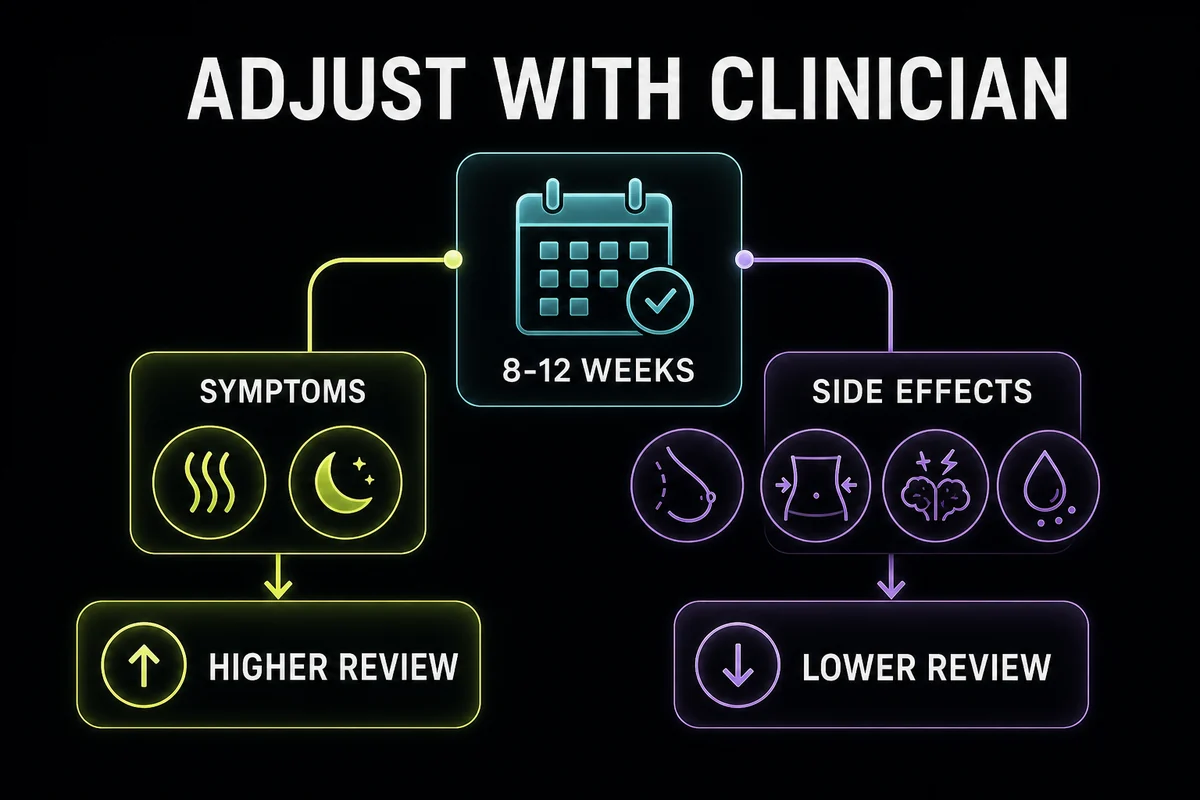
- Start low and review at 8 to 12 weeks. That window gives the dose a fair trial before any change [7][8]. - Titrate by symptoms. Step up if symptoms persist, step down if side effects appear, one increment at a time [1][7]. - Check levels where relevant. Mainly with patches and gels, and mainly if response is unexpected; oral dosing is usually judged on symptoms [8]. - Reassess route. A switch from oral to transdermal is common if clot risk factors are present, since the skin route does not raise liver clotting factors [7][8]. - Review at least yearly. An annual check revisits whether to continue, adjust, or plan an eventual taper [8][9].
Pellets are dosed on a different model again, as an implant rather than a daily or weekly dose, and we do not chart them here; see HRT pellet dosing for how that differs. Regimen also shifts with menopausal stage, which we cover in HRT for perimenopause.
If you do not yet have a prescriber to do this titration with, that is the next step, because none of the numbers above become a personal dose without one. You can compare the best online HRT providers to find a clinician who will set and adjust your dose, and review what HRT costs with and without insurance before you book. For a non-hormonal angle on menopause support, see our overview of peptides for menopause.
Frequently Asked Questions
References
- Drugs.com. Estradiol Dosage Guide (FDA-label based). Accessed 2026. https://www.drugs.com/dosage/estradiol.html
- British Menopause Society. HRT Practical Prescribing, May 2026. https://thebms.org.uk/wp-content/uploads/2026/06/03-NEW-BMS-TfC-Practical-Prescribing-MAY2026-C.pdf
- Menopause Matters. HRT preparations and doses, September 2021. https://www.menopausematters.co.uk/pdf/HRT-Doses-Sep2021.pdf
- Speaking of Women's Health. Menopausal Hormone Therapy Chart. Accessed 2026. https://speakingofwomenshealth.com/health-library/menopausal-hormone-therapy-chart
- MedlinePlus. Estradiol. Accessed 2026. https://medlineplus.gov/druginfo/meds/a682922.html
- MedlinePlus. Progesterone. Accessed 2026. https://medlineplus.gov/druginfo/meds/a604017.html
- Mayo Clinic. Hormone therapy: Is it right for you? Accessed 2026. https://www.mayoclinic.org/diseases-conditions/menopause/in-depth/hormone-therapy/art-20046372
- The Menopause Society (NAMS). 2022 Hormone Therapy Position Statement. https://menopause.org/wp-content/uploads/professional/nams-2022-hormone-therapy-position-statement.pdf
- NHS. Hormone replacement therapy (HRT). Accessed 2026. https://www.nhs.uk/conditions/hormone-replacement-therapy-hrt/
Disclosure: this article contains affiliate links to Gala Health. If you start care through them, we may earn a commission at no extra cost to you.