
Bleeding on HRT is one of the most common reasons women worry about hormone replacement therapy, and in most cases it is the body settling in rather than a sign of anything serious. Unexpected bleeding or spotting is common enough that clinic figures suggest up to 60% of HRT users notice it at some point, most often in the first 3 to 6 months after starting or changing a regimen [8]. This guide does two things: it explains exactly what bleeding to expect on each type of HRT, and it lays out the specific triggers that current menopause guidelines use to decide when bleeding should be checked. Bleeding while on HRT is usually manageable, and knowing the normal pattern is what helps you tell routine from red flag.
| Quick fact | What it means |
|---|---|
| Up to 60% of women on HRT report some bleeding | Bleeding is a common side effect, not a sign something is wrong [8] |
| Around 80% on continuous combined HRT bleed in month 1, under 10% after 12 months | Most early bleeding settles as the body adjusts [8][9] |
| Fewer than 1 in 200 (under 0.5%) of women who bleed on HRT are found to have cancer | The checkup is about ruling out a rare cause, not confirming one [4] |
| 3 to 6 months | The normal settling-in window after starting or changing HRT [3][4] |
🔑 Key Takeaways
- Early bleeding is usually the body adjusting. Spotting or bleeding in the first 3 to 6 months of starting or changing HRT is common and typically settles on its own [3][4].
- What is expected depends on your regimen. A scheduled monthly bleed is by design on cyclical HRT, while continuous combined HRT is meant to produce no bleeding once you are past the settling-in window [4].
- Some bleeding earns a call. New bleeding after a settled stretch, heavy or prolonged bleeding, or bleeding after sex should be reviewed rather than waited out [1][4].
- Do not stop HRT abruptly on your own. Stopping suddenly rebounds symptoms and makes the cause of bleeding harder to identify [4].
- Investigations are simple and cancer is a rare finding. The workup usually starts with an ultrasound, and fewer than 1 in 200 women who bleed on HRT turn out to have cancer [4].
Is Bleeding on HRT Normal?
Yes, bleeding on HRT is normal and common, especially in the first months. So can HRT cause bleeding, and does HRT cause bleeding for most women at some stage? It does, particularly early on, because hormone therapy changes the signals to the lining of your womb (the endometrium) and that lining takes time to settle into a new rhythm [3][5]. It helps to name the two kinds of bleeding, because they mean very different things:
- Scheduled (withdrawal) bleeding is a planned, predictable bleed built into cyclical HRT, when the progestogen part of the regimen is stopped for several days each cycle and the lining sheds in response, much like a period. - Unscheduled (breakthrough) bleeding is any bleeding that is not planned: spotting, an unexpected bleed on continuous HRT, or a bleed at the wrong time on a cyclical regimen.
The mechanism behind hrt and bleeding is straightforward: estrogen builds up the lining of the womb and progestogen keeps it thin. When that balance is briefly off, for example while you adjust to a new dose, the lining can shed unpredictably and you see spotting or bleeding. Mayo Clinic notes that HRT-related bleeding can be light or as heavy as a period and often stops within about six months [3]. For what else changes when you start therapy, see our guide to other common HRT side effects.
What Bleeding to Expect on Each Type of HRT
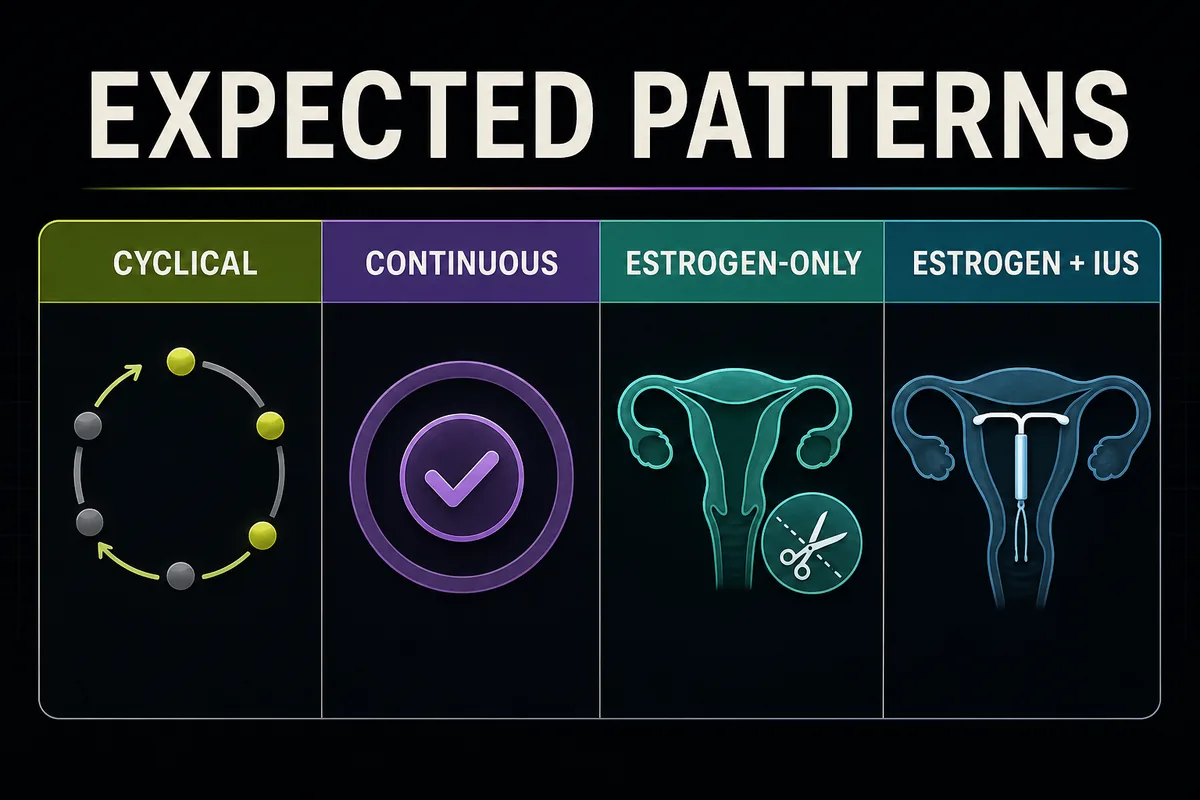
The kind of HRT you are on largely decides what a normal bleeding pattern looks like. There are three main regimens for a US reader, plus a common variation using a hormonal coil. Understanding types of HRT and how the regimens differ makes your own pattern much easier to read. In short: cyclical (sequential) combined HRT is designed to give a regular monthly bleed (around 85% of sequential users get it [8]), continuous combined HRT is designed for no bleeding once settled, estrogen-only HRT (used only after a hysterectomy) should cause no bleeding at all, and estrogen plus a Mirena IUS usually lightens or stops bleeding over time [3][4].
| HRT type | Who it is usually for | Expected bleeding | When bleeding is NOT expected |
|---|---|---|---|
| Cyclical / sequential combined | Perimenopause or early postmenopause | A regular monthly withdrawal bleed, often 3 to 7 days [4] | Bleeding at the wrong time in the cycle, or bleeds that become heavy or prolonged [4] |
| Continuous combined | 12+ months past last period | Irregular spotting or bleeding in the first 3 to 6 months only | Any bleeding once settled, or new bleeding after 6 months [4] |
| Estrogen-only (post hysterectomy) | Women without a uterus | None, ever | Any vaginal bleeding needs review because there is no lining to shed [4] |
| Estrogen + Mirena IUS | Those needing endometrial protection or lighter bleeds | Irregular spotting early, then usually light or no bleeding | Persistent or new heavy bleeding after the settling phase |
Missing an expected monthly bleed on cyclical HRT is usually fine, and can be an early sign you are moving closer to menopause and may be ready to switch to a continuous regimen. That is a change to make with your prescriber, not a reason to worry.
What Causes Bleeding on Continuous HRT
Continuous combined HRT is meant to give no bleeding at all, so a bleed on this regimen understandably gets attention. Here is what causes bleeding on continuous HRT, in rough order of how common each cause is.
The First 3 to 6 Months of Adjustment
By far the most common reason is that your body is still adjusting, as the lining thins out and stabilizes under daily progestogen. Clinic figures put this in perspective: around 80% of women bleed in the first month, roughly half are still bleeding at 3 months, and under 10% after a full year [8][9]. The NHS lists irregular bleeding or spotting as a normal side effect in the first few months of starting HRT [5]. This is the wait-and-track category, not the alarm category.
Starting Continuous HRT Too Early
If you begin continuous combined HRT while still perimenopausal, your own ovaries may still be producing estrogen in fluctuating bursts, and those natural surges compete with the steady hormones in your HRT and can trigger breakthrough bleeding. This is why guidelines reserve continuous regimens for women at least 12 months past their last natural period, and why a sequential regimen is often the better fit earlier on [4].
Progestogen Dose Too Low, Missed Doses, or Poor Absorption
The progestogen is what keeps the lining thin, so anything that reduces its effect can cause bleeding: a dose that is a little too low for you, missed doses, or patches, gels, and sprays that are not absorbing well through the skin. These are among the most fixable causes, usually with a dose or delivery change guided by your prescriber.
Structural Causes: Polyps, Fibroids, and Atrophy
Sometimes the bleeding is not about the hormones but about the plumbing. Small growths in the lining (endometrial polyps), fibroids in the muscle of the womb, and thinning of the vaginal or endometrial tissue (atrophy) can all cause spotting or bleeding. These are common, usually benign, and easy to identify on the standard workup. Vaginal atrophy in particular is a frequent and very treatable cause of light spotting.
Heavy Bleeding on Continuous HRT
Heavy bleeding on continuous HRT is different from light early spotting, and it is a see-your-doctor sign rather than a wait-it-out one. Very heavy or prolonged bleeding is on the NHS red flag list for prompt review, whatever your regimen [4]. The reassurance underneath this matters, though: even among women who do bleed on HRT, fewer than 1 in 200 (under 0.5%) are found to have cancer [4]. Getting checked is about confirming you are in the large majority, not because heavy bleeding usually means something serious.
Spotting on HRT and Breakthrough Bleeding
Spotting on HRT is light bleeding that does not need a pad or tampon, often just a few spots of pink or brown you notice on wiping. It sits at the mildest end of unscheduled bleeding, and hrt breakthrough bleeding is the broader term for any unplanned bleed while on hormone therapy. Spotting while on HRT shares the same causes and timeline as heavier breakthrough bleeding: adjustment in the first few months, progestogen effect, absorption, and structural causes like atrophy or polyps.
Most early hrt spotting settles on its own and only needs to be noted for your next review. But spotting alone still deserves a call if it happens after sex, returns after a settled stretch, or comes with pelvic pain or unusual discharge. Whenever hrt and spotting show up, the most useful thing you can do is track it: dates, how heavy it is, and anything that seems to trigger it. That record makes your review appointment far more productive.
Perimenopause HRT and Periods
Perimenopause is the stage where this gets genuinely confusing, because your own cycles are already erratic before HRT is added to the mix. Sorting out perimenopause HRT and periods comes down to knowing what your regimen is designed to do. If you are new to this stage, our guide to HRT for perimenopause covers the bigger picture.
Does HRT Stop Your Periods?
No, HRT does not stop your periods, and this is one of the most common misunderstandings. Cyclical HRT does not switch off your natural cycle; it adds a scheduled monthly withdrawal bleed on top of whatever your ovaries are still doing. Only menopause itself stops periods for good. So does HRT stop periods? Not the way many people expect. One exception worth knowing: using a Mirena IUS as the progestogen arm often lightens or stops bleeding over time.
Why Your Periods Seem to Come Back on HRT
If it feels like your periods have returned, the explanation depends on your regimen. On cyclical HRT, the monthly bleed is a withdrawal bleed, not a true menstrual period, even though it looks and feels similar. When people say their hrt periods return, this scheduled bleed is usually what they mean, and it is entirely expected. On continuous HRT, though, a period-like return of bleeding is unscheduled by definition and worth reviewing, especially after a settled stretch.
The practical skill in perimenopause is separating perimenopausal chaos from HRT-caused bleeding by pattern and timing, because fluctuating natural estrogen causes irregular bleeding of its own. If you are still deciding between approaches, our comparison of HRT or the pill in perimenopause explains how each handles cycle control.
Bleeding on HRT Guidelines: When to See a Doctor
The most detailed guidance anywhere on this exact problem is the December 2024 joint guideline on the management of unscheduled bleeding on HRT, produced by the British Menopause Society with the RCOG, RCGP, BSGE, BGCS, FSRH and GIRFT [1][2]. It is written for clinicians, so here is the patient translation, with US context from ACOG and The Menopause Society [6][7]. These bleeding on HRT guidelines boil down to a few practical rules.
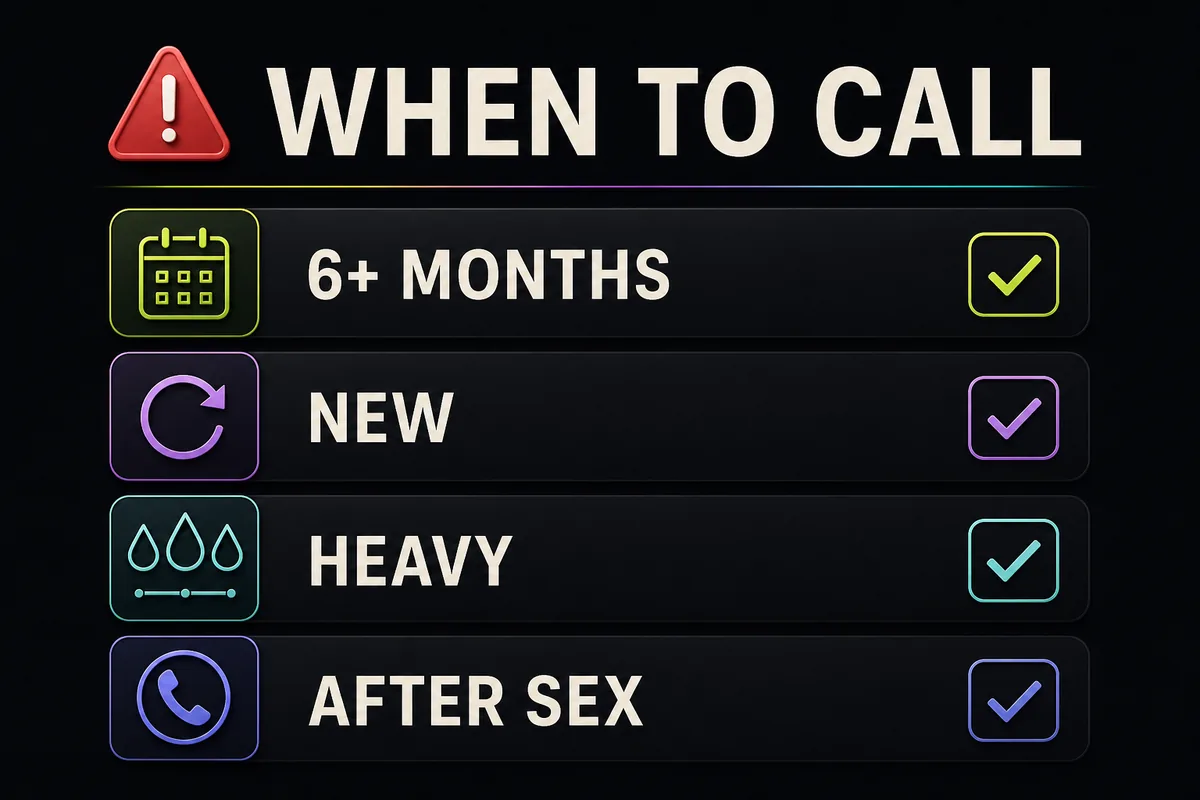
- Bleeding in the first 3 months of starting or changing HRT is expected. Note it and mention it at your review [4][5]. - Still bleeding at 3 months? Book a review appointment so your regimen can be looked at [4]. - Bleeding past 6 months, or new bleeding after a settled stretch (sudden bleeding on HRT) needs investigation, usually starting with an ultrasound [1][4]. - Immediate review regardless of timing for very heavy or prolonged bleeding, bleeding after sex, any bleeding if you have no uterus, or any bleeding if you are 12 or more months past your last period and not on HRT [4][6].
Call your clinician promptly if you have: very heavy or prolonged bleeding, bleeding after sex, any bleeding when you have had a hysterectomy, or any new bleeding after months with none. These do not usually mean something serious, but current guidelines put them on the get-checked-now list rather than the wait-and-see one [1][4].
Some people should be seen sooner because their baseline risk is higher: a BMI over 40, diabetes, Lynch or Cowden syndrome, having a uterus but no progestogen cover for 6 or more months, or being on sequential HRT for over 5 years [4]. If any of these apply, mention it when you book.
| Scenario | Is it expected? | What guidelines advise |
|---|---|---|
| Bleeding in first 3 months of new or changed HRT | Yes | Note it, track it, raise it at review [4][5] |
| Monthly bleed on cyclical HRT | Yes, by design | No action needed; this is the planned withdrawal bleed [3][4] |
| Missed withdrawal bleed on cyclical HRT | Usually fine | Often normal; can signal readiness to switch to continuous, discuss at review [4] |
| Bleeding still present at 3 to 6 months | Borderline | Book a review to assess the regimen [4] |
| Bleeding persisting past 6 months | No | Investigate, usually starting with ultrasound [1][4] |
| New bleeding after a settled stretch | No | Review and investigate even if light [1][4] |
| Heavy or prolonged bleeding, or bleeding after sex | No | Prompt review regardless of timing [1][4] |
| Any bleeding with no uterus | No | Prompt review, always [4][6] |
What Tests to Expect
If your bleeding does need looking into, the workup is calm and stepwise, and most of it ends in reassurance or a simple HRT adjustment. It usually begins with a history and a pelvic exam, then a transvaginal ultrasound to measure the thickness of your womb lining. Guidelines use endometrial thickness thresholds to decide whether further tests are needed, with different cut-offs for continuous versus sequential regimens: under the 2024 BMS guideline, a lining measuring 4 mm or less on continuous combined HRT, or 7 mm or less on sequential HRT, is reassuring, while readings above those cut-offs prompt referral for further assessment [1]. Only if the ultrasound is inconclusive or the lining looks thickened would you go on to a hysteroscopy (a slim camera look inside the womb) or a biopsy. The great majority of these investigations find a benign cause or nothing at all [4][6].
How to Stop Bleeding on HRT
There is no safe do-it-yourself way to stop bleeding on HRT; the fixes are clinician-led, but they are usually simple. How to stop bleeding on HRT depends entirely on what is driving it, which is exactly why the review matters.
- Give it time. In the first 3 to 6 months, the most effective move is often patience while your body settles [3][5]. - Adjust the progestogen. Increasing, changing, or re-timing the progestogen is a common first step when the lining is not staying thin. - Adjust the estrogen or switch route. Changing the estrogen dose, or switching between patch, gel, spray, and tablet, can fix bleeding driven by absorption. Our HRT dosage chart gives context on typical doses. - Switch regimen. Moving to sequential HRT while still perimenopausal, or to continuous once you are 12 or more months past your period, often resolves regimen-mismatch bleeding. - Consider a Mirena IUS as the progestogen arm, which frequently lightens or stops bleeding over time. - Treat the specific cause. Vaginal estrogen helps atrophy-related spotting, and polyps or fibroids can be removed if they are found to be the problem.
One firm rule: do not stop HRT abruptly on your own. Stopping suddenly can rebound your symptoms and muddies the diagnosis by changing the very pattern a clinician is trying to read [4]. If you do want to come off therapy, our guide on how to stop HRT safely covers doing it in a planned way.
If your prescriber is hard to reach, that gap is worth closing rather than living with unexplained bleeding. You can find in-person options through HRT doctors near me, or, if you cannot get a prompt appointment with your current prescriber, an online HRT clinic can reassess your dose and regimen remotely. For the full picture of therapy, our complete guide to HRT for women is a good companion read.
Frequently Asked Questions
References
- British Menopause Society and partners (RCOG, RCGP, BSGE, BGCS, FSRH, GIRFT). Management of unscheduled bleeding on hormone replacement therapy (HRT). December 2024. https://thebms.org.uk/publications/bms-guidelines/management-of-unscheduled-bleeding-on-hormone-replacement-therapy-hrt/
- Royal College of Obstetricians and Gynaecologists. Management of unscheduled bleeding on hormone replacement therapy (HRT). 2024. https://www.rcog.org.uk/guidance/browse-all-guidance/other-guidelines-and-reports/management-of-unscheduled-bleeding-on-hormone-replacement-therapy-hrt/
- Mayo Clinic. Menopause hormone therapy: Does it cause vaginal bleeding? Updated 2025. https://www.mayoclinic.org/diseases-conditions/menopause/expert-answers/hormone-replacement-therapy/faq-20058499
- Leeds Teaching Hospitals NHS Trust. HRT and Unscheduled Vaginal Bleeding. Accessed 2026. https://www.leedsth.nhs.uk/services/gynaecology/menopause/vaginal-bleeding-hrt/
- NHS. Side effects of hormone replacement therapy (HRT). Accessed 2026. https://www.nhs.uk/medicines/hormone-replacement-therapy-hrt/side-effects-of-hormone-replacement-therapy-hrt/
- American College of Obstetricians and Gynecologists. Perimenopausal Bleeding and Bleeding After Menopause. Accessed 2026. https://www.acog.org/womens-health/faqs/perimenopausal-bleeding-and-bleeding-after-menopause
- The Menopause Society (formerly NAMS). The 2022 Hormone Therapy Position Statement. https://menopause.org/professional-resources/position-statements
- Menopause Care. Bleeding on HRT: What's Normal? Accessed 2026. https://www.menopausecare.co.uk/blog/bleeding-on-hrt
- Abnormal Bleeding During Menopause Hormone Therapy: Insights for Clinical Management. NCBI PMC3941181. Accessed 2026. https://pmc.ncbi.nlm.nih.gov/articles/PMC3941181/
Disclosure: this article contains affiliate links to Gala Health. If you start care through them, we may earn a commission at no extra cost to you.