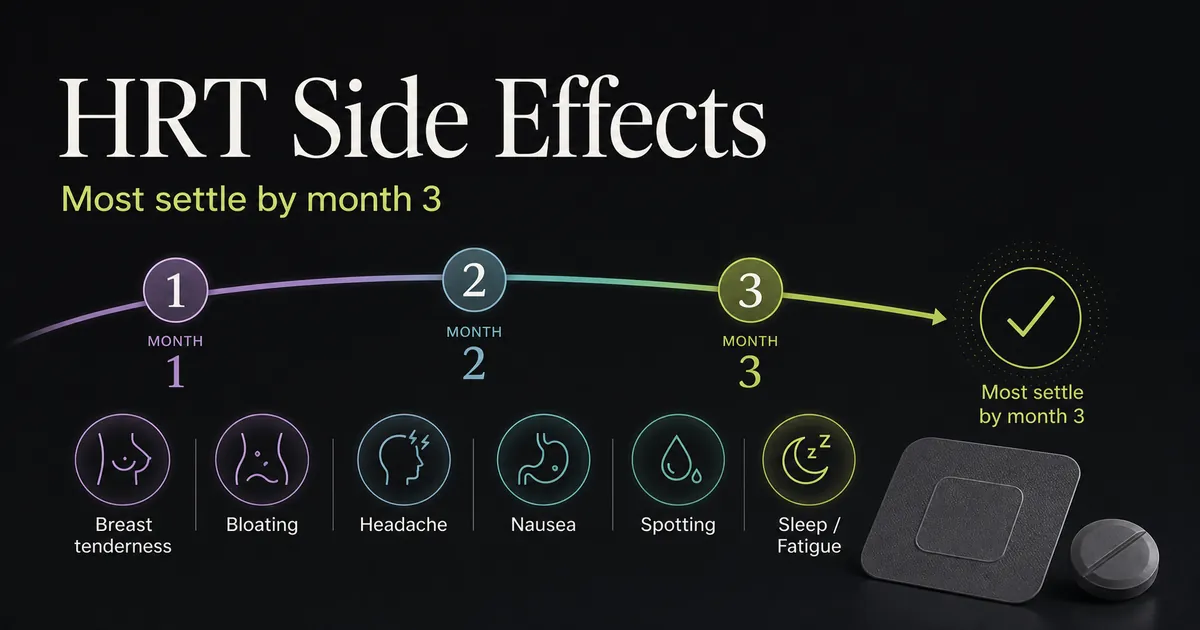

HRT side effects are usually mild, tend to mirror the menopause symptoms you already know, and settle within about three months as your body adjusts to the new hormone levels. Most of the side effects of HRT for menopause show up in the first few weeks, while estrogen and progesterone are still finding their level, which is why guidelines suggest giving a new regimen at least three months before deciding it is not working for you [1]. This guide covers what is normal early on, how estrogen and progesterone cause different effects, how your delivery method changes the picture, the serious risks in their real context, and the specific signs that are worth a call to your clinician.
🔑 Key Takeaways
- Most side effects fade by month 3. The common ones (breast tenderness, nausea, bloating, headaches) usually appear early and settle as levels stabilize, so guidance is to persevere for about three months before switching [1].
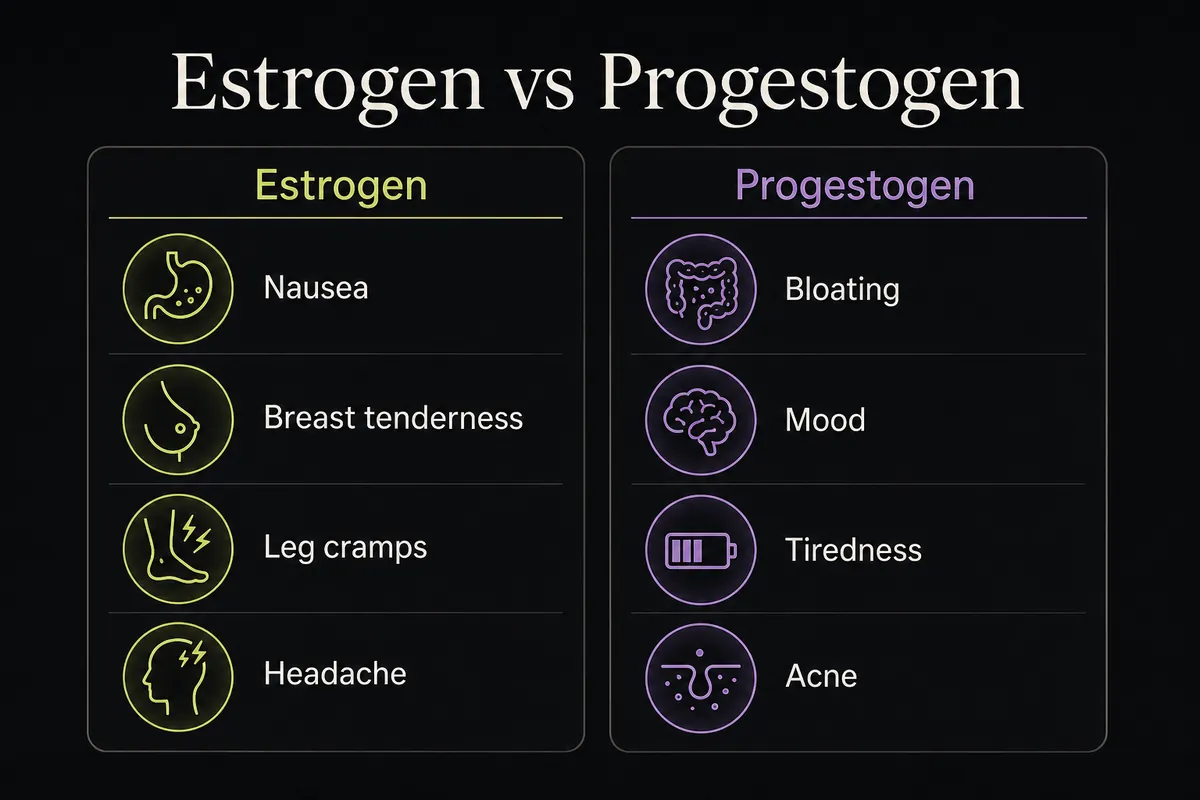
- Estrogen and progesterone cause different effects. Estrogen is more often behind nausea, leg cramps, and breast tenderness, while the progesterone or progestogen part is more often linked to bloating, low mood, tiredness, and acne [1].
- Patches and gels sidestep several oral side effects. The transdermal route avoids the liver first-pass that drives some nausea, and it is not associated with the higher clot risk seen with oral tablets [8].
- Serious risks are rare and age-dependent. For healthy women under 60 or within 10 years of menopause, guidelines conclude the benefits of HRT generally outweigh the risks [2][6].
What Are the Most Common Side Effects of HRT?
Whether people call them side effects of HRT, HRT therapy side effects, or side effects of HRT therapy, the pattern clinicians see most is the same: a cluster of mild, hormone-driven effects in the first few weeks that ease as your body adapts. The single most useful thing to know is the timeline. The NHS advises that most side effects settle within three months, so the standard first move is to give a new regimen time rather than stop early [1].
| Quick stat | What it means |
|---|---|
| About 3 months | The typical window for most side effects to settle [1] |
| 9 estrogen and 9 progestogen effects | The number of common side effects the NHS lists for each hormone [1] |
| 3 to 6 months | How long irregular bleeding can take to settle and still be normal [1] |
| Under 60 or within 10 years of menopause | The window where benefits generally outweigh risks [2][6] |
The table below is the single most useful reference on this page: every common side effect, the hormone usually behind it, roughly how long it lasts, and what tends to help. No numbers here are diagnoses of your situation, they are the typical pattern that guidelines and clinic experience describe.
Table 1: HRT side effects at a glance
| Side effect | Usually linked to | Typical duration | What helps |
|---|---|---|---|
| Breast tenderness | Estrogen (and progestogen) | Weeks to about 3 months | Supportive bra, review dose or type if it persists [1][5] |
| Nausea | Oral estrogen mainly | First few weeks | Take tablets with food, ask about a patch or gel [1][2] |
| Bloating | Progesterone or progestogen | Weeks to a few months | Hydration, less salt, smaller meals [1] |
| Headaches | Estrogen (and progestogen) | Usually transient, first weeks | Steady hydration, regular meals, OTC pain relief; transdermal often preferred for migraine [4][8] |
| Spotting or irregular bleeding | Both, endometrial adjustment | Up to 3 to 6 months | Give it time, note the pattern, review if it lasts beyond 6 months [1] |
| Mood changes | Progestogen more than estrogen | First weeks | Often eases; switching the progestogen type can help [1] |
| Tiredness or dizziness | Progestogen | First weeks | Take oral micronized progesterone at bedtime [1] |
| Leg cramps | Estrogen | First weeks | Stretching, hydration, gentle activity [1] |
| Acne | Progestogen | Weeks to months | Basic skincare, switch progestogen type if it persists [1] |
| Skin rash or itching | Estrogen (or patch adhesive) | Variable | Rotate patch sites, review the formulation [1][4] |
| Hair thinning or changes | Estrogen and progestogen balance | Variable | Usually settles; see the hair section below [1] |
| Diarrhea | Both | Usually short-lived | Usually mild; a delivery-method switch can help if it persists [1] |
Data sources: NHS estrogen and progestogen side effect lists [1], with management framing consistent with Mayo Clinic, Patient.info, and ACOG guidance [2][4][5].
HRT Estrogen Side Effects
The estrogen part of HRT is the one that relieves hot flashes and night sweats, and its common side effects reflect the body adjusting to a higher, steadier estrogen level. The NHS lists nine HRT estrogen side effects: headaches, breast tenderness or swelling, spotting or light bleeding, nausea, mood changes, leg cramps, a rash or itching, diarrhea, and hair loss [1]. A drug reference for estradiol lists the same core effects, which is a useful cross-check that the NHS list is not UK-specific [9].
One detail matters for how you take estrogen. Oral estrogen passes through the liver first, which makes nausea more likely and is also why oral tablets carry a higher blood clot risk than estrogen delivered through the skin [8]. If nausea or the clot-risk question is on your mind, a patch or gel sidesteps both, which is covered in the delivery-method section below. Hair changes are common enough to worry people; for how estrogen affects the scalp and what helps, see HRT and hair loss.
Progesterone and Progestogen Side Effects
If you still have a uterus, HRT includes a progesterone or synthetic progestogen to protect the womb lining, and this component causes a slightly different set of effects. The NHS progestogen list is: period or bleeding changes, headaches, breast tenderness, nausea, diarrhea, tiredness or dizziness, mood changes, a rash, and acne [1].
Two clinical points are worth knowing because they change how the effects show up. First, micronized progesterone (the body-identical form) is usually taken at night, and some women notice a low mood or a groggy, hungover feeling the next morning; this typically eases within a few weeks as the body adjusts, and taking it a little earlier in the evening can help [1][4]. Second, synthetic progestogens are more often linked to premenstrual-type effects (bloating, breast tenderness, irritability) than micronized progesterone, so a woman who does not tolerate one progestogen may do well on another [1]. The takeaway is that progestogen effects are often fixable by changing the type or the timing rather than stopping HRT. If you want to see standard amounts, our HRT dosage chart lays out how progesterone is typically dosed alongside estrogen.
Side Effects by Delivery Method: Pills, Patches, Gels, and Vaginal Estrogen
How you take HRT changes which side effects you are most likely to get and, importantly, changes your risk profile. Oral tablets, transdermal patches, gels or sprays, and low-dose vaginal estrogen are not interchangeable when it comes to side effects.
Table 2: Side effects by delivery method
| Method | Common side effects specific to it | Clot risk profile | Notes |
|---|---|---|---|
| Oral tablets | Nausea, digestive upset | Associated with a higher clot risk than the transdermal route [8] | Convenient; the first pass through the liver drives some effects [2][8] |
| Transdermal patch | Skin irritation or redness at the patch site | Not shown to raise clot risk at standard doses [6][8] | Rotate sites; often preferred if clot risk or migraine is a concern [4][8] |
| Gel or spray | Skin irritation; possible transfer to others through skin contact | Transdermal route, same lower clot-risk profile [8] | Let it dry, wash hands, and keep the area covered around others [1][4] |
| Low-dose vaginal estrogen | Local irritation or discharge | Minimal systemic absorption, so systemic clot risk largely does not apply [2] | Treats vaginal and urinary symptoms; systemic side effects and risks largely do not apply [2][5] |
That last row is a common source of confusion. Low-dose vaginal estrogen is absorbed mostly where it is applied, so the systemic side effects and serious risks discussed on this page largely do not apply to it, a distinction Mayo Clinic and menopause specialists both draw [2][5]. For a fuller comparison of routes, see types of HRT, and for placement tips and skin reactions specifically, see HRT patches: placement and side effects.
The First 3 Months: What to Expect Week by Week
Because most effects are front-loaded, it helps to know roughly when they arrive and when they should be fading. This is about starting HRT and settling in, not about how quickly the benefits build (for that timeline, see how long HRT takes to work).
- Weeks 1 to 2: Nausea, breast tenderness, bloating, and headaches are most likely now, as hormone levels rise and your body registers the change [1]. - Weeks 3 to 6: Many early effects begin to ease. This is usually the earliest reasonable point to raise a dose or type change with your clinician if something is genuinely intolerable, rather than switching in the first fortnight [1]. - Months 2 to 3: Most side effects have settled, which lines up with the standard three-month review. Irregular spotting can still be present and can take up to six months to fully settle while remaining normal [1].
Keeping a short diary of what you feel and when makes that three-month review far more useful, because a pattern is easier to act on than a memory.
How to Manage Specific HRT Side Effects
HRT Breast Tenderness: Does It Go Away?
For most women, yes. HRT breast tenderness typically appears in the first weeks and eases within a few weeks to about three months as levels stabilize [1][5]. A supportive, well-fitted bra helps in the meantime. Breast tenderness that is persistent, one-sided, or comes with a new lump is a reason to review the dose or type with a clinician and to get the breast checked rather than wait it out [5].
HRT Bloating
Bloating on HRT is usually related to the progesterone component and tends to improve within the first few months [1]. Staying hydrated, cutting back on salt, and eating smaller, more regular meals are the simple first steps. The important caveat: bloating that is persistent and comes with pain, urinary frequency, a change in bowel habit, or unscheduled bleeding is not a side effect to ride out and should be reviewed promptly.
HRT and Headaches
HRT and headaches are common early and usually transient [4]. Steady hydration, regular meals, and standard over-the-counter pain relief cover most cases. If you get migraine, this is worth flagging: many clinicians prefer transdermal estrogen (a patch or gel) for migraine sufferers because it delivers a steadier level and avoids the oral route's higher clot risk [4][8].
HRT and Acne
HRT and acne is usually linked to the progestogen component [1]. Basic skincare (a gentle cleanser, non-comedogenic products, not over-scrubbing) is the first line, and because different progestogens behave differently on the skin, switching the progestogen type is a common and effective fix if breakouts persist.
Fatigue and Nausea
Does HRT make you tired? It can. Tiredness and dizziness are listed progestogen side effects, and for most women they fade as the body adjusts [1]. Because oral micronized progesterone is mildly sedating, taking it at bedtime turns that into an advantage and reduces next-morning grogginess. People often ask, can HRT make you tired, and the honest answer is yes at first, but the timing of the dose is usually the fix. For nausea, taking oral estrogen with food is the simplest step, and a switch to a patch or gel resolves it for many people [1][2].
Bleeding and Spotting
Some bleeding or spotting is expected in the first three to six months on continuous combined HRT, and a planned monthly withdrawal bleed is by design on sequential (cyclical) regimens [1]. Early breakthrough spotting usually settles on its own. Because the rules for what counts as normal differ by regimen and there are specific red flags, we keep it short here and point you to the full guideline breakdown in bleeding on HRT: what is normal and what needs review.
Is HRT Safe? HRT Risks in Context
Is HRT safe? For most healthy women under 60 or within 10 years of the start of menopause, the answer from current guidelines is yes, the benefits generally outweigh the risks, a position set out in the 2022 Menopause Society hormone therapy position statement and echoed by Mayo Clinic and Cleveland Clinic [2][3][6]. The risks of HRT are real but small in absolute terms for this group, and they depend heavily on your age, your personal and family history, and which type and route you use. The named risks below matter, but so does keeping them in proportion.
Blood clots. Oral HRT is associated with a higher risk of venous blood clots than transdermal patches or gels. Large database studies found the transdermal route was not linked to an increased clot risk at standard doses, while oral tablets were associated with a higher risk than baseline, and that baseline is itself low in healthy women in their 50s [6][8]. This is a major reason clinicians often reach for a patch or gel when clot risk is a concern.
Stroke, gallbladder, and endometrial cancer. Systemic HRT is associated with a small increase in the risk of stroke and gallbladder disease [2][3]. Taking estrogen on its own when you still have a uterus raises the risk of endometrial (uterine) cancer, which is exactly why a progestogen is added for women who have not had a hysterectomy [2][3].
Breast cancer. Combined (estrogen plus progestogen) HRT is linked to a small increase in breast cancer risk that grows with longer use. For women around age 50, the Collaborative Group on Hormonal Factors in Breast Cancer estimated roughly one extra breast cancer diagnosis for every 50 women who use combined HRT for five years, counted over the following 20 years; estrogen-only HRT carries a smaller increase [7]. This is one paragraph on purpose; for the full picture with absolute numbers by age and duration, see HRT and breast cancer risk, explained with absolute numbers.
Weight gain. One of the most common fears is not actually a proven risk. The NHS states there is little evidence that HRT itself causes meaningful weight gain, and midlife weight change tends to happen with or without it [1]. We cover the evidence in full in does HRT cause weight gain.
Is HRT safe for women with a specific history? That is where the general answer stops and a personal one begins. A history of blood clots, hormone-sensitive cancer, or liver disease changes the calculus, which is why the decision is a clinician conversation rather than a rule [2][6]. For a broader primer on the benefits and trade-offs, see our overview of HRT for women.
When to Call a Doctor
Most side effects are the settling-in kind and do not need urgent attention. A few signs do, and they are worth knowing before you start.
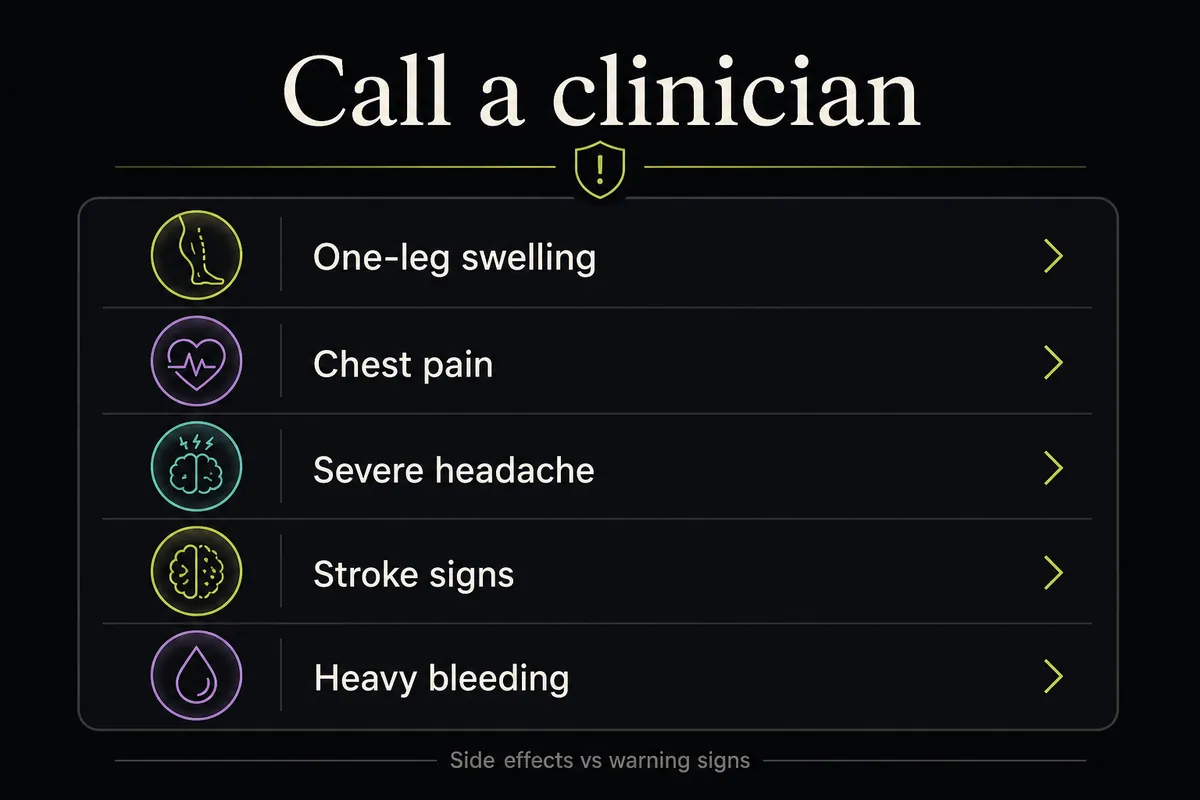
Get urgent medical help for any of the following: sudden pain or swelling in one leg, chest pain or breathlessness, a sudden or severe headache, signs of a stroke (face drooping, arm weakness, slurred speech), heavy or persistent bleeding that lasts beyond six months, or any bleeding that starts again after a settled, bleed-free stretch [1][4].
Non-urgent reasons to book a review include side effects that are severe or still troubling you past the three-month mark, or wanting to change your type, dose, or delivery route. Switching type, dose, or route almost always needs a prescriber, so readers without one can see how online HRT works for what a remote menopause visit involves, and what HRT costs if price is part of the decision to change methods.
Frequently Asked Questions
References
- NHS. Side effects of hormone replacement therapy (HRT). Accessed 2026. https://www.nhs.uk/medicines/hormone-replacement-therapy-hrt/side-effects-of-hormone-replacement-therapy-hrt/
- Mayo Clinic. Hormone therapy: Is it right for you? Updated April 18, 2025. https://www.mayoclinic.org/diseases-conditions/menopause/in-depth/hormone-therapy/art-20046372
- Cleveland Clinic. Hormone Therapy for Menopause Symptoms. Reviewed March 12, 2024. https://my.clevelandclinic.org/health/treatments/15245-hormone-therapy-for-menopause-symptoms
- Patient.info. What are the side effects of HRT? Published August 2025. https://patient.info/features/hormones/what-are-the-side-effects-of-hrt
- American College of Obstetricians and Gynecologists. Hormone Therapy for Menopause FAQ. Accessed 2026. https://www.acog.org/womens-health/faqs/hormone-therapy-for-menopause
- The Menopause Society (formerly NAMS). The 2022 Hormone Therapy Position Statement. https://menopause.org/professional-resources/position-statements
- Collaborative Group on Hormonal Factors in Breast Cancer. Type and timing of menopausal hormone therapy and breast cancer risk. Lancet 2019;394:1159-1168. https://www.thelancet.com/journals/lancet/article/PIIS0140-6736(19)31709-X/fulltext
- Vinogradova Y, Coupland C, Hippisley-Cox J. Use of hormone replacement therapy and risk of venous thromboembolism. BMJ 2019;364:k4810. https://www.bmj.com/content/364/bmj.k4810
- Drugs.com. Estradiol Side Effects. Accessed 2026. https://www.drugs.com/sfx/estradiol-side-effects.html
Disclosure: this article contains affiliate links to Gala Health. If you start care through them, we may earn a commission at no extra cost to you.