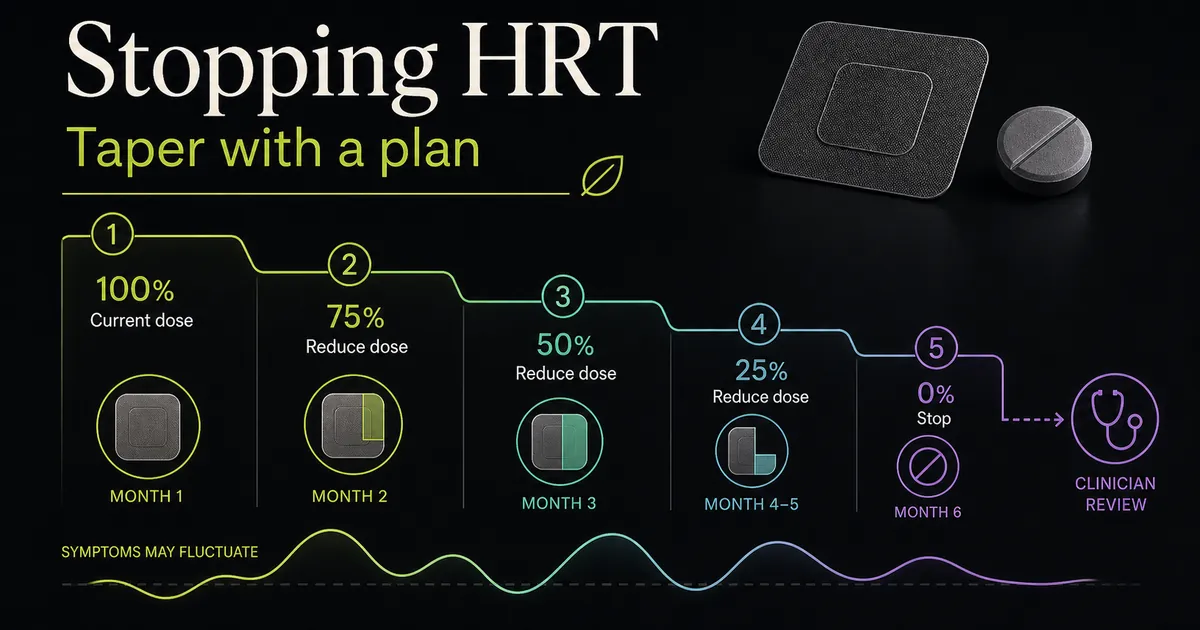

Stopping HRT is a personal decision, not a deadline: there is no fixed age when you must come off hormone replacement therapy, and when you do stop, it is usually recommended to reduce your dose gradually over about 3 to 6 months [1]. The evidence is honest about its limits, though: one randomized trial found symptoms returned at similar rates whether women tapered down or stopped abruptly [5]. Roughly half of the women who had hot flashes before HRT notice them again after stopping, and for most that return is temporary [4]. Here is what to expect when coming off HRT and how to do it safely.
| Quick fact | What it means |
|---|---|
| The NHS suggests reducing your dose gradually over 3 to 6 months | A slow taper is the common approach, though a suggestion, not a strict rule [1] |
| Over half of women reported hot flashes again after discontinuing estrogen plus progestin in the WHI follow-up | A return of symptoms is common and does not mean something is wrong [4] |
| A randomized trial found similar symptom recurrence whether women tapered or stopped abruptly | Tapering is not proven to prevent symptoms from coming back [5] |
| Returning hot flashes usually ease within months, but can linger up to a year for some | Most settle with time, a minority take longer [1][4] |
🔑 Key Takeaways
- No fixed stop age. The Menopause Society does not require routine discontinuation at 60 or 65; it is an individual decision with your clinician [3].
- Tapering is common but not proven superior. The NHS suggests reducing over 3 to 6 months, yet a trial found similar symptom return whether women tapered or stopped abruptly [1][5].
- Expect a possible temporary return of hot flashes, sleep problems, and mood changes, usually easing over months [4].
- Bone protection ends when HRT ends [3], so raise bone health when coming off long-term therapy.
- You can usually restart if life without HRT is worse, at a lower dose or different route [3].
Do You Have to Stop Taking HRT?
No. There is no arbitrary time limit: the NHS states there is no fixed limit on how long you can take HRT [1], and the Menopause Society 2022 position statement is explicit that routine discontinuation at 60 or 65 is not required, only periodic review [3].
Women stop for many reasons, none of them wrong: symptoms have eased with age, risk concerns (being over 60, or breast cancer or clot risk factors), side effects, a new medical condition, cost or supply, or preference. On the risk most people worry about, the numbers help: in the combined estrogen plus progestogen data the extra breast cancer signal worked out to fewer than 1 additional case per 1,000 women per year [6], a level the Menopause Society frames as rare and best weighed individually [3]. For the full picture, see our overviews of HRT for women: benefits and risks and the pros and cons of HRT.
How to Stop HRT Safely: Taper vs Cold Turkey
There is no firm clinical consensus on the best way to stop. The NHS and most clinicians suggest reducing the dose gradually over 3 to 6 months, noting symptoms are less likely to come back if you taper [1]. But when this was tested, a randomized controlled trial comparing a taper-down against abrupt discontinuation found similar rates of symptom recurrence either way [5], and a 2025 British Journal of General Practice review concluded that clinicians still need better evidence [8].
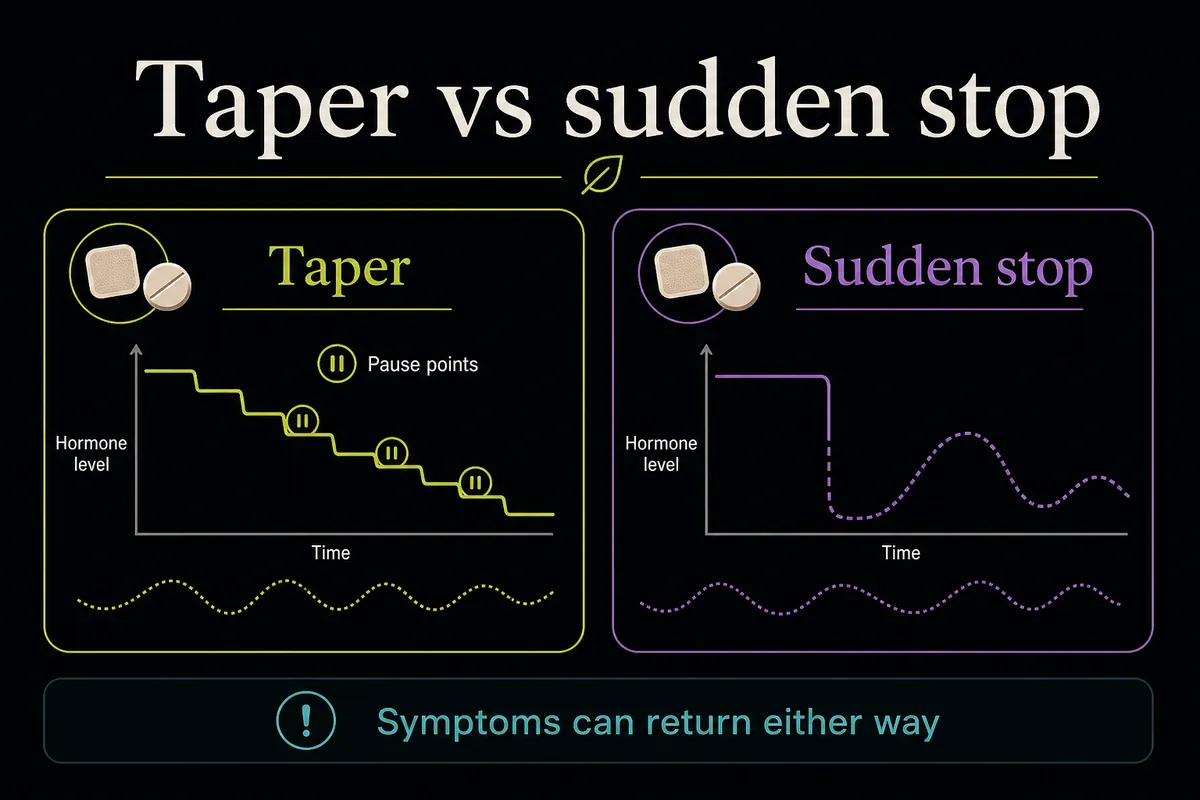
So, honestly: tapering may make the transition smoother and gives you an exit ramp if symptoms surge. But stopping HRT cold turkey is not dangerous for most women, and you can stop HRT suddenly if you prefer a clean break; the main downside is a sharper rebound in the early weeks, not a health hazard.
What a typical taper looks like
A gradual taper generally means reducing the estrogen dose in steps every few weeks to months, for example moving to a lower-dose patch or tablet and using it less often where the form allows. While your uterus is present, the progestogen is kept matched to the estrogen so the womb lining stays protected; some specialists reduce the estrogen first and hold the progestogen steady, then stop both once symptoms stay settled. Treat these as patterns your prescriber may use, not a schedule to follow alone. For how doses are structured, see our HRT dosage chart.
Who should not stop abruptly
Anyone advised to stop for a medical reason should follow their clinician's plan. Surgical menopause (ovaries removed) and premature ovarian insufficiency deserve extra care, because hormone therapy there replaces hormones the body should still be making, so stopping early carries real bone and cardiovascular costs [3].
| Aspect | Gradual taper | Stopping suddenly |
|---|---|---|
| How hormone levels change | Stepwise decline over months | Sharp drop after the last dose |
| Symptom rebound | Usually a gentler onset | Often a sharper rebound in the first weeks |
| What the evidence says | A randomized trial found similar symptom recurrence either way [5] | A randomized trial found similar symptom recurrence either way [5] |
| Flexibility | Easy to pause or step back up | All or nothing |
| Typical duration | About 3 to 6 months [1] | Immediate |
| Who tends to choose it | The default most clinicians suggest [1] | Women who want a clean break, or must stop for a medical reason |
The trial evidence does not support claims that tapering is superior [5], so the case for a taper is comfort and control, not proven protection.
HRT Withdrawal Symptoms: What to Expect
If symptoms follow your last dose, they usually appear within the first weeks and settle over the following months [4]. Feeling unwell coming off HRT for a short while is common and, for most women, temporary. The side effects of stopping HRT are largely the return of the symptoms HRT was controlling, plus a short adjustment as hormone levels fall.
Withdrawal vs recurrence: which one is happening?
Two different things can follow your last dose. A short-lived rebound as your body adjusts to the hormone drop hits within days to a few weeks, then fades. A true recurrence, the return of your own menopause symptoms that HRT had been masking, behaves like your original symptoms and persists. Timing is the clue: trouble still there past roughly 3 months is more likely genuine recurrence, the usual point to review options with your clinician [2]. This is a practical distinction, not a formal diagnosis.
The stopping HRT side effects women most often notice:
- Hot flashes and night sweats [1][4] - Sleep disruption and waking through the night [2] - Mood swings, irritability, and anxiety [2] - Fatigue and brain fog [2] - Joint and muscle aches [2] - Vaginal dryness [1] - Temporary spotting or a short bleed on combined regimens [1]
For how these compare with symptoms you can get while still on therapy, see our guide to HRT side effects.
Stopping HRT headaches
Some women get headaches coming off HRT, similar to the headache some get around their period when estrogen naturally dips; it usually settles as levels stabilize over the following weeks. Keep the expectation modest: an adjustment headache is common and self-limiting. A severe new headache, one with visual changes or weakness, or one that keeps worsening is a reason to contact your clinician.
Stopping HRT breast pain
Breast tenderness is more often a side effect of being on HRT than of stopping it, and it commonly improves once you come off, because it is frequently dose or progestogen related [1]. Sore breasts are not, on their own, a reason to quit in a hurry; they are a conversation about dose or formulation with your prescriber [3]. What always warrants evaluation, on or off HRT, is a new lump, one-sided pain that persists, or a skin or nipple change.
What Happens When You Stop HRT: A Realistic Timeline
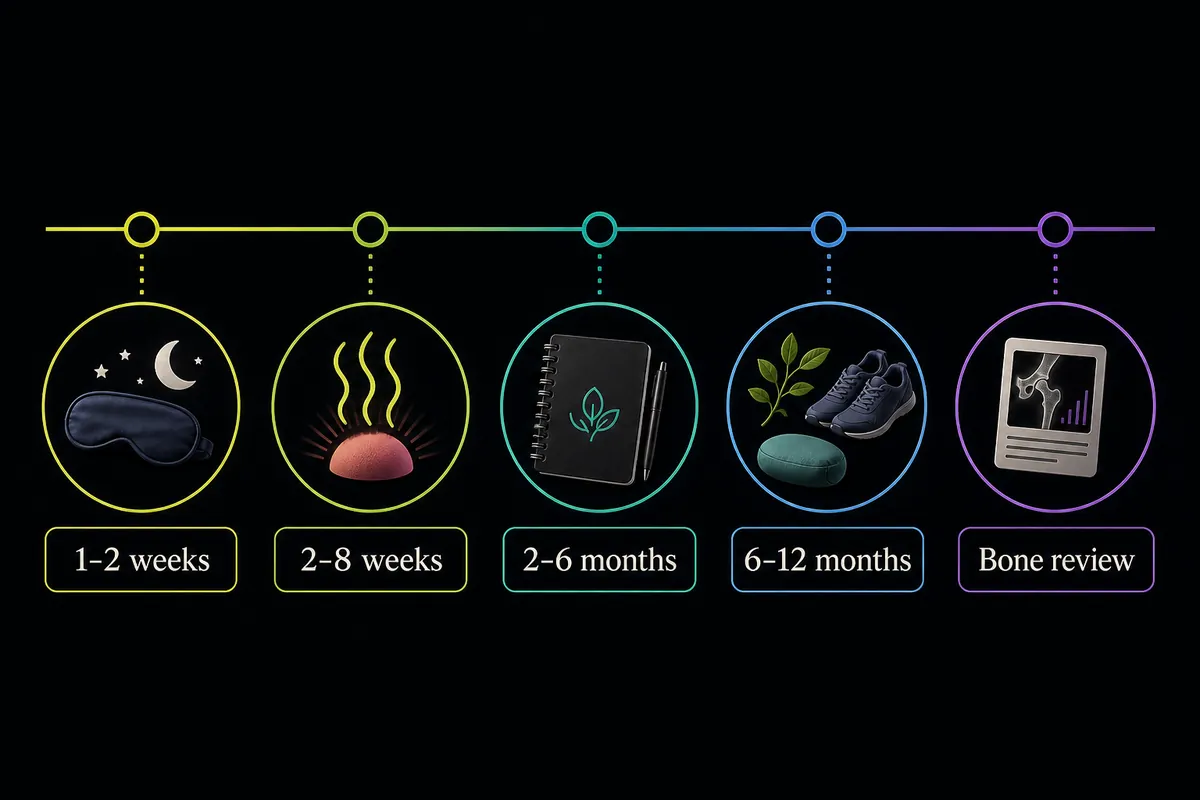
No two women follow the same path, so treat this as a rough map; who gets symptoms, and how strongly, varies widely.
| Time since stopping | What commonly happens | What helps |
|---|---|---|
| First 1 to 2 weeks | Hormone levels fall; the earliest rebound symptoms appear for some | Sleep, hydration, cooling, and knowing this phase is usually short |
| Weeks 2 to 8 | Hot flashes and sleep problems are most likely if they are coming; the WHI follow-up found return commonly here [4] | Trigger management; note whether symptoms are easing or building |
| Months 2 to 6 | Many women stabilize; symptoms still present past 3 months are worth reviewing [2] | A clinician review if symptoms persist past about 3 months |
| Months 6 to 12 | Most who were going to settle have; a minority still have vasomotor symptoms | Non-hormonal options or a low-dose restart if symptoms disrupt life |
| Beyond 12 months | Bone loss resumes its postmenopausal trajectory once estrogen is withdrawn [3] | A bone health conversation, especially after long-term use [3] |
What happens when you stop taking HRT in the longer view is quieter than the early weeks: the protection estrogen gave your skeleton ends when the estrogen does [3], which our guide to HRT and osteoporosis covers.
How long does HRT stay in your system after stopping?
How long HRT stays in your system after stopping depends mostly on the delivery form, and is worth separating from how long symptoms last:
- Patches and gels clear within roughly a day or two of removal (transdermal estradiol has a short half-life). - Oral estradiol clears within a few days of the last tablet. - Vaginal estrogen clears over days; Medical News Today reports a 2018 study in which vaginal estriol levels fell continuously after about 6 days [2]. - Pellets are the exception: an implant keeps releasing hormone for months and cannot easily be removed, so stopping is slow by design (see HRT pellets).
Hormones leaving your bloodstream is not the same as symptoms settling; the medication may be gone in days while the readjustment plays out over weeks to months.
I Stopped HRT and Feel Better: Why That Happens
Plenty of women say they stopped HRT and feel better, and that is a real experience with honest reasons behind it, no testimonials needed. First, the side effects stopped: progestogen-related bloating, breast tenderness, low or flattened mood, and breakthrough bleeding are dose and formulation dependent, and they disappear when the drug does [1][3]. Second, the regimen may simply have been wrong for you, a mismatch of type, dose, or route rather than a verdict on HRT, so a regimen review is an alternative to quitting. Third, your menopause symptoms may have naturally resolved, because HRT bridges you through them rather than delaying them, so once they fade the drug may be doing little except causing side effects.
The honest counterweight: feeling better is real, but it does not mean the silent benefits keep running, and bone protection in particular ends when estrogen ends [3]. If you stopped mainly because of side effects, a different formulation might have given you both relief and comfort, which is a clinician conversation rather than a reason to restart on your own.
Coming Off HRT After 15 Years or More
Coming off HRT after 15 years or more usually means you are older, and age shifts the calculation. The risk-benefit balance does change past 60, but the Menopause Society does not require routine discontinuation at any age; it asks for periodic re-evaluation, not an automatic stop [3]. As a matter of common practice, the longer and higher-dose the therapy, the more gradually many clinicians prefer to bring it down.
Two things are worth watching after long-term use. Because estrogen has been protecting your skeleton, a conversation about bone health, possibly a DEXA scan, is reasonable when you come off [3]. And symptom return tends to be less likely the further past menopause you are, though not zero [4].
Restarting HRT after stopping
Restarting HRT after stopping is often possible, usually at a lower dose or a different route. The nuance that matters is timing: restarting many years after menopause involves a different cardiovascular risk conversation than continuing would have, because the timing of when hormone therapy is initiated affects its risk profile [3][6]. If you do restart, our guide to how long HRT takes to work sets expectations, and for the over-60 picture see the benefits of HRT after 65.
How to Manage Symptoms Without HRT
If you are staying off HRT, there are evidence-backed ways to manage symptoms that may return, all worth raising with your clinician rather than starting solo.
How to stop hot flushes without HRT
For how to stop hot flushes without HRT, the recognized options include:
- Cognitive behavioral therapy (CBT), recommended in UK guidance for vasomotor symptoms and low mood. - SSRIs and SNRIs, antidepressants that also reduce hot flashes for many women. - Gabapentin, particularly useful for night-time flashes. - Oxybutynin, which can reduce flushing. - Fezolinetant, a non-hormonal neurokinin-3 receptor antagonist the FDA approved in 2023 for moderate to severe hot flashes caused by menopause [7]. - Lifestyle levers, including avoiding triggers, cooling, weight management, and regular exercise for sleep and mood.
These are options to discuss with your clinician, not a dosing guide. One point often missed: vaginal estrogen is not systemic HRT; low-dose local estrogen for dryness and urinary symptoms can usually be continued or started even after you stop systemic HRT [1][3]. Herbal products such as black cohosh have weak, mixed evidence and are not regulated like medicines [3], so be wary of anything promising to "get you off HRT." For broader non-hormonal support, see our overview of peptides for menopause.
When to Talk to Your Clinician
Most symptoms after stopping pass on their own, but some warrant a call rather than a wait:
- Any vaginal bleeding that starts after HRT is fully stopped always needs evaluation; see bleeding on HRT. - A severe drop in mood, or feeling unable to cope. - Chest pain or breathlessness. - A fracture or new bone pain.
If symptoms are simply persisting past about 3 months, that is the usual threshold to review options, which may include restarting a low dose, switching to a non-hormonal therapy, or using local vaginal estrogen for dryness [1][2]. If you are weighing whether stopping is right at all, our overview of HRT for women: benefits and risks and our guide to HRT side effects are good places to start.
Frequently Asked Questions
References
- NHS. When to take HRT (how long to take it and stopping HRT). Accessed 2026. https://www.nhs.uk/medicines/hormone-replacement-therapy-hrt/when-to-take-hormone-replacement-therapy-hrt/
- Medical News Today. What happens when you stop HRT? How to stop safely. Accessed 2026. https://www.medicalnewstoday.com/articles/what-happens-when-you-stop-hrt
- The Menopause Society (formerly NAMS). The 2022 Hormone Therapy Position Statement. https://menopause.org/professional-resources/position-statements
- Ockene JK, Barad DH, Cochrane BB, et al. Symptom experience after discontinuing use of estrogen plus progestin. JAMA, 2005;294(2):183-193. https://pubmed.ncbi.nlm.nih.gov/16014592/
- Lindh-Astrand L, Bixo M, Hirschberg AL, et al. A randomized controlled study of taper-down or abrupt discontinuation of hormone therapy in women treated for vasomotor symptoms. Menopause, 2010;17(1):72-79. https://pubmed.ncbi.nlm.nih.gov/19675505/
- WebMD. Menopause: Should You Quit HRT? Accessed 2026. https://www.webmd.com/menopause/features/quitting-hormone-replacement-therapy
- U.S. Food and Drug Administration. FDA Approves Novel Drug to Treat Moderate to Severe Hot Flashes Caused by Menopause (fezolinetant). May 2023. https://www.fda.gov/news-events/press-announcements/fda-approves-novel-drug-treat-moderate-severe-hot-flashes-caused-menopause
- British Journal of General Practice. When, why, and how to stop HRT: women and clinicians need more evidence. BJGP, 2025;75(756):292. https://bjgp.org/content/75/756/292
Disclosure: this article contains affiliate links to Gala Health. If you start care through them, we may earn a commission at no extra cost to you.