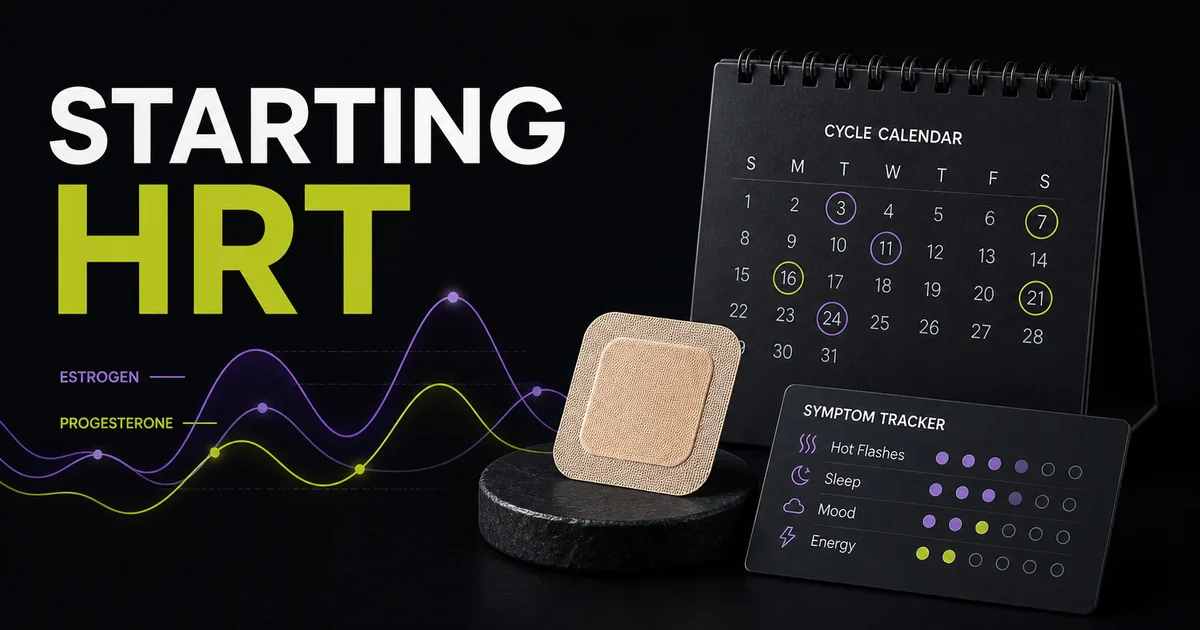

HRT for perimenopause is a legitimate option long before your final period, and you do not have to wait until symptoms become severe to consider it [2]. Perimenopause and HRT are often discussed as if hormone therapy belongs only after menopause, but hormone replacement therapy (HRT, also called menopausal hormone therapy) can be started while you are still cycling. This guide covers when to start HRT in perimenopause, the signs you may need it, what starting actually feels like in the first three months, and how to tell whether it is working or needs a change. For the broader picture, see our complete guide to HRT for women.
| Perimenopause fact | Why it matters |
|---|---|
| Usually begins in the mid-40s | Symptoms can start years before periods stop [3] |
| Lasts about 4 to 8 years on average | HRT can be considered at any point in that window [3] |
| Average US menopause age is 51 | Menopause is confirmed 12 months after the last period [1] |
| HRT is the most effective treatment for hot flashes and night sweats | This is the main reason clinicians offer it [4] |
🔑 Key Takeaways
- You can start HRT during perimenopause, while you still have periods, without waiting for them to stop or for symptoms to become severe [2].
- There is no single blood test for perimenopause. Hormone levels swing too much to be diagnostic, so the decision is based on your symptoms and age [1].
- The benefit and risk balance is most favorable when HRT is started within about 10 years of menopause or before age 60 [4].
- Give it up to three months on a stable dose before judging whether it works; dose or route adjustments in that window are normal, not failure [2][4].
- Signs HRT is not working include no change after three months, symptoms that improved then returned, or side effects that never settle; these are reasons to book a review, not to stop on your own [1][2].
Can You Start HRT in Perimenopause While You Still Have Periods?
Yes. You can start HRT in perimenopause while you are still having periods, and there is no requirement to wait until they stop or until symptoms become severe [2]. The NHS is explicit that HRT can begin as soon as menopausal symptoms are troubling you, not only once you are postmenopausal [2].
The reason perimenopause and HRT need a slightly different approach comes down to what your hormones are doing. In menopause, estrogen sits consistently low. In perimenopause, it fluctuates, sometimes swinging high before dropping, which is why symptoms can feel erratic and unpredictable. That difference shapes the regimen. When you still have a uterus and are still cycling, HRT in perimenopause is usually given as sequential (cyclical) combined therapy: daily estrogen plus a progestogen for part of each cycle, which produces a monthly withdrawal bleed. After menopause, continuous combined therapy (daily estrogen and daily progestogen, with no scheduled bleed) becomes the norm [7].
Because perimenopausal hormones swing rather than sit low, some clinicians prefer approaches that steady the cycle rather than simply topping up estrogen, since standard HRT can occasionally amplify the fluctuations that are already happening. That is a genuine clinical judgment call your prescriber makes with you, and it is one reason perimenopause hrt is not a single fixed prescription. The detailed comparison of stabilizing versus topping-up sits in its own guide below; here the key point is that starting during perimenopause is both possible and common.
Do I Need HRT? Signs You Need HRT in Perimenopause
If you are asking "do I need HRT," the honest answer is that it depends on how much your symptoms are affecting your life, not on a lab result. The clinical threshold is bothersome symptoms, not a particular severity score [2].
Common signs you need HRT, or at least a conversation about it, include:
- Irregular or changing menstrual cycles - Hot flashes and night sweats - Sleep disruption and waking unrefreshed - Mood changes, irritability, or low mood - Brain fog and trouble concentrating - Vaginal dryness or discomfort - More frequent urinary tract infections - Heart palpitations - New joint aches and stiffness
There is no single blood test that confirms perimenopause. Hormone levels rise and fall so much from day to day that a one-off measurement can be misleading, so diagnosis is based on your age and symptom pattern rather than bloodwork [1]. That is why two people with similar lab numbers can need very different plans.
Not sure where you fall? Our do I need HRT quiz can help you organize your symptoms before you talk to a clinician. It is a starting point for the conversation, not a diagnosis, and your clinician will weigh your full history before recommending anything.
When to Start HRT in Perimenopause
The simplest guidance on when to start HRT is this: start when symptoms interfere with your life. There is no minimum severity you have to reach first, and there is no rule that your periods have to have stopped [2]. If hot flashes, poor sleep, or mood changes are disrupting your days, that is a valid reason to discuss starting.
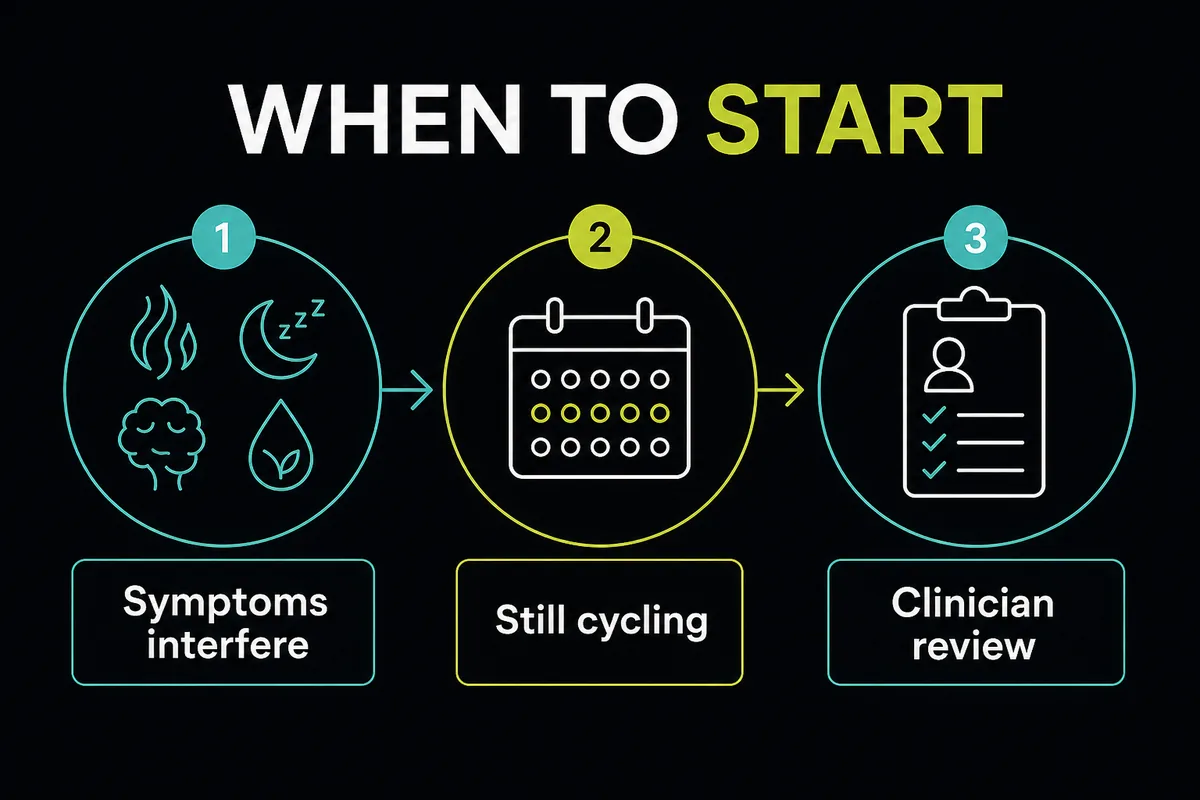
Timing does matter for the benefit and risk balance. Major guidelines describe a favorable window: the balance is most favorable when HRT is started within about 10 years of menopause or before age 60, when symptoms are present [4]. Starting HRT perimenopause, before menopause is even complete, sits comfortably inside that window, which is part of why the peri years are a reasonable time to begin if symptoms warrant it.
Two situations change the calculus. Premature menopause (before age 40) and early menopause (before age 45) are generally treated with HRT or a combined hormonal contraceptive at least until the average age of natural menopause, because the goal is to replace hormones the body would ordinarily still be making [2]. This is about protecting long-term health, not only easing symptoms, so the usual "start only if bothered" framing does not fully apply.
One recent development is worth noting for context. In November 2025, the US Food and Drug Administration announced it was moving to remove the boxed warning from systemic HRT products [5]. That is a change to drug labeling and how risks are communicated, not a declaration that HRT is free of risk, and it does not replace the individualized discussion you have with your clinician.
HRT Doses in Perimenopause vs After Menopause
The regimen changes as you move from perimenopause to postmenopause, and understanding why makes it easier to know what to expect. The guiding principle throughout is the lowest effective estrogen dose that controls your symptoms, adjusted at reviews rather than set once and forgotten [1].
| Perimenopause | Post menopause (within 10 yrs) | Age 60+ or 10+ yrs post | |
|---|---|---|---|
| Typical regimen | Sequential (cyclical) combined | Continuous combined | Individualized, low dose |
| Progestogen pattern | 10 to 14 days per cycle | Daily | Daily |
| Expected bleeding | Monthly withdrawal bleed | None after adjustment | None expected |
| Preferred routes | Any; transdermal if clot risk | Any; transdermal if clot risk | Transdermal favored |
| Benefit and risk balance | Favorable when symptomatic | Most favorable window | Discuss carefully, risks may outweigh |
Sources: NHS [2], The Menopause Society 2022 position statement [4], NICE NG23 [7]. This table is regimen level only and does not list specific products or milligram doses. For those specifics, see our HRT dosage chart and the overview of types of HRT.
Starting HRT After Menopause or at 60: What Changes
If you got through perimenopause and are now asking about starting HRT after menopause, HRT remains an option, and the benefit and risk balance is still considered most favorable within about 10 years of your final period [4]. The regimen typically shifts to continuous combined therapy, which is designed to avoid a monthly bleed once your body has adjusted.
Starting HRT at 60 or more than 10 years after menopause is more individualized. After that point, some risks can begin to outweigh the benefits for symptom relief, and when HRT is used, clinicians generally favor lower doses and transdermal routes (patches or gel), which carry a lower clot risk than tablets [2][7]. Whether you need HRT after menopause at all comes down to whether symptoms still bother you. See HRT for menopause and the benefits of HRT after 65 for how the conversation changes with age.
What to Expect When Starting HRT
Knowing what to expect when starting HRT removes a lot of the worry, because the first few weeks are rarely smooth and that is normal. Your body is adjusting to a new hormonal baseline, and settling takes time. Here is a realistic first three months.
| Timeframe | What is common | What to do |
|---|---|---|
| Weeks 1 to 4 | Breast tenderness, mild nausea, headaches, bloating, irregular spotting as your body adjusts | Expect some settling-in effects; note anything severe |
| Weeks 4 to 12 | Hot flashes and night sweats usually ease first; sleep and mood often follow | Keep a simple symptom log; give it time |
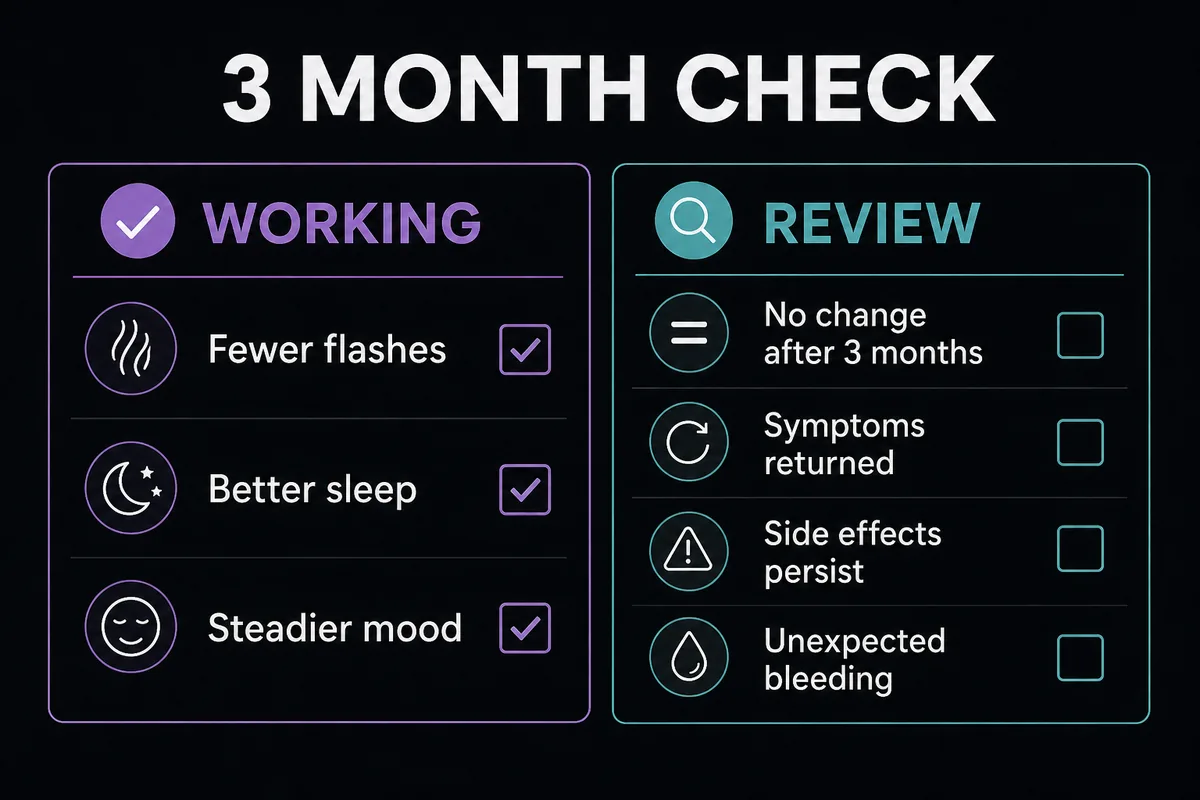
| Month 3 review | A standard checkpoint; dose or route changes are common and expected | Book a review to fine-tune the regimen |
Sources: NHS [2], The Menopause Society 2022 position statement [4].
The single most useful expectation to set is patience. Finding the right regimen is often a process of adjustment rather than a perfect first prescription, and up to three months on a stable dose is a fair trial before deciding whether it is working [2][4]. Starting HRT is a settling-in period, not an instant switch. For the full symptom-by-symptom timeline, see how long HRT takes to work.
Joint Pain After Starting HRT
Some women report new or temporarily worse joint aches when starting or adjusting HRT. Musculoskeletal aches and stiffness are commonly reported during the menopausal transition itself, a period defined by fluctuating hormones, so new aches around the time you start therapy are not unusual [1]. In most cases they ease as your dose settles over the adjustment window.
Because the formal evidence on transient joint pain specifically triggered by starting HRT is thin, it is best not to overclaim a mechanism. What matters practically: mild aches that settle within the first few weeks usually do not need action, but joint pain that is severe, persistent, or getting worse deserves a clinician review to check your dose and rule out other causes.
Signs HRT Is Working
The clearest signs HRT is working usually appear inside the first three months: fewer and milder hot flashes and night sweats, better sleep, steadier mood, and less vaginal dryness [2][4]. Hot flashes and sleep tend to shift first, while mood and other symptoms often follow. If you are tracking your progress, our guide on how long HRT takes to work breaks down the timeline symptom by symptom.
Signs HRT Is Not Working
No page in the usual search results covers this well, yet it is one of the most practical questions. The signs HRT is not working generally fall into a few patterns:
- Symptoms are unchanged after three months on a stable dose - Symptoms improved at first, then returned - New or worsening side effects that do not settle - Bleeding patterns that change unexpectedly (see bleeding on HRT)
A lack of response usually has a fixable explanation. The dose may be too low, there may be an absorption issue with a patch or gel, or the route may not suit you. It is also possible that some symptoms are being driven by something else entirely. Thyroid problems, for example, can mimic menopausal symptoms and are a classic overlap a clinician checks for [1].
A review appointment looks at your symptoms, your regimen, and sometimes your levels. Clinicians do not routinely test hormones on HRT, but in specific situations they may check an estradiol level, for instance if absorption is in question (see estradiol levels on HRT). The most important rule: do not stop abruptly on your own. Guidance is to review the plan rather than quit cold, because symptoms can rebound [2].
HRT or Birth Control in Perimenopause
During perimenopause, hormones swing rather than decline steadily, and that opens up two different strategies. Some clinicians prefer low-dose combined hormonal contraception, which suppresses the erratic natural cycle and replaces it with steady dosing. HRT works differently: it tops up hormones without suppressing your own cycle. Suppression-and-substitution versus topping-up is the core distinction people are weighing when they compare the two during the peri years.
A few practical points. HRT is not contraception, so it does not prevent pregnancy [2]. You cannot take the combined contraceptive pill alongside HRT, but the progestogen-only pill (mini pill) usually can be used with it [2]. Which route suits you depends on whether you still need contraception, your risk factors, and your symptoms. The full comparison lives in our dedicated guide to HRT or the pill for perimenopause.
Who Should Not Take HRT
HRT is not right for everyone, and some conditions make it unsuitable or require a specialist assessment first.
Talk to your clinician before starting HRT if you have any of the following: a history of breast, endometrial, or ovarian cancer; a previous stroke or heart attack; a history of blood clots or a clotting disorder; uncontrolled high blood pressure; active liver disease; or unexplained vaginal bleeding, which should be evaluated before any HRT is started [4][6].
When clot risk is the concern, transdermal estrogen (patches or gel) carries a lower clot risk than oral tablets and may be an option where tablets are not, though this is always a clinical decision [2][6]. Your clinician weighs your full history rather than applying a blanket rule.
On breast cancer specifically, framing matters. The widely cited increase from the Women's Health Initiative was small in absolute terms, and that trial's average participant was about 63 years old, older than most women starting HRT in perimenopause, which affects how the findings apply to a younger starter [4]. This is neither a reassurance that HRT is risk-free nor a reason to be frightened; it is context your clinician uses to personalize the decision. For people who cannot take HRT, non-hormonal options exist, and some also explore peptides for menopause as part of a broader conversation. You can read more about the general trade-offs in our overview of HRT side effects.
Who Can Prescribe HRT
In the US, several types of clinician can prescribe HRT: OB/GYNs, primary care physicians, nurse practitioners, physician associates, and licensed telehealth clinicians. The catch is that menopause-specific training varies widely, and not every prescriber has deep experience with hormone therapy.
The recognized way to find a clinician with dedicated menopause training is The Menopause Society's practitioner directory, which lists Menopause Society Certified Practitioners (MSCPs) and is available at menopause.org [8]. Searching for an MSCP is a reliable filter when you want someone who focuses on this area.
Telehealth has made access far easier, which is a real benefit, but it comes with a trade-off worth naming: continuity of care and monitoring still matter, including mammograms, bone density where relevant, and regular reviews. Convenience should not replace follow-up. If in-person access is limited, see our comparison of vetted online HRT providers, or use our guide to finding HRT doctors near me for local options.
Frequently Asked Questions
References
- Mayo Clinic. Perimenopause: Diagnosis and treatment. Accessed 2026. https://www.mayoclinic.org/diseases-conditions/perimenopause/diagnosis-treatment/drc-20354671
- NHS. When to take hormone replacement therapy (HRT). Accessed 2026. https://www.nhs.uk/medicines/hormone-replacement-therapy-hrt/when-to-take-hormone-replacement-therapy-hrt/
- Cleveland Clinic. Perimenopause. Accessed 2026. https://my.clevelandclinic.org/health/diseases/21608-perimenopause
- The 2022 Hormone Therapy Position Statement of The North American Menopause Society. Menopause. 2022;29(7):767-794. https://pubmed.ncbi.nlm.nih.gov/35797481/
- NPR. The FDA is removing a warning label from hormone therapy for menopause. November 11, 2025. https://www.npr.org/2025/11/11/nx-s1-5590203/hormone-therapy-fda-health
- American College of Obstetricians and Gynecologists (ACOG). Hormone Therapy for Menopause. Accessed 2026. https://www.acog.org/womens-health/faqs/hormone-therapy-for-menopause
- National Institute for Health and Care Excellence (NICE). Menopause: diagnosis and management (NG23). Accessed 2026. https://www.nice.org.uk/guidance/ng23
- The Menopause Society. Find a Menopause Practitioner directory (MSCP). Accessed 2026. https://menopause.org/
- NHS. Symptoms of menopause and perimenopause. Accessed 2026. https://www.nhs.uk/conditions/menopause-and-perimenopause/symptoms/
Disclosure: this article contains affiliate links to Gala Health. If you start care through them, we may earn a commission at no extra cost to you.