
HRT for menopause is the single most effective treatment available for hot flashes and night sweats, and for most women who start within about 10 years of their final period or before age 60, the benefits generally outweigh the risks [1][3]. The real decision hinges on two things, timing and your personal health history, not on a single yes or no rule that applies to everyone. In November 2025 the U.S. Food and Drug Administration removed the boxed warning from estrogen products used for menopause, a shift that reflects how much the evidence has changed since the early 2000s [6]. This guide covers the genuine benefits, the risks in real numbers, when you can start (including years after your final period), a month by month relief timeline, and what the untreated path actually looks like if you decide to skip it.
| Quick stat | What it means |
|---|---|
| Up to 80% of women get hot flashes during the transition | Menopausal symptoms are the norm, not the exception, so the question is usually how to treat them, not whether they will happen [5][8] |
| Systemic estrogen is the most effective hot-flash treatment | No non-hormonal option matches it for vasomotor symptoms [3] |
| Benefits generally outweigh risks when started before 60 or within 10 years of menopause | This "window" is the core of the modern timing conversation [3][7] |
| The FDA removed the boxed warning from menopause estrogen products in Nov 2025 | The old front-of-label warning, based on older data, no longer applies to these products [6] |
🔑 Key Takeaways
- Hormone therapy is the most effective treatment for hot flashes and night sweats, and it also helps sleep, vaginal dryness, urinary symptoms, and bone loss [1][3].
- Timing matters more than almost anything else. Starting before age 60 or within 10 years of your final period is when the benefit-to-risk balance is most favorable [3][7].
- The risks are real but usually small in absolute terms, and they differ by therapy type and route; a table below lays them out instead of leaving them vague.
- You can start HRT after menopause, and menopause is exactly when most women begin; the honest question is how many years past it you are, which changes how a clinician approaches it [1][7].
- Going through menopause without HRT is a legitimate choice, but untreated hot flashes last a median of about 7 years, and effective non-hormonal options now exist [8].
- The November 2025 FDA label change removed a boxed warning based on older, higher-risk data and does not mean hormone therapy is risk-free [6].
What Is HRT for Menopause?
HRT for menopause, also called menopausal hormone therapy (MHT or HT), replaces the estrogen your ovaries stop making after your final period, and adds a progestogen when needed to protect the uterus [1][3]. The falling estrogen of menopause is what drives hot flashes, night sweats, disturbed sleep, and vaginal and urinary changes, so HRT treatment for menopause works by restoring that hormone to a level that calms those symptoms [1][4]. When people say "menopause and HRT" in the same breath, this is what they mean: putting back the hormone the body has lost, at the lowest dose that controls symptoms.
There are two structural choices your clinician will consider, and they are simpler than the long product lists suggest.
Estrogen alone or estrogen plus progestogen
If you still have your uterus, systemic estrogen is paired with a progestogen (progesterone or a synthetic progestin), because unopposed estrogen thickens the uterine lining and raises the risk of endometrial cancer [1][4]. The progestogen keeps that lining in check. If you have had a hysterectomy, you take estrogen alone, since there is no uterus to protect [1][4]. That single fact (uterus or no uterus) drives most of the estrogen-only versus combined decision.
Systemic or low-dose vaginal
Systemic estrogen (a pill, patch, gel, spray, or ring) circulates through the whole body and treats whole-body symptoms like hot flashes and night sweats [1][3]. Low-dose vaginal estrogen (a cream, tablet, or ring) treats only the genitourinary symptoms, vaginal dryness, painful sex, and some urinary problems, with minimal absorption into the bloodstream and a much lower risk profile [3][5]. Many women use one or the other; some use both. We keep this section deliberately short, because the full menu of products and routes belongs in our guide to the types of HRT and our broader companion piece on HRT for women: benefits, risks, and who it is right for.
Benefits of HRT for Menopause
The benefits of HRT for menopause are well documented in every major guideline, and they go well beyond hot flashes. Here is what hormone therapy is genuinely good for, framed as what the evidence supports rather than as promises.
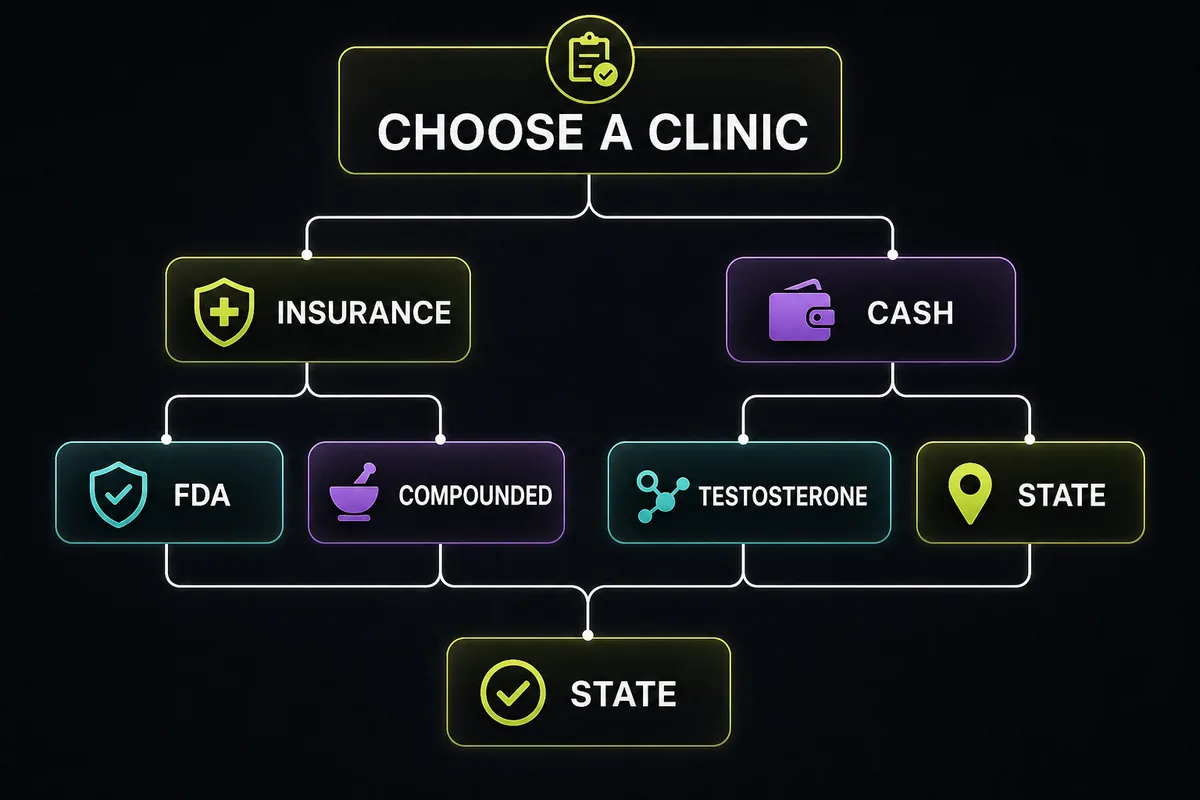
- Hot flashes and night sweats: systemic estrogen is the most effective treatment available, and no non-hormonal drug matches it [1][3]. - Sleep: better sleep usually follows fewer night sweats, and bedtime progesterone has a mild calming effect for some women [2][3]. - Vaginal dryness and painful sex: estrogen restores vaginal tissue; low-dose vaginal estrogen works directly and is very effective for this [3][5]. - Urinary symptoms and recurrent urinary tract infections: vaginal estrogen can reduce urinary urgency and recurrent infections tied to thinning tissue [4][5]. - Bone loss and fractures: HRT slows the accelerated bone loss of early menopause and reduces fracture risk while you stay on it [3][7]. - Possible cardiovascular and type 2 diabetes association: when started within the window, hormone therapy is associated with a lower risk of coronary disease and diabetes, though the Menopause Society frames this as an association, not a reason to start HRT on its own [3][7].
The benefits of HRT after menopause are strongest for symptom relief and bone protection. It is just as important to be clear about what HRT is not proven to do. It is not a weight-loss treatment, and it is not prescribed to prevent dementia; Harvard Health is explicit that the evidence does not support using hormone therapy for cognitive protection [5]. We cover the weight question separately in our guide on does HRT cause weight gain.
The Real Risks, in Numbers and by Timing
This is the part every other page keeps vague, so here it is in a table. The point is absolute-risk framing: the risks of HRT are real, but for a healthy woman starting near menopause they are usually small in absolute terms, and they differ a lot by therapy type and route [2][3][7].
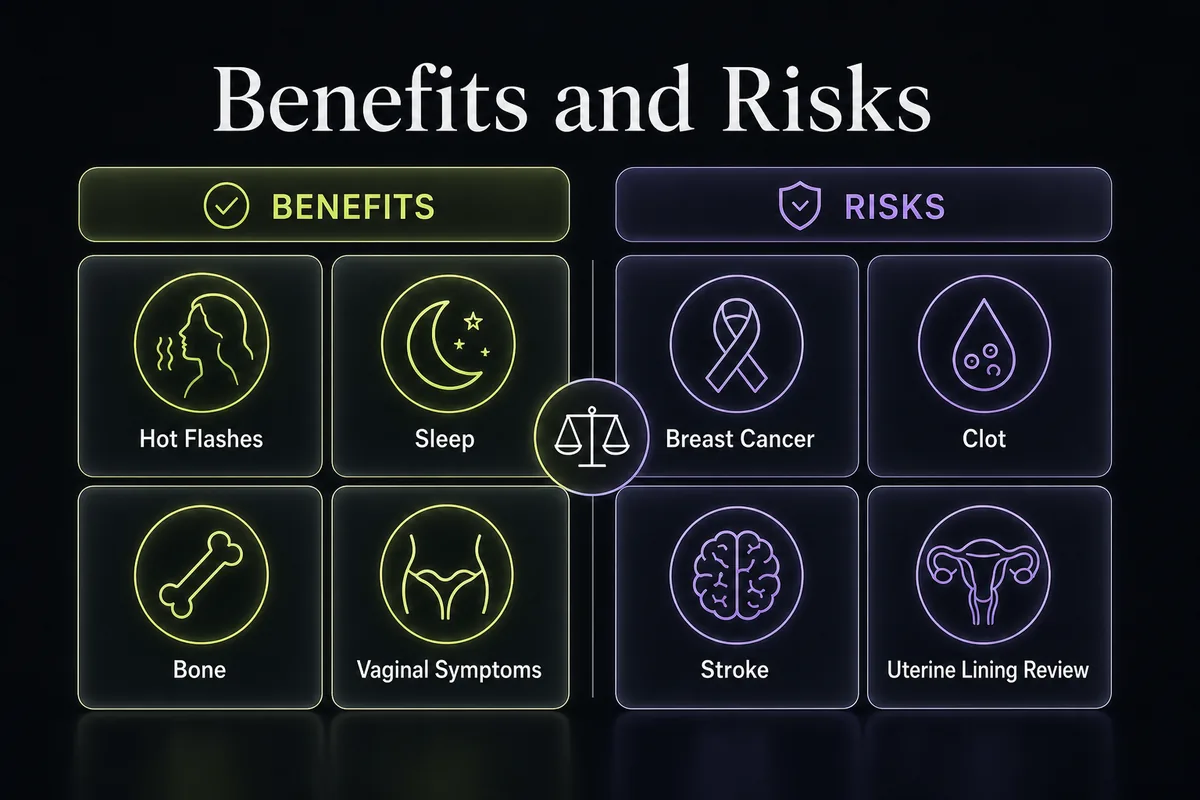
| Risk | Estrogen only | Estrogen plus progestogen | Low-dose vaginal estrogen |
|---|---|---|---|
| Breast cancer | Little or no added risk in the early years; any increase emerges only after about 7 years of use [3][7] | A small increase that emerges after about 3 to 5 years of use, on the order of fewer than 1 extra case per 1,000 women per year [2][3] | Not associated with increased breast cancer risk at standard low doses [3][5] |
| Blood clots (VTE) | Oral raises clot risk; transdermal (patch, gel, spray) does not appear to raise it meaningfully [1][7] | Same pattern; oral carries more clot risk than transdermal [1][7] | Minimal absorption, not linked to a meaningful clot risk [3][5] |
| Stroke | Small increase with oral estrogen, larger with older age and higher doses; transdermal appears lower risk [3][7] | Similar small increase, route and dose dependent [3][7] | Not associated [3][5] |
| Endometrial (uterine) cancer | Raises risk if you have a uterus, which is why estrogen alone is reserved for women without one [1][4] | Adding a progestogen protects the lining and returns risk toward baseline [1][4] | Generally not associated at low doses; report any bleeding to your clinician [3][5] |
| Gallbladder disease | Increased with oral estrogen, less with transdermal [4][7] | Increased with oral, less with transdermal [4][7] | Not associated [5] |
The absolute figures above come from the Women's Health Initiative, the large randomized trial that anchors the modern risk estimates and the NAMS 2022 position statement [7][10]. To put real numbers on it: in the WHI, the combined estrogen-plus-progestogen arm was linked to roughly 8 extra invasive breast cancers, 8 extra strokes, 8 extra blood clots in the lungs, and 7 extra coronary heart disease events per 10,000 women for each year of use, alongside about 5 fewer hip fractures and 6 fewer colorectal cancers over the same window [7][10]. That works out to fewer than 1 extra case of any single one of these per 1,000 women per year. The estrogen-only arm told a different story: it did not raise breast cancer and actually trended slightly lower, about 6 fewer cases per 10,000 women per year, although it still carried a small increase in stroke [7][10].
What the 2025 FDA label change actually means
In November 2025 the FDA removed the boxed warning that had sat at the top of estrogen product labels for menopause since the mid-2000s [6]. That warning grew out of the Women's Health Initiative, whose participants averaged about 63 years of age and largely used older oral formulations (conjugated equine estrogen and medroxyprogesterone), not the transdermal estradiol and micronized progesterone that are common today [6]. The removal reflects that the original warning was applied too broadly to women near menopause. It does not mean hormone therapy is risk-free. Experts still caution that systemic estrogen carries individualized risks that a clinician should weigh, while very low-dose vaginal estrogen has minimal systemic absorption and a much smaller risk footprint [6]. This is the piece of context that the Mayo, Cleveland, and ACOG pages predate.
Who should not take HRT
Hormone therapy is not for everyone. Clinicians generally avoid systemic HRT if you have a history of hormone-sensitive cancer (breast or endometrial), a prior blood clot, stroke, or heart attack, active liver disease, or unexplained vaginal bleeding that has not been evaluated [1][4]. Some of these are absolute barriers and some are cautions that depend on your full picture, which is why the starting point is always a conversation with a clinician who can review your history rather than a checklist you apply to yourself.
Can You Start HRT After Menopause?
Yes. You can start HRT after menopause, and in fact menopause is exactly when most women begin, because that is when symptoms are usually at their peak [1][3]. The question that actually matters is not whether you can take HRT after menopause but how many years past your final period you are. The consensus "window" is that starting before age 60 or within 10 years of your final period gives the most favorable balance of benefits and risks, an idea often called the timing hypothesis: estrogen started in relatively healthy, younger blood vessels behaves differently than estrogen started a decade or more later [3][7]. So can you start HRT after menopause? For most women in that window, the answer is a straightforward yes.
More than 10 years past menopause
Postmenopausal HRT started more than 10 years out, or after age 60, is where the calculus changes, and this is what "HRT postmenopausal" searches are usually circling. It is not off the table, but a clinician weighs your baseline cardiovascular risk more heavily, often prefers a transdermal route (a patch or gel bypasses the liver and does not appear to raise clot risk the way tablets can), and tends to start low and titrate [1][7]. Importantly, low-dose vaginal estrogen for vaginal and urinary symptoms remains a reasonable option at essentially any age, because its systemic absorption is minimal [3][5]. A menopause-trained clinician can assess whether systemic therapy still makes sense for you; our deeper guide on the benefits of HRT after 65 covers the later-life question in detail, and the do I need HRT quiz is a structured way to prep for that conversation.
Does HRT delay menopause?
No, HRT does not delay menopause. It relieves symptoms and can mask the transition (because you no longer feel the hot flashes that signal it), but it does not postpone ovarian aging or push back the biological process itself [3]. That is why symptoms can return when you stop, sometimes within weeks, which is one reason clinicians often taper rather than stop abruptly; our guide on stopping HRT explains how that is usually managed.
HRT Before and After Menopause: What Actually Changes, and When
One thing no other page on this topic offers is a plain relief timeline, so here is what typically changes on HRT before and after menopause, month by month. Treat every figure as a typical range, not a guarantee; real people fall on either side depending on dose, route, and starting symptoms [2][3].
| Timeframe | Symptoms typically improving | Side effects status |
|---|---|---|
| Weeks 2 to 4 | Hot flashes and night sweats start to ease; sleep often steadies | Breast tenderness, light spotting, or mild nausea may appear as your body adjusts [2][4] |
| Month 3 | Hot flashes near their full relief; mood and energy steadier; vaginal comfort improving | Most early side effects (tenderness, nausea, bloating) settling [2][3] |
| Months 6 to 12 | Vaginal and urinary symptoms, libido, skin, and joint comfort continue improving; bone loss slowing | Unscheduled spotting usually resolved by about 6 months [4] |
| Beyond year 1 | Steady symptom control; bone protection continues while on therapy | Side-effect profile stable; annual benefit-and-risk review [3][7] |
This is a summary; the deep dive on speed by symptom and route lives in our guide to how long HRT takes to work.
About those face before and after pictures
Searches for face before and after HRT pictures menopause are common, and the honest answer deserves care. Estrogen does influence skin collagen, thickness, and hydration, so some women notice their skin feeling less dry and a little firmer over months of treatment [9]. But the dramatic viral before-and-after HRT pictures for menopause you see online usually reflect lighting, camera angle, makeup, weight change, or unrelated cosmetic treatments, not hormone therapy alone. We do not publish fabricated before-and-after images, and hormone therapy is not a cosmetic procedure. Expect subtle, gradual skin comfort at most, not a transformation, and be skeptical of any photo promising otherwise.
Menopause Without HRT: What to Expect
Menopause without HRT is a legitimate path, and many women take it, so here is what the untreated course typically looks like rather than a scare pitch. Hot flashes and night sweats are not always short-lived: in the SWAN study, vasomotor symptoms lasted a median of about 7 years, and for some women more than 10 [8]. Genitourinary symptoms (vaginal dryness, painful sex, urinary changes) tend to progress rather than resolve on their own, and bone loss accelerates in the first years after menopause [3][7]. None of that means you must take HRT; it means the choice depends on how severe your symptoms are and what your personal risk profile looks like.
If you skip or cannot take hormones, the non-hormonal toolkit has grown a lot. It includes fezolinetant (Veozah, approved 2023) and elinzanetant (Lynkuet), newer drugs that target the brain pathway behind hot flashes; certain SSRIs and SNRIs (low-dose paroxetine is FDA-approved for hot flashes); gabapentin; oxybutynin; and clonidine [4][5][6]. Cognitive behavioral therapy and clinical hypnosis have evidence for vasomotor and sleep symptoms, and lifestyle steps (layered clothing, sleep hygiene, limiting triggers, and regular activity) help at the margins [4][5]. For a look at where research-stage options fit, see our overview of peptides for menopause; some readers also ask about tirzepatide's off-label uses in the midlife-metabolism conversation, though that is a separate topic from hormone therapy.
Surgical Menopause Without HRT
Surgical menopause without HRT is a different situation and deserves its own note. When both ovaries are removed (a bilateral oophorectomy), estrogen does not taper over years; it drops abruptly, so symptoms tend to be more intense and to arrive all at once [1]. When the ovaries are removed before about age 45 and HRT is not used, the long-term risks to the heart, bones, and cognition are higher than for natural menopause [7]. For that reason, guidelines generally support hormone therapy at least until the natural age of menopause (around 51) for women in this situation, absent a contraindication, precisely to offset that abrupt loss [1][7]. This is a decision to make with the surgical team and a menopause-trained clinician rather than something to navigate alone.
Best HRT for Menopause: Matching the Type to Your Symptoms
There is no single best HRT for menopause; the best option is the one matched to your symptoms, your anatomy, and your risk factors. The table below shows the HRT options for menopause that clinicians typically consider first for each situation. Frame this as "what is usually considered," not as medical advice for your specific case.
| Your situation | Type usually considered first | Why |
|---|---|---|
| Moderate to severe hot flashes and night sweats | Systemic estrogen (patch, gel, spray, or pill) | Whole-body symptoms need whole-body treatment, and systemic estrogen is the most effective option [1][3] |
| Vaginal dryness or painful sex only | Low-dose vaginal estrogen | Treats genitourinary symptoms directly with minimal absorption and far lower risk [3][5] |
| Intact uterus (no hysterectomy) | Systemic estrogen plus a progestogen | The progestogen protects the uterine lining from estrogen-driven overgrowth [1][4] |
| Clot risk factors or migraine with aura | Transdermal estrogen (patch, gel, spray) over oral | Skin-delivered estrogen bypasses the liver and does not appear to raise clot risk the way tablets can [1][3] |
| After a hysterectomy | Estrogen alone | No uterus means no progestogen is needed [1][4] |
| More than 10 years past menopause | Individualized, often transdermal and low dose; vaginal estrogen for genitourinary symptoms | Later starts weigh baseline cardiovascular risk, so route and dose are chosen to minimize it [1][7] |
Side Effects in the First Months
Most side effects of HRT show up early and settle within a few months as your body adjusts. The common ones are breast and nipple tenderness, light spotting or breakthrough bleeding, bloating, and mild nausea [2][3][4]. Sore nipples on menopause HRT are a frequent early complaint and usually ease within the first few months; if tenderness persists, a dose or route change often helps [2][4]. On the question of HRT and breast growth in menopause, be realistic: estrogen can cause temporary tenderness and some change in breast density, but a meaningful increase in breast size is not the expected outcome of treatment [2][3].
A few symptoms are worth a prompt call rather than waiting: new vaginal bleeding after it had stopped, bleeding that is heavy or persistent, or clot symptoms such as pain and swelling in one calf, chest pain, or sudden breathlessness [2][4]. These are not typical settling-in effects. For the full picture, see our guides to HRT side effects and bleeding on HRT, which cover management in far more depth than we can here.
Cost and Coverage: Does Medicaid Cover HRT for Menopause?
Cost is a real part of the decision, so does Medicaid cover HRT for menopause? Generally yes for FDA-approved generics, with variation. Generic systemic estradiol (pills and patches) and micronized progesterone are widely available as low-cost generics, and most insurance plans, including Medicaid programs, cover FDA-approved generic hormone therapy, though formularies vary by state and plan and prior authorization is sometimes required for brand-name products [1][4]. Coverage specifics change by state and year, so the reliable move is to check your own state's Medicaid formulary or ask the prescriber's office to confirm before you fill a prescription; we have not listed prices or state-by-state rules here because those are exactly the details that go stale. Our guide on what HRT costs with and without insurance walks through the pricing landscape, and if access is the barrier, our roundup of the best online HRT providers covers menopause-focused telehealth options.
Frequently Asked Questions
References
1. Mayo Clinic. Hormone therapy: Is it right for you? https://www.mayoclinic.org/diseases-conditions/menopause/in-depth/hormone-therapy/art-20046372 2. Cleveland Clinic. Hormone Therapy for Menopause Symptoms. https://my.clevelandclinic.org/health/treatments/15245-hormone-therapy-for-menopause-symptoms 3. The Menopause Society. Hormone Therapy (patient education). https://menopause.org/patient-education/menopause-topics/hormone-therapy 4. American College of Obstetricians and Gynecologists (ACOG). Hormone Therapy for Menopause (FAQ517). https://www.acog.org/womens-health/faqs/hormone-therapy-for-menopause 5. Harvard Health. Understanding hormone therapy for menopausal symptoms. https://www.health.harvard.edu/womens-health/understanding-hormone-therapy-for-menopausal-symptoms 6. NPR. Is hormone therapy for menopause right for you? 6 things to know. November 11, 2025. https://www.npr.org/2025/11/11/nx-s1-5590203/hormone-therapy-fda-health 7. The 2022 Hormone Therapy Position Statement of The North American Menopause Society. Menopause. 2022;29(7):767-794. https://pubmed.ncbi.nlm.nih.gov/35797481/ 8. Avis NE, et al. Duration of menopausal vasomotor symptoms over the menopause transition (SWAN). JAMA Internal Medicine. 2015;175(4):531-539. https://pubmed.ncbi.nlm.nih.gov/25686030/ 9. Review of hormonal replacement therapy options for the treatment of menopause. PMC. https://pmc.ncbi.nlm.nih.gov/articles/PMC12463494/ 10. Writing Group for the Women's Health Initiative Investigators. Risks and Benefits of Estrogen Plus Progestin in Healthy Postmenopausal Women: Principal Results From the Women's Health Initiative Randomized Controlled Trial. JAMA. 2002;288(3):321-333. https://pubmed.ncbi.nlm.nih.gov/12117397/
References
- Mayo Clinic. Hormone therapy: Is it right for you? Accessed 2026. https://www.mayoclinic.org/diseases-conditions/menopause/in-depth/hormone-therapy/art-20046372
- Cleveland Clinic. Hormone Therapy for Menopause Symptoms. Accessed 2026. https://my.clevelandclinic.org/health/treatments/15245-hormone-therapy-for-menopause-symptoms
- The Menopause Society. Hormone Therapy (patient education). Accessed 2026. https://menopause.org/patient-education/menopause-topics/hormone-therapy
- American College of Obstetricians and Gynecologists (ACOG). Hormone Therapy for Menopause (FAQ517). Accessed 2026. https://www.acog.org/womens-health/faqs/hormone-therapy-for-menopause
- Harvard Health. Understanding hormone therapy for menopausal symptoms. Accessed 2026. https://www.health.harvard.edu/womens-health/understanding-hormone-therapy-for-menopausal-symptoms
- NPR. Is hormone therapy for menopause right for you? 6 things to know. November 11, 2025. https://www.npr.org/2025/11/11/nx-s1-5590203/hormone-therapy-fda-health
- The 2022 Hormone Therapy Position Statement of The North American Menopause Society. Menopause. 2022;29(7):767-794. https://pubmed.ncbi.nlm.nih.gov/35797481/
- Avis NE, et al. Duration of menopausal vasomotor symptoms over the menopause transition (SWAN). JAMA Internal Medicine. 2015;175(4):531-539. https://pubmed.ncbi.nlm.nih.gov/25686030/
- Review of hormonal replacement therapy options for the treatment of menopause. PMC. Accessed 2026. https://pmc.ncbi.nlm.nih.gov/articles/PMC12463494/
- Writing Group for the Women's Health Initiative Investigators. Risks and Benefits of Estrogen Plus Progestin in Healthy Postmenopausal Women: Principal Results From the Women's Health Initiative Randomized Controlled Trial. JAMA. 2002;288(3):321-333. https://pubmed.ncbi.nlm.nih.gov/12117397/
Disclosure: this article contains affiliate links to Gala Health. If you start care through them, we may earn a commission at no extra cost to you.