Peptides for dogs have moved from a fringe interest among sport-dog handlers to something ordinary owners now ask their vets about. The usual entry point is a senior dog: stiff in the mornings, reluctant on stairs, already on NSAIDs and joint supplements that have stopped doing much. The owner reads about BPC-157, tries a six-week course, and reports that the dog is moving noticeably better.
This guide covers what is actually being used, how to dose it by bodyweight, how to give it, what timeline to expect, and where the genuine risks are. It is written for owners working with a vet — which is how this should be done, and increasingly how it is being done.

My co-founder's dog Jerzie before peptides vs. after peptides.
She's almost 16. 10 months ago, she had vestibular disease, and two seizures at the same time.
Vets advised to put her down, but instead we put her on NAD+, BPC-157, and TB-500.
2 weeks in, she's running again!
Quick Answer: What Works in Dogs
- BPC-157 is the default starting peptide. Broadest evidence across tissue types, works for both joints and gut, cheapest of the options.
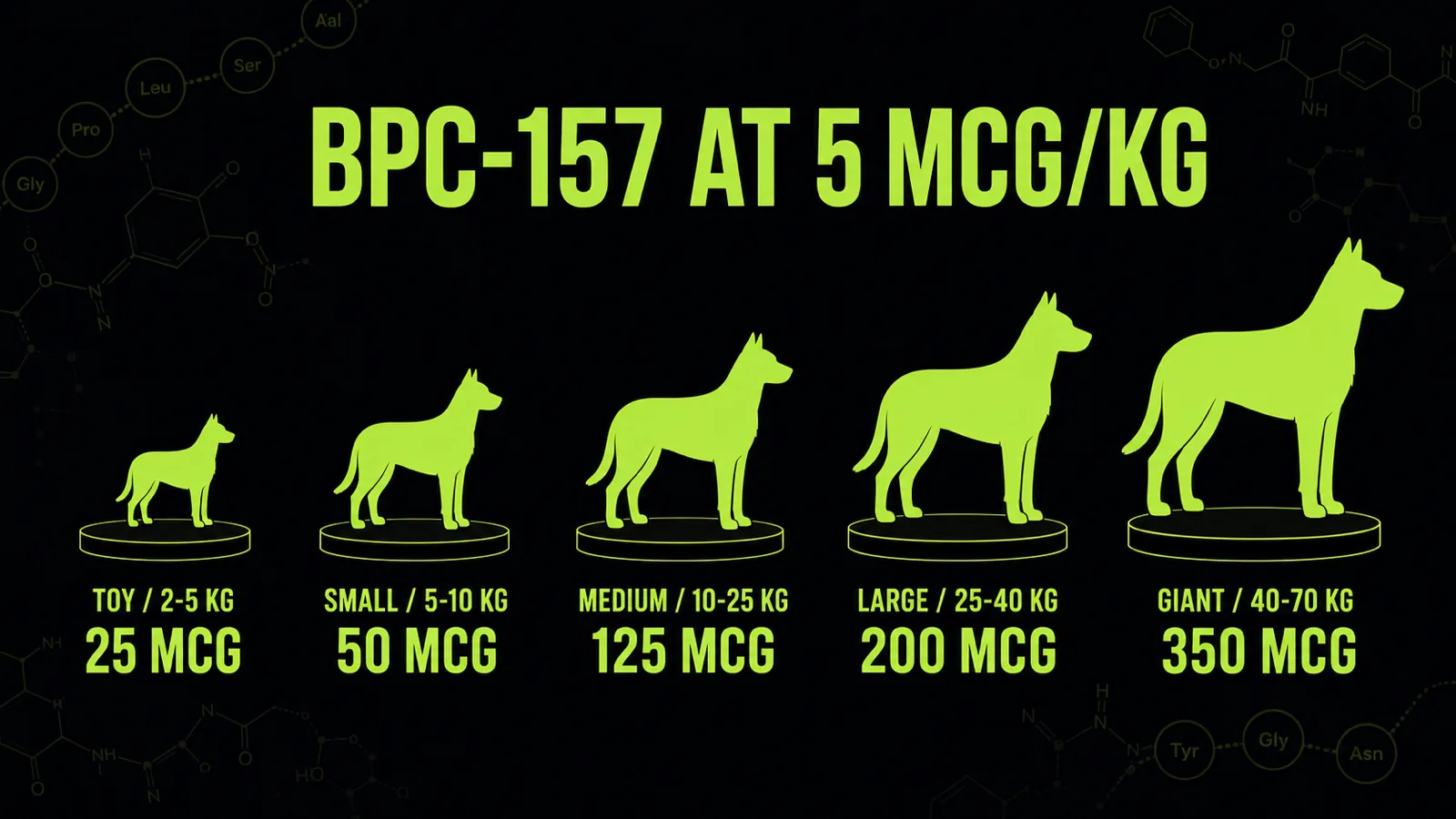
- Dose is 2–10 mcg/kg/day, with 5 mcg/kg the standard starting point. A 30 kg dog lands around 150 mcg per day.
- Subcutaneous injection is the most effective route for joint and soft-tissue work; oral makes more sense for IBD and gut problems.
- Expect early changes at 1–2 weeks, meaningful change at 4–6 weeks. Chronic arthritis is slower than acute injury.
- Osteoarthritis is the number one reason owners start. Over 65% of dogs aged seven and up have some degree of it.
- The one real red flag is cancer. BPC-157 and TB-500 promote blood vessel growth; avoid in dogs with known or suspected tumours.
Why Dog Owners Are Turning to Peptides
Canine osteoarthritis is extraordinarily common. Roughly 20% of dogs over the age of one have some form of it, and that figure climbs past 65% in dogs over seven. The conventional ladder — weight management, joint supplements, NSAIDs, then stronger analgesia — works well for a while and then stops working, or stops being tolerable. Long-run NSAIDs carry GI and renal costs that get harder to justify in an older dog.
That leaves a large population of animals where the owner has been told there is nothing more to do except manage pain. Peptides appeal precisely because they are proposed to act on repair rather than on pain signalling.
The second driver is orthopaedic surgery. Cranial cruciate ligament rupture is one of the most common orthopaedic injuries in dogs, and TPLO surgery is a long, expensive recovery. Post-operative peptide protocols have become common in sport-dog practice for the same reason athletes use them: the goal is shortening the window in which the animal is compromised.
Collagen Peptides vs. Research Peptides for Dogs
Two unrelated products reach dog owners under the word "peptide", and searches for one routinely land on the other. Worth separating them before going further.
Collagen peptides, sold as hydrolyzed collagen, are ordinary collagen protein enzymatically broken into short chains so it absorbs more readily. It is a powder you scoop onto food — mostly glycine, proline and hydroxyproline — sold in pet aisles, farm and feed retailers, and as an ingredient in joint chews. No prescription, no meaningful toxicity ceiling, because functionally it is food. It supplies raw material for connective tissue and may deliver a few bioactive di- and tripeptides, but it does not target anything.
The canine evidence is modest and often misattributed. The strongest joint data belongs to undenatured type II collagen (UC-II), which is a different preparation working through oral tolerance rather than amino acid supply, and which has produced measurable lameness and mobility improvements in controlled dog trials. Hydrolyzed collagen peptides rest mainly on human joint and skin data plus reasonable extrapolation. So: are collagen peptides good for dogs? For general joint, skin and coat maintenance in a healthy or mildly stiff dog, yes — cheap, safe, and slow, with changes measured over months rather than weeks. For a specific injury, they are not the tool.
Research peptides — BPC-157, TB-500, GHK-Cu, KPV — are defined short sequences with signalling activity at receptors and pathways. They are dosed in micrograms, usually injected, and aimed at a particular problem: a torn ligament, an inflamed gut, a post-surgical recovery. None is an approved veterinary product and none has controlled canine trials behind it. The trade is a real mechanism and a real evidence gap, against collagen's weak mechanism and strong safety record.
These are not competing choices. Collagen is a dietary supplement and sits alongside anything else without interaction — plenty of owners run it as background support while using a research peptide for a defined problem. If collagen is what brought you here, the full collagen peptides guide covers types, dosing and what the human evidence actually shows.
BPC-157 for Dogs
BPC-157 is a 15-amino-acid chain derived from a protein found in gastric juice. It drives angiogenesis — the formation of new blood vessels — which brings oxygen and nutrients into damaged tissue, and it upregulates growth hormone receptor expression and VEGF signalling in healing tissue. In rodent models it accelerates repair across tendons, ligaments, muscle, nerve and bone, and it protects and rebuilds gut mucosa.
In dogs it is used for two broad families of problem:
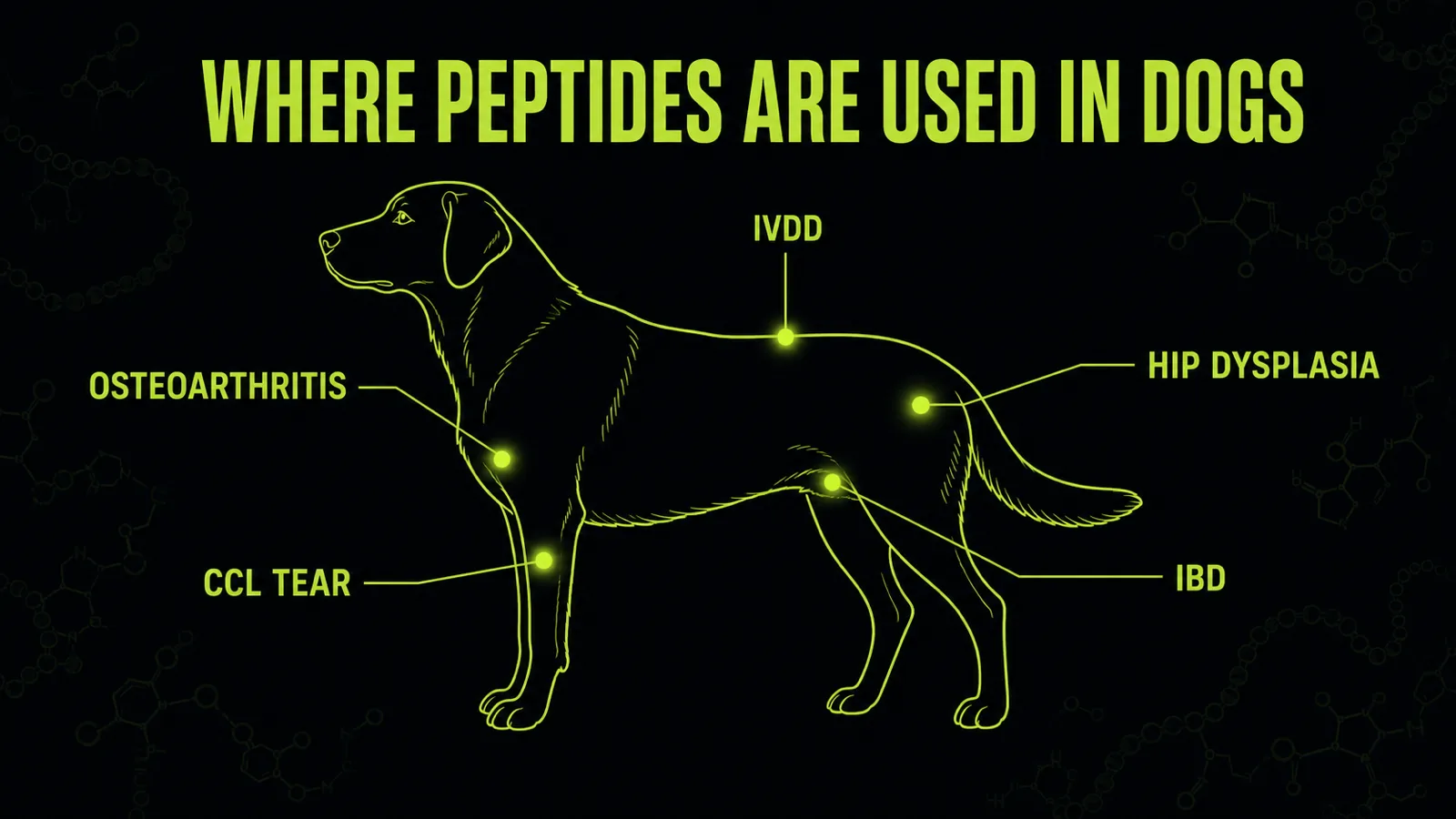
Musculoskeletal. Osteoarthritis, hip dysplasia, soft-tissue strains, partial CCL tears, IVDD, and post-surgical recovery after TPLO or spinal procedures. The proposed benefit is reduced joint inflammation, better synovial fluid quality, and faster repair of the ligament and tendon structures around the joint.
Gastrointestinal. Inflammatory bowel disease, chronic diarrhoea, gastric ulceration and so-called leaky gut. This is where oral dosing makes sense, since the mucosa is the target tissue. See our BPC-157 gut health guide for the underlying research.
TB-500 for Dogs
TB-500 is a synthetic fragment of thymosin beta-4. Its mechanism is different from BPC-157: it works primarily through actin sequestration and cell migration, and it stimulates tenocyte proliferation and collagen production. That makes it the more targeted choice for tendon and ligament injury specifically.
In practice it is most often run alongside BPC-157 rather than instead of it. Because the two act on different pathways there is no redundancy, and the combination is standard in sport-dog and equine practice for serious soft-tissue injury. TB-500 is dosed less frequently than BPC-157 — typically twice weekly in a loading phase — because of its longer tissue residence.
GHK-Cu for Dogs
GHK-Cu is a copper tripeptide found naturally in mammalian blood and saliva, dogs included. It drives collagen and elastin synthesis and shifts gene expression toward a repair phenotype. In dogs it is used for wound healing, surgical scar remodelling, skin and coat quality, and as an adjunct in arthritis protocols.
It is the most useful of the four for anything involving skin: hot spots, slow-healing wounds, post-surgical incisions. Because copper clearance depends on liver function, it deserves more thought in a dog with hepatic disease. See GHK-Cu side effects for the full profile.
KPV for Dogs
KPV is a three-amino-acid fragment of alpha-MSH — lysine, proline, valine — that keeps the anti-inflammatory activity of the parent molecule without its effects on pigmentation or hormones. It inhibits NF-kB directly inside the cell.
What makes it interesting for dogs is delivery. KPV is stable in the gastrointestinal environment and absorbed via PepT1 transporters in the intestinal epithelium — transporters that upregulate in inflamed tissue. Inflammation effectively increases the peptide's own uptake at the site that needs it. It produced significant anti-inflammatory effects in mouse colitis models, and in dogs it is used for chronic gut inflammation, IBD and atopic dermatitis. No canine clinical trials have been published.
Dosing Peptides by Dog Weight
Dosing is bodyweight-scaled. The off-label range most commonly cited in veterinary use is 2–10 mcg/kg/day, and the tier depends on the condition rather than the dog's size.
Start low. Most vets working with peptides begin at the 2–5 mcg/kg end and adjust based on response rather than opening at the top of the range.
Which tier applies:
- 2 mcg/kg — maintenance, mild systemic inflammation, ongoing gut support once an acute problem has settled.
- 5 mcg/kg — the usual starting point for moderate joint pain, soft-tissue repair and post-surgical healing.
- 10 mcg/kg — acute or severe injury and advanced orthopaedic disease. Short courses, and the tier that most warrants veterinary oversight, particularly in seniors or dogs on multiple medications.
How to Give It
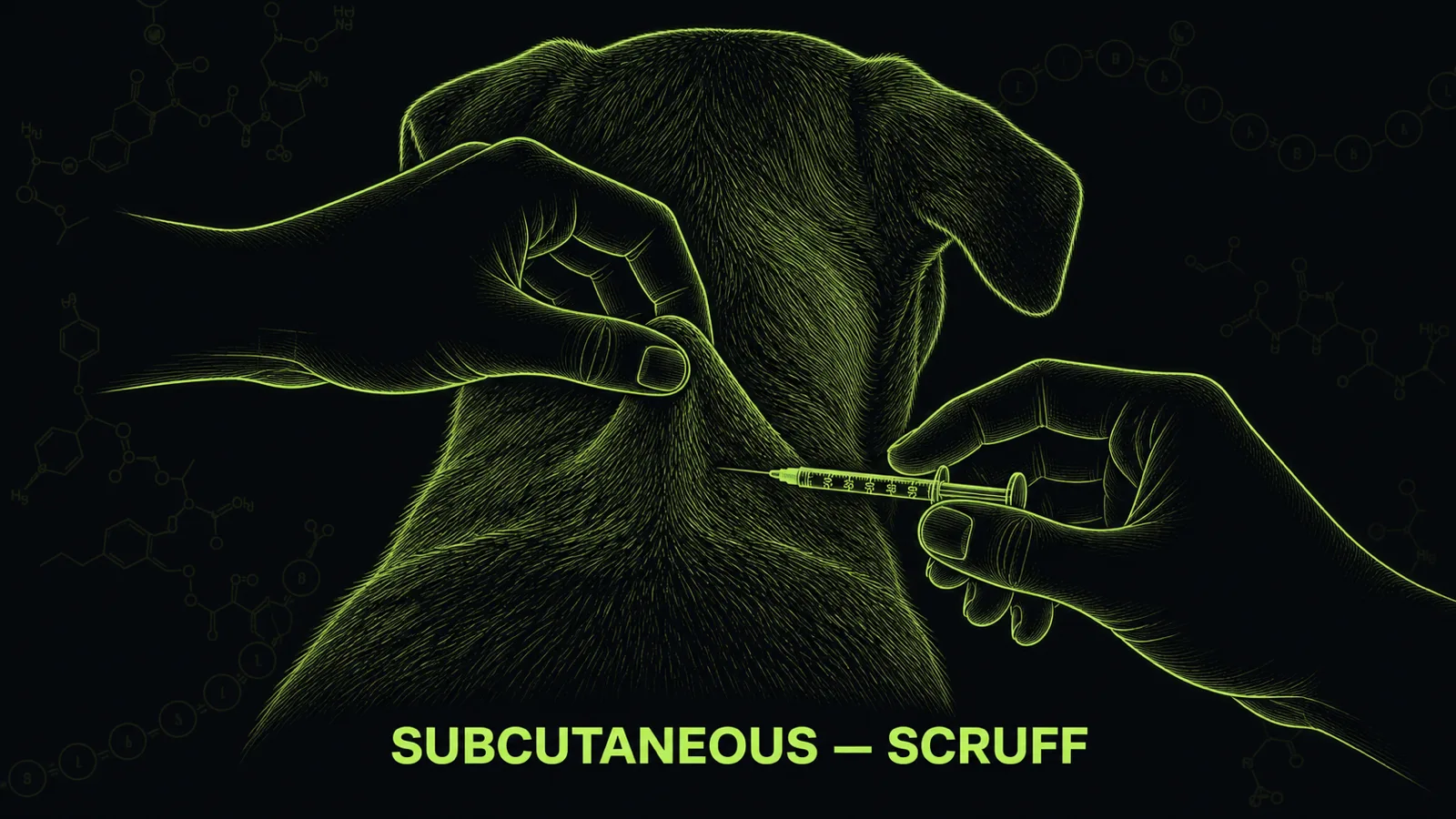
Subcutaneous injection is the most effective route for anything musculoskeletal. The loose skin over the scruff or the flank works well; the technique is identical to giving subcutaneous fluids, which many owners of senior dogs have already been taught. Use insulin syringes, rotate sites, and keep the reconstituted vial refrigerated.
Most dogs tolerate this far better than owners anticipate. BPC-157 in particular stings very little.
Oral dosing is the sensible choice for gut conditions, where the mucosa itself is the target and systemic absorption is not the point. It is the weaker route for joints and tendons. Our oral vs injection comparison covers the bioavailability question in detail.
Cycle length. Acute injury and post-surgical protocols typically run four to six weeks. Chronic arthritis and gut conditions often run six to eight. Stop and reassess rather than continuing indefinitely — most protocols are not designed for continuous use.
Stacking: When One Peptide Is Not Enough
Single-peptide protocols are the norm and the sensible place to start. Stacks come into play for serious injury or where a dog has several overlapping problems, which is common in seniors.
The standard pairing is BPC-157 plus TB-500, known in human circles as the Wolverine stack. The argument for it is mechanistic rather than dose-related: BPC-157 acts on angiogenesis, VEGF signalling and growth hormone receptor expression, while TB-500 acts on actin sequestration, cell migration and tenocyte proliferation. There is no overlap to be redundant about. For a partial CCL tear or a significant tendon injury, running both is the most commonly reported approach in sport-dog practice.
Adding GHK-Cu makes sense where skin or an incision is involved — post-surgical recovery being the obvious case, where you are healing an internal repair and a skin closure at the same time.
Adding KPV makes sense where inflammation is the dominant feature rather than structural damage: a dog with both arthritis and IBD, or arthritis and atopic dermatitis, which is a common pairing in older animals.
Four-way blends sold as a single vial — KLOW being the widely available one, combining GHK-Cu, BPC-157, TB-500 and KPV — reduce both cost and the practical burden of drawing four separate doses. The trade-off is that you lose the ability to dose each component independently, which matters if you want a high BPC-157 dose and a low GHK-Cu dose.
Peptides for Megaesophagus in Dogs
Megaesophagus comes up often enough in peptide searches to deserve a direct answer, and the honest one is uncomfortable: there is no evidence base here at all.
The condition is a loss of esophageal muscle tone and coordinated motility. Food collects in a dilated esophagus instead of moving to the stomach, and the dog regurgitates it back undigested. The danger is not the regurgitation but what follows it — aspiration pneumonia is what actually kills dogs with megaesophagus, and it is the reason this is a serious diagnosis rather than an inconvenient one.
Diagnosis matters more than treatment choice, because acquired megaesophagus is frequently secondary to something identifiable and treatable. Myasthenia gravis is the most common of these and is confirmed with an acetylcholine receptor antibody titre. Hypothyroidism and hypoadrenocorticism are also on the list. Treating the underlying disease can improve or resolve the megaesophagus itself, which no peptide is going to do. A dog that has not had that workup should have it before anything else is added.
As for peptides specifically: no published canine study has examined BPC-157 or any related peptide in megaesophagus. The reason owners ask is that BPC-157 has rodent work behind it on gastrointestinal healing, including esophageal tissue and sphincter function, most of it from a single research group. Extrapolating from rat esophagus to a dog with a structurally dilated esophagus and a possible autoimmune cause is a long reach, and nobody has tested it.
What genuinely changes outcomes here is mechanical and medical management — upright feeding in a Bailey chair with the dog held vertical afterwards, adjusting food consistency to whatever that individual dog moves best, treating aspiration pneumonia early and aggressively, and managing any underlying condition. If a peptide is used at all it belongs on top of that, after a diagnosis, with a vet who knows it is being given. It is not a substitute for any part of the above.
Size and Breed Considerations
Dosing is linear in mcg/kg, but a few practical differences follow from size.
Toy and small breeds face the same problem cats do: the calculated dose is small enough that measurement error becomes significant. A 3 kg terrier at 5 mcg/kg needs 15 mcg, and drawing that accurately from a concentrated vial is not realistic. Reconstitute with more bacteriostatic water so the volume is readable.
Giant breeds have the opposite problem — cost. A 65 kg mastiff at the high tier needs 650 mcg daily, which works through a 10 mg vial in about two weeks. Anyone treating a giant breed should price a full course before starting rather than partway through.
Brachycephalic breeds deserve a note on handling rather than dosing. Restraint stress is a genuine risk in a bulldog or pug, so an eight-week daily injection course needs to be weighed against oral dosing where the indication allows it.
Deep-chested and orthopaedically predisposed breeds — German Shepherds, Labradors, Rottweilers — are overrepresented in CCL rupture and hip dysplasia, which is why they are overrepresented in peptide use. That is a population effect, not a breed-specific response.
What the Timeline Actually Looks Like
How to Tell Whether It Is Working
"He seems better" is not much to go on six weeks and two hundred dollars later, and dogs are very good at masking pain. Owners who track something concrete make better decisions about whether to continue.
Useful things to measure before starting and at fortnightly intervals:
- Stairs and jumping. Whether the dog takes stairs unprompted, and whether it gets onto the sofa or into the car without help. Binary, easy to record, and the change owners most often notice first.
- Time to rise. How long from lying down to standing, especially first thing in the morning. Count seconds — it is more sensitive than impressions.
- Walk tolerance. Distance before the dog slows, lags or wants to turn back, on the same route each time.
- Lameness score. Your vet can score gait at the start and at six weeks. This is the closest thing to an objective measure available outside a research setting.
- Stool quality for gut protocols, using a standard faecal scoring chart rather than description.
- Video. Thirty seconds of the dog walking away from and toward the camera, filmed the same way each time. Owners consistently underestimate gradual change, and side-by-side video is what settles the question.
Because these are uncontrolled, unblinded observations by someone who wants the treatment to work, expectancy effects are real. That is exactly why recording concrete measures beforehand is worth the small effort.
Safety and When Not to Use
Veterinary case series spanning over a decade report no serious adverse events, and peptides do not carry the GI and renal burden that long-term NSAIDs do. But no controlled canine trials exist, and there are situations that warrant genuine caution.
Known or suspected cancer. This is the one that matters most. BPC-157 and TB-500 both promote angiogenesis, which is the mechanism that heals tissue and, theoretically, the mechanism that could support tumour growth. There is no evidence either peptide causes cancer. There is a sound argument for not using them in a dog with a diagnosed mass or unexplained clinical signs that have not been worked up — and older dogs are exactly the population where undiagnosed masses are most likely and where owners are most motivated to try peptides.
Existing kidney or liver disease. BPC-157 shows organ-protective effects in rodents, but that work was in healthy organs. Behaviour in already-compromised organs is unknown. GHK-Cu deserves separate thought in hepatic disease because copper clearance is liver-dependent.
Dogs on multiple medications. Interaction data effectively does not exist. Veterinary input on dose selection is strongly recommended for seniors and polypharmacy cases.
Vendor quality. Research peptides carry no requirement that contents match the label, and purity varies widely. Impurities were the FDA's stated original concern when BPC-157 and TB-500 were placed in Category 2 of the bulk substances list.
What It Costs
A month of BPC-157 for a medium dog of 20–30 kg typically runs $50–$150 for the peptide itself, plus veterinary consultation fees. Larger dogs cost proportionally more since dosing is weight-based; a giant breed at the high tier can go through vials several times faster than a terrier at maintenance.
Stacking BPC-157 with TB-500 roughly doubles peptide cost. Blends such as KLOW, which combine GHK-Cu, BPC-157, TB-500 and KPV in a single vial, work out cheaper per compound than buying four separately — see the KLOW blend review.
Where to Buy
Two routes. A compounding pharmacy through your veterinarian gives you a product formulated for animals at a verified concentration with a professional accountable for it. That is the better option when you can get it, and it became more plausible after the FDA's July 2026 advisory committee voted narrowly in favour of allowing pharmacies to compound BPC-157, KPV, TB-500 and MOTS-c — though that recommendation is non-binding.
Research-grade vendors are where most owners end up. The critical filter is third-party batch testing: buy from suppliers publishing a certificate of analysis that names the batch and the testing lab. Our BPC-157 vendor guide covers who actually tests.
For the wider regulatory picture across species, see the peptides for animals overview. Cat owners should read peptides for cats, where dosing precision and kidney disease change the calculus; horse owners should start with peptides for horses.