Semaglutide & Tirzepatide from Yucca · US-licensed Rx · From $146 · Buy now, pay later

Start your 1-min quiz
PDPeptideDeck
01· StoreShop Peptides↗02GLP-1 Suppliers03Calculator04Free TrialAI Coach
Shop
Start HerePeptide Vendors →
Home/Peptides/Peptide guidesPeptides for Horses: TB-500, Tendon Injuries, Ulcers & Competition Rules (2026)
Peptide guides10

Peptides for Horses: TB-500, Tendon Injuries, Ulcers & Competition Rules (2026)

Published July 29, 2026Updated July 29, 2026
Quick Brief

Equine peptide use has the longest track record of any species. Dosing for a 500 kg horse, tendon and suspensory protocols, EGUS, and the competition rules to check first.

Peptides for Horses: TB-500, Tendon Injuries, Ulcers & Competition Rules (2026)

Procurement

TB-500 (5MG)
In StockShips from USA

TB-500 (5MG)

TB-500 (5MG) from Ascension Peptides, third-party tested and shipped from the US. Use code PEPTIDEDECK for 50% off.

$27.00$54.00
Get TB-500 (5MG) - 50% Off with PEPTIDEDECK
Contents0%
Why Equine Use Came FirstTB-500 for HorsesBPC-157 for HorsesDosing for a 500 kg HorseGHK-Cu, Wounds and Proud FleshFitting Peptides Into a Rehabilitation ProgrammeCompetition Rules: Read This Before You DoseLegality and SafetyFrequently Asked Questions
TB-500 (5MG)

Procurement

TB-500 (5MG)

In StockShips from USA
$27.00$54.00
Get TB-500 (5MG) - 50% Off with PEPTIDEDECK

Last updated: July 29, 2026

Peptides for horses are the oldest branch of veterinary peptide use — older than the human biohacking market that made these compounds famous. Equine practices have been using TB-500 for tendon and ligament injury since the early 2000s, which gives equine use the longest real-world track record of any species.

The reason is straightforward. Tendon injuries end careers, tendon tissue heals slowly because its blood supply is poor, and a peptide whose primary action is angiogenesis addresses exactly that limitation. This guide covers what is used, dosing for a 500 kg animal, gastric ulcers, and the competition rules that dog and cat owners never have to think about.

Quick Answer: Peptides in Horses

  • TB-500 is the first-line choice for tendon and ligament injury, not BPC-157. It has the longest equine track record and stimulates tenocyte proliferation directly.
  • BPC-157 is the choice for gastric ulcers (EGUS) and for soft-tissue and wound work, often stacked with TB-500.
  • Dosing is bodyweight-scaled like every species, but at 500 kg the absolute quantities are large — a 5 mcg/kg dose is 2,500 mcg, so vial economics look completely different.
  • Check competition rules before you dose anything. Regulations differ between FEI, national federations and racing commissions, and they change.
  • Nothing here is approved for horses. Use is off-label and grey-market, and in performance horses the regulatory exposure is real.

Why Equine Use Came First

Sport-dog and equine practices were using BPC-157, TB-500, oxytocin and GnRH agonists routinely for tendon, mucosal, reproductive and behavioural indications years before the human wellness market discovered them. The economics explain it: a performance horse represents a large investment, tendon injuries are common and career-ending, and conventional treatment options for a bowed tendon are limited and slow.

The clinical problem is specific. Tendon is poorly vascularised, which is why it heals slowly and why the repair tissue is often mechanically inferior to what it replaced. Any intervention that improves blood supply to healing tendon is attacking the actual bottleneck rather than the symptoms.
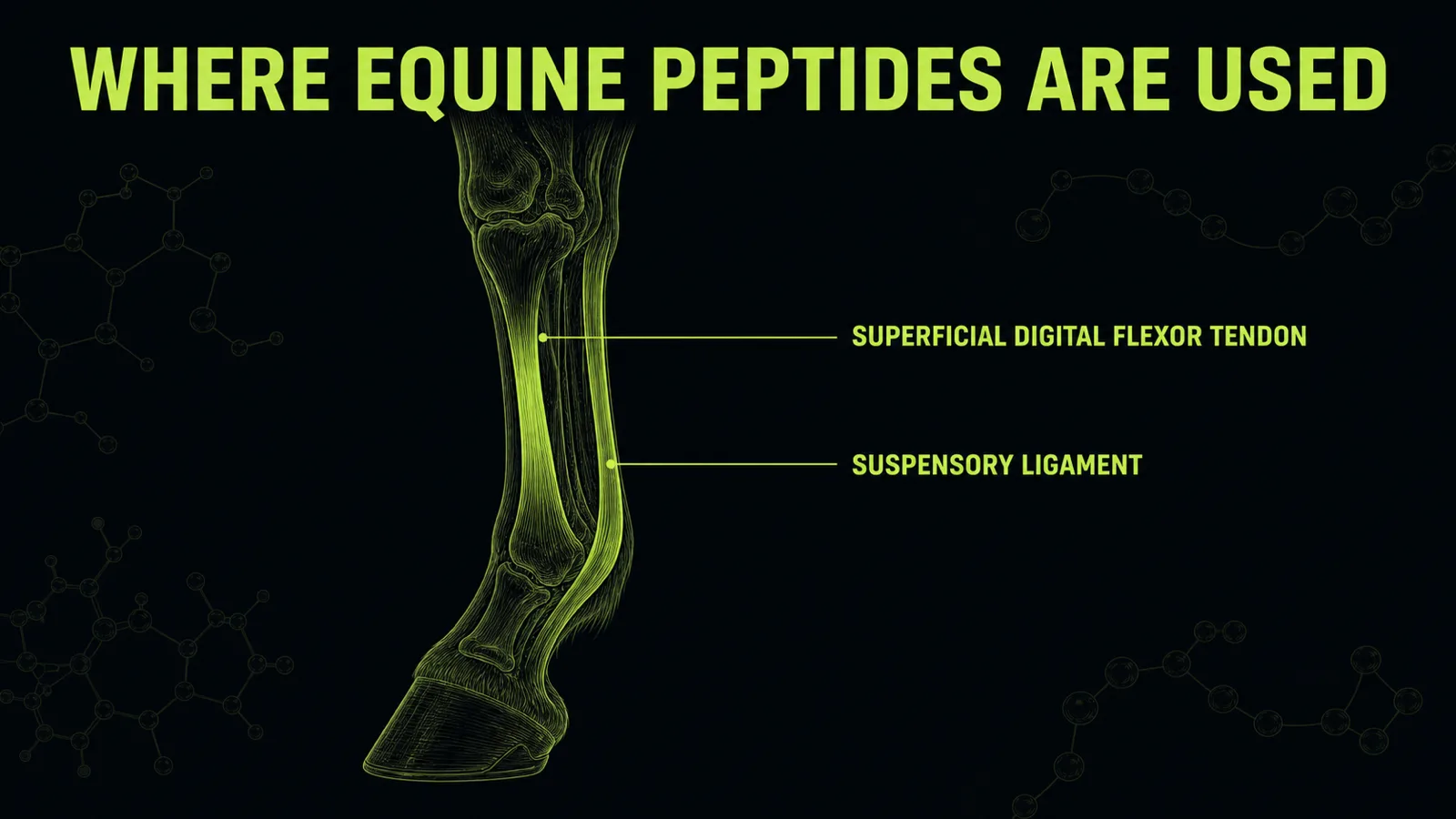
Diagram of equine injuries treated with peptides including superficial digital flexor tendon and suspensory ligament damage
Tendon and suspensory injuries dominate equine peptide use — the tissues where poor blood supply limits healing.

TB-500 for Horses

TB-500 is a synthetic fragment of thymosin beta-4, a protein central to tissue repair. It works through actin sequestration and cell migration, and research indicates it stimulates tenocyte proliferation and collagen production — the specific cellular processes tendon repair depends on. It also promotes angiogenesis, which addresses the blood supply problem directly.

Equine applications:

  • Superficial digital flexor tendon injury — the classic bowed tendon, and the injury TB-500 is most associated with.
  • Suspensory ligament desmitis — both branch and body lesions.
  • Deep digital flexor tendon lesions.
  • Muscle tears and general soft-tissue trauma.

Published veterinary research favours TB-500 over BPC-157 specifically for tendon and ligament work, which is the reverse of the ordering in dogs. Dosing is less frequent than daily — loading schedules of twice weekly followed by weekly maintenance are typical, reflecting the peptide's longer tissue residence. See TB-500 side effects for the safety profile.

BPC-157 for Horses

BPC-157 earns its place in equine practice for two distinct reasons.

Gastric ulcers. Equine gastric ulcer syndrome is extraordinarily common in performance horses — a consequence of stall confinement, concentrate feeding, intermittent forage access and training intensity. BPC-157 was originally characterised as a gastroprotective peptide derived from gastric juice, and mucosal protection and repair is its most direct application. For a horse on omeprazole with recurring ulceration after withdrawal, this is the most compelling indication in the species.

Soft tissue and wounds. Angiogenesis, VEGF signalling and reduced inflammation apply here as in every species. It is frequently run alongside TB-500 for significant tendon injury, since the two act on different pathways.

Peptide
Primary equine use
Route
Frequency
TB-500
SDFT and suspensory injury, muscle tears
IM or SC injection
Loading 2× weekly, then weekly
BPC-157
Gastric ulcers (EGUS), soft tissue, wounds
IM, SC or oral for ulcers
Daily
GHK-Cu
Wound healing, proud flesh, scar remodelling
Topical or SC
Daily to every other day
TB-500
Primary equine use
SDFT and suspensory injury, muscle tears
Route
IM or SC injection
Frequency
Loading 2× weekly, then weekly
BPC-157
Primary equine use
Gastric ulcers (EGUS), soft tissue, wounds
Route
IM, SC or oral for ulcers
Frequency
Daily
GHK-Cu
Primary equine use
Wound healing, proud flesh, scar remodelling
Route
Topical or SC
Frequency
Daily to every other day

Dosing for a 500 kg Horse

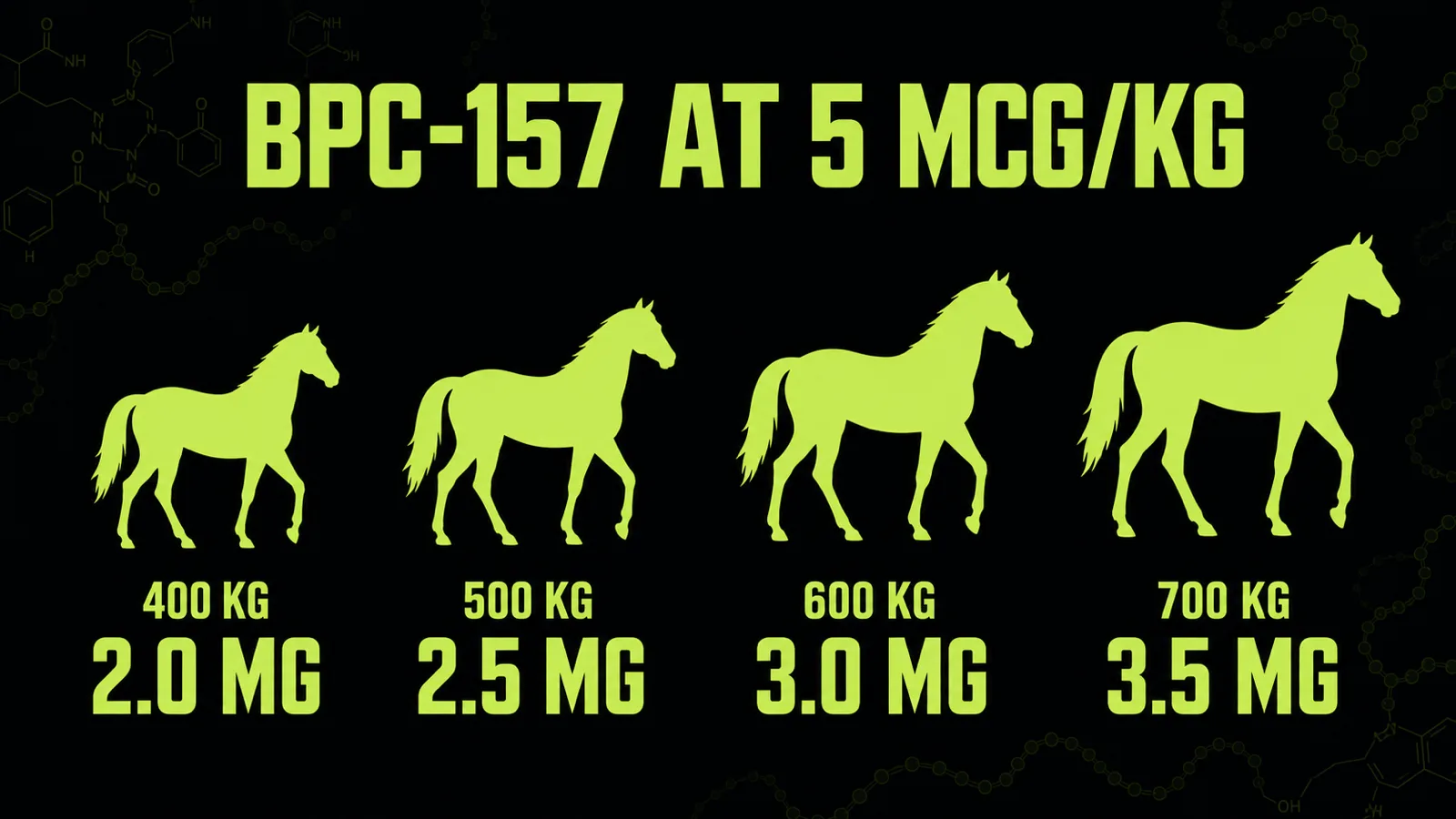
The mcg/kg logic is the same as every other species; the absolute numbers are what change. At 500 kg, a 5 mcg/kg dose is 2,500 mcg — 2.5 mg, or a quarter of a standard 10 mg vial in a single dose.
Horse weight
Low (2 mcg/kg)
Standard (5 mcg/kg)
High (10 mcg/kg)
400 kg (880 lb)
800 mcg
2,000 mcg
4,000 mcg
500 kg (1,100 lb)
1,000 mcg
2,500 mcg
5,000 mcg
600 kg (1,320 lb)
1,200 mcg
3,000 mcg
6,000 mcg
700 kg (1,540 lb)
1,400 mcg
3,500 mcg
7,000 mcg
400 kg (880 lb)
Low (2 mcg/kg)
800 mcg
Standard (5 mcg/kg)
2,000 mcg
High (10 mcg/kg)
4,000 mcg
500 kg (1,100 lb)
Low (2 mcg/kg)
1,000 mcg
Standard (5 mcg/kg)
2,500 mcg
High (10 mcg/kg)
5,000 mcg
600 kg (1,320 lb)
Low (2 mcg/kg)
1,200 mcg
Standard (5 mcg/kg)
3,000 mcg
High (10 mcg/kg)
6,000 mcg
700 kg (1,540 lb)
Low (2 mcg/kg)
1,400 mcg
Standard (5 mcg/kg)
3,500 mcg
High (10 mcg/kg)
7,000 mcg
Equine peptide dosing chart showing milligram doses by horse bodyweight from 400kg to 700kg
At 500 kg, a single standard dose is a quarter of a 10 mg vial.
Vial economics change completely at equine scaleA 10 mg vial that lasts a 5 kg cat an entire eight-week course covers four days for a 500 kg horse at the standard dose. Multi-vial purchasing and correspondingly larger reconstitution volumes are the norm, and cost per course is an order of magnitude higher than in small animals. This is also why batch consistency matters more here — you will be working through a lot of product.

Administration is intramuscular or subcutaneous. Injection volumes are meaningful rather than the fractions of a millilitre used in cats, which makes accurate dosing considerably easier. Standard equine injection sites and technique apply, and this is work for someone competent with equine injections.

TB-500 (5MG)
Top Pick TB-500 (5MG) TB-500 (5MG) from Ascension Peptides, third-party tested and shipped from the US. Use code PEPTIDEDECK for 50% off. Exclusive 50% off — use code PEPTIDEDECK
Get TB-500 (5MG) - 50% Off with PEPTIDEDECK

GHK-Cu, Wounds and Proud Flesh

GHK-Cu occupies a smaller but genuine niche in equine practice. Horses are exceptionally good at injuring themselves on fencing, and distal limb wounds are notoriously difficult: minimal soft tissue coverage, poor blood supply, constant movement across the wound bed, and a strong tendency toward exuberant granulation tissue — proud flesh.

GHK-Cu drives collagen and elastin synthesis and shifts gene expression toward an organised repair phenotype rather than disordered granulation. That is the theoretical argument for using it on lower limb wounds, and it applies topically as well as systemically, which sidesteps both the cost and the regulatory exposure of injecting a large animal.

It is also used in scar remodelling after wounds have closed and as an adjunct in surgical incision healing. The copper load that warrants caution in a small cat is a non-issue at equine bodyweight.
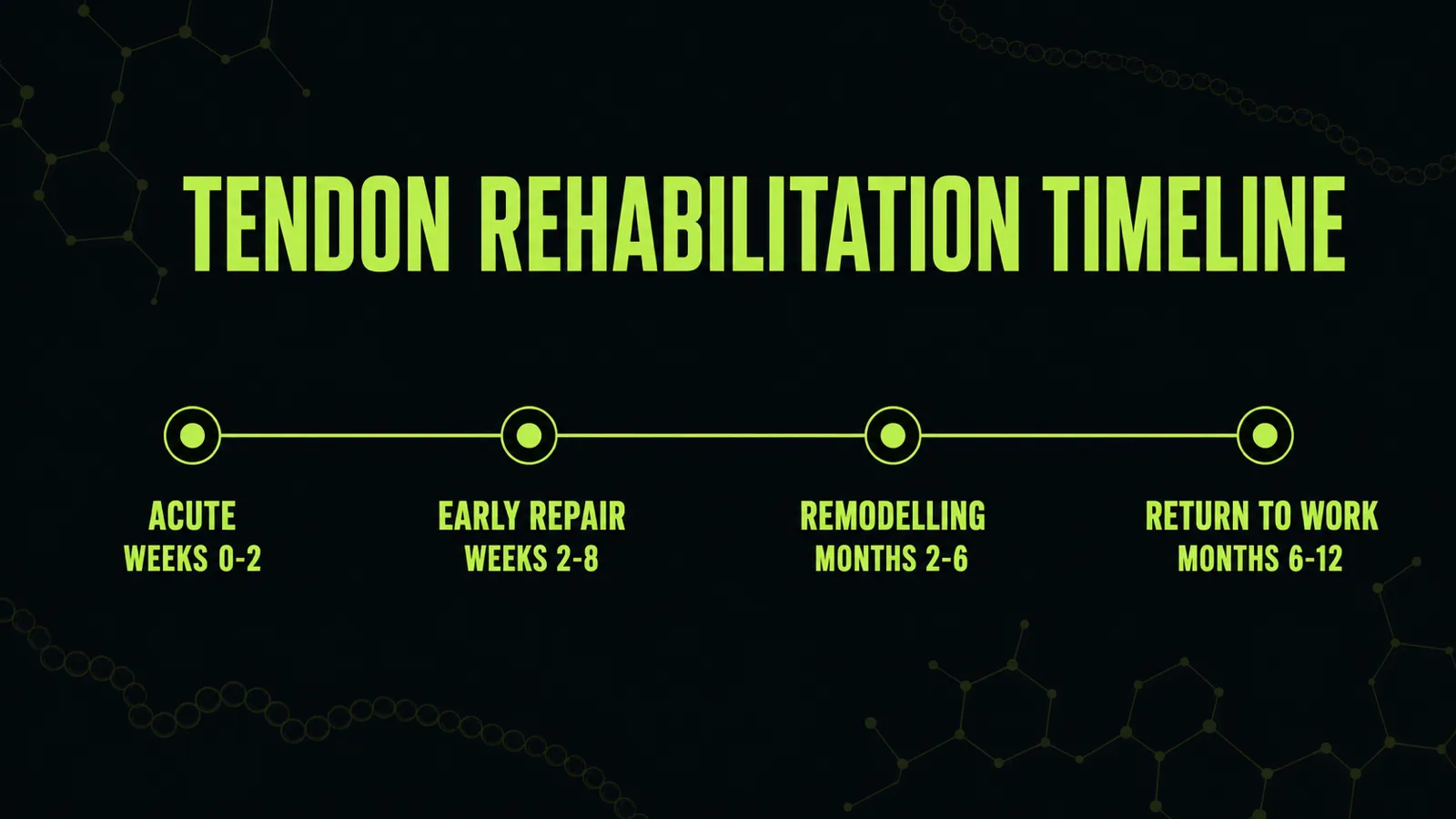
Equine tendon rehabilitation timeline showing controlled exercise progression alongside peptide protocol phases
Peptides sit inside a rehabilitation programme — they do not shorten the controlled exercise phase.

Fitting Peptides Into a Rehabilitation Programme

The most common mistake in equine peptide use is treating the peptide as the programme rather than as one input into it. Tendon outcomes are determined by graded loading and imaging-led reassessment, and no peptide changes that.

Where peptides fit, roughly:

Rehab phase
Typical duration
What the peptide is for
What determines progression
Acute inflammatory
Weeks 0–2
Limiting secondary damage; BPC-157 daily, TB-500 loading dose
Resolution of heat, swelling and pain — not the calendar
Early repair
Weeks 2–8
Angiogenesis and tenocyte activity while collagen is laid down
Ultrasound showing fibre pattern beginning to organise
Remodelling
Months 2–6
Supporting organised collagen alignment under controlled load
Serial ultrasound and tolerance of increasing work
Return to work
Months 6–12
Usually discontinued; competition rules become the governing factor
Imaging plus veterinary clearance, never owner impression
Acute inflammatory
Typical duration
Weeks 0–2
What the peptide is for
Limiting secondary damage; BPC-157 daily, TB-500 loading dose
What determines progression
Resolution of heat, swelling and pain — not the calendar
Early repair
Typical duration
Weeks 2–8
What the peptide is for
Angiogenesis and tenocyte activity while collagen is laid down
What determines progression
Ultrasound showing fibre pattern beginning to organise
Remodelling
Typical duration
Months 2–6
What the peptide is for
Supporting organised collagen alignment under controlled load
What determines progression
Serial ultrasound and tolerance of increasing work
Return to work
Typical duration
Months 6–12
What the peptide is for
Usually discontinued; competition rules become the governing factor
What determines progression
Imaging plus veterinary clearance, never owner impression

The honest summary is that a peptide may improve the quality of the healing environment during the repair and remodelling phases. It does not license bringing a horse back sooner, and horses returned to work early on the strength of feeling better re-injure at the same rates they always have.
PureBac 7x tested bacteriostatic water 10mL vial
7x Quality Tested Bac Water

Don't ruin a $300 peptide on generic bac water.

Sterile, non-pyrogenic, exactly 0.9% benzyl alcohol, with a COA on every batch. Made for peptide reconstitution, not repackaged from generic stock.

0.9% benzyl alcohol 7x tested in USA COA every batch
Get PureBac bac water From $7.99 · Free shipping over $150

Competition Rules: Read This Before You Dose

This is the section with no equivalent in the dog and cat guides, and it is the one that costs people the most.

Regulatory status varies by governing body and changes over time. BPC-157 was added to the WADA prohibited list in 2022 and its status has since shifted; that is the human anti-doping framework, and it is not the framework that governs your horse. What governs your horse is the FEI, your national federation, or the relevant racing commission — and each maintains its own prohibited substances list with its own detection thresholds and withdrawal guidance.

Points worth being explicit about:

  • Check the current list, not a summary. These lists are revised, and an article — this one included — is not a substitute for the governing body's published rules on the day you compete.
  • There is no published withdrawal time for compounds that are not approved veterinary medicines. Absence of a stated withdrawal period is not the same as absence of detection risk.
  • Testing capability moves. A compound not routinely screened for today may be screened for next season, and samples can be stored.
  • Responsibility sits with the person responsible under FEI rules regardless of who administered what.

For a horse in active competition, the honest position is that using unapproved peptides carries regulatory risk that cannot be eliminated by timing. For a horse out of competition on a rehabilitation programme, that calculus is entirely different.

Legality and Safety

No peptide discussed here is approved for use in horses. Compounded animal drugs made from bulk substances are unapproved drugs, though FDA guidance GFI #256 sets out conditions under which the agency does not intend to take enforcement action. In July 2026 an FDA advisory committee voted narrowly in favour of allowing compounding pharmacies to prepare BPC-157, KPV, TB-500 and MOTS-c — a non-binding recommendation aimed at human compounding, but one that shifts the broader picture. The peptides for animals overview covers the regulatory position in full.

On safety, the same angiogenesis caution applies: these peptides promote blood vessel growth, which argues against use in an animal with a known or suspected neoplasm. Vendor quality is the other live issue, and it matters more at equine doses simply because of the quantity involved. Buy from suppliers publishing third-party certificates of analysis that name the batch and the testing laboratory — our TB-500 sourcing guide covers who actually tests.

Peptides are an adjunct to a rehabilitation programme, not a replacement for one. Controlled exercise progression, imaging-led reassessment and appropriate rest remain what determines whether a tendon injury resolves. A peptide that improves the healing environment does nothing for a horse brought back to work too early.

For the small-animal picture, see peptides for dogs and peptides for cats.
Frequently Asked Questions

Is TB-500 or BPC-157 better for horses?
For tendon and ligament injury, TB-500. It has the longest equine track record of any peptide, going back to the early 2000s, and research indicates it stimulates tenocyte proliferation and collagen production directly. BPC-157 is the better choice for gastric ulcers and general soft-tissue and wound healing. They act through different mechanisms and are commonly run together for significant tendon injury.
How much BPC-157 does a horse need?
Bodyweight scaling puts a 500 kg horse at roughly 1,000 mcg daily at the low tier, 2,500 mcg at the standard 5 mcg/kg dose, and 5,000 mcg at the high tier. In practical terms that means a standard 10 mg vial supplies about four days at the standard dose, so equine protocols consume far more product than small-animal ones and cost accordingly.
Are peptides banned in competition?
Rules differ by governing body and they change, so the only reliable answer is to check the current prohibited substances list published by the FEI, your national federation or the relevant racing commission before dosing. BPC-157 was added to the WADA list in 2022 and its status has shifted since, but WADA governs human sport, not equine competition. There are no published withdrawal times for unapproved compounds, and that is not the same as no detection risk.
Can peptides heal a bowed tendon?
They address a genuine bottleneck — tendon heals slowly largely because its blood supply is poor, and TB-500 promotes angiogenesis and tenocyte activity. What they will not do is substitute for a controlled rehabilitation programme. Tendon outcomes are determined by graded exercise progression and imaging-led reassessment; a peptide can improve the healing environment but cannot compensate for returning a horse to work too soon.
Can BPC-157 help with equine gastric ulcers?
It is one of the more compelling equine indications. BPC-157 was originally characterised as a gastroprotective peptide derived from gastric juice, and mucosal protection and repair is its most direct application. EGUS is very common in performance horses, and recurrence after omeprazole withdrawal is a familiar problem. Evidence remains rodent research plus veterinary experience rather than controlled equine trials.
How is it administered to a horse?
Intramuscular or subcutaneous injection, using standard equine injection sites and technique. Unlike cats, where doses are fractions of a millilitre and dilution is the main practical problem, equine volumes are large enough to measure easily. For gastric ulcers, oral administration is a reasonable route since the gastric mucosa is the target tissue.
TB-500 (5MG)

Recommended Supplier

In StockShips from USA

TB-500 (5MG)

TB-500 (5MG) from Ascension Peptides, third-party tested and shipped from the US. Use code PEPTIDEDECK for 50% off.

$27.00$54.00

Exclusive 50% off — use code PEPTIDEDECK

Get TB-500 (5MG) - 50% Off with PEPTIDEDECK

Buy Related Peptides — 99%+ Purity

BPC-157

BPC-157

5mg Single Vial · 99%+ Purity

$55.00$59.99
From $55.00
TB-500

TB-500

5mg Single Vial · 99%+ Purity

$50.00$60.00
From $50.00

Related Topics

peptides for horsesTB-500 for horsesBPC-157 for horsesequine peptide therapyhorse tendon injury peptideequine gastric ulcers BPC-157peptides for equine tendon repair
Back to Peptides
Contents0%
Why Equine Use Came FirstTB-500 for HorsesBPC-157 for HorsesDosing for a 500 kg HorseGHK-Cu, Wounds and Proud FleshFitting Peptides Into a Rehabilitation ProgrammeCompetition Rules: Read This Before You DoseLegality and SafetyFrequently Asked Questions
TB-500 (5MG)

save 50% with code

Get 50% Off
PDPeptideDeck

Research-backed guides, dosing tools and reviews for peptides and GLP-1 medications.

01 · Explore

  • Peptide Guides
  • Oral Peptides
  • HRT Guide
  • TRT Guide
  • Blog
  • Calculators
  • AI Coach
  • Shop

02 · GLP-1

  • GLP-1 Guide
  • GLP-1 Programs
  • GLP-1 Reviews

03 · Company

  • About
  • Contact

04 · Dosing Charts

MOTS-cSermorelinSelankGHK-CuSemaglutideGLOWTesamorelin5-Amino-1MQCagrilintideMK-677FOXO4-DRIZepboundMounjaroWegovyKisspeptinSS-31Thymosin Alpha-1KPVEnclomipheneGlutathione
© 2026 PeptideDeck