Ipamorelin and tesamorelin get grouped together constantly, usually under a heading like "growth hormone peptides." That grouping hides the single most important fact about them: they are not the same class of compound, they do not bind the same receptor, and only one of them has ever been through a pivotal human trial.
Tesamorelin is an FDA-approved drug with 816 patients behind its label. Ipamorelin is a research peptide whose development program was abandoned before approval and whose human data amounts to a couple of pharmacokinetic studies. If you only take one thing from this page, take that asymmetry — it drives every other difference below.
🔑 Quick Decision
- Choose tesamorelin if: visceral abdominal fat is the actual target. It is the only one of the two with trial evidence for that specific outcome
- Choose ipamorelin if: you want a mild, selective GH nudge for sleep and recovery, and you accept that the human evidence is thin
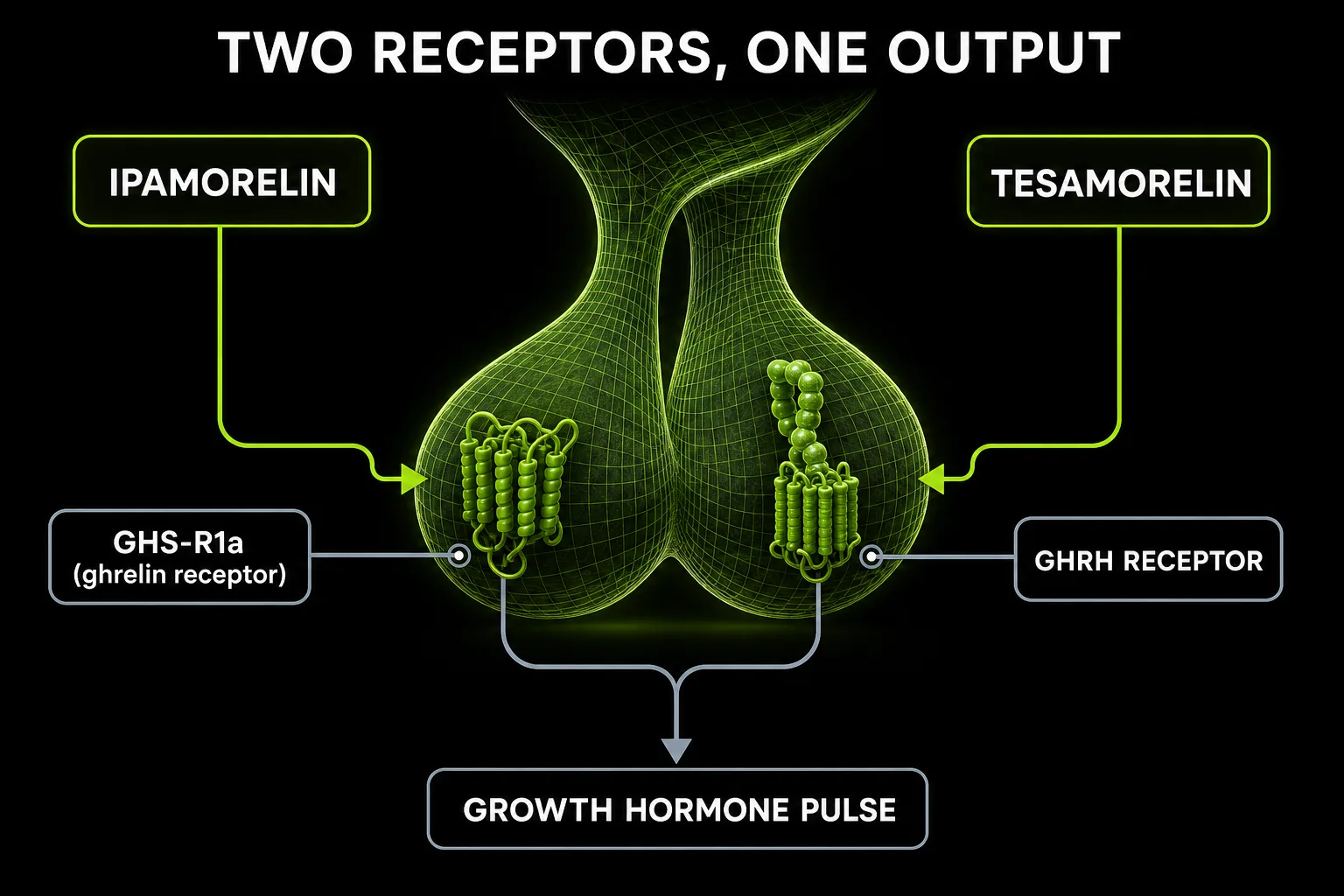
- They hit different receptors — tesamorelin is a GHRH analog, ipamorelin is a ghrelin-receptor (GHS-R1a) agonist. That is why they stack rather than compete
- Only tesamorelin is FDA approved, as Egrifta, and only for HIV-associated lipodystrophy. Every other use is off-label
- Neither is currently compoundable under 503A. Ipamorelin was pulled from Category 2 in September 2024 and never added to Category 1
Ipamorelin vs Tesamorelin: At a Glance
How They Work: Two Receptors, One Output
Both compounds end up raising growth hormone, which is why they get lumped together. They get there through completely separate doors.
Ipamorelin: A Selective Ghrelin-Receptor Agonist
Ipamorelin is a pentapeptide that binds GHS-R1a, the same receptor ghrelin uses. It was designed to solve a specific problem with the earlier growth hormone releasing peptides: GHRP-2 and GHRP-6 raise growth hormone effectively but drag cortisol, prolactin and appetite up with them.
The original characterisation work found that ipamorelin did not release ACTH or cortisol at levels meaningfully different from GHRH stimulation, even at doses more than 200 times the ED50 for growth hormone release. That selectivity is genuinely the compound's defining feature and the reason it stayed popular for twenty-five years after its developer shelved it.
Two caveats deserve stating plainly, because most write-ups skip them. First, the selectivity data is heavily rodent-derived; there is no large, well-powered human dose-response study confirming zero cortisol or prolactin rise in every person at every dose. Second, receptor desensitisation is a known property of chronic GHRP dosing, and no long-term human desensitisation study exists for ipamorelin. "Selective" is well supported. "Selective forever, in humans, at any dose" is not.
For the full picture on what ipamorelin does and does not do, see our guide to ipamorelin benefits and results.
Tesamorelin: A Stabilized GHRH Analog
Tesamorelin is a synthetic version of human growth hormone releasing hormone (1-44) with a trans-3-hexenoyl group attached to the N-terminus. That modification is the whole trick: unmodified GHRH is chewed up by DPP-4 in minutes, and the added group protects it long enough to be a viable drug.
Because it works upstream at the GHRH receptor, tesamorelin amplifies the body's own pulsatile growth hormone rhythm rather than overriding it. Negative feedback through somatostatin and IGF-1 stays intact, which is the standard argument for secretagogues over exogenous HGH.
Our tesamorelin peptide guide covers the mechanism in more depth, and the tesamorelin review walks through what the approval actually covers.
Visceral Fat: The Comparison Is Not Close
This is the section that should decide the question for most people, so it is worth being precise about what was measured.
The pivotal tesamorelin program enrolled 816 adults with HIV-associated abdominal fat accumulation. Participants self-administered 2 mg subcutaneously daily. The primary endpoint was percent change in visceral adipose tissue on single-slice CT at the L4-L5 level, and the trialists pre-specified 8% as the minimum clinically meaningful reduction. Tesamorelin delivered 15-18% VAT reduction over 26 weeks, roughly double the bar they set for themselves. Longer follow-up puts the range at 15-20% over 6-12 months, with parallel reductions in trunk fat, hepatic fat and waist circumference.
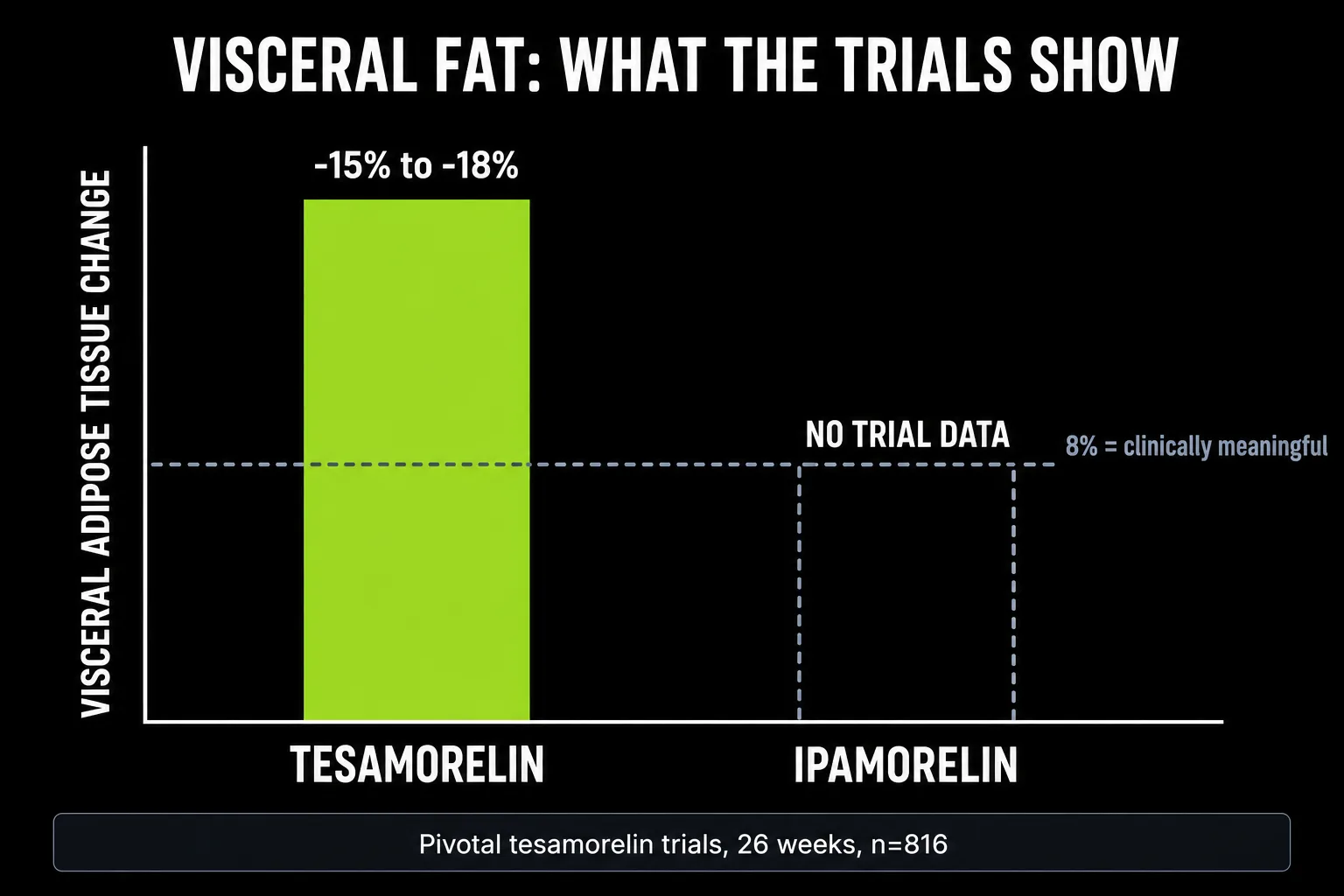
Ipamorelin has no equivalent number. Not a worse number, not a smaller effect: no published human trial has measured what ipamorelin does to visceral adipose tissue. Anyone quoting a percentage for ipamorelin and visceral fat is extrapolating from growth hormone physiology, not citing data.
That does not mean ipamorelin does nothing for body composition. It means the honest comparison is "measured effect versus unmeasured effect," and if visceral fat is your specific target, one of those is a considerably safer bet. The tesamorelin dosage guide covers how the trial protocol translates to practice.
Where Ipamorelin Actually Fits
Reading the section above, it would be easy to conclude ipamorelin is simply the weaker compound. That is the wrong takeaway, because the two are not competing for the same job.
Ipamorelin's appeal is the shape of its side effect profile, not the size of its effect. Among ghrelin-receptor agonists it is the mild one: minimal cortisol, negligible prolactin, no meaningful effect on FSH, LH, TSH or ACTH at studied doses, and no dramatic hunger spike. People who react badly to GHRP-6's appetite surge or GHRP-2's cortisol bump generally tolerate ipamorelin.
Its roughly two-hour half-life is also considerably longer than tesamorelin's 26-38 minutes, which makes once-nightly dosing coherent — ipamorelin is usually run before sleep to sit alongside the body's largest natural growth hormone pulse. Practical dosing is covered in our ipamorelin dosage guide, and the realistic outcome range in ipamorelin benefits.
Legal and Regulatory Status in 2026
This is the part that changed most recently, and getting it wrong has practical consequences.
Tesamorelin is FDA approved as Egrifta, indicated for reducing excess abdominal fat in people with HIV-associated lipodystrophy. That is the only approved indication. Prescribing it for general body composition in an otherwise healthy adult is off-label — legal for a physician to do, but not what the approval covers. Routes are laid out in how to get tesamorelin.
Ipamorelin has never been approved anywhere. Its compounding status is the detail people get wrong: ipamorelin and ipamorelin acetate were removed from the FDA's interim 503A Category 2 list on 27 September 2024, after the original nominators withdrew the nomination. Removal from Category 2 was not a promotion. Ipamorelin was never added to Category 1, so it sits in limbo — not formally flagged as a significant safety risk, but not eligible for 503A compounding either. At the October 2024 PCAC meeting the FDA's own analysis recommended against inclusion.
Ipamorelin was also not among the seven peptides reviewed at the July 2026 PCAC meeting. Our coverage of the 2026 FDA peptide vote explains what that meeting did and did not decide.
Dosing Compared
A note on the mass difference: a 5 mg vial of ipamorelin at 250 mcg per dose yields about 20 doses. A 5 mg vial of tesamorelin at 2 mg daily yields two and a half. Per-vial prices look similar; cost per week is not remotely similar. Run that math before assuming tesamorelin is affordable at research-peptide pricing. Our reconstitution calculator handles the conversion.
Side Effects Compared
The overlap is larger than the differences. Both raise growth hormone, so both produce the classic growth-hormone side effect cluster: water retention, transient joint aches, tingling in the hands, and injection site reactions.
Tesamorelin's label adds specifics the trials were large enough to catch — injection site erythema and pruritus, peripheral edema, arthralgia, and elevated blood glucose. That last one matters: growth hormone is counter-regulatory to insulin, and anyone with impaired glucose tolerance should be monitoring. Details are in tesamorelin side effects.
Ipamorelin's reported profile is milder, but read that carefully: a milder reported profile from two small PK studies is not the same evidentiary weight as a mild profile across 816 monitored patients. Absence of reports is partly absence of looking. The general framework is in our peptide side effects guide.
Can You Stack Them?
Yes, and the mechanism is the reason. A GHRH analog and a ghrelin-receptor agonist act on separate receptors, and combining a GHRH with a GHRP produces a larger growth hormone pulse than either alone. That is the same logic behind the far more common CJC-1295 and ipamorelin pairing.
The practical objection is cost rather than pharmacology. Tesamorelin at label dose is expensive enough that most people stacking for general body composition end up using a cheaper GHRH. If you want to see how the combination is actually run, we cover it in the tesamorelin and ipamorelin stack guide.
Which Should You Choose?
If you are still deciding between the wider field rather than these two specifically, our ranking of the best growth hormone peptides in 2026 compares the full set, and sermorelin vs tesamorelin covers the other common tesamorelin comparison.
Where to Buy
Both are sold as research compounds by US vendors. Tesamorelin is also available by prescription as Egrifta, which is the route to take if you want pharmacy-grade product and physician oversight, and the route that costs dramatically more.
For research-grade material, we track pricing and testing in where to buy tesamorelin and ipamorelin for sale. Whichever you choose, third-party purity documentation is the thing worth insisting on.
Frequently Asked Questions
This article is for research and educational purposes. Neither compound is a substitute for medical advice, and tesamorelin's only approved indication is HIV-associated lipodystrophy. Talk to a qualified physician before starting anything discussed here.