🔑 Key Takeaways
- Ipamorelin is a selective GHRP (growth hormone releasing peptide) that triggers GH release without raising cortisol or prolactin
- Ipamorelin benefits include fat loss, lean muscle support, improved sleep quality, faster recovery, and anti-aging effects
- Unlike older GHRPs, ipamorelin is highly selective — you get the GH pulse without the appetite spike or hormonal side effects
- The CJC-1295 + ipamorelin combination is considered the gold standard for maximizing GH release
- Works for both men and women, with specific advantages for women dealing with body composition and recovery
If you've spent any time researching peptides for body composition or longevity, you've probably run into ipamorelin. It's consistently one of the most recommended GH peptides — not because it's the most powerful, but because it's one of the cleanest. The ipamorelin benefits people care about (fat loss, recovery, sleep, muscle) show up without the cortisol spikes, hunger waves, and prolactin issues that plagued older growth hormone secretagogues.
This guide covers how it works, what the ipamorelin benefits actually look like in practice, how to use it, and how it stacks up against the alternatives.
What Is Ipamorelin?
Ipamorelin is a synthetic pentapeptide — five amino acids — designed to mimic ghrelin and stimulate the pituitary gland to release growth hormone. It was developed in the late 1990s and studied by Novo Nordisk before research pivoted elsewhere. It belongs to the GHRP (growth hormone releasing peptide) class but stands out from its predecessors for one key reason: selectivity.
Older GHRPs like GHRP-6 and GHRP-2 stimulate GH release effectively, but they also trigger significant cortisol and prolactin increases, along with strong hunger signals. Ipamorelin was specifically engineered to minimize those off-target effects. You get the GH pulse, and that's mostly it.
How Ipamorelin Works
Understanding the mechanism behind ipamorelin benefits helps you use it strategically rather than just hoping for results.
Ipamorelin binds to ghrelin receptors (specifically GHSR-1a) on the pituitary gland. This binding triggers a pulse of growth hormone release — mimicking the natural GH pulsatility your body produces. Critically, ipamorelin does this without meaningfully affecting:
- Cortisol — the stress hormone that blunts GH's anabolic effects and drives fat storage
- Prolactin — elevated prolactin interferes with testosterone and estrogen balance
- ACTH — the adrenocorticotropic hormone that drives cortisol production
- Appetite signals — unlike GHRP-6, ipamorelin doesn't cause significant hunger spikes
💡 How the GH Pulse Works
Growth hormone isn't released continuously — it comes in pulses, primarily during deep sleep and after exercise. Ipamorelin triggers additional pulses without disrupting the body's natural pulsatility or causing the feedback suppression that exogenous HGH can produce. This makes it a much more physiologically compatible approach to GH optimization.
The downstream effects of the GH pulse are what produce the results users care about: IGF-1 production from the liver, lipolysis (fat breakdown), protein synthesis support, and tissue repair signaling.
Ipamorelin Benefits: The Full List
The ipamorelin benefits documented across research and user experience are wide-ranging, which is why this peptide attracts interest from athletes, people focused on body composition, and those interested in longevity and aging.
Fat Loss
Growth hormone is lipolytic — it directly stimulates the breakdown of stored fat. Ipamorelin benefits for fat loss are particularly noticeable around visceral fat and stubborn areas that are resistant to diet alone.
Lean Muscle Support
Through IGF-1 upregulation, ipamorelin supports protein synthesis and muscle tissue maintenance — particularly valuable during a cut when muscle loss is a concern.
Improved Sleep Quality
GH is secreted primarily during slow-wave sleep, and ipamorelin creates a bidirectional relationship — it amplifies the GH pulse during sleep AND can independently improve sleep depth and duration.
Faster Recovery
Connective tissue repair, injury healing, and post-workout recovery are all enhanced by elevated GH and IGF-1. This is one of the most practically significant effects for active people.
Bone Density Support
Growth hormone and IGF-1 play a direct role in bone remodeling. This may include improved bone mineral density over longer cycles — relevant for aging populations and anyone with bone density concerns.
Anti-Aging Effects
GH levels decline steadily after your mid-20s. Restoring more youthful GH pulsatility through ipamorelin may support skin elasticity, energy levels, cognitive sharpness, and overall vitality.
Ipamorelin for Fat Loss
Fat loss is one of the primary reasons people research ipamorelin benefits — and the mechanism is straightforward. Growth hormone directly activates hormone-sensitive lipase, the enzyme that breaks down stored triglycerides in fat cells. The result is increased free fatty acid release into circulation, where it can be used as fuel.
What makes this particularly useful: GH-driven lipolysis preferentially targets visceral fat (the deep abdominal fat linked to metabolic disease) and stubborn subcutaneous deposits that are famously resistant to caloric restriction. This is the fat that diet and exercise often struggle to shift after a certain point.
The fat loss effects are most pronounced when combined with appropriate nutrition. This isn't a shortcut that works without a reasonable diet — but it can meaningfully accelerate what's already working, and it helps preserve lean mass during a deficit in a way that caloric restriction alone doesn't.
Ipamorelin for Muscle Growth and Recovery
Ipamorelin isn't a substitute for anabolic steroids in terms of raw muscle-building power — that's not the right comparison. But the ipamorelin benefits for muscle growth operate through a different and often complementary mechanism: IGF-1-driven protein synthesis and connective tissue repair.
When ipamorelin triggers a GH pulse, your liver responds by producing IGF-1 (insulin-like growth factor 1). IGF-1 is a potent anabolic signal that promotes satellite cell proliferation, myoprotein synthesis, and — critically — collagen and connective tissue repair. This last point matters enormously for anyone training hard: tendons, ligaments, and joint tissue recover much slower than muscle, and IGF-1 is one of the few things that meaningfully speeds that process.
Practically speaking, many users report that the most noticeable effects in a training context are:
- Faster recovery between sessions (less soreness, better readiness)
- Injury healing that's genuinely accelerated
- Better maintenance of muscle mass during aggressive cuts
- Gradual, lean gains over longer cycles (3–6 months)
Ipamorelin for Sleep and Recovery
Sleep is where a huge portion of ipamorelin benefits show up — and this is one of the first things many users notice. The connection between growth hormone and sleep is tight: roughly 70% of daily GH secretion happens during slow-wave (deep) sleep, and ipamorelin amplifies that nocturnal pulse significantly.
Many users report deeper, more restorative sleep within the first week of ipamorelin use — not the kind of subjective improvement that could be placebo, but measurable things like waking less frequently, feeling genuinely rested in the morning, and dreaming more vividly (a marker of REM depth).
The recovery dimension extends beyond sleep itself. Tissue repair, immune function, and hormonal regulation all happen primarily during sleep. By amplifying GH release during this period, ipamorelin essentially turns your sleep into a more efficient recovery window. Athletes who've added ipamorelin to their protocol often describe feeling like they've added an extra recovery day per week — not because they're sleeping more, but because each hour of sleep is doing more work.
💡 Best Timing for Sleep Benefits
For maximizing the sleep and recovery benefits and overnight recovery, dosing 30–60 minutes before bed is the most common approach. This times the GH pulse with your natural nocturnal GH peak and slow-wave sleep window. Keep the dose away from any large meals, especially carbohydrate-heavy ones, to avoid insulin interference.
CJC-1295 + Ipamorelin: Why They're Better Together
If you've spent any time researching ipamorelin, you've almost certainly seen it discussed alongside CJC-1295. This combination has become the default protocol for most people pursuing GH optimization, and there's a good mechanistic reason for that.
Ipamorelin is a GHRP — it triggers GH release from the pituitary. CJC-1295 is a GHRH (growth hormone releasing hormone) analog — it works upstream of the pituitary by extending the GHRH signal that tells the pituitary to be receptive to GH release in the first place.
When you combine them:
- CJC-1295 primes the pituitary and extends the window of GH release
- Ipamorelin triggers a clean, selective GH pulse within that window
- The combined effect is a larger, more sustained GH release than either compound produces alone
Research comparing GHRH + GHRP combinations to either compound alone consistently shows synergistic GH amplification — often 2–10x the GH output of either peptide individually. This is why the ipamorelin benefits you'll see reported in stacking contexts are more pronounced than solo ipamorelin data.
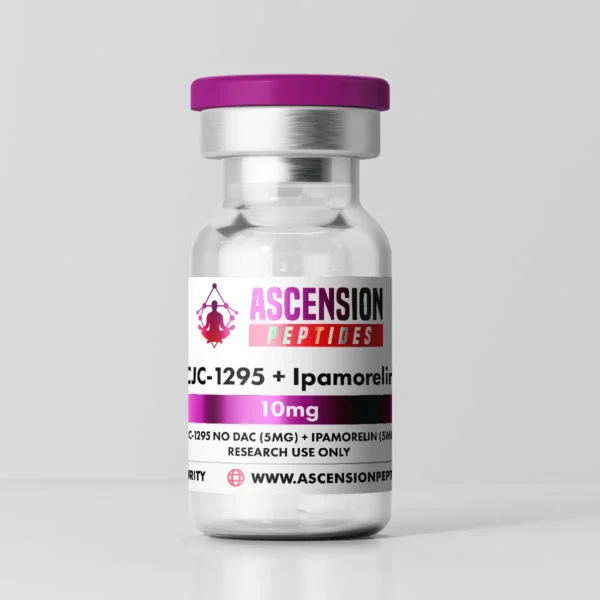
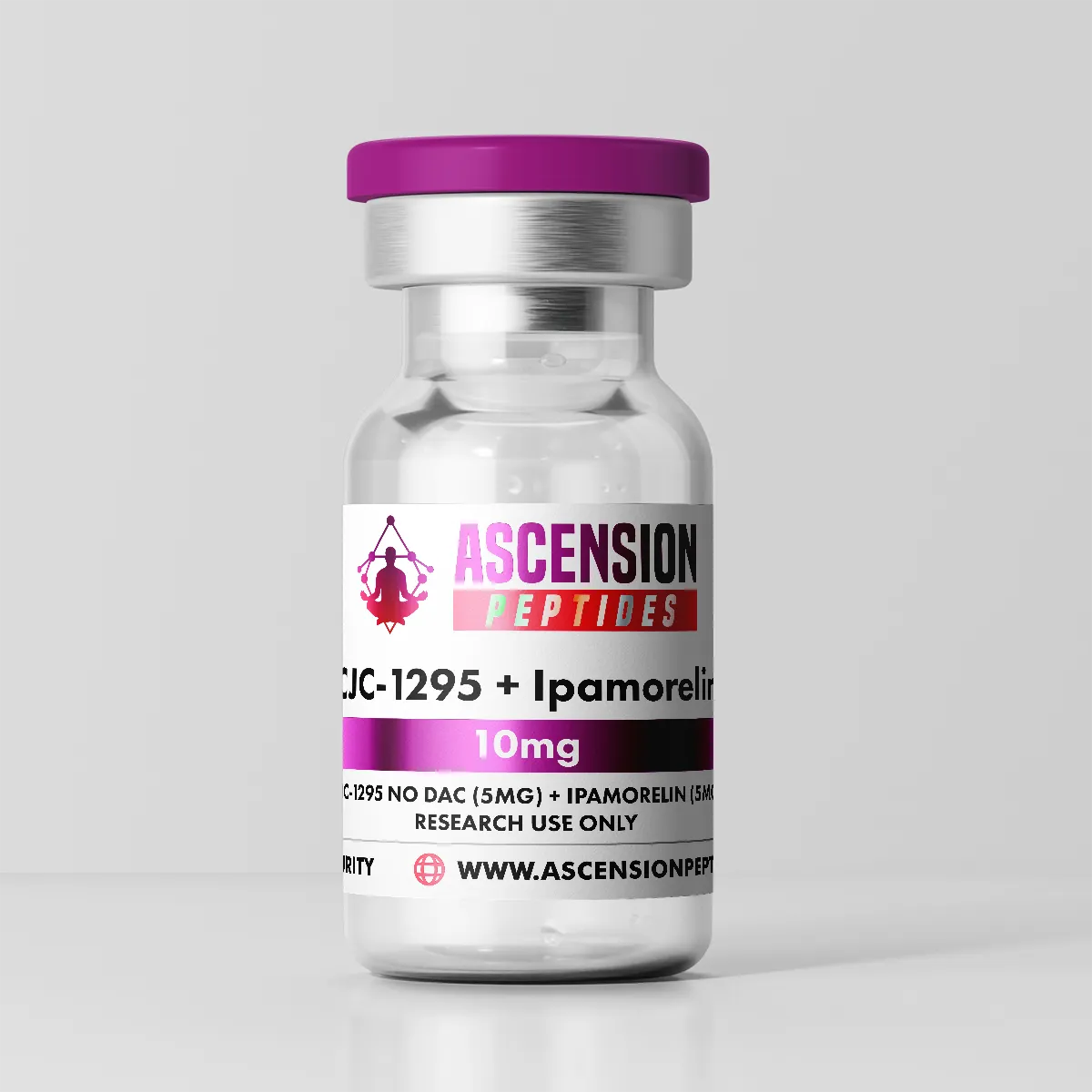
Ascension Peptides carries research-grade CJC-1295 5mg and Ipamorelin 5mg separately, so you can run the standard combination protocol at your preferred doses.
Ipamorelin for Women: What's Different?
Ipamorelin benefits are relevant for women, and in some ways the compound is particularly well-suited for female users — primarily because of what it doesn't do.
Older GHRPs caused significant cortisol and prolactin elevations. Elevated prolactin is especially problematic for women — it disrupts the menstrual cycle, interferes with estrogen and progesterone balance, and can cause galactorrhea. Ipamorelin's selective profile means these hormonal disruptions don't occur, making it a much cleaner option.
The ipamorelin benefits women report most frequently:
Body Composition
Fat loss (particularly from the midsection and thighs) and lean muscle preservation during a caloric deficit. Women often respond well to the lipolytic effects because GH sensitivity tends to be higher in women than in men.
Skin and Hair Quality
Elevated GH and IGF-1 support collagen synthesis — which translates to improved skin elasticity and texture. This is one of the more consistently noticed effects among female users, especially those in their 30s and 40s.
Sleep and Energy
Improved deep sleep quality and morning energy are commonly reported. Women dealing with hormonal sleep disruption (perimenopause, luteal phase issues) often find this effect particularly noticeable.
Bone Density
Relevant for perimenopausal and postmenopausal women where bone density decline is a real health concern. The IGF-1 upregulation from ipamorelin supports bone remodeling alongside other interventions.
Dosing for women is generally on the lower end of the standard range — 100–200 mcg per injection — and response is often strong enough at these doses that starting high isn't necessary.
Ipamorelin vs Sermorelin: Which Is Better?
Sermorelin is the other commonly prescribed GH peptide (or was, before US compounding pharmacy restrictions changed the landscape). Both stimulate GH release, but they work through different mechanisms and have a different profile of effects.
In practice, many protocols use both ipamorelin and sermorelin together (since they hit complementary pathways), but if you're choosing between them, ipamorelin's longer half-life, cleaner selectivity, and widely available research-grade supply make it the more practical choice for most users.
Body composition changes and recovery are well-documented and broadly replicated. Sermorelin's efficacy is real, but the combination of ipamorelin + CJC-1295 (a more stable GHRH analog) tends to outperform sermorelin on GH output by a meaningful margin.
Ipamorelin Side Effects
Ipamorelin has one of the better safety profiles in the peptide space, particularly compared to exogenous HGH or older GHRPs. Here's what you should be aware of:
- Water retention — The most common complaint. Elevated GH increases aldosterone activity and can cause mild fluid retention, particularly in the early weeks. Usually resolves as the body adapts.
- Tingling or numbness — In the hands and feet. Also common with HGH and related to GH-driven fluid shifts. Generally mild and temporary.
- Fatigue — Some users feel more tired, especially if dosing during the day rather than before sleep. Timing the dose before bed typically resolves this.
- Headache — Mild and typically transient, most common during the first week.
- Injection site reactions — Mild redness or irritation at the subcutaneous injection site. Standard for injectable peptides.
What ipamorelin doesn't cause at research doses: cortisol spikes, prolactin elevation, pituitary suppression, or the appetite storms that make GHRP-6 difficult to manage. The ipamorelin benefits-to-side-effect ratio is genuinely favorable compared to alternatives.
Ipamorelin Dosage
Ipamorelin is administered subcutaneously — a small injection into the fat layer under the skin, similar to insulin injections. The dosing is fairly consistent across most protocols:
For reconstitution: ipamorelin is typically supplied as a lyophilized (freeze-dried) powder. Reconstitute with bacteriostatic water according to the concentration you want. Standard practice is 1–2 mg per mL, which gives you clean, easy-to-measure doses with a standard insulin syringe.
If you want research-grade ipamorelin for a standard protocol, Ascension Peptides offers Ipamorelin 5mg and CJC-1295 5mg for the combination stack.