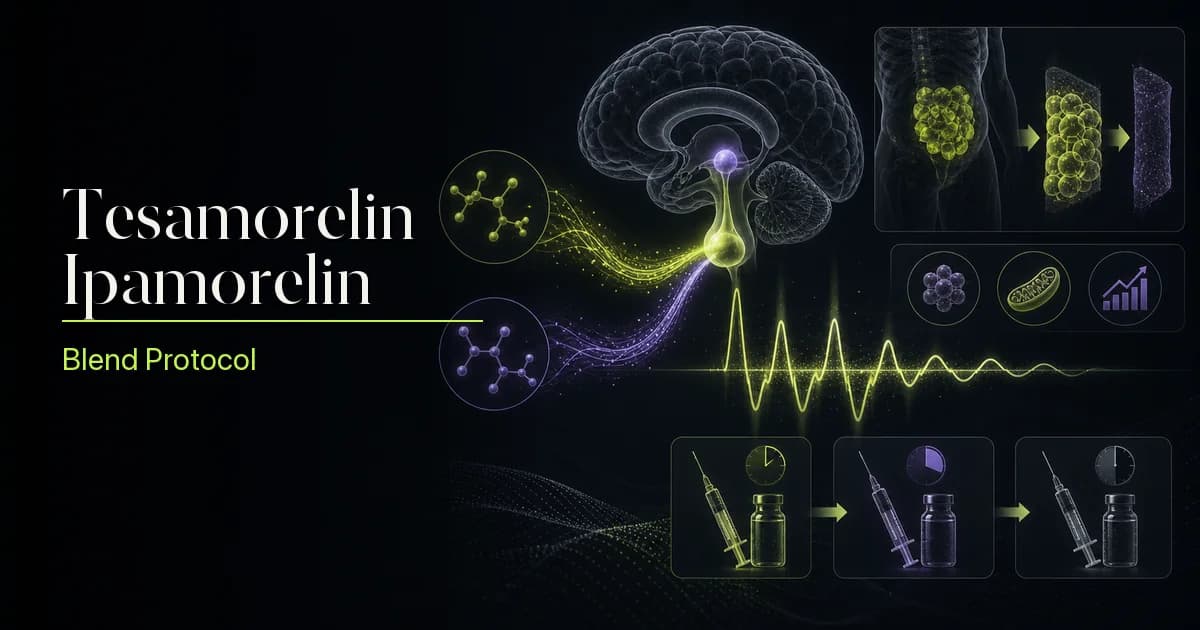
The tesamorelin ipamorelin stack pairs two growth hormone (GH) peptides that work on completely different switches in the same system. Tesamorelin is a stabilized growth hormone releasing hormone (GHRH) analog that tells the pituitary how much GH to make, while ipamorelin is a selective ghrelin receptor agonist that tells the pituitary when to fire and removes the natural brake (somatostatin) that holds GH back. Because they act through two separate, complementary pathways, combining a GHRH agent with a growth hormone releasing peptide (GHRP) produces a GH pulse that is several times larger than either one alone.[1][2] This guide explains the mechanism behind that synergy, how researchers structure a tesamorelin ipamorelin blend, realistic dosing math in both metric and US units, what the human trial data actually shows for each peptide, and a frank look at the safety questions, costs, and who this combination is not appropriate for.
🔑 Key Takeaways
- Tesamorelin (Egrifta) is an FDA-approved GHRH analog for HIV-associated excess abdominal fat, dosed at 2 mg subcutaneously; ipamorelin is a research-only, non-FDA-approved selective GHRP. The two are not approved as a combination by any regulator.[3][6]
- The rationale for the stack is genuine pharmacological synergy: GHRH analogs set the amplitude of the GH pulse while GHRPs initiate the pulse and suppress somatostatin, so together they release substantially more GH than the sum of each alone.[1][2]
- Tesamorelin alone reduced visceral fat by roughly 15% versus placebo over 26 weeks and raised IGF-1 by about 100 ng/mL in its pivotal HIV trials.[4]
- Ipamorelin's defining trait is selectivity: in the original 1998 characterization it released GH without raising cortisol, ACTH, or prolactin even at doses over 200 times the GH-releasing dose.[5]
- The combination shares the GH-class risks of elevated IGF-1, glucose intolerance, and fluid retention, and human data on the stack specifically (rather than each peptide individually) is essentially absent.[3][6]
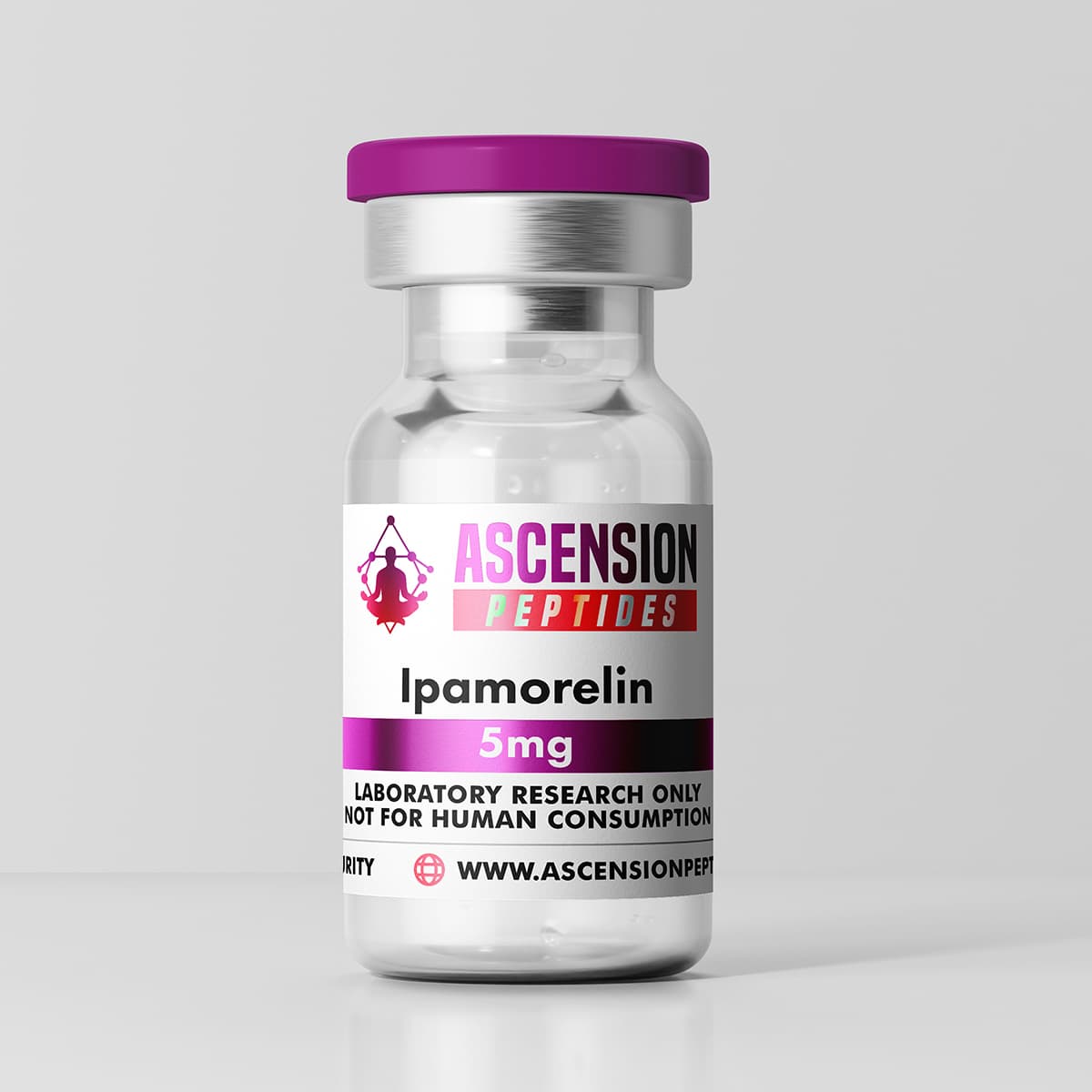
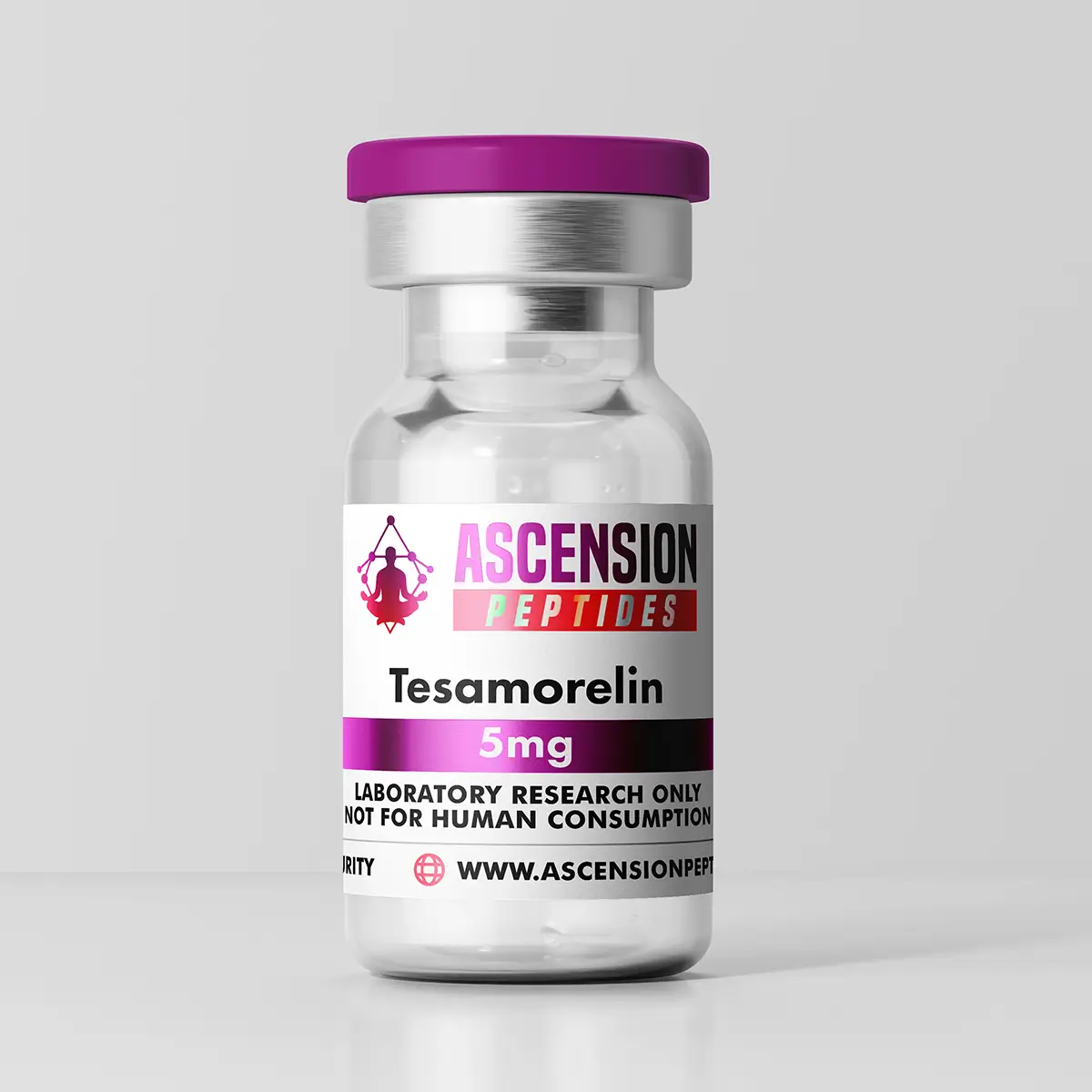
Both halves of this stack are available as research peptides — Ascension carries tesamorelin 5mg and ipamorelin 5mg, third-party tested and US-shipped.
What Is the Tesamorelin + Ipamorelin Stack?
A tesamorelin ipamorelin stack is the co-administration of two different classes of growth hormone secretagogue. The logic mirrors the much more common CJC-1295 + ipamorelin stack, except tesamorelin replaces CJC-1295 as the GHRH-class partner. Both pairings follow the same blueprint, a GHRH analog plus a GHRP, and the difference comes down to which GHRH agent you anchor the stack on.
Tesamorelin is a synthetic analog of the full 44-amino-acid human GHRH sequence with a trans-3-hexenoic acid group added to the N-terminus. That modification makes it resistant to dipeptidyl peptidase-4 (DPP-4) degradation, so it survives in circulation long enough to drive meaningful GH release.[3] It is the only peptide in this pairing that is FDA-approved, marketed as Egrifta and, in its newer weekly-reconstitution formulation, Egrifta WR.[7]
Ipamorelin is a synthetic pentapeptide (Aib-His-D-2-Nal-D-Phe-Lys-NH2) that activates the growth hormone secretagogue receptor (GHS-R1a), the same receptor the hunger hormone ghrelin uses.[5] Unlike the GHRP-6 and GHRP-2 peptides it was derived from, ipamorelin does not trigger meaningful hunger, cortisol, or prolactin release, which is why it became the GHRP of choice in modern stacks.[5] For deeper background on each peptide individually, see our tesamorelin peptide guide and our ipamorelin benefits guide.
Important regulatory context
Tesamorelin is FDA-approved only for the reduction of excess abdominal fat in people with HIV-associated lipodystrophy. Ipamorelin has no FDA approval for any indication and is sold for laboratory research use only. Combining them for body composition, anti-aging, or athletic goals is off-label or non-approved use, not a sanctioned protocol. Nothing here is medical advice or an endorsement of unsupervised use.
Why Combine a GHRH Analog With a GHRP? The Synergy Explained
The pituitary releases GH under push-pull control. GHRH pushes (it stimulates GH synthesis and release), somatostatin pulls (it suppresses release), and ghrelin-type signals amplify the pulse and blunt somatostatin's brake. Tesamorelin and ipamorelin hit two of those three levers at once.
- Tesamorelin (the GHRH arm) binds the GHRH receptor on pituitary somatotrophs and sets the amplitude of the GH pulse, how high it climbs.[3]
- Ipamorelin (the GHRP arm) binds GHS-R1a, initiates the pulse, and suppresses somatostatin so the brake comes off.[2][5]
When a GHRP is given alongside a GHRH agent, the combined GH response is markedly greater than additive. Classic secretagogue research established that endogenous GHRH is required for the full GH response to a GHRP, and that the two act synergistically rather than simply stacking their separate effects.[2] Reviews of growth hormone secretagogues confirm that GHRH and GHRP, used together, synergistically stimulate GH release, and that GHRPs do not blunt GHRH action when given beforehand.[1] In practical terms, the GH pulse from the pair runs roughly two to three times higher than from either agent on its own, which is the entire reason researchers bother running two peptides instead of one.[1][2]
Why ipamorelin and not GHRP-6 or GHRP-2?
All three are GHRPs and all three synergize with a GHRH analog. The reason ipamorelin dominates modern stacks is its clean side-effect profile. In its original characterization it released GH without meaningfully raising cortisol or ACTH, even at doses more than 200 times the GH-releasing dose, whereas GHRP-6 and GHRP-2 reliably bump cortisol and trigger hunger.[5] See our GHRP-2 vs GHRP-6 comparison for how the older GHRPs differ.
Tesamorelin vs Ipamorelin: Side-by-Side
The two peptides are not interchangeable. They sit in different drug classes, have very different evidence bases, and contribute different things to the stack. The table below synthesizes the published pharmacology and trial data for each.
What the Human Data Shows (Per Peptide)
It is important to be honest about the evidence: there are no published controlled trials of the tesamorelin + ipamorelin combination in humans. What exists is solid trial data on each peptide separately, plus the well-established GHRH-plus-GHRP synergy principle. Here is what each side brings.
Tesamorelin's trial record
Tesamorelin earned FDA approval on two pivotal 26-week, placebo-controlled Phase 3 trials in HIV-associated lipodystrophy (412 and 404 patients). At 2 mg daily, visceral adipose tissue (VAT) fell by about 27.8 cm2 in the first study versus 5.1 cm2 on placebo, and by about 21 cm2 versus a 1 cm2 change in the second, a pooled net VAT reduction of roughly 15% versus placebo.[4] IGF-1 rose by approximately 106-109 ng/mL in the treatment groups.[4] Notably, the benefit was not durable after stopping: patients switched to placebo re-accumulated visceral fat back toward baseline, meaning the effect depends on continued use.[4]
Beyond fat loss, a separate randomized, double-blind, placebo-controlled trial of GHRH (tesamorelin, dosed at 1 mg/day for 20 weeks) in 152 older adults found improvements in executive cognitive function in both healthy seniors and those with mild cognitive impairment, with IGF-1 staying within the physiological range.[9] That cognitive signal is intriguing but is not an approved use.
Ipamorelin's trial record
Ipamorelin's strongest evidence is its 1998 characterization as the first selective GHRP. In that work it released GH with high potency in vitro and in vivo, was blocked by a GHS-R1a antagonist (confirming receptor specificity), and, critically, did not raise ACTH or cortisol above what GHRH itself produced, even at doses more than 200 times the GH-releasing dose.[5] Its GH-releasing effect is real and well-documented in animal and cell models; large long-term human outcome trials (for body composition or aging) do not exist. That gap is why ipamorelin remains research-only.
Effect-size reality check
The headline visceral-fat numbers come from tesamorelin monotherapy at 2 mg daily in people with HIV lipodystrophy, not from the combination and not from healthy or athletic populations. Adding ipamorelin is expected, on mechanistic grounds, to raise the GH pulse, but no trial has quantified what that adds to fat loss, lean mass, or recovery in a stack. Treat any "stack results" claim that puts a precise percentage on the combination with skepticism.
Tesamorelin + Ipamorelin Dosing: How Researchers Structure the Blend
Dosing protocols circulating in the research community are extrapolated from each peptide's individual pharmacology, not from combination trials. The structure below reflects commonly described research parameters and is presented for educational completeness only, not as a protocol to follow.
Because both peptides have short half-lives and the goal is a strong combined pulse, they are typically administered at the same time so the GHRH and GHRP signals arrive together. Many research timing notes favor bedtime dosing to align with the body's natural overnight GH surge, and emphasize dosing on an empty stomach because elevated glucose and insulin blunt GH release.
Reconstitution and dosing math (worked example)
Peptides ship as lyophilized powder and must be reconstituted with bacteriostatic water. The math is the part beginners get wrong. As a worked example using ipamorelin: if a 5 mg (5,000 mcg) vial is reconstituted with 2 mL of bacteriostatic water, the concentration is 2,500 mcg per mL. A 250 mcg dose is then 0.1 mL, which on a 100-unit (U-100) insulin syringe is the 10-unit mark. For a step-by-step walkthrough, see our guides on how to reconstitute peptides and how to calculate peptide doses. Tesamorelin's clinical 2 mg dose is reconstituted per its package instructions; the newer Egrifta WR formulation was designed to reduce reconstitution frequency.[7]
Note on the F8 / weekly formulation
In 2024 the FDA approved a new "F8" formulation of tesamorelin (Egrifta WR) that allows weekly rather than daily reconstitution, lowering the day-to-day handling burden of the drug.[7] The active peptide and its daily dosing for the approved indication are unchanged; the improvement is in formulation and preparation convenience.
Tesamorelin + Ipamorelin vs Other GH Stacks
This blend is one of several GHRH-plus-GHRP combinations. The most common alternative is CJC-1295 + ipamorelin. The choice hinges on the GHRH-class partner.
For broader context on where each peptide ranks, see our overviews of the best growth hormone peptides in 2026 and the head-to-head GH peptides ranked. A different tesamorelin combination, the AOD-9604 + tesamorelin + MOTS-c stack, targets fat loss through a separate mechanism set and should not be confused with this GHRH-plus-GHRP pairing.
Who Might Consider It, and Who Should Not
This is a high-caution decision, not a casual one. The flow below summarizes how the published cautions map onto real situations.
Safety, Side Effects, and Monitoring
The combination inherits the risk profile of the GH axis. The most important categories from the tesamorelin label and the secretagogue safety literature are:
- IGF-1 elevation. Both peptides raise GH and therefore IGF-1. Persistently high IGF-1 is the basis for the malignancy contraindication and warrants periodic monitoring.[4][6]
- Glucose intolerance. GH is counter-regulatory to insulin; secretagogue studies document rises in blood glucose and HbA1c, so glucose status should be checked, especially in anyone prediabetic.[1][6]
- Fluid retention. Edema, joint pain, and carpal-tunnel-type symptoms are recognized GH-class effects.[6]
- Injection-site reactions. Redness, itching, and irritation are among the most common complaints with subcutaneous tesamorelin.[3]
- Unknown long-term and combination risk. Reviewers note that long-term malignancy and mortality data for GH secretagogues are not available, and there is no controlled safety data on this specific two-peptide stack.[1]
For peptide-specific breakdowns, see our pages on tesamorelin side effects and ipamorelin side effects.
Cost snapshot (orientation only)
FDA-approved Egrifta is a specialty medication and, without insurance, branded tesamorelin commonly runs into four figures per month at US retail; the HIV indication means many patients access it through insurance and patient-assistance pathways. Research-grade ipamorelin is comparatively inexpensive per vial. Because pricing shifts constantly and research-grade material is unregulated, confirm current numbers directly and never treat low price as a quality signal. Cost should be the last factor in this decision, not the first.
If you are still deciding whether to run both or pick one, ipamorelin vs tesamorelin compares them directly on mechanism, evidence, cost and side effects.
Frequently Asked Questions
The Bottom Line
The tesamorelin ipamorelin stack rests on real pharmacology: a GHRH analog and a selective GHRP hit complementary switches in the GH axis, and the combination of those two classes reliably produces a larger GH pulse than either alone.[1][2] Tesamorelin brings the strongest human data of any GHRH-class peptide, with FDA approval and clear visceral-fat results in its studied population, while ipamorelin contributes a clean, selective GH-releasing signal.[4][5] What is missing is exactly what matters most for anyone outside the approved HIV indication: controlled human trials of the combination, long-term safety data, and any quantified benefit for healthy or athletic users. The known risks, IGF-1 elevation, glucose intolerance, and fluid retention, are not hypothetical. If you are considering this combination, the responsible path is clinician supervision, baseline and follow-up labs, and a clear-eyed understanding that you are operating ahead of the evidence.
References
- Sigalos JT, Pastuszak AW. The Safety and Efficacy of Growth Hormone Secretagogues. Sex Med Rev. PMC5632578.
- Bowers CY. Growth Hormone-Releasing Peptides. Comprehensive Physiology, 1998 (GHRH/GHRP synergy).
- EGRIFTA (tesamorelin for injection) FDA Prescribing Information, original approval 2010 (mechanism, DPP-4 resistance, dosing).
- Falutz J, et al. Growth hormone and tesamorelin in HIV-associated lipodystrophy (Phase 3 VAT and IGF-1 data). PMC3218714.
- Raun K, et al. Ipamorelin, the first selective growth hormone secretagogue. Eur J Endocrinol. 1998. PMID 9849822.
- EGRIFTA FDA Label (2019 revision): indication, contraindications, warnings (IGF-1, glucose, fluid retention).
- FDA Approves F8 Formulation (Egrifta WR) of Tesamorelin for HIV-Associated Lipodystrophy. ContagionLive.
- Egrifta (Tesamorelin) Pharmacokinetics: half-life, Cmax, Tmax, bioavailability. RxList / FDA label data.
- Baker LD, et al. Effects of GHRH (tesamorelin) on cognitive function in MCI and healthy older adults. JAMA Neurol. 2012. PMID 22869065.