In the HRT vs TRT comparison, the core difference is scope: TRT (testosterone replacement therapy) replaces one hormone, testosterone, while HRT (hormone replacement therapy) is the broader umbrella term for replacing any hormone the body no longer makes in adequate amounts. Search the phrase either way, HRT vs TRT or trt vs hrt, and the honest starting point for the difference between HRT and TRT is one taxonomy fact: because testosterone is a hormone, TRT is technically one type of HRT. In everyday clinical use, though, the two words point at different patients. "HRT" usually means menopausal hormone therapy (estrogen, with or without progesterone) for women, and "TRT" means testosterone therapy for men with low testosterone 95. Same family, different treatments. This guide covers what each one is, exactly how they differ, where they genuinely overlap, and how to tell which applies to you. Both are prescription therapies guided by bloodwork, not anti-aging or performance shortcuts.
Key Takeaways
- TRT is a subtype of HRT: testosterone is a hormone, so all TRT is technically hormone replacement, but not all HRT is TRT 95.
- Different patients in everyday use: "HRT" typically means estrogen-based menopausal therapy for women, and "TRT" means testosterone therapy for men with diagnosed low testosterone 91.
- Both are diagnosed with rules, not guesses: TRT needs symptoms plus two low morning testosterone tests (below about 300 ng/dL); menopausal HRT is most favorable when started under 60 or within 10 years of menopause 27.
- They overlap for women: low-dose testosterone has one recognized use in women, hypoactive sexual desire disorder after menopause, at female-range doses only 11.
- Both are prescription-only and monitored: neither is an over-the-counter supplement, an anti-aging cure, or a muscle shortcut, and testosterone is a Schedule III controlled substance 4.
Quick reference
| Point | What it means |
|---|---|
| HRT = any hormone | Most often estrogen, with or without progesterone, for menopause 9 |
| TRT = testosterone only | Most often for male low testosterone (hypogonadism) 5 |
| Relationship | TRT is one type of HRT, so the terms are related but not interchangeable |
| Access | Both are prescription-only and monitored with blood tests 49 |
HRT vs TRT: What's the Difference?
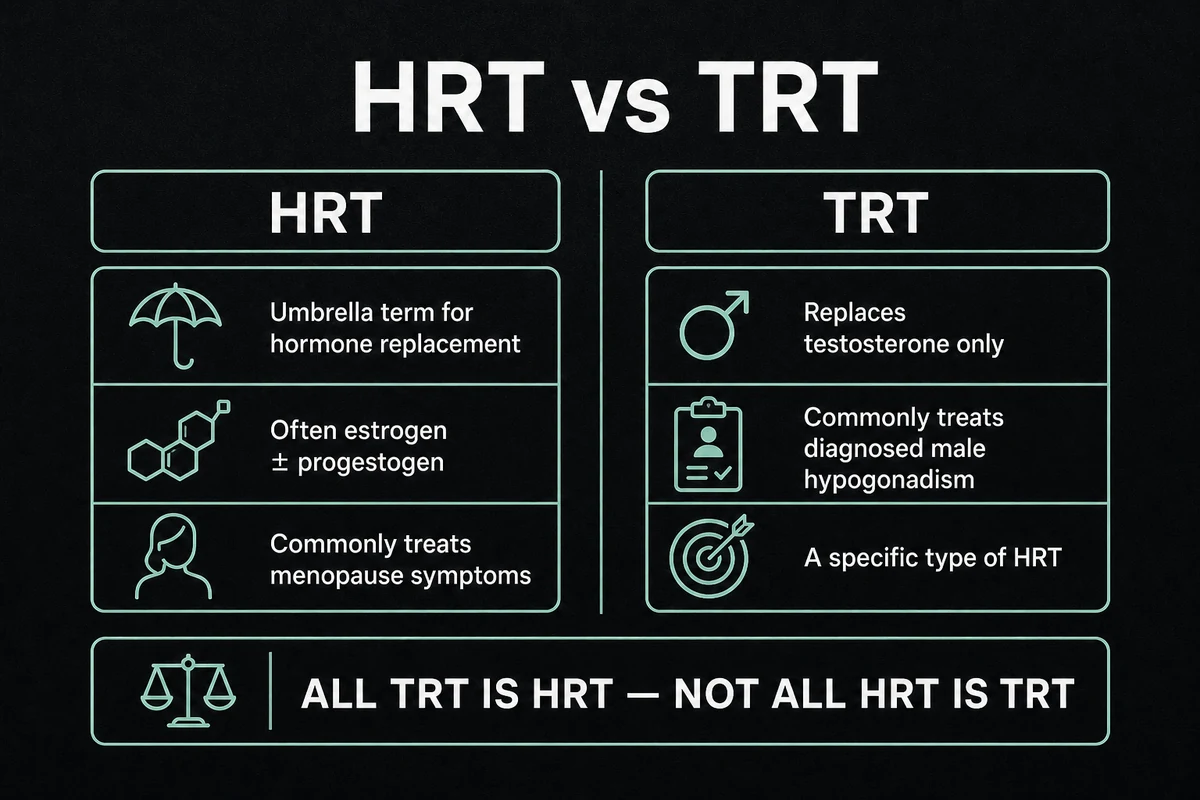
The difference between HRT and TRT comes down to two things: how much they cover, and who typically gets them. HRT is the wide category for replacing any hormone the body has stopped producing in adequate amounts, while TRT is the narrow case that replaces testosterone specifically. That scope difference maps onto different patients, women in or after menopause for HRT, men with low testosterone for TRT, which is why the two abbreviations feel like separate treatments even though one contains the other. The table below compares HRT and TRT on the dimensions that matter.
Table 1. HRT vs TRT at a glance
| Feature | HRT (hormone replacement therapy) | TRT (testosterone replacement therapy) |
|---|---|---|
| What it replaces | Any deficient hormone, most often estrogen (with or without progesterone) 9 | Testosterone only 5 |
| Most common use | Menopause symptoms in women: hot flashes, night sweats, vaginal dryness, bone loss 9 | Low testosterone (hypogonadism) in men 1 |
| Typical patient | Women in or after menopause (also broader hormone deficiency) 8 | Men with diagnosed low testosterone; occasionally women (HSDD, low dose) 11 |
| How it is diagnosed | Menopausal symptoms, with or without hormone testing; timing matters (under 60 or within 10 years of menopause) 7 | Symptoms plus two early-morning total-testosterone tests below about 300 ng/dL 2 |
| Main hormones and forms | Estrogen and/or progestogen; pills, patches, gels, vaginal forms 6 | Testosterone; injections, gels, patches, pellets, oral, nasal 5 |
| Key monitoring | Symptom response, blood pressure, breast and pelvic health per clinician 8 | Testosterone level, hematocrit or hemoglobin, PSA, estradiol 1 |
| Notable risks | Blood clots, stroke, breast cancer (estrogen plus progestin), dementia (older-age start) 10 | Raised hematocrit, reduced fertility, acne, sleep apnea; AFib, PE, and AKI signal in TRAVERSE 3 |
| Relationship | Umbrella category (TRT is one type of HRT) | A specific type of HRT |
| Prescription and legal status | Prescription-only 9 | Prescription-only; testosterone is a Schedule III controlled substance 4 |
The practical takeaway is that HRT and TRT overlap in definition but point at different treatments in everyday use. The rest of this guide unpacks each side so you can see where you fit.
What Is HRT (Hormone Replacement Therapy)?
HRT means replacing hormones the body has stopped producing in adequate amounts 9. Most of the time, when people say HRT they mean menopausal hormone therapy: estrogen given to relieve hot flashes, night sweats, and vaginal dryness, and to help slow the bone loss that accelerates after menopause 97.
Estrogen therapy vs estrogen plus progestogen
There is one rule that decides which form of HRT a woman is offered: the uterus rule. Women who still have a uterus take estrogen together with a progestogen (a progestin), because unopposed estrogen can thicken the uterine lining and raise the risk of endometrial (uterine) cancer; the progestogen protects against that. Women who have had a hysterectomy can usually take estrogen alone 6. This is why you will hear clinicians distinguish estrogen therapy (ET) from estrogen-plus-progestogen therapy (EPT). It is not a marketing distinction, it is a safety one.
Who HRT is for and the timing window
For menopausal HRT, timing matters as much as the diagnosis. The Menopause Society's position is that the benefit-risk balance is generally favorable for most healthy, symptomatic women who start therapy under age 60 or within 10 years of menopause onset, and less favorable when treatment is started later 7. Mayo Clinic frames the same idea around candidacy: bothersome symptoms and no strong contraindications favor treatment, while starting many years after menopause does not 8. The framing here is about absolute risk, not fear: for a symptomatic woman in that window, the added risks are small in absolute terms, and the symptom relief is often substantial.
HRT is also the umbrella term used for other kinds of hormone replacement, including thyroid hormone and gender-affirming hormone therapy, but this guide focuses on the menopausal-HRT-versus-TRT comparison people are usually asking about.
What Is TRT (Testosterone Replacement Therapy)?
Testosterone is the main male sex hormone, and TRT is prescription testosterone used to restore a normal level in men diagnosed with low testosterone, a condition called hypogonadism 1351. The goal is replacement, bringing a genuinely low level back into the normal male range, not pushing it above normal. You can read the full explainer in our guide to what TRT is.
How low testosterone is diagnosed
TRT is not started on symptoms alone, and it is not started on a single blood draw. Guidelines call for a diagnosis based on consistent symptoms plus two separate early-morning total-testosterone measurements, using a total testosterone below about 300 ng/dL as a widely used cutoff for deficiency 21. Morning timing matters because testosterone peaks early in the day, and repeating the test matters because a single low reading can be a fluke. Once a man is on therapy, the target is the normal range, and clinicians track it over time; our guide to target testosterone levels covers what that range looks like in practice.
TRT comes in several forms, including injections, gels, patches, pellets, oral, and nasal preparations, so the delivery method can be matched to the person 5. Crucially, testosterone is FDA-approved for hypogonadism caused by a medical problem, not for the normal, gradual decline that comes with aging alone, and not for physique or performance 412. For a fuller breakdown of delivery options, see our guide to the forms of TRT.
Is HRT the Same as TRT?
No, HRT and TRT are not the same, but they are related. TRT is a type of HRT, because testosterone is a hormone, so all TRT is technically hormone replacement, while not all HRT is TRT 95. In common usage the two words are not interchangeable: "HRT" usually refers to menopausal estrogen therapy for women, and "TRT" refers to testosterone therapy for men. So if you are wondering whether HRT and TRT are the same thing, the precise answer is that they are the same in category (both replace a hormone) but different in what they replace and who typically receives them.
The confusion is understandable: clinics market "HRT for men," and both treatments replace a hormone under medical supervision and monitoring. That surface similarity blurs the terms, even though the treatments they usually describe are distinct.
"HRT for men" usually just means TRT
In legitimate medicine, hormone replacement for men most often means testosterone therapy. When a men's clinic advertises "HRT," it is usually describing TRT for diagnosed low testosterone 14. Where caution is warranted is the broader "hormone optimization" pitch: stacks that add growth hormone, DHEA, or thyroid hormone without a diagnosed deficiency are not guideline-supported and can carry real risks. Testosterone for a man with confirmed hypogonadism is the evidence-based version of "male HRT"; a multi-hormone cocktail sold for anti-aging is not. If you have seen testosterone lumped in with anabolic steroids, our explainer on whether TRT is a steroid draws the line clearly, and our guide to TRT alternatives covers the legitimate non-testosterone options.
HRT and TRT for Men vs Women
The reason the terms split largely along sex is simple: the hormone being replaced is different. Women who need hormone replacement most often need estrogen; men who need it most often need testosterone. But the picture is not perfectly clean, because testosterone has a narrow, real role in women too.
HRT for women (menopause)
For women, HRT usually means estrogen, with or without a progestogen depending on the uterus rule, to treat menopausal symptoms and help protect bone density, most favorably when started under 60 or within 10 years of menopause onset 967. This is the classic, best-studied use of hormone replacement, and it is what most people picture when they hear "HRT."
TRT for women
Testosterone therapy in women is far more limited. There is no established indication for testosterone in women except hypoactive sexual desire disorder (HSDD) in postmenopausal women, and even then only at physiologic, female-range doses, not male doses 11. This is the one place where HRT and TRT genuinely overlap for women: a postmenopausal woman on estrogen-based HRT may, in specific cases, be offered low-dose testosterone as well. It is a small, carefully bounded use, not a general "women's TRT" category. Our guide to testosterone therapy for women covers the nuance.
What HRT and TRT have in common
Strip away the differences and the two therapies share a spine. Both replace a hormone the body no longer makes enough of. Both are prescription-only and monitored with periodic bloodwork. And neither is an anti-aging cure or a performance and muscle shortcut, no matter how they are marketed 71. Whichever term applies to you, the underlying logic is the same: confirm a deficiency, replace to a normal level, and monitor over time.
HRT and TRT Risks and the Evidence
Both therapies have real risks, and both have been studied in large trials that are worth understanding in context rather than in headlines. The goal here is absolute-risk framing: what the evidence actually shows, without fear and without hand-waving it away.
HRT risks (the WHI in context)
The 2002 Women's Health Initiative (WHI) linked estrogen-plus-progestin therapy to higher risks of heart disease, stroke, blood clots, breast cancer, and dementia in its study population, which was on average older and further from menopause than the women HRT is typically offered to today 10. That finding is real and should not be dismissed; it is also not the whole story. The modern reading, reflected in the Menopause Society's position, is that for symptomatic women under 60 or within 10 years of menopause the benefits generally outweigh the risks, that HRT should not be used to prevent chronic disease, and that transdermal (skin) and lower-dose routes appear to lower the clot and stroke risk compared with older oral regimens 7. In absolute terms, the increase in breast-cancer risk from combined therapy is small for most women in that window, which is why the guidance is individualized rather than a blanket yes or no. The accurate summary is not that "the WHI was debunked," but that its results apply most strongly to late starters and are balanced by real symptom benefit for women who start early.
TRT risks and heart health
On the TRT side, the label-anchored risks include a raised red blood cell count (hematocrit), testicular shrinkage, reduced fertility, acne, fluid retention, and possible worsening of untreated sleep apnea 15. On cardiovascular safety, the 2023 TRAVERSE trial studied testosterone gel in men who were at higher cardiovascular risk and found it noninferior to placebo for major adverse cardiac events (heart attack, stroke, and cardiovascular death), but with higher rates of atrial fibrillation, pulmonary embolism, and acute kidney injury 3. That is a nuanced result: it does not show TRT is "proven safe for the heart," and the FDA still limits approved use to diagnosed hypogonadism 4. Our guides to TRT side effects and TRT and heart health go deeper on how these risks are weighed and monitored.
One risk deserves its own line: TRT suppresses the body's own testosterone production and can reduce fertility, which matters a great deal to men who want to father children. Men in that position are often managed with alternatives that support natural production instead of replacing it, such as enclomiphene or hCG. Our guide to TRT and fertility explains the trade-off.
HRT or TRT: Which Do You Need?
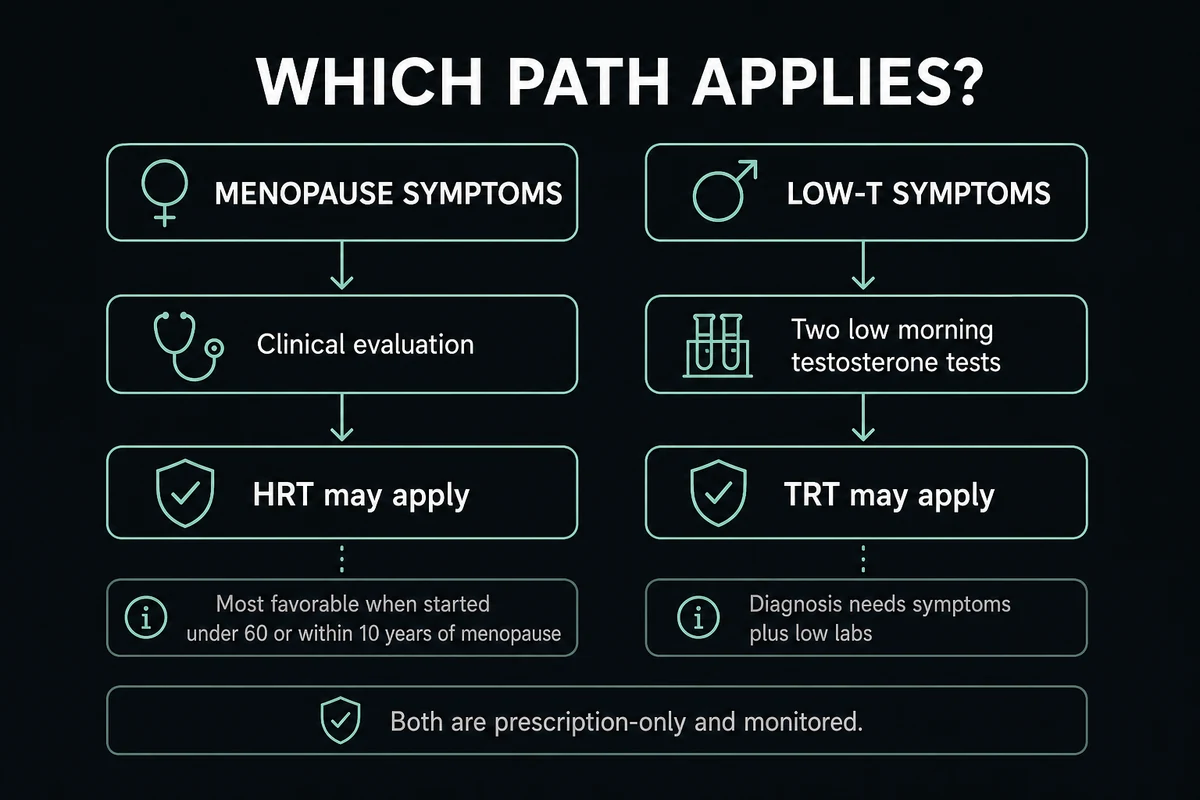
The honest answer to "HRT or TRT, which do I need" is that it depends on which hormone is deficient, plus your symptoms and your sex. A man with symptoms and two low early-morning testosterone tests is a TRT candidate. A woman with bothersome menopausal symptoms is an HRT candidate. A postmenopausal woman with HSDD may be offered low-dose testosterone alongside her estrogen therapy, which is the overlap case. This is decision framing, not medical advice: the gate for both is identical, which is to see a clinician, get the right bloodwork, and decide together.
Both HRT and TRT are prescription-only and individualized, and neither is a self-managed supplement or something to buy around a doctor. If you are weighing testosterone specifically, our guides to TRT dosage and the best age for TRT cover how clinicians tailor treatment, and if you are comparing testosterone against non-prescription options, see testosterone boosters vs peptides and our comparison of TRT vs sermorelin, MK-677, and enclomiphene.
Questions to bring to your clinician: Which hormone do my symptoms and labs actually point to? Do I meet the diagnostic threshold (two low morning testosterone tests for TRT, or a symptom and timing assessment for menopausal HRT)? What form and dose fit my health history? What are my personal risks given my age, heart health, and (for men) fertility plans? How will we monitor this over time, and when would we reassess?
Frequently Asked Questions
HRT (hormone replacement therapy) is the umbrella term for replacing any hormone the body lacks, most often estrogen for menopause 9. TRT (testosterone replacement therapy) replaces testosterone specifically, usually in men with low testosterone 5. TRT is one type of HRT, so the terms are related but not interchangeable.
No. TRT is a type of HRT, so all TRT is hormone replacement, but not all HRT is TRT 9. In everyday use, "HRT" means menopausal hormone therapy for women and "TRT" means testosterone therapy for men, so the two words are not interchangeable.
Women's hormone therapy is usually estrogen-based HRT. Testosterone (TRT) has no established use in women except hypoactive sexual desire disorder in postmenopausal women, at low female-range doses, per the 2019 Global Consensus Position Statement 11.
Yes. Both are prescription therapies monitored with blood tests, and testosterone is a Schedule III controlled substance 4. Neither is an over-the-counter supplement or an anti-aging shortcut.
References
- Bhasin S, et al. Testosterone Therapy in Men With Hypogonadism: An Endocrine Society Clinical Practice Guideline. Journal of Clinical Endocrinology & Metabolism, 2018.
- Mulhall JP, et al. Evaluation and Management of Testosterone Deficiency: AUA Guideline. American Urological Association, 2018.
- Lincoff AM, Bhasin S, et al. Cardiovascular Safety of Testosterone-Replacement Therapy (TRAVERSE). New England Journal of Medicine, 2023;389:107-117.
- U.S. Food and Drug Administration. FDA issues class-wide labeling changes for testosterone products.
- Cleveland Clinic. Testosterone Replacement Therapy (TRT). Accessed 2026.
- Cleveland Clinic. Hormone Therapy for Menopause Symptoms. Accessed 2026.
- The Menopause Society (NAMS). The 2022 Hormone Therapy Position Statement. Menopause, 2022.
- Mayo Clinic. Hormone therapy: Is it right for you? Accessed 2026.
- MedlinePlus. Hormone Replacement Therapy. U.S. National Library of Medicine. Accessed 2026.
- National Heart, Lung, and Blood Institute (NIH). Women's Health Initiative (WHI). Accessed 2026.
- Davis SR, et al. Global Consensus Position Statement on the Use of Testosterone Therapy for Women. Journal of Clinical Endocrinology & Metabolism, 2019.
- Mayo Clinic. Testosterone therapy: Potential benefits and risks as you age. Accessed 2026.
- MedlinePlus. Testosterone. U.S. National Library of Medicine. Accessed 2026.
The information in this article is for educational purposes only and does not constitute medical advice. Always consult a healthcare professional before starting any new supplement or compound. Results vary by individual.