
TRT for women, meaning testosterone replacement therapy prescribed to women, is a real but narrow treatment, and most of what you read about it online overstates the case. Women do produce testosterone and do need it, but testosterone therapy for women is prescribed off-label in the United States because no testosterone product is FDA-approved for female use 58. The one use backed by strong evidence is low sexual desire after menopause, specifically a condition doctors call hypoactive sexual desire disorder (HSDD), not energy, weight loss, muscle, mood, or anti-aging 12. This guide sticks to what the major medical guidelines actually support: which women it may help, how it is dosed (roughly one tenth of a man's dose), why transdermal creams are preferred over pellets and injections, and where the honest limits and risks are. For the male version of this therapy, see our pillar guide to testosterone replacement therapy.
Key Takeaways
- Women need testosterone too: the ovaries and adrenal glands make it, and it plays a role in libido, mood, bone, and muscle, with levels falling naturally to roughly a quarter of youthful levels by midlife 56.
- The only strongly proven use is postmenopausal HSDD: major guidelines endorse a monitored trial for low sexual desire after menopause and recommend against using testosterone for fatigue, mood, cognition, bone, or muscle 123.
- It is off-label with no FDA-approved female product: every prescription in the US is off-label, usually compounded, and compounded dose accuracy is unreliable 58.
- Dosing is physiologic, about one tenth of the male dose: roughly 5 mg per day of a transdermal cream restores premenopausal levels, and the goal is to stay within the normal female range, not above it 79.
- Virilization is dose-dependent, and some effects are permanent: acne and extra hair are common and reversible, while voice deepening and clitoral enlargement occur mainly at high doses and may not reverse 412.
- There is a real stop rule: clinicians recheck your level, and if there is no meaningful benefit by about 6 months, treatment is stopped 12.
Female TRT at a Glance
Before the detail, here is the short version. Every row below is expanded later in this guide.
Table 1. Female TRT at a glance
| Question | Answer |
|---|---|
| Is it FDA-approved for women? | No. There is no FDA-approved testosterone product for women; all use is off-label 58. |
| Strongest proven use | Low sexual desire (HSDD) after menopause 12. |
| Preferred delivery | Transdermal cream or gel 12. |
| Typical dose vs men | About one tenth of the male dose 79. |
| Target blood level | Within the normal premenopausal female range, not above it 15. |
| Main risks | Acne and extra hair growth; voice and other virilizing changes at high doses 412. |
Can Women Take TRT?
Yes, women can take TRT, but only under medical supervision and off-label, and for a much narrower reason than the clinics advertising it usually admit. Testosterone is not only a male hormone. Women's bodies produce it in smaller amounts and rely on it, so the question is not whether women have a use for testosterone but whether adding more of it treats a specific problem 5. The honest answer from the guideline literature is that it does, for one condition: distressing low sexual desire after menopause 12.
Everything beyond that is where the evidence thins out. Marketing pages frequently present testosterone as a fix for tiredness, weight, brain fog, or "hormone optimization," but the bodies that write the clinical guidelines specifically recommend against prescribing it for those reasons because trials have not shown a reliable benefit 13. So the accurate framing of "can women take TRT" is: yes, as a carefully dosed and monitored trial for a defined sexual-desire problem, not as a general wellness or anti-aging tool 8.
What Testosterone Does in the Female Body
Testosterone in women is made mostly by the ovaries and the adrenal glands, along with tissues that convert other hormones into it 56. It contributes to sexual desire, and it has supporting roles in mood, bone strength, and muscle. Unlike the sharp drop in estrogen at menopause, testosterone declines gradually with age. By the time a woman reaches midlife, her testosterone can be roughly a quarter of what it was in her twenties, and this fall is a normal part of aging rather than a disease on its own 56.
That gradual decline is important context, because a low number on a lab test does not automatically mean a woman will feel better with more testosterone. The guidelines are explicit that there is no validated blood-test threshold that defines "testosterone deficiency" in women, which is a big reason treatment is guided by symptoms (specifically sexual desire) rather than by chasing a target number 13.
Normal Testosterone Levels in Women
Women's testosterone levels are far lower than men's, and the reference ranges reflect that. Cleveland Clinic puts the normal total testosterone for adult women at roughly 15 to 70 ng/dL, with a typical value around 40, compared with about 193 to 824 ng/dL for men 5. Because female levels sit near the bottom of what many standard lab assays can measure accurately, a sensitive assay (liquid chromatography with mass spectrometry, often written LC-MS/MS) is preferred for women, and a protein called sex hormone binding globulin (SHBG) also affects how much testosterone is active 15.
Table 2. Normal testosterone levels in women
Lab reference ranges vary between labs, and male thresholds (for example the 300 ng/dL figure used for men) do not apply to women. For how levels are tracked during treatment, see testosterone levels on TRT.
Signs of Low Testosterone in Women
The one symptom that the evidence ties to low testosterone in women is low sexual desire that causes personal distress, which is what HSDD means 12. When testosterone therapy helps, this is the domain it helps in.
Many other symptoms often blamed on low testosterone, including fatigue, low mood, and brain fog, are common, real, and worth taking seriously, but they are non-specific, meaning they have many possible causes 6. Crucially, trials have not shown that testosterone reliably improves them, so the guidelines do not endorse treating them with testosterone 13. If you have those symptoms, they deserve a proper workup (thyroid, iron, sleep, mood, menopause status, and medication review) rather than an assumption that testosterone is the answer. A low testosterone level alone, without distressing low desire, is not a reason to start therapy 3.
Does TRT Therapy for Women Actually Work?
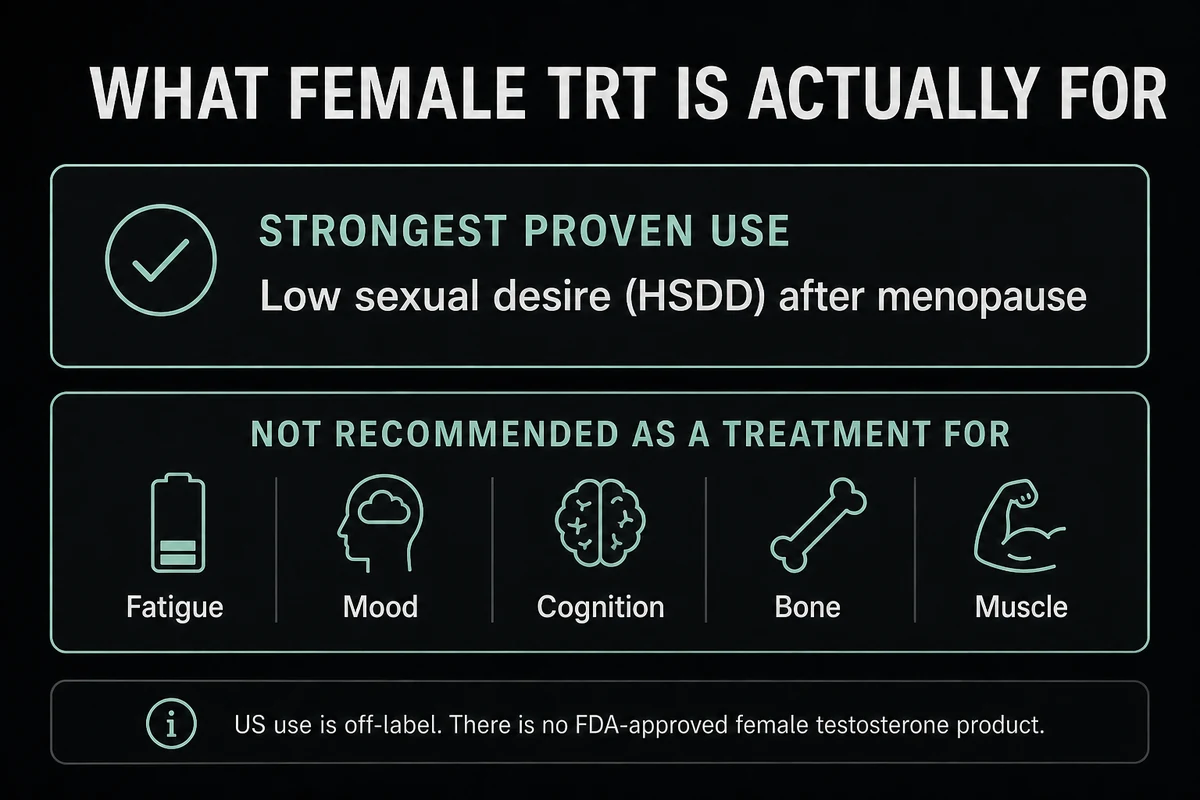
For the specific question it was studied to answer, yes. This is the load-bearing evidence section, so it is worth stating precisely. The 2019 Global Consensus Position Statement 1, the 2021 ISSWSH clinical practice guideline 2, and a 2019 systematic review and meta-analysis of randomized trials 4 all agree on the same bottom line: in postmenopausal women, testosterone improves sexual function, including desire, arousal, and satisfaction, when used at physiologic doses.
The same sources are equally clear about where TRT therapy for women does not have proven benefit. The Global Consensus statement recommends against prescribing testosterone to treat cognition, mood, bone density, muscle mass, general well-being, or metabolic health, because the evidence does not support a benefit for those uses 1. The Endocrine Society likewise advises against making a general diagnosis of "androgen deficiency" in women and against widespread use, while supporting a carefully monitored trial for HSDD 3. So the honest summary is narrow and specific: testosterone can help low sexual desire after menopause, and it is not a validated treatment for energy, weight, muscle, or anti-aging 134.
Female TRT: Types and Dosing
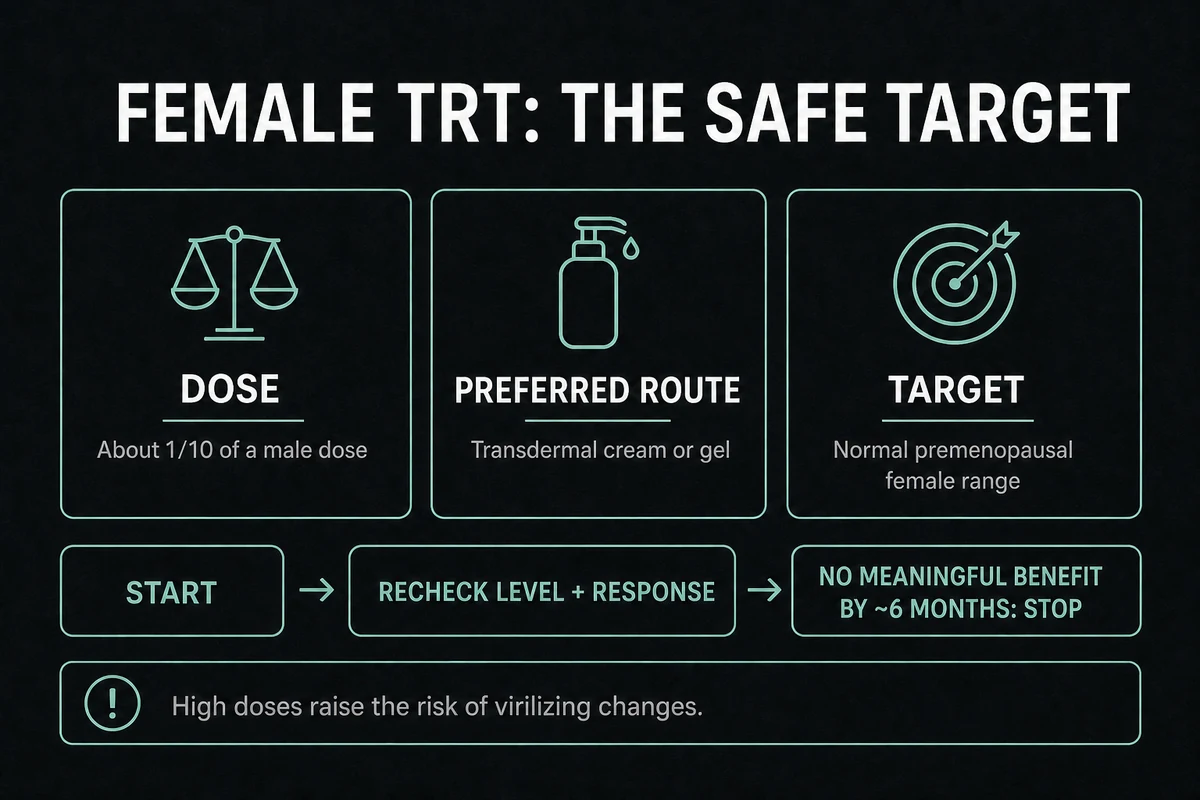
Female TRT is defined by two principles that separate it sharply from male treatment: the delivery method matters, and the dose is small. Getting either wrong is where a lot of harm and disappointment come from.
Delivery Methods for Women on TRT
Guidelines prefer transdermal testosterone (a cream or gel applied to the skin) for women, because it delivers a steady, low amount and keeps blood levels physiologic 12. Pellets and intramuscular injections are not recommended in women, because they tend to produce supraphysiologic peaks (levels above the normal female range) that raise the risk of virilizing side effects, and injections are hard to dose low enough 1. Oral testosterone is also discouraged because it can worsen cholesterol 14. This is a direct correction of a common error: many promotional pages lead with pellets or weekly injections, but that is not what the guideline evidence supports for women.
Table 3. Delivery methods for female TRT and the guideline stance
| Method | How it is used | Guideline stance |
|---|---|---|
| Transdermal cream or gel | A small daily amount of a compounded or fractional product applied to the skin | Preferred 12 |
| Pellets | Implanted under the skin every 3 to 6 months | Not recommended; supraphysiologic peaks 1 |
| Intramuscular injection | Injected weekly or every two weeks | Not recommended in women; hard to dose low, supraphysiologic peaks 1 |
| Oral (tablet or troche) | Swallowed or dissolved in the mouth | Not recommended; adverse effects on cholesterol 14 |
For a fuller comparison of formulations, see types of TRT.
How Much Testosterone Do Women Take?
Roughly one tenth of a man's dose. A woman's physiologic requirement is far smaller, and the target is to restore levels to the normal premenopausal range, not to push above it 19. In one study highlighted by Harvard Health, a testosterone cream delivering about 5 mg per day restored premenopausal testosterone levels in women 9. Mayo Clinic and others describe the female dose as a small fraction of what men use 7.
The most important idea here is that the normal female range is a ceiling, not a goal to exceed. "More" is not "better" in female TRT; higher levels do not deliver more desire benefit, and they do raise the risk of the virilizing side effects covered below 14. This is the opposite of the "optimize your numbers high" pitch some clinics use. For dosing principles in the male context (which are not interchangeable with female dosing), see TRT dosage.
The FDA and Compounding Reality
There is no FDA-approved testosterone product for women in the United States, so every female prescription is off-label 58. In practice this usually means a compounding pharmacy prepares a low-dose cream, or a clinician prescribes a small fraction of a product approved for men. Both routes have a real limitation: compounded dose accuracy is not tightly regulated and has been documented to be unreliable, so the amount in the tube may not match the label 8.
Products approved for men are also not designed or tested for women, and their labels reflect that. AndroGel, a testosterone gel, is indicated for men only and carries an explicit warning that women and children exposed to it (for example through skin contact) can develop virilizing effects, which is why users are told to cover the application site 1012. The injectable Depo-Testosterone label states it is for use in males and warns of fetal harm and virilizing effects 11. None of this means women cannot be treated safely, but it does mean female TRT is inherently an off-label, carefully supervised undertaking rather than a routine prescription.
Risks and Side Effects of TRT for Women
The side effects of testosterone in women are best understood by dose, because that is what determines both how likely they are and whether they reverse.
At physiologic doses, the common side effects are acne, oily skin, and some extra hair growth (hirsutism), and these are generally reversible if the dose is lowered or treatment stops 412. The meta-analysis of trials found that testosterone increased acne and hair growth compared with placebo, which is consistent with what you would expect from an androgen 4.
The more serious concern is virilization at supraphysiologic doses (levels pushed above the normal female range). Deepening of the voice, enlargement of the clitoris, and male-pattern scalp hair loss occur mainly when levels run too high, and some of these changes, particularly voice deepening and clitoral enlargement, can be permanent 412. This is the single strongest argument for staying within the physiologic range and for avoiding pellets and injections that overshoot it 1. Longer-term safety, including any effect on breast or cardiovascular risk, is not well established because the trials have mostly been short, which is a genuine unknown rather than a reassurance 48. For the male-focused version of this topic, see TRT side effects.
Who Should Not Use TRT
Some women should not use testosterone therapy at all. Mayo Clinic and product labeling flag pregnancy and breastfeeding (because testosterone can cause fetal harm and virilization), current or past breast or uterine cancer (hormone-sensitive cancers), and active heart, blood vessel, or liver disease as situations where testosterone is contraindicated or used only with great caution 711. Because of the pregnancy risk, testosterone is not appropriate for anyone who could become pregnant without reliable contraception; our page on TRT and fertility covers the reproductive considerations. Your clinician will screen for these before considering a prescription.
How Women on TRT Are Monitored
Monitoring is what keeps female TRT physiologic and honest. A typical approach is to measure baseline testosterone and SHBG before starting, then recheck the testosterone level after a few weeks and periodically thereafter to confirm it stays within the normal female range rather than climbing above it 125. Cleveland Clinic describes retesting about 4 to 6 weeks after starting and then roughly every 6 months 5.
There is also a stop rule, which is something promotional pages rarely publish. The guidelines advise discontinuing testosterone if there is no meaningful improvement in sexual desire by about 6 months, since continuing beyond that exposes a woman to side-effect risk without proven benefit 12. Cleveland Clinic adds a caution against use beyond about two years given the limited long-term safety data 5. In other words, female TRT is a monitored trial with a defined off-ramp, not an open-ended commitment.
Female TRT vs Menopause Hormone Therapy (HRT)
Testosterone therapy is not the same thing as menopause hormone therapy. Standard hormone therapy for menopause uses estrogen, often combined with progesterone (or a progestin), to treat symptoms like hot flashes, night sweats, and vaginal changes 14. Testosterone is a different hormone with a different, much narrower role, and it is sometimes added to menopause hormone therapy and sometimes used on its own, but it is not a substitute for estrogen and is not a standard menopause treatment outside of HSDD 114.
If you are weighing these options, the distinction matters because they treat different problems: estrogen-based therapy targets classic menopause symptoms, while testosterone targets low sexual desire specifically. Our detailed comparison, TRT vs HRT, walks through how clinicians decide between and combine them.
Frequently Asked Questions
Yes, but off-label and under medical supervision, and mainly for one reason. The strongest evidence supports a carefully dosed, monitored trial of testosterone for distressing low sexual desire after menopause (HSDD) 12. Guidelines recommend against using it for fatigue, mood, cognition, bone, or muscle because the benefit is not proven 13.
At physiologic doses and with monitoring, short-term side effects are usually limited to acne and some extra hair growth, which tend to reverse 4. The main safety concern is virilization (such as voice deepening and clitoral enlargement) at high doses, which can be permanent, and long-term safety is not well established because trials have been short 4812. It is contraindicated in pregnancy, with hormone-sensitive cancers, and with active heart, vessel, or liver disease 711.
About one tenth of the male dose. In practice this is often around 5 mg per day of a transdermal cream, which studies show can restore premenopausal levels, with the target being a physiologic level rather than a high one 79. Pushing the dose higher does not add desire benefit and raises the risk of side effects 14.
It depends on the dose. Acne and mild extra hair growth are the common, generally reversible effects at physiologic doses 4. A deeper voice and clitoral enlargement occur mainly at supraphysiologic (too-high) doses and can be permanent, which is the main reason clinicians keep levels within the normal female range and avoid pellets and injections in women 1412.
Menopause hormone therapy (often called HRT) uses estrogen, usually with progesterone, to treat symptoms like hot flashes and vaginal changes, while testosterone therapy targets low sexual desire specifically 114. Testosterone is sometimes added to menopause hormone therapy but is not a replacement for estrogen and is not a standard menopause treatment outside of HSDD; see our TRT vs HRT comparison for details.
References
- Davis SR, Baber R, Panay N, et al. Global Consensus Position Statement on the Use of Testosterone Therapy for Women. J Clin Endocrinol Metab. 2019.
- Parish SJ, Simon JA, Davis SR, et al. ISSWSH Clinical Practice Guideline for the Use of Systemic Testosterone for Hypoactive Sexual Desire Disorder in Women. 2021.
- Wierman ME, Arlt W, Basson R, et al. Androgen Therapy in Women: A Reappraisal. An Endocrine Society Clinical Practice Guideline. J Clin Endocrinol Metab. 2014.
- Islam RM, Bell RJ, Green S, Page MJ, Davis SR. Safety and efficacy of testosterone for women: a systematic review and meta-analysis. Lancet Diabetes Endocrinol. 2019;7(10):754-766.
- Cleveland Clinic. Testosterone Therapy for Women: What To Know. Accessed 2026.
- Cleveland Clinic. Low Testosterone in Women. Accessed 2026.
- Mayo Clinic. Testosterone therapy in women: Does it boost sex drive? Accessed 2026.
- Harvard Health Publishing. Testosterone therapy: Is it for women? Accessed 2026.
- Harvard Health Publishing. Study identifies effective testosterone dose for women. Accessed 2026.
- FDA / DailyMed. AndroGel (testosterone) gel, Prescribing Information. Accessed 2026.
- FDA / DailyMed. Depo-Testosterone (testosterone cypionate) injection, Prescribing Information. Accessed 2026.
- MedlinePlus. Testosterone Topical. U.S. National Library of Medicine. Accessed 2026.
- American College of Obstetricians and Gynecologists. Hormone Therapy for Menopause Symptoms (FAQ). Accessed 2026.
The information in this article is for educational purposes only and does not constitute medical advice. Always consult a healthcare professional before starting any new supplement or compound. Results vary by individual.