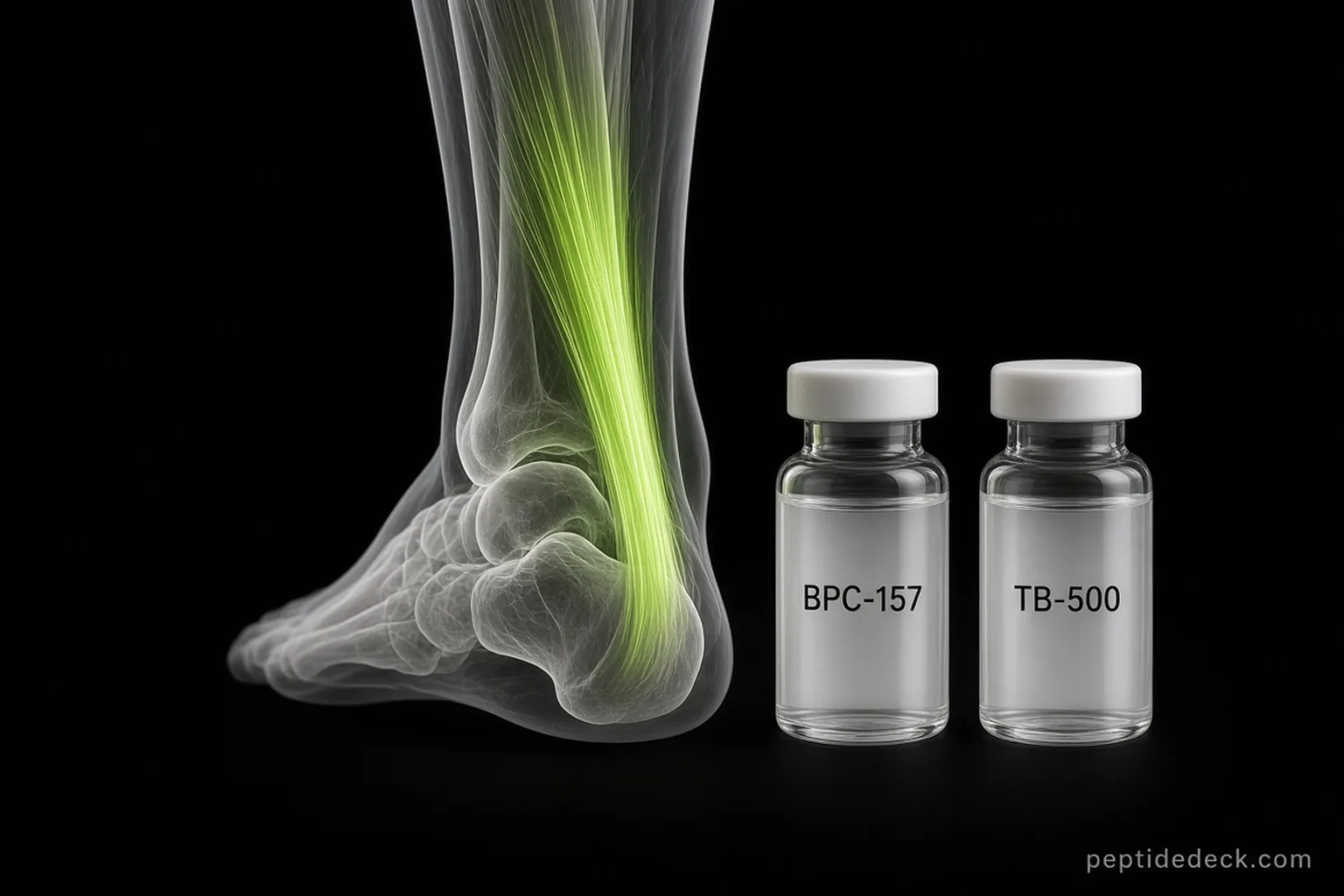
Tendon injuries test your patience like nothing else. If you are looking at peptides for tendon repair, start with this: no peptide drug is approved for any tendon or ligament injury, anywhere. BPC-157, the name every forum recommends, has been reported in exactly 16 people with knee pain, in a phone survey with no comparison group (PMID 34324435).
🔑 Key Takeaways
- Why the only human BPC-157 joint report cannot tell you whether it worked
- The hormone that did raise tendon collagen in people, and why no peptide vendor sells it
- What happened when TB-500's parent protein went up against placebo
- The rotator cuff finding that rarely comes up in peptide forums
- The dose-math trap hiding inside a pre-blended Wolverine vial
If you are reading this, something has been hurting for a while. An Achilles that flares on every hill, a shoulder that will not lift a bag, a heel that hurts on the first step. Rest and physio helped a bit. This page grades every peptide people use for tendons and ligaments by what was actually tested in humans, condition by condition.
What peptides for tendon repair actually means
It mostly means two injectable peptides. BPC-157 and TB-500 are sold separately and as a 1:1 blend called the Wolverine stack. GHK-Cu, growth hormone secretagogues such as CJC-1295 and ipamorelin, and IGF-1 LR3 show up as add-ons.
None of them is an approved medicine for tendons. The US FDA lists both BPC-157 and TB-500 among bulk substances that may present significant safety risks in compounding, and for TB-500 it says it has not identified any human exposure data at all (FDA, page current as of April 2026).
The conditions people use them for are different problems, which matters for how you read the evidence:
- Tendinopathy (Achilles, patellar, tennis elbow): slow overload damage, not an acute cut.
- Ligament sprains (ankle, knee MCL): an acute tear of tissue that joins bone to bone.
- Rotator cuff tears: often repaired surgically; retear is the outcome tracked.
- Plantar fasciitis: chronic heel pain from the thick band under the foot.
- Post-surgical repair: a repaired tendon or graft knitting into bone.
Most animal data people quote comes from clean surgical cuts through healthy tendon, closer to an acute rupture than to slow tendinopathy.
The evidence table: who was tested in people
Here is every peptide, graded by human data. The grade is for tendon or ligament outcomes only, so a strong record elsewhere does not count.
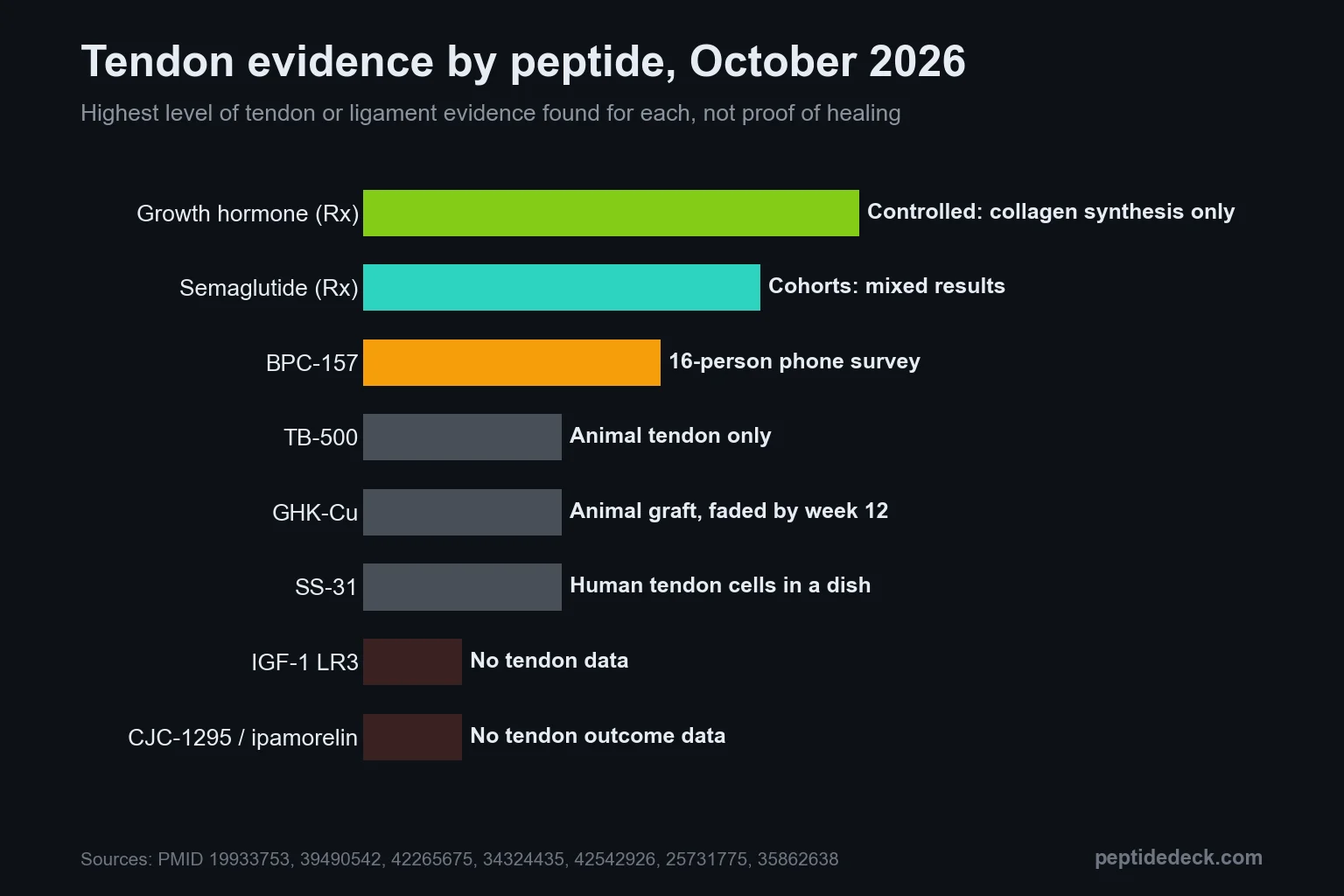
BPC-157: strong animal data, a thin human record
The animal results are genuinely impressive. In a 2003 Zagreb study, BPC-157 given after a surgical Achilles cut produced stronger, fuller tendon repair by day 14 than saline, on load to failure, function scores and tissue slides (PMID 14554208). The same group reported better knee ligament (MCL) healing over 90 days by injection, drinking water or cream (PMID 20225319).
Cell work from Taiwan found it sped up tendon fibroblast migration (PMID 21030672) and raised their growth hormone receptors (PMID 25415472). It also appears to raise VEGF, the signal that grows new blood vessels (PMID 20388964).
Then you look for people. A 2025 systematic review in sports medicine found 36 BPC-157 musculoskeletal studies: 35 in animals or cells and one in humans (PMID 40756949).
That one human report is a chart review from a Florida hormone clinic. Of 17 patients who had knee injections, 16 answered a phone survey 6 to 12 months later. Eleven of 12 who got BPC-157 alone, and 3 of 4 who also got thymosin beta-4, said their pain improved (PMID 34324435). No MRI, no function score, no control group, and mixed causes of knee pain. The review counted only 7 of 12 with relief lasting over six months.
All three human BPC-157 reports (knee pain, a 12-woman bladder pilot, a 2-person IV safety test) come from one clinic author group in Alternative Therapies in Health and Medicine, and none has a control arm (PMID 39325560, PMID 40131143).
The first proper test is now registered. The University of Arkansas plans to randomise 30 adults after arthroscopic rotator cuff repair to daily self-injected BPC-157 or saline for 90 days, with blinded strength testing at 12 weeks and 5 months (NCT07803250). It is not yet recruiting, starts around January 2027, and has not posted a dose. More in our BPC-157 guide.
TB-500 and the thymosin beta-4 trials
TB-500 is a fragment, not the full protein. The FDA describes it as thymosin beta-4 fragment LKKTETQ. The full 43-amino-acid thymosin beta-4 is the molecule a drug company actually took into human trials.
Those trials were for skin wounds, not tendons, and the registry results are sobering. In a placebo-controlled phase 2 trial in 72 people with venous leg ulcers, 12 of 55 wounds closed on thymosin beta-4 gel versus 4 of 17 on placebo, 22% against 24% (NCT00832091). The published paper said the 0.03% dose "may" speed healing (PMID 20536470). A matching pressure-ulcer trial closed 8 of 54 versus 3 of 18, 15% against 17% (NCT00382174).
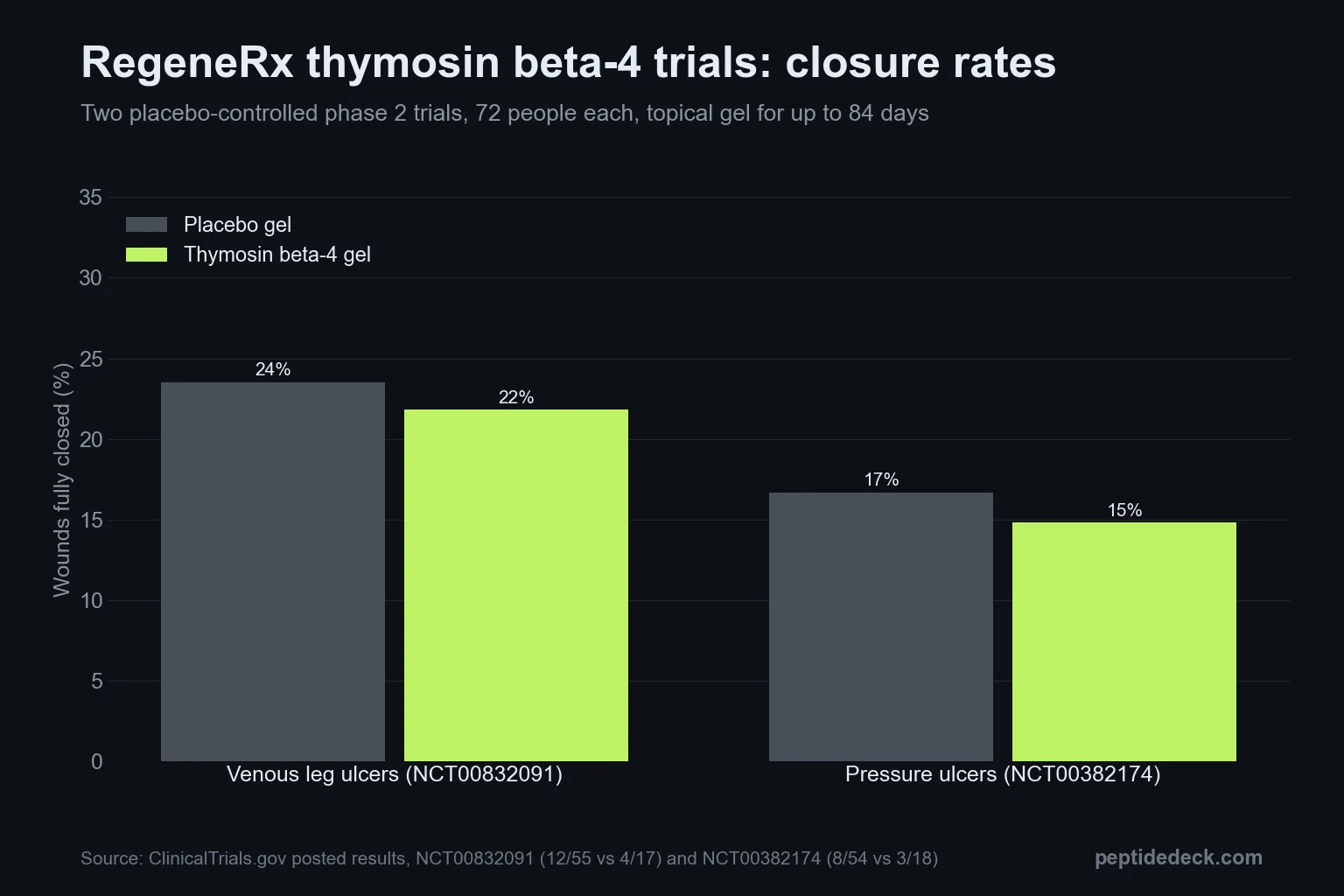
A wound is not a tendon, so this does not prove TB-500 fails on tendons. It does show what tends to happen when an exciting animal story finally meets a placebo arm. For tendons specifically, TB-500 has animal data only. See our TB-500 guide for the rest of its record.
Does the Wolverine stack beat either peptide alone?
Only one study has tested the combination. A 2026 Turkish trial cut and repaired the Achilles tendons of 32 lab animals, eight per group: saline, BPC-157, TB-500, or both, injected daily for four weeks (PMID 42542926).
TB-500 alone produced the only significant gain in load to failure. BPC-157 alone improved tissue scores numerically but not significantly. The combination "did not confer additional benefits compared to either agent alone." That is the opposite of how the stack is usually sold.
The practical upshot: if you still want to try the blend, buy it knowing the synergy claim has no support yet. Price matters too, because a full course can run several vials; our guide on where to buy the Wolverine stack compares vendors, testing and cost per mg (Ascension pays us a commission at no extra cost to you).
Growth hormone: a real human signal you cannot buy
This is the one controlled human tendon result. Copenhagen researchers gave healthy young adults recombinant growth hormone, 33 to 50 mcg/kg a day for 14 days (PMID 19933753).
Tendon collagen I gene activity rose 3.9-fold and tendon collagen protein synthesis 1.3-fold, while muscle protein synthesis did not change. The authors concluded growth hormone matters more for strengthening connective tissue than for muscle growth.
Two caveats. Collagen synthesis is not the same as a healed tendon, and this was prescription growth hormone at measured doses in healthy people. CJC-1295 and ipamorelin raise your own growth hormone, but neither has a single tendon outcome study.
Rotator cuff tears: surgery data and a trial not yet started
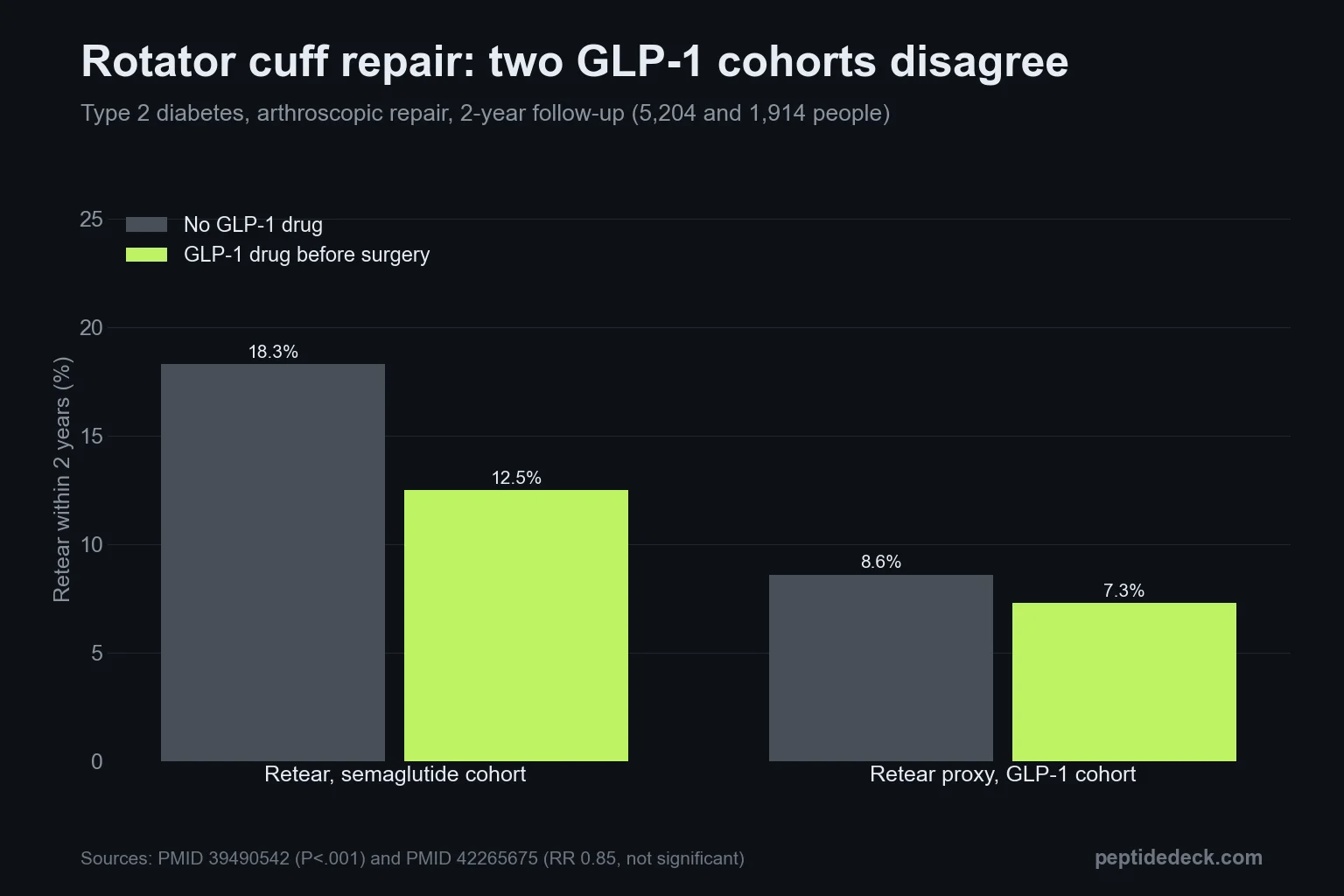
The biggest rotator cuff numbers involve semaglutide. A Yale-led database study matched 1,094 people with type 2 diabetes on semaglutide to 4,110 who were not, all having arthroscopic cuff repair (PMID 39490542).
Two-year retear was 12.5% with semaglutide versus 18.3% without, and any complication within 90 days was 11.0% versus 27.4%. It is a Level III billing-code study, several authors disclose consulting for surgical device makers, and people healthy enough to be on semaglutide may differ in ways matching cannot fix.
A second cohort found no clear effect. In 957 matched pairs from the TriNetX network, two-year revision was 1.0% versus 1.1% and the retear proxy 7.3% versus 8.6%, neither significant (PMID 42265675).
For BPC-157 and TB-500 on cuff tears, the only human evidence is the Arkansas trial that has not started. One timing risk is real: a full-thickness tear can retract while you try injections, and a retracted tear is harder to repair.
Ligament sprains and ACL grafts
No peptide has human ligament data. The ligament evidence is the 90-day BPC-157 MCL study above (PMID 20225319) and one GHK-Cu graft study.
In that study, 72 animals had ACL reconstruction and weekly knee injections of saline or GHK-Cu (PMID 25731775). At 6 weeks the GHK-Cu knees were less lax (p = 0.009); by 12 weeks the difference was gone, and ultimate graft strength never differed. The authors wrote that the benefit "could not last as treatment discontinued." More on the copper peptide in our GHK-Cu guide.
Plantar fasciitis: no BPC-157 or TB-500 data at all
Not one study exists, in animals or people. Heel injections of BPC-157 or TB-500 are pure extrapolation.
The only peptide signal is again semaglutide. In a Shanghai cohort of 2,902 people with heel pain over six months, the 92 on semaglutide improved 14.86 points more on the Foot Health Status pain score (95% CI 9.97 to 19.75) and their plantar fascia thickened more slowly (PMID 40788007). In an uncontrolled pilot, 30 people on semaglutide went from 28.1 to 60.3 on that pain score over 12 months. Less body weight on the heel is the simplest explanation.
Heel pain that will not settle can also be a stress fracture or a trapped nerve, which no injection will solve. If your back is also involved, our peptides for back pain page covers that evidence separately.
How long tendon healing takes, with or without peptides

Tendons are judged in months, not weeks. Look at the time points the studies themselves use:
A typical 4 to 8 week peptide cycle ends before the first checkpoint any human tendon study uses. If your pain eases by week three, that is welcome, but it is not proof the tendon has remodelled. Keep up the progressive loading your physio sets.
Wolverine stack dose math, if you still go ahead
No dose has been tested on a human tendon. The Arkansas trial uses daily subcutaneous injection for 90 days but has not posted its dose. What follows is arithmetic, not a recommendation.
The Wolverine vial holds 10 mg BPC-157 and 10 mg TB-500 together. Whatever water you add, the two always come out 1:1:
The trap is the fixed ratio. Online plans usually pair a small daily BPC-157 amount (250 to 500 mcg) with a much larger weekly TB-500 amount (2 mg or more, twice a week). A 1:1 blend cannot do both: at 500 mcg of BPC-157 a day you get 3.5 mg of TB-500 a week, and at 250 mcg you get 1.75 mg. Run your own numbers in the peptide calculator before you mix.
Safety: what can go wrong
Most risks come from the vial, not the molecule. These are the ones that matter for tendon users:
- Unregulated vials. Neither peptide is approved anywhere; the FDA flags immune-reaction and impurity concerns for both (FDA).
- Infection. A non-sterile joint injection can cause septic arthritis; peri-tendon shots can seed deep infection.
- Blood-vessel growth signalling. BPC-157 appears to raise VEGF (PMID 20388964). Nobody knows what that does to an undiagnosed tumour.
- Mast-cell reactions. Injectable peptides can activate mast cells directly through the MRGPRX2 receptor (PMID 25517090). People with hypermobile Ehlers-Danlos or mast cell activation syndrome, common among repeat ligament injuries, may react more.
- Sport testing. WADA prohibits BPC-157 under S0, non-approved substances (WADA Prohibited List). Tested athletes risk a ban.
- Masked pain. Overloading a tendon that feels better than it is can turn a partial tear into a full one.
Do not stop any prescribed medication, including anti-inflammatories or diabetes drugs, to make room for a peptide.
What to ask your doctor
1. Is this tendinopathy, a partial tear or a full-thickness tear, and do I need imaging to know?
2. If it is a full-thickness tear, how long can I wait before surgery becomes harder?
3. Is my loading programme progressive enough, and what should I feel by week 6 and week 12?
4. Would weight loss or a GLP-1 drug make sense for my heel or shoulder, given my other conditions?
5. If I use a peptide anyway, which signs of infection or reaction mean I should come straight back?
Frequently Asked Questions
Sources
- Lee E, Padgett B. Intra-articular injection of BPC 157 for multiple types of knee pain. Altern Ther Health Med. 2021;27(4):8-13. PMID 34324435
- Lee E, Burgess K. Safety of intravenous infusion of BPC157 in humans: a pilot study. Altern Ther Health Med. 2025;31(5):20-24. PMID 40131143
- Lee E, Walker C, Ayadi B. Effect of BPC-157 on symptoms in patients with interstitial cystitis: a pilot study. Altern Ther Health Med. 2024;30(10):12-17. PMID 39325560
- Vasireddi N, et al. Emerging use of BPC-157 in orthopaedic sports medicine: a systematic review. HSS J. 2025;21(4):485-495. PMID 40756949
- Staresinic M, et al. BPC 157 and healing of the transected Achilles tendon (animal model). J Orthop Res. 2003;21(6):976-83. PMID 14554208
- Cerovecki T, et al. Pentadecapeptide BPC 157 (PL 14736) and medial collateral ligament healing (animal model). J Orthop Res. 2010;28(9):1155-61. PMID 20225319
- Chang CH, et al. The promoting effect of pentadecapeptide BPC 157 on tendon healing involves tendon outgrowth, cell survival, and cell migration. J Appl Physiol. 2011;110(3):774-80. PMID 21030672
- Chang CH, et al. Pentadecapeptide BPC 157 enhances the growth hormone receptor expression in tendon fibroblasts. Molecules. 2014;19(11):19066-77. PMID 25415472
- Brcic L, et al. Modulatory effect of gastric pentadecapeptide BPC 157 on angiogenesis in muscle and tendon healing. J Physiol Pharmacol. 2009;60 Suppl 7:191-6. PMID 20388964
- Bicer O, et al. Effects of BPC-157 and TB-500 on Achilles tendon healing (animal model). Jt Dis Relat Surg. 2026;37(3):822-837. PMID 42542926
- Guarnera G, et al. The effect of thymosin treatment of venous ulcers. Ann N Y Acad Sci. 2010;1194:207-12. PMID 20536470
- Doessing S, et al. Growth hormone stimulates the collagen synthesis in human tendon and skeletal muscle without affecting myofibrillar protein synthesis. J Physiol. 2010;588(2):341-51. PMID 19933753
- Seddio AE, et al. Lower risk of postoperative complications and rotator cuff retear associated with semaglutide use in patients with type II diabetes undergoing arthroscopic rotator cuff repair. Arthroscopy. 2025;41(2):199-206. PMID 39490542
- Yang MY, Hung LW. GLP-1 receptor agonist therapy and 2-year structural outcomes after arthroscopic rotator cuff repair in type 2 diabetes. BMC Musculoskelet Disord. 2026;27(1):699. PMID 42265675
- Fu SC, et al. Tripeptide-copper complex GHK-Cu (II) and healing after ACL reconstruction (animal model). J Orthop Res. 2015;33(7):1024-33. PMID 25731775
- Zhang X, et al. Evaluation of SS-31 as a potential strategy for tendinopathy treatment: an in vitro model. Am J Sports Med. 2022;50(10):2805-2816. PMID 35862638
- Yang F, et al. Association of semaglutide use with outcomes in chronic plantar heel pain. Int J Surg. 2025;111(12):9333-9341. PMID 40788007
- McNeil BD, et al. Identification of a mast-cell-specific receptor crucial for pseudo-allergic drug reactions. Nature. 2015;519(7542):237-41. PMID 25517090
- University of Arkansas. Impact of BPC-157 on recovery from rotator cuff repair surgery. ClinicalTrials.gov NCT07803250 (not yet recruiting).
- RegeneRx. Thymosin beta 4 in venous stasis ulcers, phase 2, posted results. ClinicalTrials.gov NCT00832091.
- RegeneRx. Thymosin beta 4 in pressure ulcers, phase 2, posted results. ClinicalTrials.gov NCT00382174.
- US FDA. Certain bulk drug substances for use in compounding that may present significant safety risks (content current as of 04/22/2026). fda.gov
- World Anti-Doping Agency. Prohibited List, S0 non-approved substances. wada-ama.org
Related reading: peptides for arthritis and peptides for wound healing, where the thymosin beta-4 trials are covered in full.
Medical Disclaimer: This article is for educational purposes only and is not medical advice. BPC-157, TB-500 and the other peptides discussed are not approved by the FDA or any other regulator for tendon, ligament or plantar fascia conditions. Talk to a qualified clinician before using any peptide, and do not stop prescribed medication without medical guidance.