Some wounds simply refuse to close. If you are reading about peptides for wound healing, you probably know that wound: a foot, leg or pressure ulcer that has looked the same for months. One peptide drug is approved for this job, though not in the US: injected recombinant human EGF for advanced diabetic foot ulcers, approved in Cuba and other countries (PMID 20051095). The peptides sold online have a stranger record. Two have positive human trials, one lost to placebo, and the most hyped one has never been tested on a human wound.
🔑 Key Takeaways
- The sold peptide with the best ulcer-closure result, and the step it could not work without.
- Why the lowest LL-37 dose beat the highest one.
- What the thymosin beta-4 registry shows that the paper did not.
- The BPC-157 gap that most sellers leave out.
- The cancer warning on a US wound gel that applies to "angiogenic" peptides.
If you are living with a slow wound, you know the routine. Dressings, check-ups, measuring, waiting. Two weeks without change feels like going backwards, which is why peptide claims spread so fast. Here is what happened when these peptides were put on human wounds.
What peptides for wound healing actually means
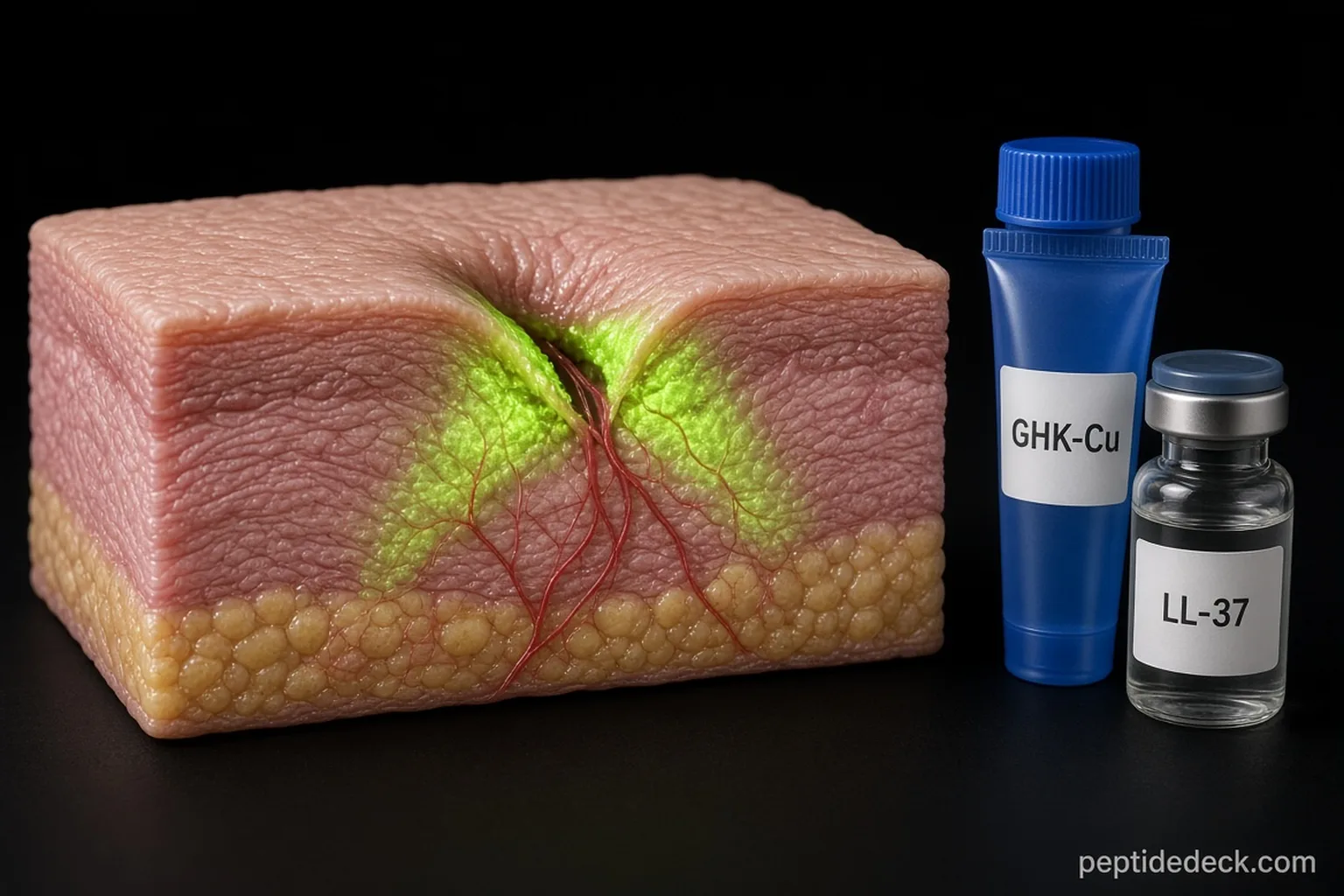
Two different things hide under this phrase. The first is approved peptide and protein drugs, prescribed by wound clinics. The second is the vials sold online: GHK-Cu, LL-37, TB-500 and BPC-157.
The approved side is small. Recombinant human EGF (Heberprot-P), a 53 amino acid polypeptide, is injected into the ulcer. In a double-blind trial of 149 people with deep (Wagner grade 3 or 4) diabetic foot ulcers, 44 of 53 on 75 µg had half the ulcer covered in granulation tissue at 2 weeks, vs 19 of 48 on placebo; 40 of 53 vs 25 of 48 later closed (PMID 20051095).
In the US, the approved option is becaplermin gel (Regranex), a growth factor protein. Its FDA label covers diabetic neuropathic ulcers only; efficacy in pressure and venous ulcers has not been established.
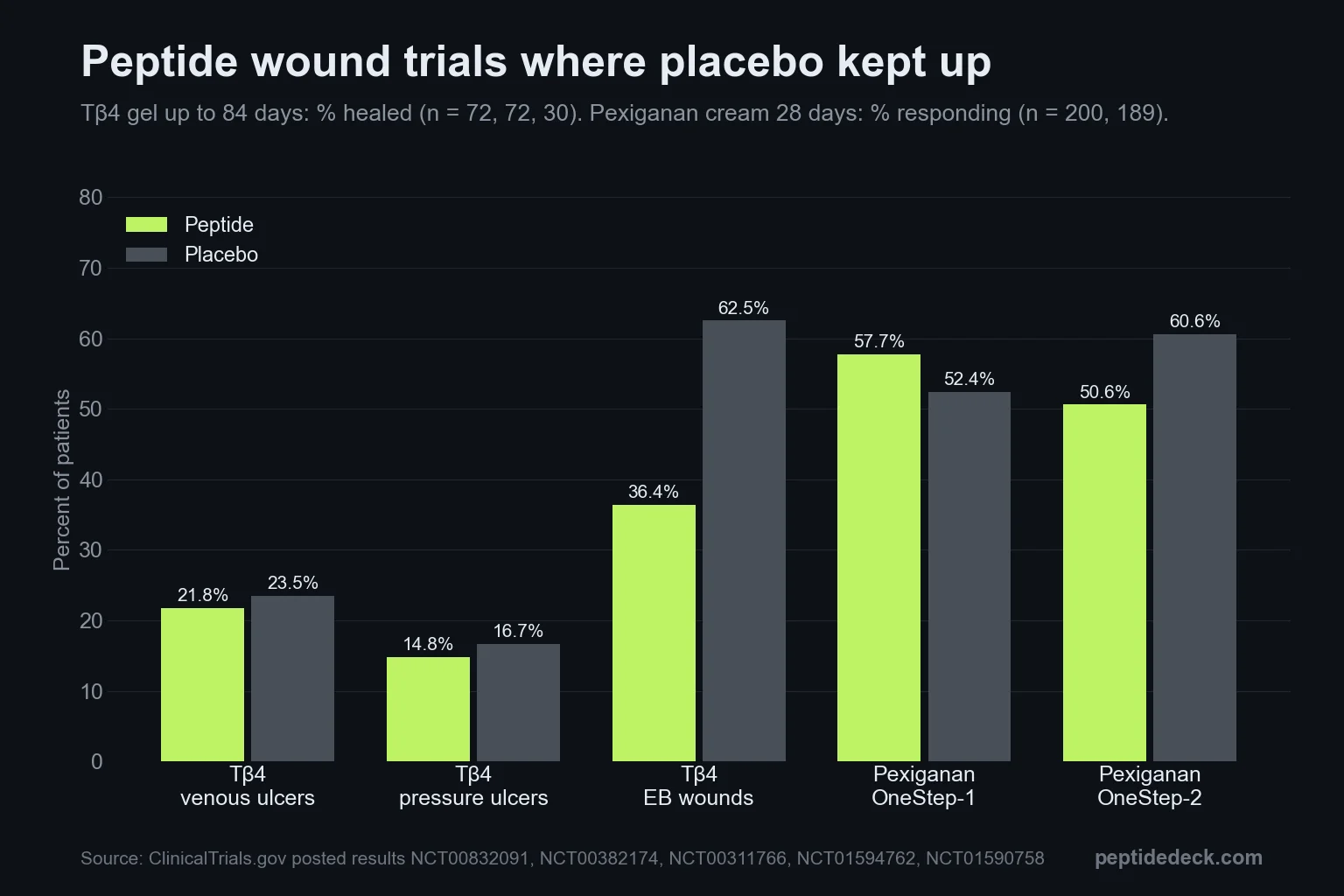
One antimicrobial peptide reached phase 3 and failed. Pexiganan 0.8% cream vs placebo cream in mildly infected diabetic foot ulcers: clinical response 56 of 97 vs 54 of 103 (NCT01594762) and 43 of 85 vs 63 of 104 (NCT01590758).
The evidence, graded peptide by peptide
Here is every trial in one table. Rows link to the abstract or registry record, so you can check the numbers yourself.
One pattern stands out. Every human trial of a sold peptide was topical, small and mostly developer-run. None tested the vials people buy today.
GHK-Cu: one diabetic ulcer win, one venous loss
GHK-Cu has the oldest human wound data. In 1994, a multicentre, evaluator-blinded trial tested a sterile GHK-Cu gel (Iamin) against vehicle gel in diabetic ulcers on the sole of the foot (PMID 17147644). Everyone got sharp debridement and pressure-relieving footwear.
The results were striking. Median closure was 98.5% vs 60.8%. In ulcers over 100 mm², it was 89.2% vs -10.3%: the vehicle-treated ulcers grew. Infections were 7% vs 34%. One condition: treatment had to start immediately after debridement.
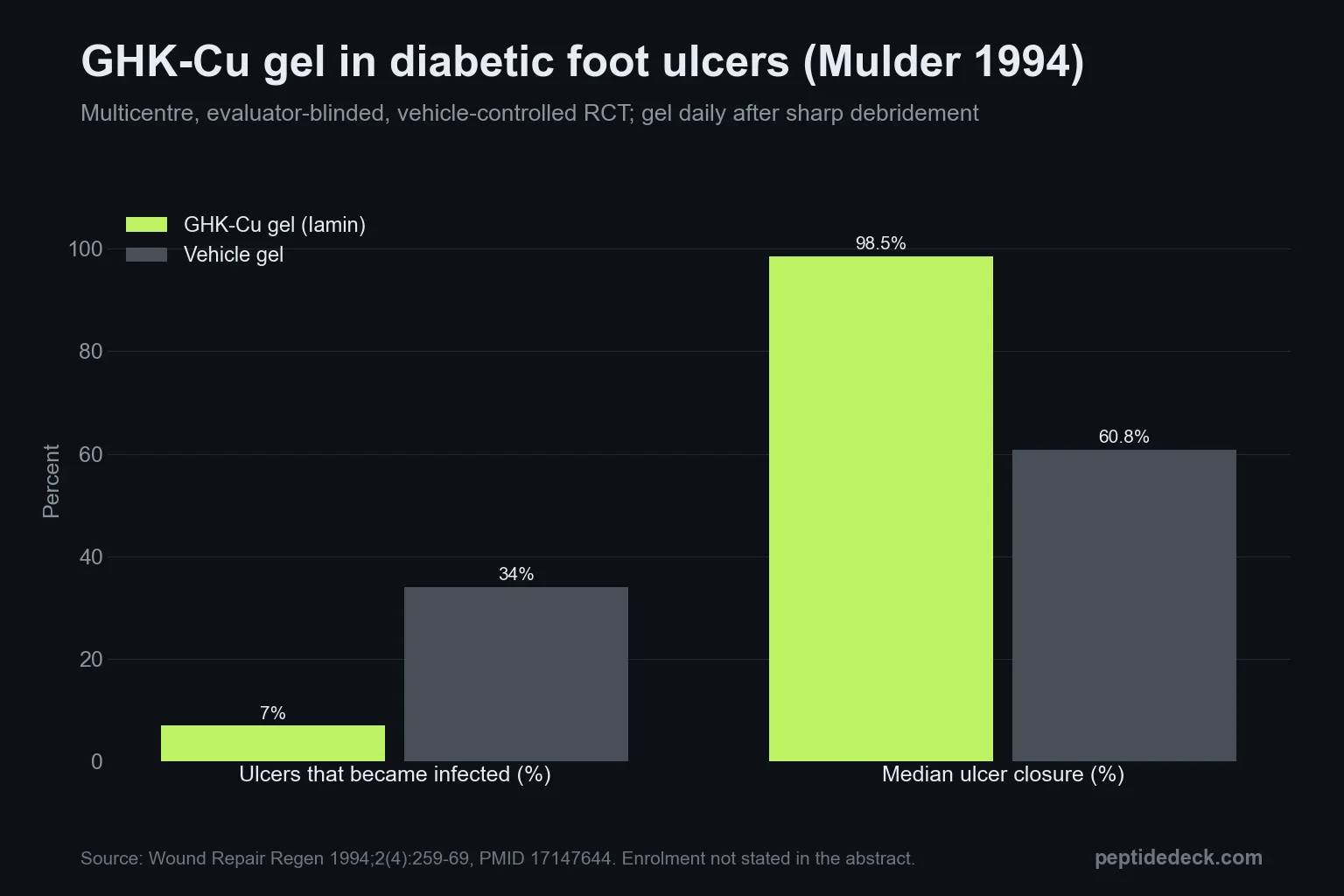
Then the other result. In a 1992 trial of 86 people with venous stasis ulcers, a 0.4% GHK-Cu cream did no better than an inert placebo cream, while silver sulfadiazine beat both (PMID 1495150). The abstract of the 1994 study does not state how many people enrolled, and Iamin gel was never approved.
So the one positive GHK-Cu wound trial used a sterile gel plus proper debridement, in diabetic foot ulcers. More on our GHK-Cu page.
LL-37: a strong start, then a null trial
LL-37 is the body's own antimicrobial peptide. Its first human trial looked excellent. Thirty-four people with hard-to-heal venous leg ulcers got LL-37 (0.5, 1.6 or 3.2 mg/mL) or placebo twice weekly for 4 weeks (PMID 25041740).
The healing rate was about six times placebo at 0.5 mg/mL (p = 0.003) and three times at 1.6 mg/mL (p = 0.088, not significant). Mean ulcer area fell 68% and 50%. The 3.2 mg/mL dose matched placebo, so more was not better. The developer, Pergamum AB, ran it.
The follow-up was bigger. HEAL LL-37, a phase IIb trial of 148 people on compression (median ulcer duration 20.3 months), tested 0.5 and 1.6 mg/mL against placebo (PMID 34687253). Overall, LL-37 showed no significant improvement. A post hoc look found benefit only in ulcers of at least 10 cm². Three authors worked for the developer.
A third trial in Jakarta tested LL-37 cream twice weekly for 4 weeks on mildly infected diabetic foot ulcers (PMID 37480520). The granulation index rose more with LL-37 on days 7 to 28 (p = 0.006 to 0.037), but bacterial counts and inflammatory markers did not fall. The registry (NCT04098562) lists 40 planned participants. More on our LL-37 page.
Thymosin beta-4 and TB-500: no edge on closure
The published paper sounded hopeful. RegeneRx tested thymosin beta-4 gel daily for up to 84 days in 73 people with venous stasis ulcers. The paper said the 0.03% dose "may have the potential to accelerate wound healing" (PMID 20536470).
The registry tells you more. Its posted results show 12 of 55 people on thymosin beta-4 fully healed vs 4 of 17 on placebo: 22% vs 24% (NCT00832091). A sister trial in 72 people with pressure ulcers posted 8 of 54 healed vs 3 of 18, or 15% vs 17% (NCT00382174). A third, in epidermolysis bullosa wounds, stopped early with 8 of 22 healed vs 5 of 8 on placebo (NCT00311766).
TB-500 is a fragment built around thymosin beta-4's actin-binding region. A seven amino acid version helped wounds heal in aged mice (PMID 12581423); TB-500 itself has no human wound test. See the TB-500 page for what it has been studied for.
BPC-157: never tested on a human wound
BPC-157 is the most hyped healing peptide. Its wound evidence is all from animals. Topical BPC-157 sped up closure of alkali burns in lab animals and raised VEGF, a blood vessel growth signal, in the wound tissue (PMID 25995620). A BPC-157 cream improved burn healing in mice given steroids (PMID 12781609).
There is no human wound study. The only human BPC-157 reports come from one clinic group (Altern Ther Health Med) with no control arm, none on wounds. BPC-157, TB-500 and GHK-Cu blends have never been tested in anyone. The details are on our BPC-157 page.
Wound by wound: what the trials cover
Wound type changes the answer completely. A foot ulcer result says little about a leg ulcer.
Diabetic foot ulcers
The sold peptides look best here: the GHK-Cu gel and the small LL-37 cream trial. The stakes are highest too. Among 133,791 French adults with a first diabetic foot ulcer, 14.6% died within a year and 3.5% had a major amputation (PMID 41615296). GLP-1 drug use was linked with lower mortality, in an observational study.
Venous leg ulcers
Mostly negative. LL-37 lost its edge in the big trial, thymosin beta-4 healed 22% vs 24%, and 0.4% GHK-Cu cream matched placebo. Compression stays the base of care. In 38,834 matched pairs, people started on a GLP-1 drug had fewer nonhealing ulcers (0.61% vs 0.92%), in an observational study (PMID 41895589).
Pressure ulcers
Only thymosin beta-4 was tested: 15% healed vs 17% on placebo. Pressure relief and nursing care do the heavy lifting.
Surgical wounds
No trial above enrolled surgical incisions, so no sold peptide has human data here. Put nothing on an incision your surgeon has not cleared.
Everyday cuts and scrapes
No peptide has been tested on ordinary cuts in a trial; clean and cover them. For cosmetic use on intact skin, our GHK-Cu cream guide explains what the creams were and were not studied for.
Doses and concentrations used in the trials
These are the amounts people actually received. None came from a vial bought online.
The gap between these products and the vials matters. If you are comparing where to buy GHK-Cu (Ascension pays us a commission at no extra cost to you), know what arrives: a 100mg vial listed at $59 before the PEPTIDEDECK code, as freeze-dried powder, not the sterile metered gel from the 1994 trial. Our broader peptides for skin guide covers intact-skin uses.
Safety: what can go wrong with wounds
Wounds are an open door for infection. These are the risks that matter most.
- An infected diabetic foot ulcer is an emergency in slow motion. It needs debridement, offloading and often antibiotics; pexiganan did not beat placebo in mild infection. Of people who had a major amputation after a foot ulcer, 28.8% died within a year (PMID 41615296).
- Growth signals carry a cancer caveat. Becaplermin's FDA label warns that cancers distant from the application site occurred in users of this growth-promoting gel. BPC-157 raised VEGF in animal wounds (PMID 25995620) and GHK-Cu did so in human fibroblasts in a dish (PMID 15655171). No cancer signal has been shown for them, and no long-term human data exist.
- Non-sterile product on broken skin. Online vials are not made as sterile wound products. Putting reconstituted powder on an open ulcer, or injecting near one, with diabetes or poor circulation risks deep infection.
- Mast-cell reactions. Injectable peptides can activate mast cells directly through MRGPRX2 (PMID 25517090), causing flushing or hives, more so with reactive skin or MCAS.
- Do not stop prescribed medication or drop compression or offloading to try a peptide.
What to ask your doctor
Is my wound infected, and does it need debridement or antibiotics? Is my blood flow good enough to heal it? Would compression or offloading help? Am I a candidate for becaplermin? Is any peptide safe with my cancer history or medicines?
Frequently Asked Questions
Sources
- Fernández-Montequín JI, et al. Intralesional rhEGF in advanced diabetic foot ulcers. Int Wound J. 2009;6(6):432-43. PMID 20051095
- Mulder GD, et al. GHK-Cu gel in diabetic ulcers. Wound Repair Regen. 1994;2(4):259-69. PMID 17147644
- Bishop JB, et al. Two wound healing agents in venous stasis ulcers. J Vasc Surg. 1992;16(2):251-7. PMID 1495150
- Grönberg A, et al. LL-37 in hard-to-heal venous leg ulcers. Wound Repair Regen. 2014;22(5):613-21. PMID 25041740
- Mahlapuu M, et al. HEAL LL-37 phase IIb in venous leg ulcers. Wound Repair Regen. 2021;29(6):938-950. PMID 34687253
- Miranda E, et al. LL-37 cream in diabetic foot ulcer. Arch Dermatol Res. 2023;315(9):2623-2633. PMID 37480520
- Guarnera G, et al. Thymosin treatment of venous ulcers. Ann N Y Acad Sci. 2010;1194:207-12. PMID 20536470
- Thymosin beta 4, venous stasis ulcers, posted results. NCT00832091
- Thymosin beta 4, pressure ulcers, posted results. NCT00382174
- Thymosin beta 4, epidermolysis bullosa, posted results. NCT00311766
- Pexiganan OneStep-1, posted results. NCT01594762
- Pexiganan OneStep-2, posted results. NCT01590758
- LL-37 cream in diabetic foot ulcers, registry record. NCT04098562
- Huang T, et al. BPC-157 in alkali-burn wounds. Drug Des Devel Ther. 2015;9:2485-99. PMID 25995620
- Sikiric P, et al. BPC-157 creams in burned mice. Burns. 2003;29(4):323-34. PMID 12781609
- Philp D, et al. Thymosin beta 4 in diabetic and aged mice wounds. Wound Repair Regen. 2003;11(1):19-24. PMID 12581423
- Pollard JD, et al. Copper tripeptide and irradiated fibroblasts. Arch Facial Plast Surg. 2005;7(1):27-31. PMID 15655171
- Bonnet JB, et al. GLP-1 drugs and mortality after diabetic foot ulcers. Diabetes Care. 2026;49(5):730-739. PMID 41615296
- Go CC, et al. GLP-1 drugs and venous ulcer healing. Ann Vasc Surg. 2026;129:35-42. PMID 41895589
- McNeil BD, et al. Mast-cell receptor MRGPRX2. Nature. 2015. PMID 25517090
- REGRANEX (becaplermin) gel, US label, section 5.1. DailyMed
Medical Disclaimer: This article is for general information only and is not medical advice. None of GHK-Cu, LL-37, TB-500 or BPC-157 has FDA approval for wound healing. Chronic and diabetic wounds can become limb-threatening; see a doctor or wound clinic for any wound that is not improving, and do not stop prescribed medication without medical advice.