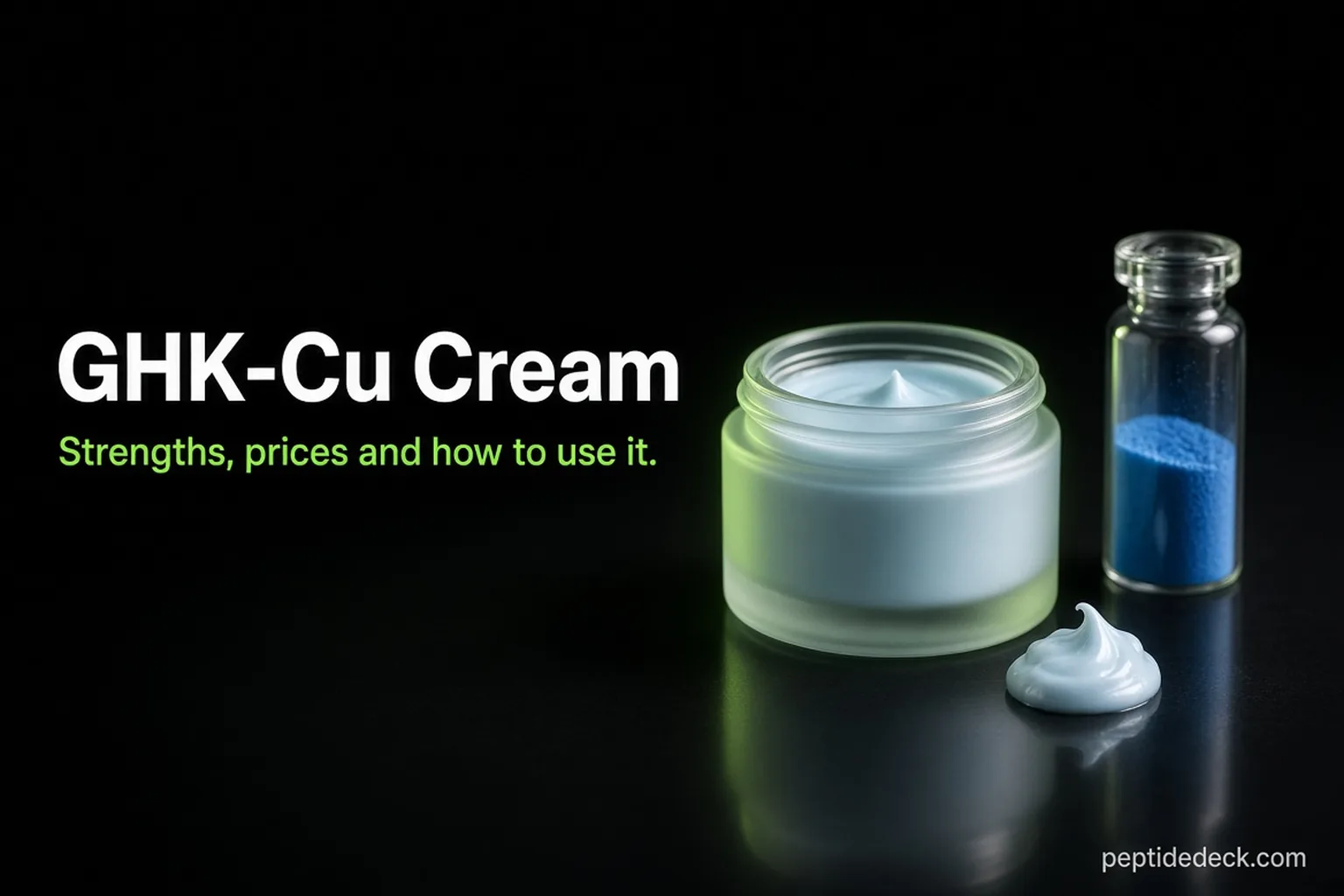
Most GHK-Cu cream labels don't tell you enough. A jar marked "4%" might hold 4% GHK-Cu, or a peptide blend where copper peptide is a small share. Prices run from $20 a jar to $149 a month for creams that look almost identical. This guide shows what the percentage on a GHK-Cu cream really means, what the 12-week trials found, what each option costs per 100 mg of copper peptide, and how to use it without cancelling it out with the rest of your routine.
🔑 Key Takeaways
- The percentage on the label can mean two different things, and one quick check tells you which
- The trials ran for 12 weeks, so judging a cream at week three is judging it too early
- One well-run trial found no benefit, and it tells you what a cream is not for
- Vitamin C in the same step can work against the copper peptide
- Mixing your own from powder gives you control, but it isn't the cheap route
Prices below were checked on each seller's own page on September 28, 2026, and every study claim links to its source at the end.
What Is GHK-Cu Cream?
It's a moisturizer carrying a copper peptide. GHK-Cu is a three-amino-acid peptide (glycine, histidine, lysine) bound to a copper ion, and your body makes it naturally. Levels in blood fall with age, which is part of why it became a skincare ingredient.
On an ingredient list it usually appears as "copper tripeptide-1". In a cream it's the active, and everything else in the jar (oils, glycerin, emulsifiers) is the delivery vehicle. For the full background on the peptide itself, see our GHK-Cu copper peptide guide.
What the Percentage on a GHK-Cu Cream Means
Start with the number on the jar. There are two honest ways to state strength, and one that tells you much less.
- GHK-Cu by weight. A 60 g jar at 2% holds 1,200 mg of GHK-Cu. This is the figure you want, and the good labels also print the milligrams.
- Milligrams per jar. Divide by the jar's weight to get the percentage: 2,400 mg in 60 g is 4%.
- "Peptide complex" percentages. A "4% peptide" claim can describe a blend of several peptides. Unless the label says how much of that is copper tripeptide-1, you don't know the GHK-Cu strength.
Colour is a useful second check. GHK-Cu is blue, and creams with a meaningful amount of it usually carry a visible blue tint. A bright white cream claiming a high GHK-Cu percentage deserves a question to the seller, and a batch certificate of analysis is the only real answer.
GHK-Cu Cream Options Compared
Prices vary far more than the creams do. Here's what the main routes cost, worked out per 100 mg of GHK-Cu where the seller publishes enough to do the maths.
Two things stand out. The cheapest cream per milligram is also one of the highest-strength ones, so price is not a quality signal on its own. And the prescription route costs the most because you're paying for a clinician and a compounding pharmacy, not for more copper peptide. Our guide to how to get GHK-Cu covers the prescription and compounding route in more detail.
What the Studies on GHK-Cu Cream Show
Twelve weeks is the number to remember. The main human trials applied a GHK-Cu cream for about three months before measuring anything.
That's an encouraging set of results, but read it with two caveats. Most of these trials were run or funded by companies selling copper peptides, and several are known mainly through summaries in a 2018 review by Loren Pickart, the scientist who discovered GHK and founded Skin Biology. Independent, fully published cosmetic trials are thin.
The one negative trial matters too. In 86 people with leg ulcers, a 0.4% GHK-Cu cream did no better than an inactive cream, while silver sulfadiazine did. So a cream is a cosmetic tool for photoaged skin, not a wound treatment.
Does it get in? A lab study on human skin found that copper applied as GHK-Cu passed through the skin over 48 hours and left a reserve in the skin tissue itself. That supports the idea that a cream delivers something, though it doesn't tell you how much reaches the collagen layer of your face.
How to Use GHK-Cu Cream
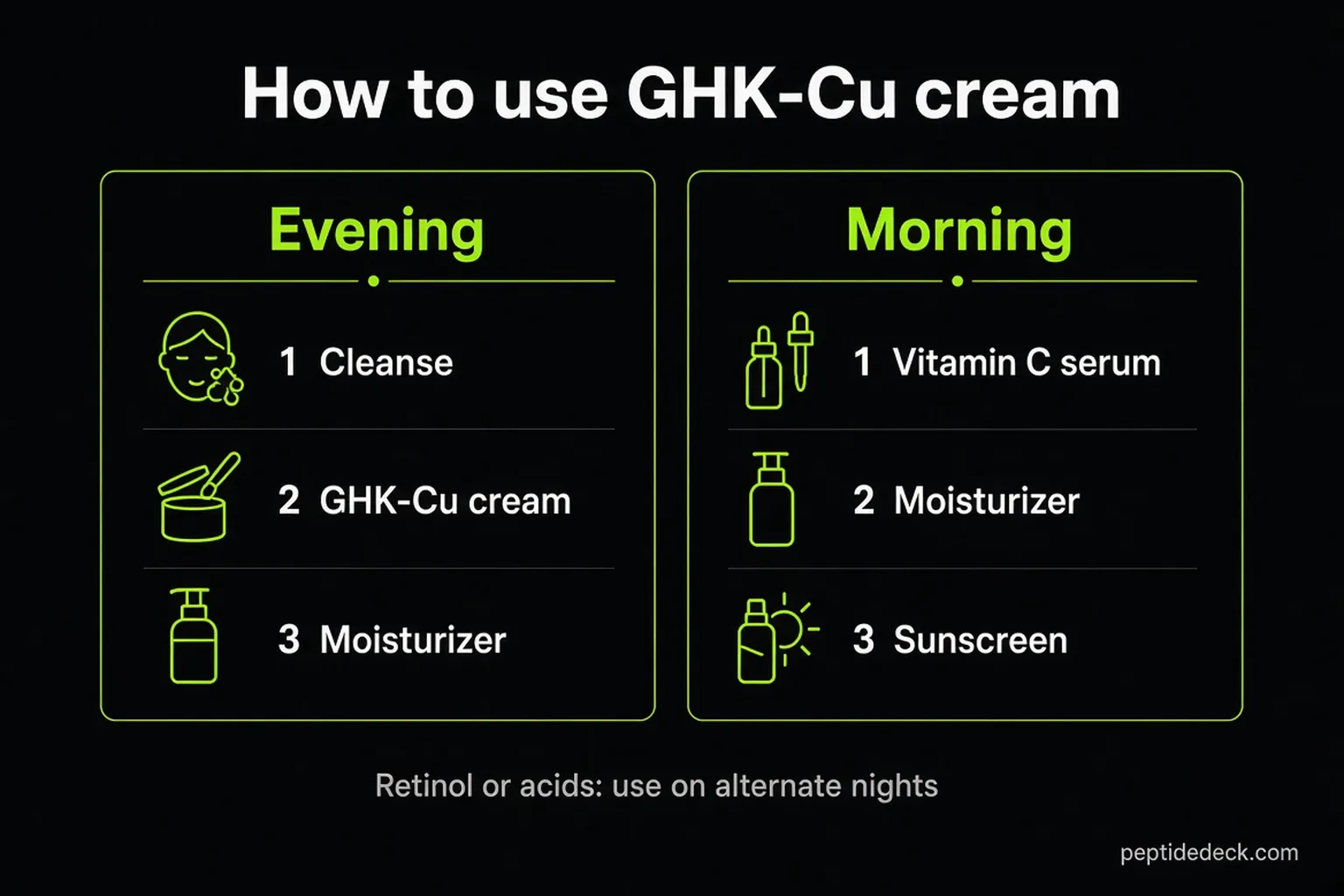
Evening is the easy slot. It keeps the copper peptide away from a morning vitamin C serum and leaves the night for it to work without competition.
- Patch test first. Put a little on your inner arm or behind the ear for 48 hours before using it on your face.
- Apply to clean skin. A pea-sized amount covers the face. The main facial trial used the cream twice a day.
- Keep vitamin C for the morning. Vitamin C serums are acidic, and copper and ascorbic acid react with each other, so using them in the same step can blunt both.
- Alternate nights with retinol or acids. Stacking strong actives is the usual cause of irritation, and it makes it hard to tell which product is doing what.
- Wear sunscreen every morning. The trials were on sun-damaged skin, and a cream can't keep up with ongoing sun exposure.
If you use a microneedling roller, lab models show needling increases how much GHK-Cu gets through the skin. Only apply a sterile product to freshly needled skin, though. A jar you've been dipping your fingers into isn't one.
What to Expect From GHK-Cu Cream, and When
Week one won't show much. Any change in the first few weeks is mostly the moisturizer: softer, better-hydrated skin.
The trials measured skin thickness, firmness and fine lines at 8 to 12 weeks, so that's the fair point to judge. Take a photo in the same light before you start and again at week 12. Our GHK-Cu before and after guide covers what realistic changes look like.
Side Effects and Who Should Skip It
Irritation is the main thing to watch for. Redness, stinging or itching usually comes from combining GHK-Cu with other actives, or from the cream's other ingredients, and it settles when you stop.
- Stop if a rash or swelling appears, and don't use it on broken or infected skin.
- If you have a known copper allergy or a copper-related condition such as Wilson's disease, ask a doctor before using it.
- If you're pregnant or breastfeeding, there's no safety data either way, so check with your doctor first.
The full list is in our GHK-Cu side effects guide.
Making Your Own GHK-Cu Cream From Powder
It buys you control, not savings. Some people prefer to buy GHK-Cu as a pure powder and stir it into a moisturizer they already trust, because they know exactly what's in it and can mix a fresh batch each time.
The maths is simple. A 100 mg vial mixed into 10 g of cream gives 1%, and the same vial in 50 g gives 0.2%. Here's how one 100 mg vial works out.
That's the honest trade-off: gram for gram, a homemade 1% cream costs far more than a ready-made 2% jar. What you get is a single-ingredient powder with a published purity figure and a strength you set yourself.
- Dissolve first. GHK-Cu dissolves easily in water. Dissolve the powder in a few drops of distilled water before stirring it in, or it won't spread evenly.
- Choose a plain base. Use a fragrance-free moisturizer with no vitamin C, acids or retinol in it.
- Mix small batches. Make only what you'll use in about two weeks, keep it in the fridge in a clean, labelled container, and write the date on it.
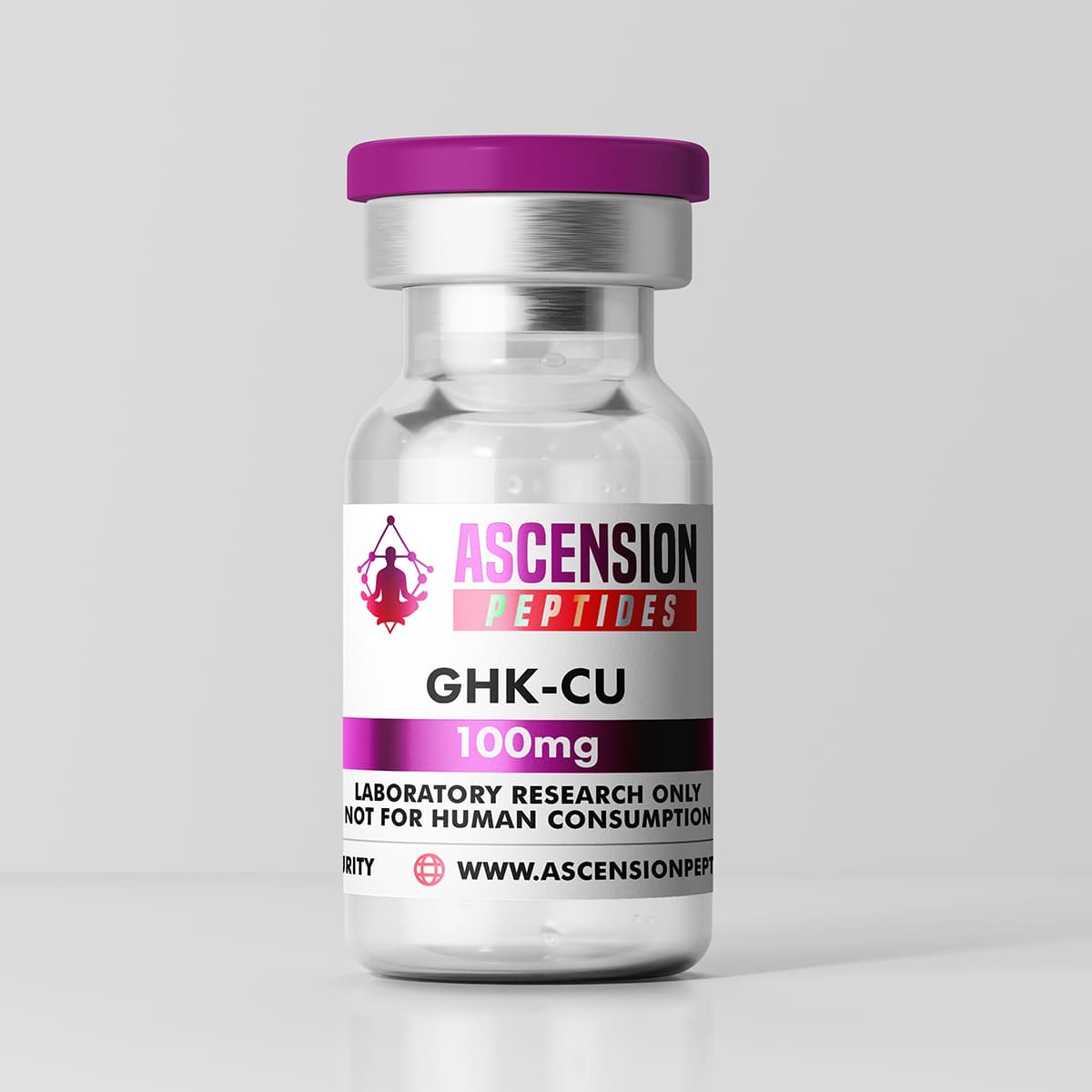
If you're comparing where to buy GHK-Cu powder, check for a batch-matched certificate of analysis before price. Our guide to where to buy GHK-Cu compares vendors. The product card on this page is Ascension's GHK-Cu 100 mg vial, which is a powder, not a finished cream. It costs $59, or $29.50 with the code PEPTIDEDECK. PeptideDeck earns a commission if you buy through that link. For a water-based serum instead of a cream, see the dilution section of our GHK-Cu for skin and hair guide.
Sources
Every study claim above links back here.
- Pickart L, Margolina A. Regenerative and protective actions of the GHK-Cu peptide in the light of the new gene data. Int J Mol Sci. 2018. PubMed 29986520 (summarizes the facial, eye-area, thigh-skin and nano-carrier trials)
- Hostynek JJ, Dreher F, Maibach HI. Human skin retention and penetration of a copper tripeptide in vitro as function of skin layer. Inflamm Res. 2010. PubMed 20703511
- Bishop JB, et al. A prospective randomized evaluator-blinded trial of two potential wound healing agents for the treatment of venous stasis ulcers. J Vasc Surg. 1992. PubMed 1495150
- Li H, et al. Microneedle-mediated delivery of copper peptide through skin. Pharm Res. 2015. PubMed 25690343
- Product prices and strengths: Neurogan Health, Skin Biology, AgelessRx and Ascension Peptides product pages, checked September 28, 2026.
Medical Disclaimer: This article is for informational purposes only and does not constitute medical advice. GHK-Cu creams are cosmetics, and the evidence for them comes mainly from small, industry-funded trials. Patch test before use, stop if irritation develops, and talk to a dermatologist about any skin condition or before combining GHK-Cu with prescription treatments.