Everyone wants the glow in the photos. You have seen the glutathione for skin posts: a drip in one arm, a brighter face three weeks later, a caption promising the same for you. The human trials tell a quieter story. Glutathione can lighten skin a little, in some people, on some parts of the body, and the form that did best in a controlled trial is not the one the clinics sell hardest.
🔑 Key Takeaways
- The form with the cleanest skin result so far is not a pill or a drip.
- Why a trial that "worked" beat placebo on only 2 of 6 spots, and why that still tells you something useful.
- What changes by week 2, week 4 and week 12, and what nobody has measured after you stop.
- The FDA notice from August 2026 that every drip-clinic customer should read.
- A five-minute photo routine that tells you whether it is working for you, not for an influencer.
If you have been fighting dark spots, uneven tone or a tan that never seems to fade, you already know how tiring it gets. You have tried the serums. You have read the reviews. And you want to know one thing before you spend another three months and another few hundred dollars: does glutathione actually do anything for skin? Here is what the studies measured, form by form, with the numbers.
What Glutathione Actually Does to Your Skin
It works on the pigment factory. Your skin color comes from melanin, made by cells called melanocytes. They build it with an enzyme called tyrosinase, and they can make two kinds: eumelanin, which is brown to black, and pheomelanin, which is red to yellow and lighter.
Glutathione nudges that process in two ways. It slows tyrosinase, and it pushes production away from the dark eumelanin toward the lighter pheomelanin. It also mops up the free radicals that sun exposure creates, which are one of the signals that tell melanocytes to make more pigment. A 2018 review in Dermatology Practical & Conceptual lists these as the main mechanisms.
That tells you what to expect. Glutathione does not bleach skin or strip out the pigment you already have. It changes how much new pigment you make and what kind. The melanin already sitting in your skin fades only as those cells shed, which is why nothing happens overnight and why your genetic base shade stays your base shade.
One catch: the same review notes that plain glutathione struggles to get inside the compartments where melanin is made. In cell studies, modified versions of the molecule blocked tyrosinase better than glutathione itself.
Brightening vs whitening: two different promises
"Brightening" usually means a more even tone: fewer dark spots, less dullness, less post-acne marks. "Whitening" or "lightening" means a shift in your overall shade. Most of the trials below measured the second one, using a device called a Mexameter that reads a melanin index from your skin. A lower number means lighter skin. Keep that in mind, because a small drop on a meter is not always something you can see in a mirror.
Glutathione for Skin Whitening: What the Human Trials Found
There are fewer studies than the marketing implies. Here are the human trials that tested glutathione on skin color, with what each one actually used and found.
What those numbers add up to
The effect is real but small. Most positive results showed up on sun-exposed skin, like the face and the outer forearm, not on skin that rarely sees daylight. That fits the mechanism: glutathione seems to blunt the pigment your skin makes in response to the sun more than it changes your base color.
Most trials also enrolled people in Asia, mostly women with medium to brown skin, ran for 4 to 12 weeks, and stopped measuring the day treatment ended. One well-run 12-week trial of 83 people found no significant difference from placebo at all. A 2025 systematic review in the International Journal of Dermatology summed it up as "moderately efficacious" for oral and topical forms, with results that are "unsustainable". On IV use, the same review was blunt: "IV glutathione is contraindicated due to lack of efficacy and side effects."
So does glutathione work for skin? Yes, modestly, for some people, mostly on sun-exposed areas, for as long as you keep taking it. That is a smaller promise than the one on the bottle. It is also a more honest one.
Glutathione Before and After: A Realistic Timeline
Photos online skip the boring middle. Here is what the trials actually saw, week by week.
Weeks 1 to 2: a meter can see it, you probably cannot
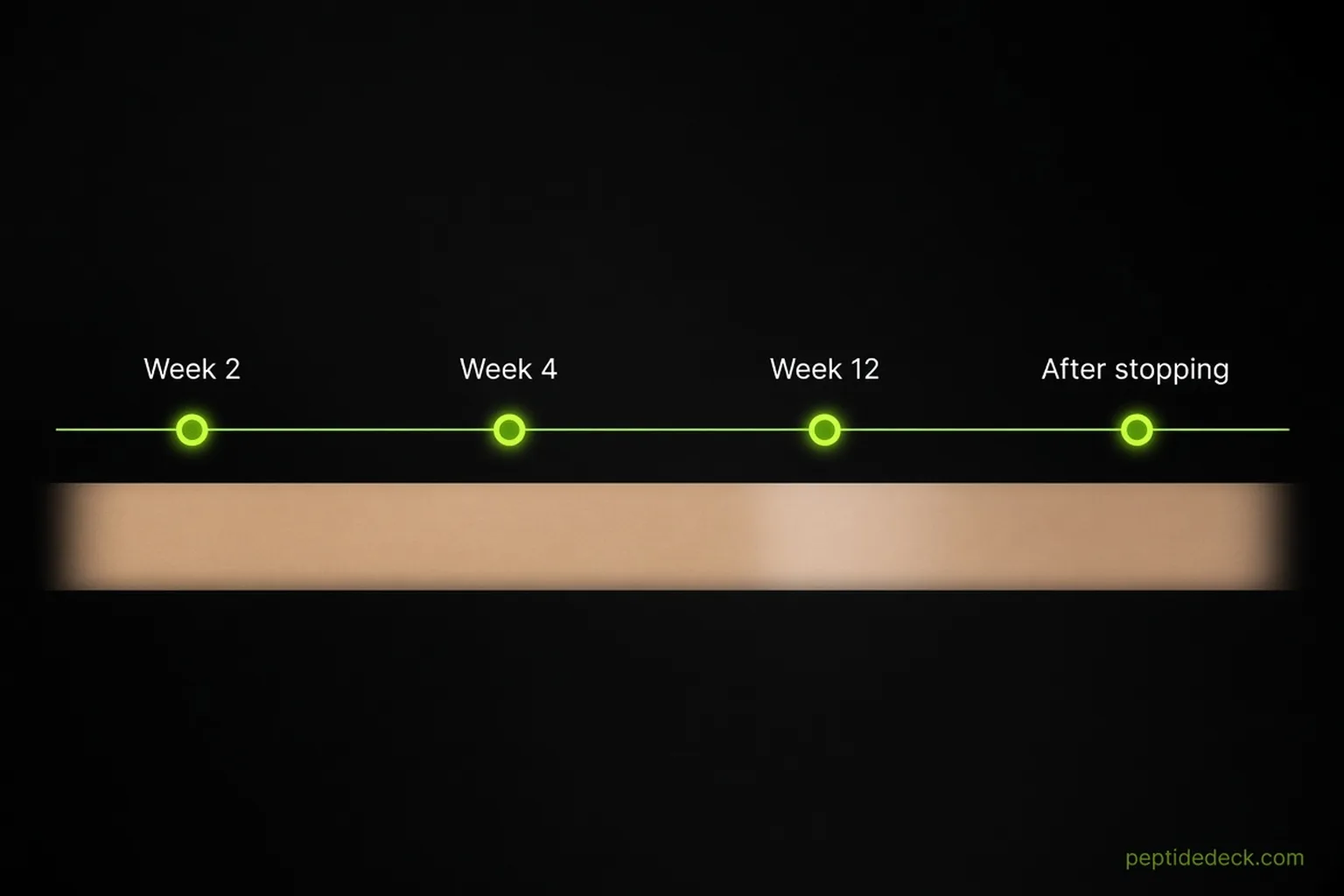
In the lozenge study of 30 Filipino women, melanin readings started dropping as early as week 2. That study had no placebo group, though, and a meter reading is far more sensitive than your eyes. Most people see nothing yet.
Week 4: the first placebo-controlled change
In the first randomized oral trial, 60 medical students took 500 mg a day or a placebo. After four weeks, melanin readings fell at all six skin sites in the glutathione group. The drop beat placebo at two of them: the right side of the face and the sun-exposed forearm.
Weeks 8 to 12: where the best results sit
This is the window the longer trials covered. A 2% glutathione lotion beat placebo from the early weeks through week 10. A cystine-plus-glutathione capsule lightened skin and shrank dark spots at 6 and 12 weeks. If you are going to see a difference in the mirror, it is most likely to show up here.
After you stop: nobody measured it
Not one trial followed people after treatment ended. Reviews describe the lightening as reversible, which makes sense: your melanocytes go back to their usual output once the glutathione is gone. Plan on it lasting only as long as you keep using it.
Why before-and-after photos mislead
A glutathione before and after on TikTok cannot separate glutathione from everything else that changed. Lighting, filters and the season all shift how skin looks, and many people start sunscreen or a hydroquinone cream in the same month. The drips themselves usually contain vitamin C, which a 2026 review in the Journal of Medicine and Life flagged as the reason no one can tell how much of an IV result comes from glutathione.
If you try it, take your own photos instead:
- Same window, same time of day, no makeup, no filter, same phone.
- Photograph your face, your outer forearm (sun-exposed) and your inner upper arm (sun-protected) side by side.
- Hold a plain white card in the frame so you can compare color fairly.
- Repeat at week 0, week 4, week 8 and week 12.
Pills vs Cream vs Soap vs Injections: Which Form Works for Skin?
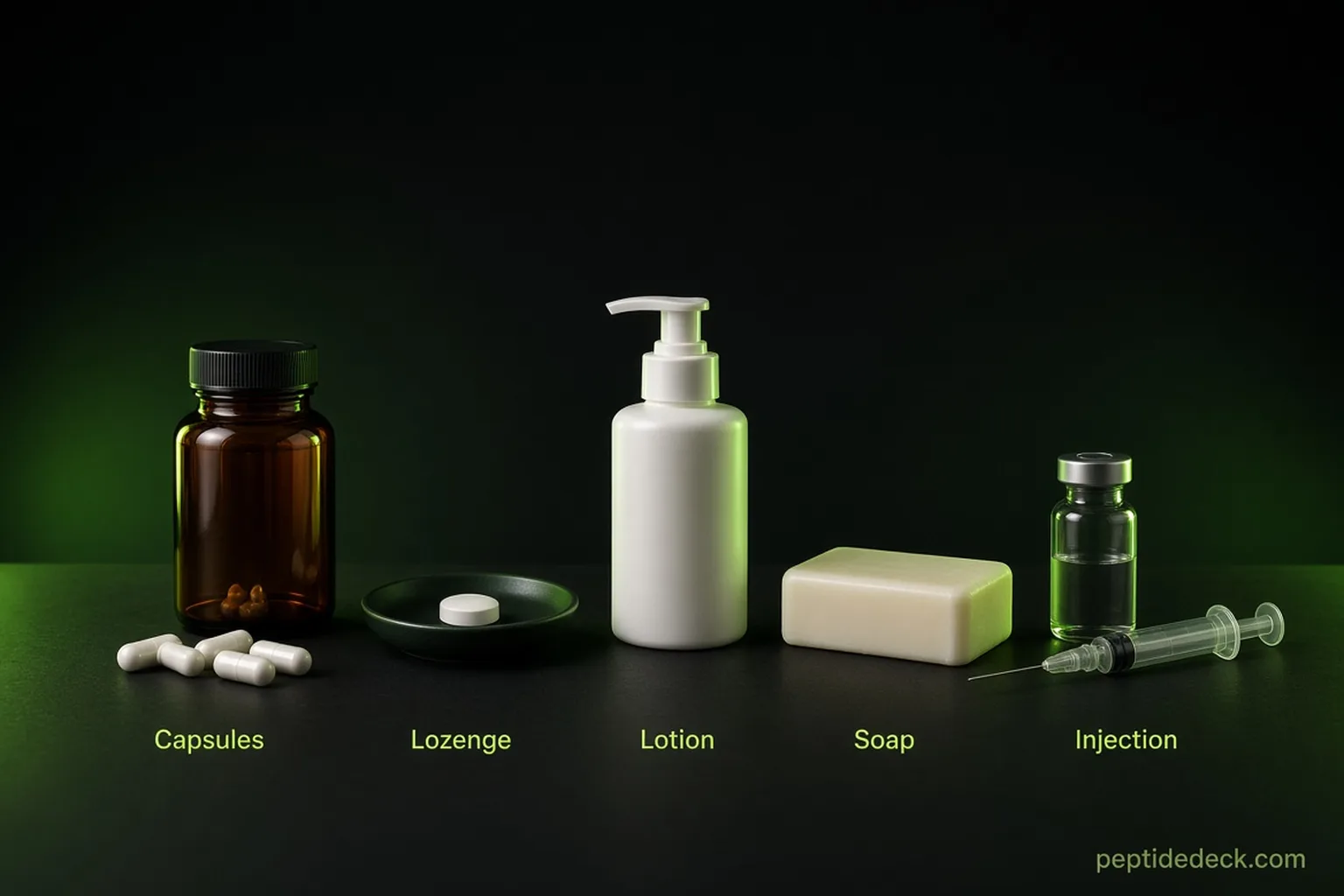
The form changes everything. Oral, topical and injected glutathione reach your skin in different ways, and the evidence for each looks very different.
Pills and lozenges
Capsules are the easiest way in, and they have the most trials. The open question is absorption: the gut breaks down much of the glutathione you swallow, which is why lozenges and liposomal versions exist. If you want the full story on what reaches your blood, our guide to liposomal glutathione covers the absorption trials in detail.
Creams and lotions
Here is the surprise. The cleanest placebo-controlled skin result came from a lotion, not a pill. In a split-face trial, 30 women put 2% oxidized glutathione on one side of the face and a placebo lotion on the other, twice a day for 10 weeks. The glutathione side came out lighter, with more moisture and fewer wrinkles. The catch is that it only works where you put it, and most glutathione creams on the shelf do not tell you their concentration.
Soap
Glutathione soap has the weakest evidence of the lot: one small case series of 15 people, judged from photos, according to a 2016 review in the South African Medical Journal. Soap sits on your skin for seconds before you rinse it off, so there is little time for anything to work.
Combining oral and topical
In the 8-week Indonesian trial, pills plus lotion beat placebo and did better than either form alone on some measures. If you try glutathione for skin at all, this pairing has the best support.
Skin Whitening Injections and Shots: What Regulators Say
This is where the risk lives. Skin whitening shots and drips are sold in med spas and clinics around the world, and almost none of that activity is backed by trial data.
The only placebo-controlled IV trial gave 1,200 mg of glutathione twice a week for six weeks. Improvement showed up in 37.5% of the glutathione group versus 18.7% on saline, a gap that did not reach statistical significance, per the 2025 systematic review above. A 2026 review of that trial also notes abnormal liver tests in eight participants and one case of anaphylaxis.
Regulators have been warning about this for over a decade:
- US FDA, 2015: a consumer update stated that the FDA has not approved any injectable drugs for skin whitening or lightening. It described a 2014 seizure of glutathione "whitening kits" sold online.
- Philippine FDA, 2019: Advisory No. 2019-182 warned of toxic effects on the liver, kidneys and nervous system, possible Stevens-Johnson syndrome, and the lack of any dosing guidelines. Injectable glutathione is approved there as an add-on in cisplatin chemotherapy, not for skin.
- US FDA, August 2026: the agency reported at least 30 patients with fever, chills, shock and sepsis-like symptoms after IV glutathione made from dietary-supplement-grade powder, some needing hospital care. Two Texas pharmacies recalled product over high endotoxin levels.
The case reports are sobering. In the UK, a woman collapsed within an hour of a high-dose glutathione infusion for skin lightening, with a fever above 41°C and acute liver injury. She recovered, but only with hospital care.
If you still want injectable glutathione
Go through a prescriber. In the US, glutathione sits on the FDA's list of bulk substances under evaluation for pharmacy compounding, so a licensed pharmacy can compound it for you with a prescription. That is the route for general antioxidant use. It does not make it an approved skin-whitening treatment, and no US drug carries that label.
Price and sourcing matter here more than anywhere else in this article. Telehealth services now sell prescription compounded glutathione from licensed US pharmacies for about $99 a month, which is often less than a single drip at a med spa. Unlabeled vials from overseas sellers are cheaper still, but they are exactly the product the August 2026 FDA notice describes. Our guide to grey market peptides explains how to check a source. For how injection therapy works beyond skin, including IV vs shots and clinic prices, see glutathione injections, and for vial math, the glutathione dosage chart.
Melasma, Dark Spots, Acne and Wrinkles
Skin tone is not the only promise. Here is how the other label claims hold up.
Melasma
Glutathione has only been tested as an add-on to procedures, not on its own. In a split-face trial of 29 women, microneedling plus glutathione improved melasma scores by 55% versus 47% for microneedling alone. A mesotherapy trial of 30 patients found adding 2% glutathione to tranexamic acid and vitamin C gave a bigger improvement than the same cocktail without it.
If melasma is your main problem, know that there is an FDA-approved cream for it. Tri-Luma combines hydroquinone, tretinoin and a steroid and is labeled for short-term treatment of moderate to severe facial melasma, alongside sunscreen. The FDA also notes there are no FDA-approved over-the-counter skin lightening products, and its labs have found high levels of mercury in some lightening creams since 2019.
Dark spots
The cystine-plus-glutathione trial of 124 Asian women found smaller facial dark spots after 6 and 12 weeks, better than placebo and better than either ingredient alone. Two of the authors work for BCF Life Sciences, which makes L-cystine. That does not cancel the result, but it is worth knowing.
Acne
There is one trial. In 40 people with mild to moderate acne, 500 mg of glutathione a day for four weeks improved 7 of 22 patients, but the result was not significantly better than placebo. Acne is not a good reason to buy glutathione.
Wrinkles and glow
Two trials hint at something. In a 12-week study of 60 women in Bangkok, 250 mg a day of reduced glutathione cut wrinkles at some sites compared with placebo, and the topical lotion also reduced wrinkle formation. These are small signals. If firmness and fine lines are your main goal, copper peptides have far more data, and our ranking of the best peptides for skin and our GHK-Cu guide are the better starting point. For a combined approach, see GLOW for skin.
Chasing the opposite effect, a deeper tan? That is a different molecule with its own risks, covered in our Melanotan 2 guide.

Glutathione Side Effects and Who Should Skip It
Oral glutathione is usually easy on you. The skin trials reported few side effects, mostly mild stomach upset. Two volunteers did leave the 12-week Thai trial because of raised liver tests, and a 2021 case report from Thailand linked glutathione whitening pills to toxic epidermal necrolysis, a severe skin reaction. That is rare, but it is a reason to stop at the first sign of a spreading rash or blisters.
Topical glutathione mainly causes mild redness or irritation. Injections carry everything listed in the section above, plus the usual risks of any IV done outside a hospital, like infection.
One risk nobody advertises: the lighter pheomelanin that glutathione favors protects you less from UV light. The 2016 South African review warned this could raise sun-related skin cancer risk. No study has shown it happening, but daily sunscreen is not optional if you use glutathione for skin.
Skip it, or talk to your doctor first, if you are pregnant or breastfeeding (there is no safety data), have kidney or liver disease, are having chemotherapy, or have reacted to glutathione before.
How to Try Glutathione for Skin Without Wasting 3 Months
Set it up like a test. That way, in 12 weeks you will know whether it is worth your money, instead of guessing from a mirror.
A 12-week glutathione skin plan based on the trials
- Pick one approach: 250 to 500 mg of reduced glutathione a day by mouth (the doses tested), a 2% glutathione lotion twice a day on the area you care about, or both.
- Give it 12 weeks. The longer trials ran 8 to 12 weeks, and most visible change landed late.
- Wear sunscreen every day. The clearest trial effects were on sun-exposed skin, and extra sun works against you.
- Take the photos at weeks 0, 4, 8 and 12 using the routine above.
- Stop right away if you get a spreading rash, blisters, or yellowing of your skin or eyes.
- Do not mix in unlabeled whitening creams. The FDA keeps finding mercury and hydroquinone in them.
Not sure which capsule to buy? Our best glutathione supplement guide compares the main products and forms. For the wider list of what glutathione does beyond skin, see glutathione benefits, or the glutathione peptide guide for dosing basics. And if you are weighing a cheaper route, NAC vs glutathione explains how the precursor compares. Glutathione drips are often sold next to NAD+; NAD+ vs glutathione covers which does what.
Frequently Asked Questions
Medical Disclaimer: This article is for informational purposes only and does not constitute medical advice. Glutathione is not approved by the US FDA for skin lightening in any form, and injectable glutathione should only be used under the care of a licensed prescriber. Talk to your doctor or a board-certified dermatologist before starting glutathione, especially if you are pregnant, breastfeeding, have kidney or liver disease, or take other medicines.