Both bottles promise you the same thing. More glutathione, the antioxidant your liver, lungs and brain lean on hardest. One hands it to you ready-made. The other hands you the one ingredient your cells run short of and lets them build it. That split is the whole NAC glutathione question, and the right answer depends on something almost no label mentions: how much glutathione you're carrying right now.
🔑 Key Takeaways
- The "NAC is well absorbed" line on most labels hides a surprising number
- Why the one trial that pitted them against each other wasn't a fair fight
- The group of people NAC did nothing for, and how to tell if you're in it
- Four weeks versus six months: the timing detail behind most "glutathione didn't work" reviews
- What NAC does that glutathione can't, including a job it does in hospital emergency rooms
- When taking both makes sense, and when it's money you don't need to spend
You already know antioxidant marketing runs ahead of the evidence. So below, each claim gets checked against the human trials behind it. By the end you'll know which one fits your situation, what dose the studies actually used, and what each costs per day.
NAC vs Glutathione: The Short Answer
It depends on your starting point. If you're likely running low on glutathione (older age, heavy drinking, a chronic illness, metabolic syndrome), NAC is the cheaper, better-studied way to refill it. If your levels are already normal, NAC may change nothing you can measure, and a well-absorbed glutathione product is the more direct way to push blood levels up.
That's the verdict most brand pages skip, because most brand pages sell one of the two. Here's how they line up.
How NAC and Glutathione Work: Precursor vs Finished Product
Glutathione is a tiny protein. It's three amino acids joined in a chain: glutamate, cysteine and glycine. Your cells build it themselves, all day, from whatever raw materials they have on hand.
Of the three, cysteine is the one that runs out first. That makes it the bottleneck. When cysteine is scarce, glutathione production slows no matter how much glutamate and glycine are around.
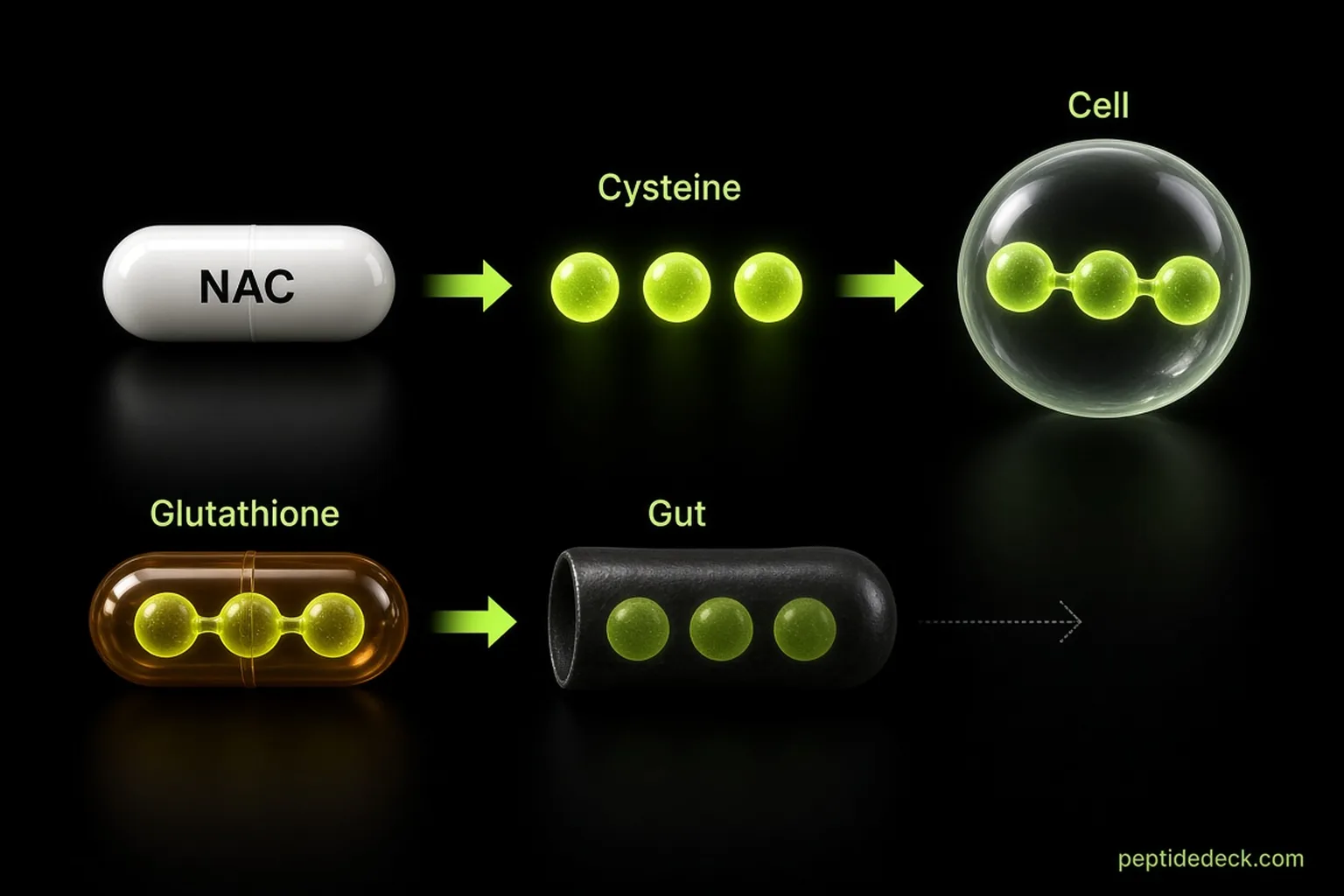
N-acetylcysteine (NAC) is a stable, swallowable form of cysteine. It doesn't contain glutathione at all. It supplies the missing part, and your cells assemble the finished molecule inside themselves, where it does its work.
A glutathione capsule takes the opposite route. It delivers the finished molecule. The catch is your gut. Enzymes in the intestine and liver cut glutathione back into its three amino acids, and a classic 1992 study found that a single 3 g dose of oral glutathione did not raise blood glutathione at all over the next four and a half hours in 7 healthy volunteers.
The absorption problem cuts both ways
Here's the part competitor pages leave out. NAC isn't "well absorbed" either, at least not intact.
In a human pharmacokinetic study, the oral availability of a 600 mg NAC dose was 6 to 10%. A second study put reduced NAC at 4.0% and total NAC at 9.1%. Most of what you swallow never reaches your bloodstream as NAC.
So why does it still work? Because it doesn't need to arrive intact. NAC passes through the liver first, gets converted to cysteine there, and the liver turns that cysteine into glutathione before releasing it. The low number describes NAC in your blood, not the glutathione your liver makes from it.
Both molecules take a beating on the way in. The real question is which one actually moves your glutathione, and the trials give a more interesting answer than "NAC wins."
Which Raises Glutathione Better? What the Human Trials Show
Only one study tested them head to head. It's worth knowing exactly what it did.
The only head-to-head trial
In 2015, French researchers ran a three-way crossover trial in 20 people with metabolic syndrome. Each person took NAC, oral glutathione and a new sublingual (under-the-tongue) glutathione, three weeks at a time.
The sublingual form won on the ratio of active to used-up glutathione (GSH/GSSG). Oral glutathione came last. NAC landed in between.
Now the fine print. The NAC arm got 200 mg a day. The two glutathione arms got 450 mg a day. That NAC dose is a third of one standard 600 mg capsule, and a sixth of the 1,200 mg a day used in most NAC trials. The study was also run with the company that makes the sublingual tablet. It tells you sublingual glutathione beat a low dose of NAC over three weeks. It doesn't tell you how a normal NAC dose compares.
NAC works when you're low
This is the study that should change how you think about NAC.
Greek researchers screened 100 men for glutathione and picked 36: twelve with low levels, twelve moderate, twelve high. Each took NAC, 600 mg twice a day, for 30 days, and placebo in a separate period.
In the low group, NAC brought glutathione back to normal and cut markers of oxidative stress. The change showed up where you'd feel it, too. Their VO2max rose 13.6%, time-trial performance 15.4% and sprint power 11.4%.
In the moderate and high groups, NAC did essentially nothing for glutathione, oxidative stress or performance.
So if you've taken NAC and felt no different, that may be the reason. Your cells only build as much glutathione as they need. Hand them extra cysteine when they're already full, and they don't overproduce.
Oral glutathione: four weeks vs six months
Plain glutathione capsules have two trials that seem to contradict each other.
In 40 healthy adults, 500 mg twice a day for 4 weeks changed nothing: not glutathione levels, not oxidative stress markers.
Then a longer 6-month placebo-controlled trial in 54 adults found the opposite. At 1,000 mg a day, glutathione rose 30 to 35% in red blood cells, plasma and lymphocytes by month six. Even 250 mg a day raised red blood cell glutathione by 29%. Levels drifted back to baseline within a month of stopping.
Read together, the message is patience. Oral glutathione seems to build body stores slowly, over months, and a one-month trial is too short to see it.
Liposomal glutathione: faster, but thinner evidence
Liposomal products wrap glutathione in fat bubbles to protect it from gut enzymes. In a 12-person pilot taking 500 or 1,000 mg a day, whole-blood glutathione peaked 40% higher after just 2 weeks, with a 25% rise in red blood cells.
That's faster than any plain capsule. The limits are real, though: 12 people, no placebo group, and funding from a liposomal glutathione maker. We break down which liposomal products are worth the premium in our liposomal glutathione guide.
The scoreboard, trial by trial
- NAC, 1,200 mg/day, 30 days: restored glutathione in people who started low; no effect in people who started normal or high
- Oral glutathione, 1,000 mg/day, 4 weeks: no change
- Oral glutathione, 250–1,000 mg/day, 6 months: up to 30–35% higher
- Liposomal glutathione, 500–1,000 mg/day, 2 weeks: up to 40% higher in whole blood (small, uncontrolled)
- Head to head, 3 weeks: sublingual glutathione beat 200 mg NAC; plain oral glutathione came last
Are you likely running low? Low blood glutathione shows up in HIV infection, heavy alcohol use and cirrhosis, and a Baylor trial found older adults had clear glutathione deficiency compared with young adults. A blood test settles it; our glutathione benefits guide covers how glutathione testing works and the symptoms that tend to go with low levels.
What NAC Does That Glutathione Can't
NAC started life as a prescription drug. That history matters.
The FDA approved NAC as a drug on September 14, 1963, and it's still on hospital shelves for two jobs. Glutathione supplements have no equivalent.
Acetaminophen (Tylenol) overdose
An acetaminophen overdose burns through the liver's glutathione, and NAC refills it fast. In a national study of 2,540 patients, oral NAC started within 8 hours of the overdose protected the liver regardless of how much acetaminophen was in the blood. The hospital regimen is a 140 mg/kg loading dose, then 70 mg/kg every 4 hours for 17 more doses. That's many grams a day, given under medical supervision, and nothing like a supplement dose.
Lungs and mucus
NAC thins mucus, which is why the FDA label lists it for emphysema, bronchitis and the lung complications of cystic fibrosis. In the PANTHEON trial, 1,006 people with moderate-to-severe COPD took 600 mg twice a day or placebo for a year. The NAC group had 1.16 flare-ups per person-year against 1.49 on placebo, a 22% cut.
Compulsive habits and cravings
NAC also calms glutamate signalling in the brain's reward circuit, a job that has little to do with glutathione. In a 12-week trial of people who compulsively pull their hair, 56% were much or very much improved on NAC versus 16% on placebo, at 1,200 to 2,400 mg a day. In cannabis-dependent teens, 1,200 mg twice a day more than doubled the odds of a clean urine test.
If any of these three is your reason for looking, the comparison is over. Glutathione has not been tested for any of them.
Where Glutathione Has the Edge
Glutathione skips the assembly line. That's its advantage.
NAC only works if your cells can still turn cysteine into glutathione, and the authors of the head-to-head trial point out that this ability tends to fade with age and illness. A glutathione product that survives the gut delivers the finished molecule regardless.
There's also some direct evidence in the liver. In a small Japanese pilot of 29 people with fatty liver disease, 300 mg of oral glutathione a day for 4 months lowered the liver enzyme ALT, along with triglycerides. It had no placebo group, so treat it as a promising signal rather than proof. The full evidence for each claimed benefit, ranked by strength, is in our glutathione benefits breakdown.
Skin brightening is the other big reason people choose glutathione over NAC. Whether it works, how long it takes and the safety questions around it are covered separately in glutathione for skin.
And if you want the highest levels, pills aren't the ceiling. Injected glutathione bypasses the gut entirely, though a pilot in Parkinson's disease found 1,400 mg IV three times a week no better than placebo on symptoms over 4 weeks. Higher blood levels don't automatically mean a bigger result. Our glutathione injections guide covers the prescription route, and the NAD+ vs glutathione comparison helps if you're choosing between IV drips.
NAC and Glutathione Dosage Side by Side
Start with the doses the trials used. That's where the results came from.
NAC:
- Everyday supplement dose: 600 mg once or twice a day
- Most trials: 1,200 mg a day, split as 600 mg twice a day (the glutathione-restoring trial and PANTHEON both used this)
- Compulsive-behaviour trials: 1,200 to 2,400 mg a day, under medical supervision
- Why split it: NAC has an elimination half-life of about 2.3 hours, so a morning and evening dose keeps supply steadier than one big dose
Glutathione:
- Plain oral: 250 to 1,000 mg a day, taken for months rather than weeks
- Liposomal: 500 to 1,000 mg a day; the pilot saw no clear difference between the two doses
- Fatty liver pilot: 300 mg a day for 4 months
- Injections: dosed by a prescriber; see the glutathione dosage chart for typical injection schedules
More isn't obviously better with either one. NAC doesn't push glutathione above normal in people who are already there, and the liposomal pilot saw no clear edge for 1,000 mg over 500 mg.
Cost Per Day: NAC vs Glutathione
The price gap is bigger than most people expect.
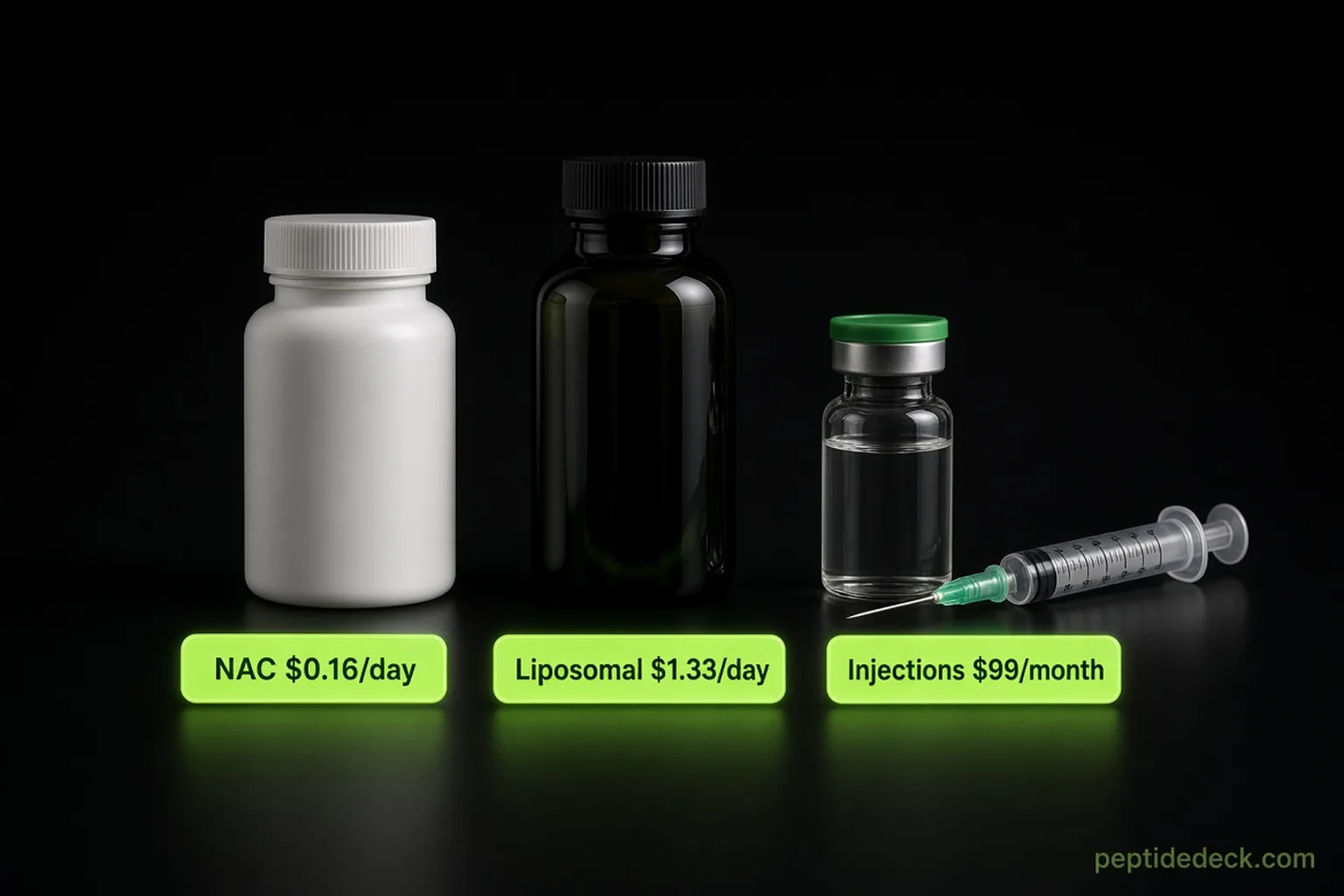
In a September 2026 check of US retail listings, a 100-count bottle of 600 mg NAC started around $8. That's about 8 cents a capsule, or roughly $0.16 a day at the 1,200 mg trial dose. A popular 500 mg liposomal glutathione ran $39.99 for 30 servings, or about $1.33 a day. Prescription glutathione injections through a telehealth service start around $99 a month.
Brands vary a lot, so check the milligrams per serving before you compare labels. Our best glutathione supplement rankings compare forms and brands if you've settled on glutathione.
One oddity on the NAC side. Because NAC was a drug before it was a supplement, the FDA says it technically doesn't qualify as a dietary supplement. In final guidance issued August 1, 2022, the agency said it would not act against NAC supplements, noting that its initial review had not revealed safety concerns and that they have been sold in the US for over 30 years. That's why you can still buy it on any pharmacy shelf.
Taking NAC and Glutathione Together

Plenty of people do. The logic holds up.
NAC feeds the glutathione your cells make inside themselves. A liposomal or long-term oral glutathione raises what's circulating in your blood. They work on different ends of the same problem, and nothing in the published trials suggests they interfere with each other.
The honest catch: no trial has tested NAC plus glutathione as a pair. You'd be combining two reasonable ideas, not following a proven protocol. For most people the added cost is hard to justify when NAC alone refills low levels for 16 cents a day.
Taking both makes the most sense if you're likely low and want a quick bump in blood levels while NAC does the slower work, or if you're already paying for glutathione for your skin and want cheap support underneath it.
There's a better-studied pairing, though. NAC combined with glycine, known as GlyNAC, was tested in a 16-week placebo-controlled trial in older adults and corrected their glutathione deficiency along with oxidative stress, inflammation and physical function. Glycine is the other ingredient that can run short with age. The doses and the full trial are in our GlyNAC guide.
Side Effects and Who Should Skip Each
Both are mild for most people. NAC has more fine print.
NAC
- Stomach: the FDA label lists nausea, vomiting and mouth sores; taking it with food is the usual fix
- Smell: NAC contains sulfur, and many capsules smell faintly of rotten eggs; it's harmless
- Asthma: the label warns of bronchospasm, mainly with the inhaled form; if you have asthma, ask your doctor first
- Nitroglycerin: in a heart trial, IV NAC plus nitroglycerin caused symptomatic low blood pressure in 7 of 24 patients versus none on nitroglycerin alone; don't combine them without medical advice
Glutathione
- Oral and liposomal: the liposomal pilot reported no serious side effects, and none of the minor complaints were attributed to the supplement
- IV: in the Parkinson's pilot, side effects were similar to placebo
- The gap: the oral trials are small and short, so long-term safety data is thinner than NAC's
If you're pregnant, breastfeeding or on prescription medication, check with your doctor before starting either one.
Which Should You Choose?
Match the product to your situation, not the marketing.
Choose NAC if you're older, drink heavily, have a chronic condition or metabolic syndrome, or want the cheapest option with the most human data. It's also the only choice if your goal is lung mucus, cravings or compulsive habits.
Choose liposomal glutathione if NAC upsets your stomach, you want a measurable rise in blood glutathione within weeks, or your levels are already normal and NAC hasn't done anything for you.
Choose plain oral glutathione if you're willing to take it daily for months. The 6-month trial says it works; the 4-week trial says don't judge it early.
Consider injections if you want the highest delivery and are happy to go through a prescriber.
One limitation hangs over all of this. There's still no large, fair head-to-head trial of a standard NAC dose against a well-absorbed glutathione. You're choosing on indirect evidence. But the indirect evidence points the same way from several angles, and at 16 cents a day, a 30-day NAC trial is a cheap way to find out which group you're in. For more options built around recovery and ageing, see our guide to the best anti-aging peptides.
Frequently Asked Questions
Medical Disclaimer: This article is for informational purposes only and does not constitute medical advice. NAC is also a prescription drug in higher doses and can interact with medications such as nitroglycerin. Glutathione injections require a prescription. Talk to your doctor before starting NAC, glutathione or any supplement, especially if you are pregnant, have asthma, liver or heart disease, or take prescription medication.