Two cheap amino acids. One very expensive question. N-acetyl cysteine and glycine, sold together as GlyNAC, are the two raw materials your cells use to build glutathione, and a small Baylor trial found that taking both helped older adults walk faster and grip harder in 16 weeks. The catch is the dose. The amount that worked is far bigger than what most GlyNAC capsules contain, and not everyone in these trials responded.
🔑 Key Takeaways
- Why older bodies often run short on the ingredients for glutathione, not on glutathione itself.
- The dose that worked can be ten times or more what one GlyNAC capsule serving gives you.
- One independent trial of 114 people found no average change, and the small group that did respond had something in common.
- What happened to walking speed 12 weeks after people stopped.
- The heart medicine that nearly doubled headaches when combined with NAC.
- How to take the trial dose for about fifty cents a day.
If you're past 60, you've probably noticed it. Stairs feel steeper, a jar lid takes two tries, and getting up from a low chair needs a push from your hands. Most people chalk that up to age and move on. The GlyNAC trials asked a narrower question: how much of that slowdown traces back to a shortage of two amino acids you can buy by the kilogram?
What Is GlyNAC? N-Acetyl Cysteine and Glycine Explained
Glutathione is built from three parts. Glutamate, cysteine and glycine get joined in two steps inside your cells, and the finished molecule mops up the reactive oxygen your mitochondria throw off as they make energy. If you want the full background, our glutathione guide covers the molecule itself.
Glutamate is almost never the problem. Cysteine and glycine are. NAC (N-acetyl cysteine) is a stable form of cysteine that your body converts back, and glycine is sold as a plain, faintly sweet powder. Put them together and you have GlyNAC, which is simply a name for taking N-acetyl cysteine glycine together in one routine.
Why would an older adult run short? A 2011 Baylor study measured it directly. Compared with younger adults, eight older adults had red-blood-cell glycine of 218 µmol/L versus 487, lower cysteine, and roughly half the glutathione (1.12 vs 2.08 mmol/L). Their cells were making glutathione at about a third of the young rate. After just two weeks of cysteine and glycine, glutathione rose 94.6% and oxidative-stress markers fell to levels no different from the young group.
That finding is the whole logic of GlyNAC. You aren't swallowing glutathione and hoping it survives your gut. You're restocking the two parts your cells are missing and letting them build their own. For how that stacks up against taking glutathione directly, see the evidence-backed glutathione benefits page.
What the Baylor Aging Trials Showed
It started with eight people. Rajagopal Sekhar's group at Baylor College of Medicine then ran a longer pilot and, later, a placebo-controlled trial. Each step answered a question the last one left open.
The 2021 pilot: 24 weeks, then 12 weeks off
Eight older adults took GlyNAC for 24 weeks, then stopped for 12. The pilot, published in Clinical and Translational Medicine, reported corrected glutathione, lower oxidative stress, better mitochondrial fuel burning, and improvements in inflammation, insulin resistance, cognition tests, strength and waist size.
The walking numbers are what most people remember. Average gait speed went from 1.0 m/s at the start to 1.3 m/s at 12 weeks and 1.5 m/s at 24 weeks. The six-minute walk rose from 546 to 603 meters. Scores on a standard memory and thinking screen (the MoCA) went from 26.0 to 28.8 out of 30. Nobody dropped out, and participants reported no stomach or other side effects.
Then they stopped. After 12 weeks off, gait speed had slipped back to 1.2 m/s, the walk distance to 562 meters and the MoCA to 27.5. That single result tells you GlyNAC works more like a diet than a course of antibiotics. The benefit lasts as long as the supply does.
The placebo-controlled trial: 16 weeks
An open-label pilot can't rule out the placebo effect. So the follow-up trial (Journals of Gerontology, 2023; NCT01870193) randomized 24 adults aged 61 to 80, all with a BMI over 27, to GlyNAC or an alanine placebo for 16 weeks. Twelve young adults also took GlyNAC for two weeks as a comparison group.
Here is what changed in the older adults, with the placebo group beside them:
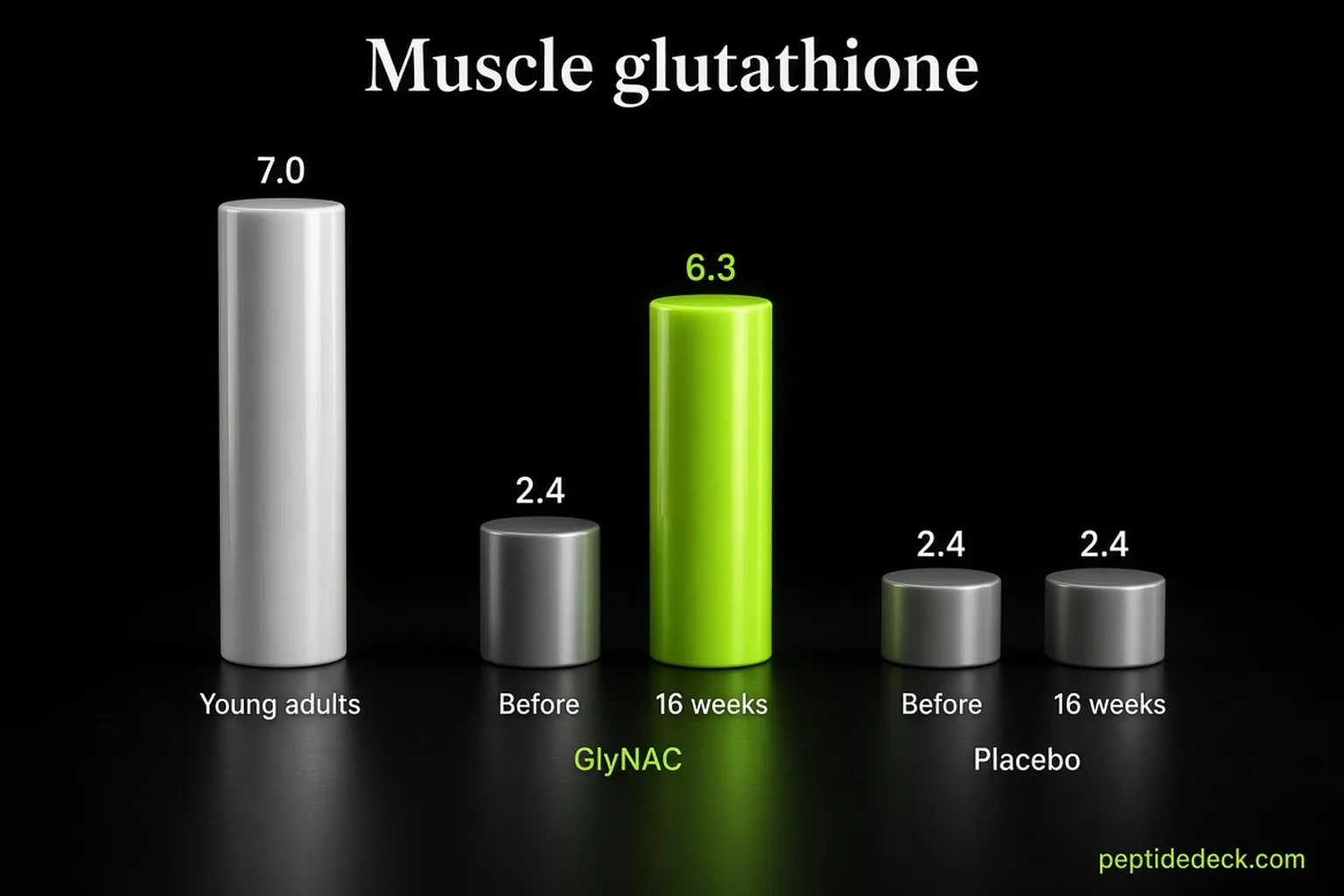
Liver and kidney blood tests, checked five times during the trial, did not rise, and no participant reported a side effect from either capsule. The authors also reported gains in 7 of the "hallmarks of aging" they measured, from mitophagy to DNA damage.
Picture what those numbers feel like. A 19% jump in walking speed is the difference between being passed on the sidewalk and keeping pace. Four extra kilos of grip is the jar lid that opens on the first try.
Other groups Baylor tested
- People with HIV: eight adults took GlyNAC for 12 weeks and improved on the same list of markers, and the gains receded when they were re-tested 8 weeks after stopping.
- Type 2 diabetes: in 10 adults, 14 days of GlyNAC raised fasting fat burning by 30% and cut insulin resistance by 22%.
- Lifespan, in animals: animals given GlyNAC lived 24% longer than controls. Nobody has shown that in people, and it's the claim most supplement labels lean on hardest.
The Limits Nobody Puts on the Label
Now the part the product pages skip. Every positive human GlyNAC trial above came from one lab, and the biggest one had 12 people taking the real thing. That's not a reason to dismiss it. It is a reason to hold it more loosely than the marketing does.
The trial that found nothing on average
Nestlé ran its own randomized trial in 114 healthy older volunteers (average age 65), testing 2.4, 4.8 or 7.2 grams a day of glycine and NAC in a 1:1 ratio for two weeks. It was safe and well tolerated. It did not raise total glutathione or improve the glutathione ratio on average, which was the main goal.
Buried in the analysis was a clue. People who started with high oxidative stress and low glutathione, and took the 4.8 or 7.2 gram doses, did make more glutathione. Everyone else stayed flat.
Two caveats cut both ways. Nestlé markets glycine-and-NAC products and holds patents on them, so it had every reason to want a positive result, and still reported a null one. And its top dose, 3.6 grams of each, is about half what a 70 kg person took in the Baylor trial, over a much shorter window.
Young, healthy people didn't improve
The Baylor trial gave GlyNAC to 12 young adults as well. They showed no improvements. That fits the Nestlé clue: GlyNAC seems to top up a shortage, and if you don't have one, there's nothing to top up.
Who the evidence actually covers: adults over 60, carrying extra weight, with measurably low glutathione and no diabetes, active cancer or liver and kidney problems. If that's you, the trials describe you well. If you're 35 and healthy, they describe someone else.
What's still missing
No human trial has compared GlyNAC against NAC alone or glycine alone, so nobody can say how much each part contributes. A Baylor trial in Alzheimer's disease (52 people) is scheduled to finish at the end of 2027. Vanderbilt is recruiting 148 knee-replacement patients for a GlyNAC trial on post-surgery pain, which would be the largest GlyNAC trial yet and the first big one run outside Baylor and Nestlé.
How Much N-Acetyl Cysteine and Glycine the Trials Used
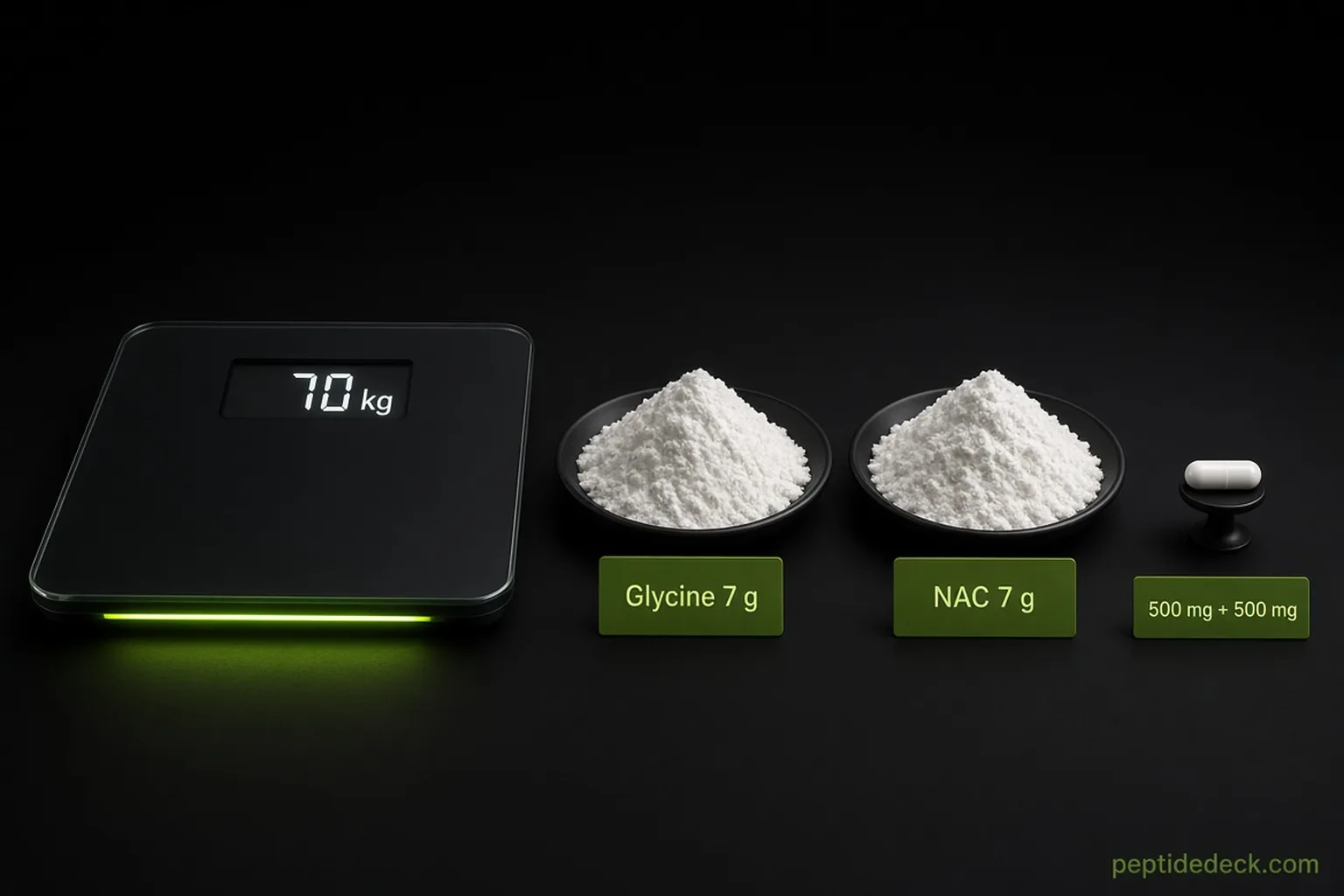
This is where most people go wrong. The Baylor trial dosed by body weight: 100 mg of glycine and 100 mg of NAC per kilogram, every day. The 2021 pilot used almost the same amounts, written in millimoles (about 100 mg/kg glycine and 132 mg/kg NAC).
Here is what 100 mg/kg of each works out to:
The older adults in the Baylor trial averaged about 89.5 kg, so most of them were taking roughly 9 grams of each amino acid a day. That's a heaped spoonful of each powder, not a pill.
The dose gap in GlyNAC capsules
Now look at a typical bottle. Many combined GlyNAC products list "1,000 mg" per serving, split evenly, which is 500 mg of glycine and 500 mg of NAC. For a 70 kg adult, the trial dose is 14 times that. Even the Nestlé trial's middle dose, which only worked in people with low glutathione, was 2.4 grams of each.
So if you've tried a GlyNAC capsule and felt nothing, the likeliest explanation is not that GlyNAC failed. It's that you took a small fraction of what the trials tested. Our glutathione dosage chart puts these numbers next to oral, liposomal and injected glutathione doses.
Do you need the full trial dose? Nobody knows the minimum that works. The trial dose is the only amount with placebo-controlled results in older adults. Many people start lower, around 2 to 3 grams of each, and build up over a few weeks as their stomach allows.
How to Take NAC and Glycine
The practical side is simple. The details decide whether you stick with it.
- Split it in two. Vanderbilt's knee-surgery trial gives the same 100 mg/kg of each in two divided doses a day. Half in the morning, half in the evening is easier on your stomach than one large dose.
- Powder beats capsules at this dose. Twelve or more capsules of each, every day, is where most people give up. Glycine dissolves easily and tastes lightly sweet, which masks some of NAC's sulfur smell.
- Take it with food if your stomach is sensitive. Loose stools and mild nausea are the usual complaints with NAC at higher doses. Dropping back and climbing slowly usually fixes it.
- Glycine at night can help sleep. In one small trial, 3 grams of glycine before bed reduced next-day fatigue after short sleep. The study was funded by a glycine maker, so treat it as a bonus, not a reason.
- Plan for months, not weeks. Blood glutathione moved within two weeks in the Baylor trial, but the strength and walking changes were measured at 16 to 24 weeks, and they faded after stopping.
If you already track your energy or recovery, GlyNAC sits naturally beside other mitochondrial approaches. Our roundup of the best peptides for energy and mitochondrial health covers options like MOTS-c that work on the same fuel-burning machinery from a different angle.
What GlyNAC Costs
This is the rare longevity supplement that is cheap. At September 2026 list prices from one large US bulk-powder seller, a 1 kg bag of NAC powder was $40.97 and a 1 kg bag of glycine powder was $34.97. That works out to about 4 cents a gram for NAC and 3.5 cents a gram for glycine.
For a 70 kg adult taking 7 grams of each daily, that is about $0.53 a day, or roughly $16 a month. One kilogram of each lasts about four and a half months. Capsules and premixed GlyNAC blends cost more per gram because you're paying for the filling and the brand, and at trial doses that difference adds up fast.
Premixed GlyNAC does have one real advantage: the ratio is fixed and you don't need a scale. If you go with powders, a cheap digital kitchen scale that reads to 0.1 gram solves that. The scoops packed in bulk bags are too rough to trust at these amounts.

Side Effects and Who Should Skip It
The safety record is quiet. Across the Baylor pilot and placebo-controlled trial, nobody withdrew because of GlyNAC, and liver and kidney markers stayed flat. The Nestlé trial also found it safe and well tolerated at up to 7.2 grams a day.
That doesn't mean it suits everyone. Check with your doctor first if any of these apply:
- You take nitroglycerin or other nitrates. In a 200-patient angina trial, adding oral NAC to a nitroglycerin patch brought side effects in 35% of patients, mostly intolerable headaches, almost twice as often as nitroglycerin alone.
- You have kidney or liver disease. The Baylor trial excluded anyone with raised liver enzymes or high creatinine, so there are no data for you, and gram-level amino acid doses add work for both organs.
- You're pregnant or breastfeeding. There are no GlyNAC safety data for either.
- You're in cancer treatment. Whether antioxidants interfere with some treatments is an open question your oncologist should answer.
- You take psychiatric medication. Glycine acts on brain receptors, so large doses are worth clearing with the prescriber.
GlyNAC vs NAC Alone vs Glutathione
You have four ways to raise glutathione. They are not interchangeable.
The logic for adding glycine is the 2011 finding that older adults ran short on both building blocks, glycine even more steeply than cysteine. If you only restock cysteine, glycine can become the next bottleneck. We break the single-ingredient choice down in NAC vs glutathione.
If the grams-a-day routine sounds like too much, the ready-made molecule is the other path. Liposomal glutathione is the most common oral form, and glutathione injections are available by prescription through US telehealth clinics that include a provider consult. For a brand-by-brand look at oral products, see our best glutathione supplement comparison, and if you're weighing a different energy molecule entirely, NAD+ vs glutathione lays out how the two differ.
Frequently Asked Questions
Medical Disclaimer: This article is for informational purposes only and does not constitute medical advice. GlyNAC doses in the trials described here were given under medical supervision with regular blood tests. Talk to your doctor before starting glycine, NAC or any glutathione product, especially if you take nitrates or other prescription medicines, have kidney or liver disease, or are pregnant or breastfeeding.