Most glutathione shots are sold on a feeling. You have seen the menu: a $30 "gluta shot," a $150 drip, a $99-a-month home kit. You have also heard that capsules barely survive your gut, which is the whole reason injectable glutathione exists. What almost nobody selling it tells you is what happens in the 14 minutes after it reaches your blood, which benefits were actually tested with a needle, and why three Texas pharmacies pulled their glutathione vials this summer.
🔑 Key Takeaways
- Why a 1,400 mg IV dose could not beat placebo in the trial clinics love to quote, and where injected glutathione did work
- The 14-minute problem, and what "how long does a glutathione shot last" really means
- IV drip, IM shot or home subQ: which route fits which goal
- The price-per-gram gap between a drip bar and a pharmacy vial (it is bigger than you think)
- The question every clinic should be able to answer after the 2026 recalls (most never get asked it)
Short version before the detail: injected glutathione is real medicine in a few narrow hospital settings and mostly a wellness purchase everywhere else. Knowing which is which saves you money, and it can save you a trip to the emergency room.
What Injectable Glutathione Does After the Needle
It leaves your blood fast. Very fast.
Glutathione is a small peptide built from three amino acids (glutamate, cysteine and glycine) that nearly every cell in your body makes for itself. It is your main in-house antioxidant, and our glutathione overview covers the chemistry. If you have ever taken plain capsules for a month and felt nothing, you already know the problem: much of an oral dose gets broken down before it counts. A needle skips the gut.
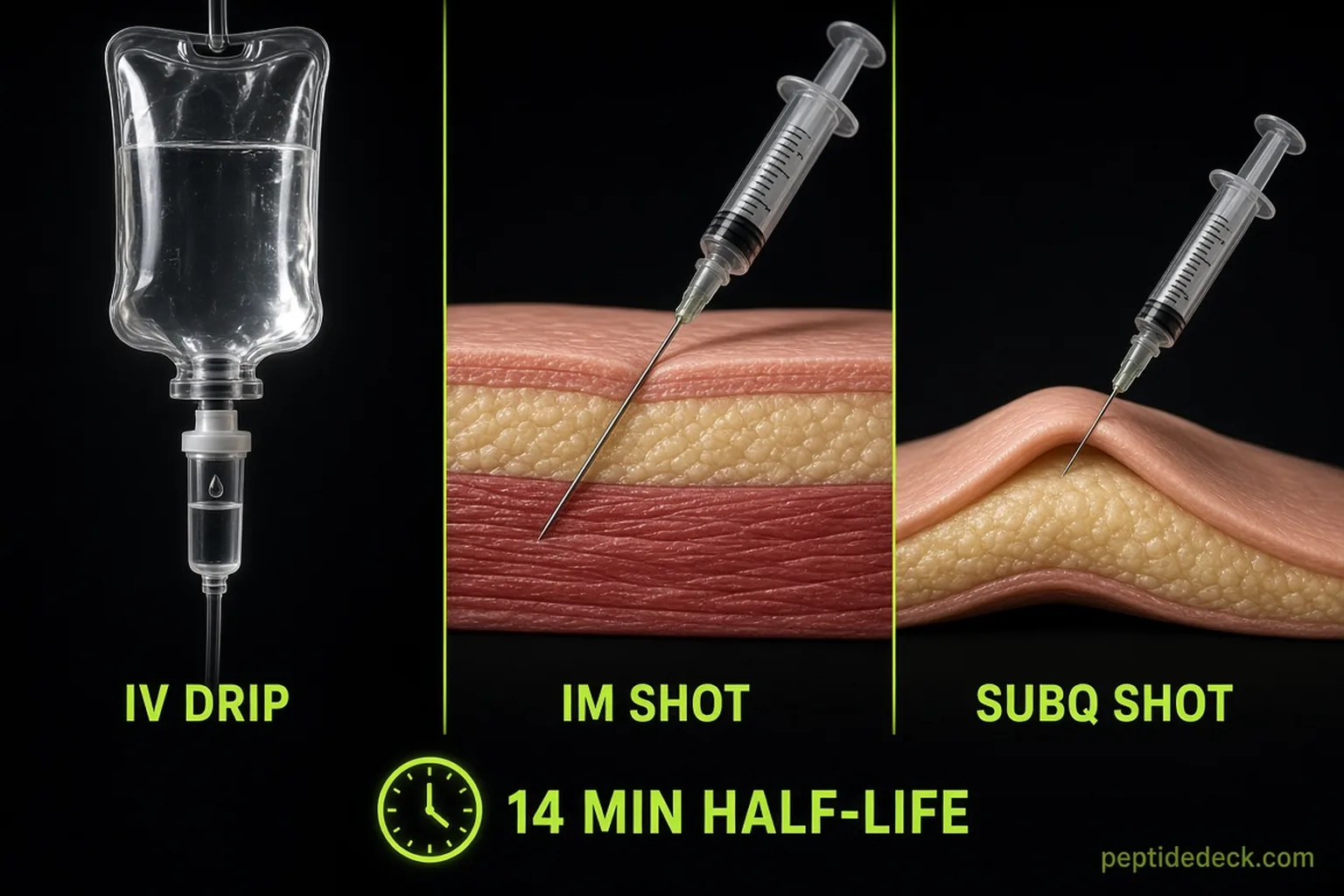
So what happens next? The clearest answer comes from a 1991 study that gave 10 healthy volunteers a large IV dose (2 g per square meter of body surface, several grams for an average adult). Blood glutathione jumped from 17.5 to 823 µmol/L. Then it fell with a half-life of 14.1 minutes. Within about an hour, most of the injected dose was out of the bloodstream.
That sounds like a waste. It is not quite.
Most cells cannot pull glutathione in whole. An enzyme on the cell surface splits it, and the cell takes in the pieces, including cysteine, the building block that limits how much glutathione you can make. In the same study, blood cysteine rose from 8.9 to 114 µmol/L. In practice, a glutathione shot works partly as a cysteine delivery, which is why N-acetylcysteine keeps showing up in the same conversations (our NAC vs glutathione comparison runs that head-to-head).
What this means for "how long does it last": the glutathione itself is gone from your blood within the hour. Anything you notice later comes from what your cells did with the building blocks, not from a level that stays up. That is also why there is no "catch-up" dose if you miss one.
IV, IM and subQ: the three ways in
- IV drip or IV push. A drip dilutes the dose in a saline bag and runs it in over 15 to 60 minutes; a push goes straight into a vein from a syringe over a few minutes. Highest peak, clinic only.
- Intramuscular (IM) shot. Usually 400 to 800 mg into the shoulder or glute at a drip bar or clinic. At the standard 200 mg/mL strength that is 2 to 4 mL, more than an insulin syringe holds.
- Subcutaneous (subQ) shot at home. An insulin syringe into the fat under the skin. A full U-100 syringe at 200 mg/mL holds 200 mg, which caps the dose per shot.
One thing all three routes share: glutathione solution is acidic. In one trial the plain solution measured pH 3.0, closer to orange juice than to your blood. That is why a glutathione shot stings more than most injections, and why pharmacy vials are usually pH-adjusted. Whether IM or subQ feels better for you is a personal call; our subQ vs IM guide explains the practical difference.
No trial has compared these routes head-to-head for any outcome. The placebo-controlled data you are about to see used IV, plus IM in one cancer trial. Home subQ is the least-studied route of the three.
Glutathione Injection Benefits: What the Trials Actually Found
Ignore the clinic menu for a minute.
Detox, glow, immunity, energy, anti-aging: those are the claims you will be sold. Below is what happened when researchers actually put glutathione into a vein or muscle and compared it with placebo or a clear baseline. It is a shorter list than the menu.
The brain trial clinics love to quote
If you or someone you love is living with Parkinson's, you have probably heard that glutathione drips help. The story starts with a 1996 Italian study: nine people with early, untreated Parkinson's got 600 mg IV twice a day for 30 days, and their disability scores fell by 42%. There was no placebo group.
When a Florida team finally ran the placebo-controlled version in 2009, 21 people got 1,400 mg IV or saline three times a week for four weeks. The glutathione group improved by 2.8 points more on the standard rating scale, a gap that was not statistically significant (p = 0.32). In the eight weeks after stopping, they worsened by 3.5 points more than placebo. The honest read: it was well tolerated, and it has not been shown to work.
Where it clearly worked: protecting nerves during chemo
This is the strongest result injected glutathione has. In a 1995 trial of 50 people on cisplatin chemotherapy for stomach cancer, glutathione was given IV right before each cisplatin dose, then 600 mg IM on days 2 to 5. By week 15, nerve damage showed up in 4 of 24 people on glutathione versus 16 of 18 on placebo. Tumor response did not suffer (76% vs 52%).
Notice where this lives: an oncology ward, with the dose timed to a specific drug. It is not evidence for a monthly wellness drip.
Walking further with poor leg circulation
People with peripheral artery disease often have to stop walking because their calves cramp. In a 40-person placebo-controlled trial, twice-daily glutathione infusions for five days pushed pain-free walking distance from 143 to 196 meters, while the saline group did not change. Small, short and one trial, but real.
Energy, detox, immunity and glow: the honest gap
Here is the uncomfortable part. The claims most people buy glutathione injections for have the least injected-route data behind them.
- The fatty-liver study you will see cited on clinic pages used oral glutathione, 300 mg a day, in 34 people with no placebo group.
- The widely shared "longer life" and "better strength" findings come from GlyNAC (glycine plus NAC) in older adults and studies in animals, not glutathione shots. Our GlyNAC guide covers that data.
- The best human data on raising body stores is for oral forms, especially liposomal glutathione.
So if you feel sharper after a drip, what is going on? Possibly the fluids, the B vitamins and vitamin C that often share the bag, or simply expecting to feel better. Possibly the glutathione. Nobody has run the trial that separates them. For the full list of benefits across every form, including food and oral supplements, see our glutathione benefits breakdown.
Glutathione IV Therapy vs Shots: Which Route Fits Your Goal
Pick the route by the goal.
If you want to copy what the trials did, glutathione IV therapy is the only route with placebo-controlled human data, and a clinic has someone on hand if you react. If you want regular dosing without driving to a clinic twice a week, home shots through a prescriber are the practical choice. If price is your main worry, a pharmacy vial wins by a wide margin, as the next section shows.
How often? The trials above ran IV glutathione two or three times a week for four weeks, or twice a day for short courses. Drip bars sell weekly visits or shot packages (one sells 10 shots for the price of 8). Home protocols usually land on 200 mg two or three times a week. We keep the exact doses, syringe units and weekly schedule on one page, the glutathione dosage chart, and the peptide calculator turns any vial and water volume into units to draw.
How long before you notice anything
- During or right after the dose: the sting, sometimes a sulfur or metallic taste, occasionally flushing. None of that is the benefit.
- Weeks 2 to 6: when people report brighter skin or more energy online. The Parkinson's trial ran a full four weeks at 1,400 mg a dose and still found no significant difference.
- After you stop: in the open-label Parkinson's study, the improvement held for 2 to 4 months before fading. In skin use, reviews agree any lightening fades once dosing stops.
If you have given it 8 to 12 weeks at a steady dose and noticed nothing, more milligrams is a guess, not a plan.
Glutathione Injection Cost in 2026
The glutathione is cheap. The chair is not.
Clinic IV drips typically run $150 to $400 a session. One Southern California drip bar lists a 400 mg IM shot at $30, an 800 mg shot at $60, and a 1,500 to 2,000 mg IV push at $85 to $99. Telehealth companies such as Embody and Heally sell prescribed home kits at a flat $99 a month, visit and shipping included. With a prescription, a 30 mL pharmacy vial at 200 mg/mL (6,000 mg) lists at about $93 with a SingleCare discount card. Here is what that means per gram.
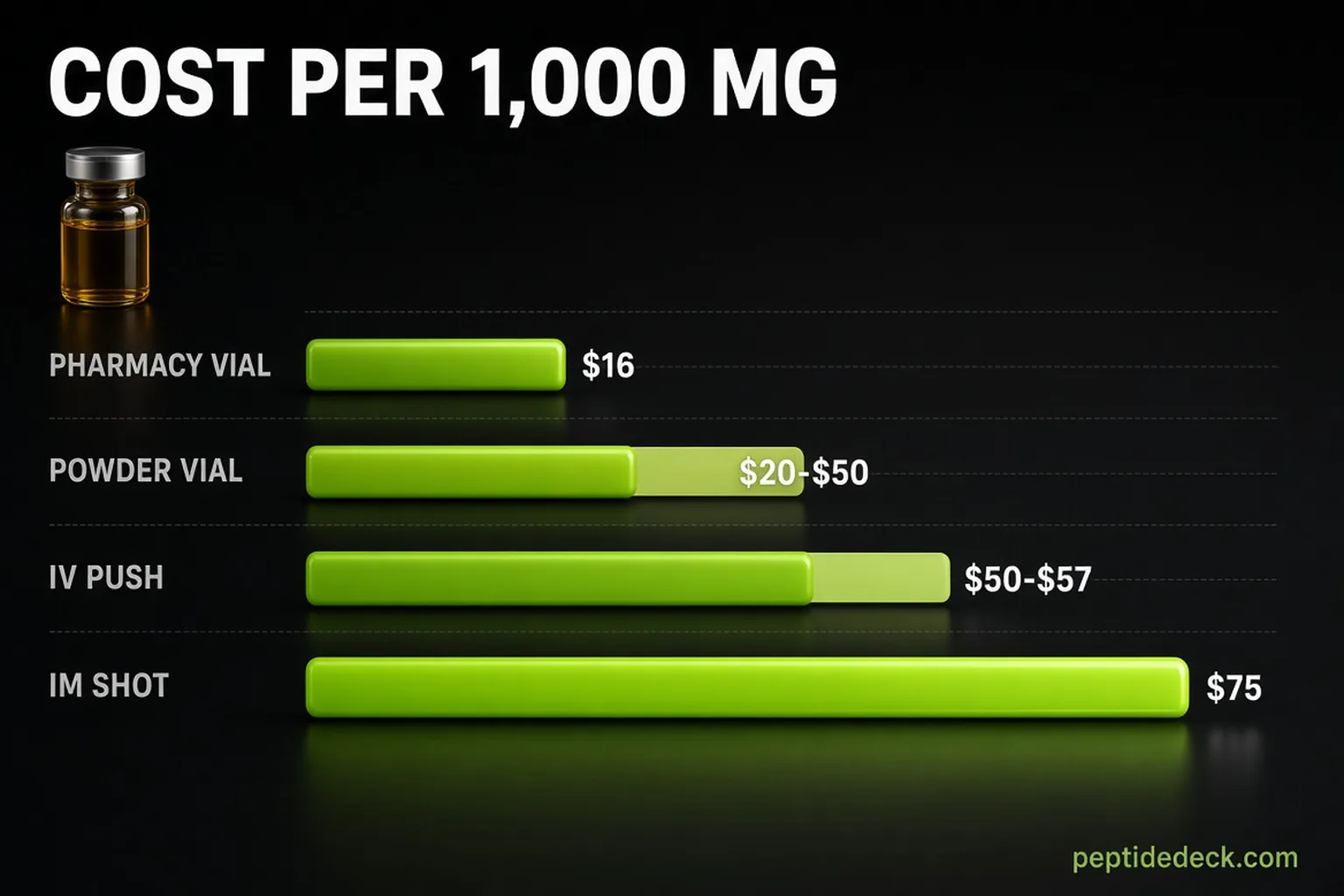
Two things stand out. First, the "5,000 mg glutathione injection" people ask about costs very different amounts depending on where you get it: under one pharmacy vial's worth (roughly $80 of drug), or roughly $250 to $300 across three IV-push visits at the drip-bar prices above. Second, a telehealth kit costs more per gram than a bare pharmacy vial. That is a real downside. What you are paying for is the prescriber, the pharmacy relationship and delivery, and you need a prescriber for the pharmacy vial anyway, so for most people the gap is smaller than it looks.
Insurance rarely covers glutathione for wellness use, so plan on paying cash. The cheapest line in the table, powder vials from online peptide vendors, carries a catch that the 2026 recalls made very concrete.
Glutathione Injection Side Effects and the 2026 Recalls
Most reactions are small. Some are not.
The common, mild ones
- Stinging or burning at the injection site, because the solution is acidic
- Soreness, redness or bruising where the needle went in
- A brief sulfur or metallic taste
- Nausea, flushing or a headache after larger IV doses
In the 2009 Parkinson's trial, side effects on 1,400 mg IV three times a week were similar to saline, and nobody dropped out because of them. Clean glutathione, given properly, is usually well tolerated.
Breathing is the exception to watch. When eight people with mild asthma inhaled 600 mg of glutathione, their lung function (FEV1) dropped by 19% on average, and several coughed or felt breathless. That was nebulized, not injected, but it is why careful clinics ask about asthma and sulfite sensitivity first.
The 2026 recalls: when the powder is the problem
The serious reactions of 2026 were not caused by glutathione itself. They were caused by what came with it.
- February 2019: the FDA warned compounders after seven patients reacted within minutes of 1,400 mg IV doses made from glutathione powder labeled "Caution: Dietary Supplement." FDA testing found endotoxin up to five times the safe limit.
- August 5, 2026: Victory Medical Center Pharmacy in Austin recalled 200 mg/mL multi-dose vials for elevated endotoxin (shipped to Texas, Florida and New York).
- August 19, 2026: Optimal Balance Pharmacy in Houston recalled a lot shipped to 14 states.
- August 27, 2026: the FDA reported at least 30 patients with fever, chills, dizziness and sepsis-like symptoms after IV glutathione, some hospitalized, traced to dietary-supplement-grade glutathione (Medisca lot #229536) used by several pharmacies.
- September 9, 2026: Centric Compounding in Houston recalled six lots, including Myers' Cocktail and Tri-Immune Boost vials that contain glutathione, after nine reaction reports.
According to the CDC, as reported by Ars Technica, cases came from Texas, Washington, Florida and New York; at least three people were hospitalized and one needed intensive care. Separately, a 2025 UK case report described a woman on tirzepatide who collapsed with a temperature above 41 °C within an hour of a high-dose cosmetic glutathione infusion. She recovered.
Fever, chills, shaking, chest pain or dizziness within minutes to hours of a glutathione dose is not a "detox reaction." It is the endotoxin picture the FDA described. Stop, get medical care, and keep the vial and its lot number.
Five questions to ask before any glutathione shot
Ask these whether you book a drip or order a home kit:
- Which pharmacy compounded this, and was the glutathione pharmaceutical grade rather than dietary-supplement grade?
- What is the lot number, and is it on any of the FDA recall notices above?
- Is the vial labeled sterile for injection, and is it pH-adjusted?
- For IV: who is on site if I react, and do you keep epinephrine?
- Do I have asthma, a sulfite sensitivity, or am I pregnant or breastfeeding? (If yes, talk to your doctor first; there is no safety data in pregnancy.)
If you are looking at powder vials instead, know what you are giving up. They are not labeled as sterile injectable material, and you usually cannot tell which grade of glutathione went in. A certificate of analysis tells you purity, not endotoxin, unless it says so; our guide to reading a peptide COA shows what to look for, and our bacteriostatic water guide covers mixing. If you are on chemotherapy, let your oncologist decide; glutathione is used deliberately in some cancer care, and that is their call.
Gluta Injections for Skin Whitening: The Short Answer
Temporary at best, risky at worst.
A 2024 systematic review found only one placebo-controlled IV trial for skin lightening: 6 of 16 people improved on glutathione versus 3 of 16 on placebo, which missed statistical significance (p = 0.054). The reviewers concluded IV glutathione is contraindicated for this use, while oral and topical forms showed modest, reversible effects. An earlier review notes that the Philippine FDA issued a public warning against IV glutathione for skin lightening after adverse events. Whatever lightening you see in "before and after" photos fades when you stop. We cover the oral, topical and injected skin data in full in our glutathione for skin guide.
When a Needle Isn't Worth It
Sometimes a capsule is the smarter buy.
If your goal is general antioxidant support rather than a specific medical use, oral options have the better human data per dollar. Liposomal glutathione and NAC both raise body stores without a prescription, a sting or an endotoxin question. Our best glutathione supplement picks rank the oral products, and if you are weighing a glutathione drip against an NAD+ drip, NAD+ vs glutathione and our NAD+ IV therapy guide lay out the trade-off. For the injectable-peptide angle on glutathione, including reconstitution, see our glutathione peptide guide.
Frequently Asked Questions
Medical Disclaimer: This article is for informational purposes only and does not constitute medical advice. Injectable glutathione is a compounded prescription medicine in the US and is not approved by the FDA for any use. Prices and recall details reflect sources checked in September 2026 and can change. Talk to your doctor before starting glutathione injections or IV therapy, especially if you have asthma, are pregnant or breastfeeding, or are being treated for cancer.