Liposomal glutathione costs more for one reason. The label says a tiny fat bubble carries the glutathione past your gut, where plain capsules supposedly get broken down to nothing. If you have ever finished a bottle and wondered whether any of it reached your blood, you are asking the right question, and the human trials answer it more clearly than most brands would like.
🔑 Key Takeaways
- The 1992 study that convinced doctors oral glutathione is useless, and the 2015 trial that quietly overturned it
- Why "reduced vs liposomal" is the wrong question to ask in the supplement aisle
- The only trial that put plain, liposomal and a third form side by side, and which one came out on top
- How fast blood levels move once you start, and how fast they fall when you stop
- Five label details that separate a real liposome from a marketing word
- The point where swallowing glutathione stops making sense
You already know glutathione matters. It is the antioxidant your cells make on their own, and you have probably read that levels fall with age, stress and illness. The open question is simpler: does the pill or liquid you take actually raise it? Here is what each human study measured, what dose it used, who paid for it, and what that means for the bottle in your cabinet.
What Liposomal Glutathione Actually Is
Start with the word on the label. A liposome is a microscopic sphere with a shell made of phospholipids, the same fatty molecules that form your cell membranes. The core is water, and the glutathione sits inside it. The idea is that the shell shields the glutathione from the enzymes in your gut long enough for more of it to cross into your blood.
Glutathione itself is a small peptide built from three amino acids: glutamate, cysteine and glycine. Our glutathione overview covers what it does inside your cells. For this article, one detail matters most.
Reduced glutathione is what sits inside the liposome
"Reduced" is not a rival form. It is the active state of the molecule, the one that can hand off an electron and neutralize a free radical. Almost every liposomal glutathione supplement contains reduced glutathione. Setria, the ingredient name you see on many labels, is a branded reduced L-glutathione made by Kyowa Hakko.
So when you compare "reduced glutathione vs liposomal glutathione," you are really comparing the same molecule in two packages: a bare capsule or powder, and a phospholipid wrapper. The only question worth asking is whether the wrapper changes what reaches your blood.
Why Plain Glutathione Got a Bad Reputation
It started with a single 1992 study. Swiss researchers gave seven healthy volunteers a large dose of plain glutathione, about 3 grams, and tracked their blood for 270 minutes. Glutathione levels in plasma did not rise. The authors blamed an enzyme called gamma-glutamyltransferase, which splits glutathione in the gut lining and liver, and concluded that swallowing it could not raise blood levels to any useful degree.
A 2011 trial seemed to confirm it. Forty healthy adults took 500 mg of plain glutathione twice a day for 4 weeks. Red cell glutathione and markers of oxidative stress did not change compared with placebo.
That is where most brand blogs stop, because it makes the case for liposomal. The story did not end there.
The 2015 trial that changed the picture
Penn State researchers ran the longest placebo-controlled trial so far. They gave 54 non-smoking adults 250 mg or 1,000 mg of plain glutathione a day for 6 months. Blood levels rose at 1, 3 and 6 months at both doses. At 6 months, the 1,000 mg group showed increases of 30–35% in red cells, plasma and lymphocytes, and 260% in cells scraped from the inside of the cheek. Natural killer cell activity, a measure of immune function, more than doubled in the high-dose group at 3 months.
Then came the detail most people miss. After a one-month washout, levels went back to baseline. Plain glutathione worked, slowly, and only while people kept taking it.
Why did the 2011 trial find nothing? It ran 4 weeks. The 1992 study looked at a single dose over a few hours. A Japanese study that measured more carefully found that after one oral dose, the glutathione bound to plasma proteins rose between 60 and 120 minutes even though free glutathione did not. The short studies were likely looking in the wrong place, or not long enough.
Does Liposomal Glutathione Work? What the Human Trials Measured
Yes, it raises blood levels. So does plain glutathione. The harder question is by how much more, and the answer rests on a handful of small studies, every one of them funded or run by a company that sells the product tested.
Here is every human study we could find that measured glutathione in the blood after people swallowed or held it in the mouth.
The Penn State liposomal pilot
The 2018 liposomal study is the one most brands cite. Twelve healthy adults aged 50 to 80 took 500 mg or 1,000 mg of liposomal glutathione a day as a liquid, measured with a 5.6 ml spoon. Glutathione rose within 1 week. By week 2, whole blood was up 40%, plasma 28%, red cells 25% and immune cells called PBMCs 100%. A marker of oxidative damage called 8-isoprostane fell 35%, and natural killer cell activity rose by up to 400%.
Those numbers look better than the plain-capsule trial, and they arrived in 2 weeks instead of months. But the study had no placebo group, only 12 people, and it was paid for by Researched Nutritionals, the company that supplied the liquid. The two dose groups also did not differ from each other, which the authors put down to the small sample.
The only three-way comparison
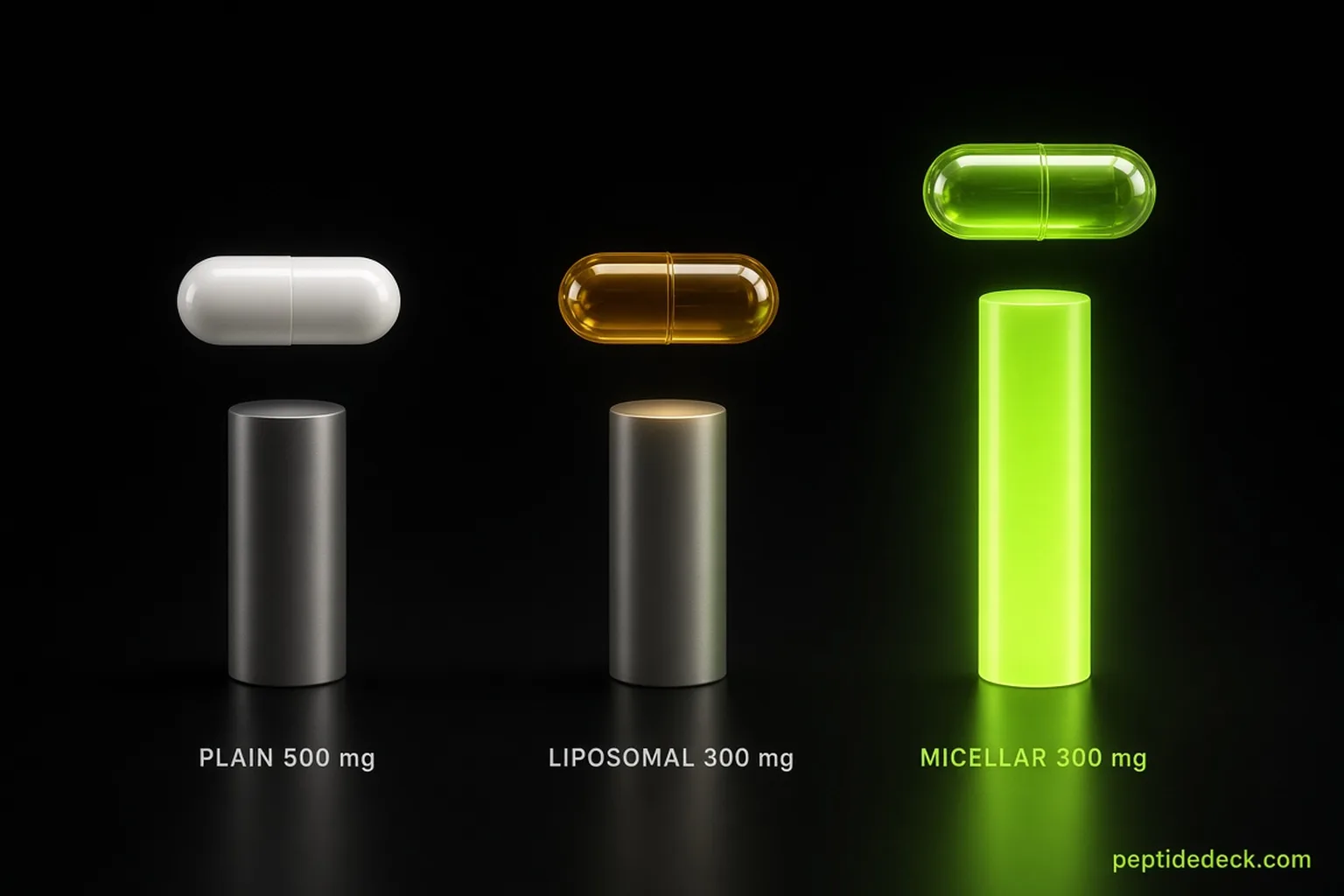
In 2026, a Canadian group published the first trial that gave the same people plain, liposomal and a third form on separate days. Fourteen healthy adults took single doses in random order, and whole-blood glutathione was tracked for 24 hours. The results are the closest thing we have to a straight answer:
- Plain glutathione, 500 mg: peak rise of 42.8 µg/mL.
- Liposomal (Setria) softgel, 300 mg: peak rise of 45.5 µg/mL.
- Micellar glutathione, 300 mg: peak rise of 103.9 µg/mL.
Read that again. At the doses given, 300 mg of liposomal glutathione did about the same as 500 mg of plain. Per milligram, liposomal came out ahead, roughly 1.8 times plain on total exposure once the numbers were scaled to the same dose, but the paper did not report whether that gap was statistically significant. The form that clearly won was the micellar one, and several of the authors are named inventors on its pending patent.
What the 3–5x claims are based on
You will see "2–4 times" and "3–5 times better absorption" on many product pages. We traced the sources where they were given. One widely read comparison page credits its 3–5x figure to a 2020 paper in Nutrients that, when you look it up, measured folate levels in pregnant women. Another manufacturer study reported a 6-fold higher peak for its own liposomal product, but with six people per group after one dose.
No trial we found has compared liposomal and plain glutathione head to head over weeks of daily use. Until one does, any multiplier on a label is a guess dressed up as a statistic.
Liposomal vs Reduced vs S-Acetyl vs Sublingual
Four forms fight for your money. Each has a different kind of proof behind it.
Plain reduced glutathione
The cheapest form has the longest placebo-controlled trial behind it. If you are patient and consistent, 1,000 mg a day raised body stores in the Penn State study. The trade-off is time: expect the gains to build over months, not days.
Liposomal glutathione
Faster rises in a small pilot, and about equal blood levels at a lower dose in the 2026 crossover. That makes it a reasonable pick if you want results sooner or prefer a smaller dose. It does not make it proven superior.
S-acetyl glutathione
Adding an acetyl group to the sulfur atom is meant to protect the molecule from gut enzymes, and cells can remove the group once it is inside. The theory is sound. The human absorption data is missing: we found no published trial in PubMed measuring blood glutathione after people swallowed S-acetyl glutathione. In September 2026, the European Food Safety Authority judged it safe at up to 300 mg a day for adults as a novel food, which speaks to safety, not absorption.
Sublingual and "nano" glutathione
Tablets that melt under the tongue aim to skip the gut entirely. In a 2015 crossover trial, 20 people with metabolic syndrome took 450 mg a day of sublingual, plain oral glutathione, or NAC for 3 weeks each. The sublingual form raised plasma glutathione and improved the ratio of active to used-up glutathione more than plain capsules did. Two of the authors worked for the tablet's maker.
"Nano glutathione" and "gluta nano" products make a similar promise with smaller particles. One 2019 study gave 15 healthy adults 1 mL of a nano-sized glutathione solution, held in the mouth for 90 seconds before swallowing. Red cell glutathione rose more than with placebo over 2 hours. A supplement company funded it, and it measured one dose, not weeks of use.
Liposomal Glutathione Liquid vs Capsules
A true liposome is a water-filled bubble. That is why so many liposomal glutathione products are liquids, and why the multi-week liposomal trials we found used liquids: the Penn State pilot and a 2021 trial that gave people with type 2 diabetes 1,260 mg a day as 15 ml of liquid for 3 months, against a placebo of empty liposomes.
Capsules and softgels labelled "liposomal" are harder to judge. Some contain pre-formed liposomes; others mix glutathione with phospholipids and rely on them forming bubbles in your gut. The 2026 crossover used a liposomal softgel and still matched plain glutathione at a lower dose, so capsules are not useless. You just cannot tell from the label which kind you are buying.
Liquid has two practical downsides you will notice on day one. Glutathione contains sulfur, so most liquids smell and taste faintly of it, and brands mask it with citrus or berry flavors. Many liquids also need refrigerating after opening. If either would stop you taking it every day, a softgel you actually take beats a liquid you forget in the fridge.
Liposomal Glutathione Dosage: What the Trials Used
There is no official dose. What exists is the range of doses that raised blood levels in people.
Doses tested in human trials
- Liposomal, 500 mg a day: blood levels up within 1 week, peak at 2 weeks (Sinha 2018)
- Liposomal, 1,000 mg a day: no clear extra gain over 500 mg in the same pilot
- Liposomal liquid, 1,260 mg a day: split morning and evening for 3 months, placebo-controlled (To 2021)
- Plain, 250 mg a day: blood up 17% and red cells up 29% at 6 months (Richie 2015)
- Plain, 1,000 mg a day: the largest gains, built over 6 months (Richie 2015)
For most people taking liposomal glutathione, that points to 250–500 mg a day as a sensible start, with 1,000 mg the upper end of what has been studied for months at a time. Check the milligrams of glutathione per serving, not the total "liposomal complex" weight, which includes the phospholipids.
How long does liposomal glutathione take to work?
Blood levels can move within 1 to 2 weeks on liposomal, based on the Penn State pilot. With plain capsules, expect 1 to 6 months. Whether you feel anything is a different matter: no trial has measured energy, mood or "detox" as an outcome. The one thing every study agrees on is that levels fade once you stop, so this is a daily habit, not a course.
Empty stomach or with food?
Brands disagree, and no trial has tested it for liposomal glutathione. In the 2026 crossover, all three forms were taken with a standard breakfast and still raised blood levels. Our best glutathione supplement guide covers morning-versus-evening timing and the products we would pick for each form.
Liposomal Glutathione Benefits and Uses: Measured vs Marketed
Brand pages list 14 or more benefits. They run from Lyme disease to autism. Human trials of oral glutathione have measured far fewer, and the gap between the two lists is where most disappointment comes from.
What oral glutathione trials have measured in people:
- Blood glutathione: up in plain and liposomal trials, as above.
- Oxidative stress markers: 8-isoprostane down 35% and the used-to-active glutathione ratio down 20% on liposomal (Sinha 2018); oxidative damage markers down in people with type 2 diabetes on liposomal liquid versus placebo (To 2021).
- Immune markers: natural killer cell activity up in both the plain and liposomal Penn State trials.
- Liver enzymes: in 29 people with fatty liver disease, 300 mg of plain glutathione a day for 4 months lowered ALT, a liver damage marker. There was no control group.
- Insulin sensitivity: in 20 men with obesity, with or without type 2 diabetes, 1,000 mg of plain glutathione a day for 3 weeks improved insulin sensitivity against placebo.
What has not panned out: in 58 children with cystic fibrosis, 24 weeks of oral glutathione did not improve growth or gut inflammation markers compared with placebo. It was safe, but it did nothing measurable.
Skin lightening and anti-aging are the most searched benefits, and they have their own small trials; our glutathione for skin guide covers them. For the wider list, including food sources and how to test your levels, see glutathione benefits.
Liposomal glutathione for weight loss
No trial has tested liposomal glutathione for weight loss. The closest evidence is the 3-week insulin sensitivity study above, which used plain capsules and was not designed to measure weight loss. If you are hoping it will move the scale, the honest answer is that nobody has shown it does.
Liposomal Glutathione Side Effects
Good news first. In every trial above, oral glutathione was well tolerated. The Penn State liposomal pilot reported no serious adverse effects and no minor ones linked to treatment. The sublingual trial recorded no adverse events in any arm. The 2026 crossover checked liver and kidney blood tests after 30 days on its micellar form and found no changes.
What people do report:
- Bloating, gas or loose stools: the usual complaints with oral supplements, and a reason to start at the low end of the dose range.
- Sulfur taste or smell: expected with liquids, because glutathione contains sulfur.
- Rash: one patient in the fatty liver study developed a rash, and the authors could not say whether glutathione caused it.
- Soy reactions: many liposomes are made from soy lecithin. If you react to soy, look for sunflower-derived phospholipids.
Check with your doctor first if: you are pregnant or breastfeeding (there is no safety data), you are having chemotherapy or radiation (antioxidants can interact with some treatments, and your oncologist needs to know), or you take medicines for a serious long-term condition.
How to Read a Liposomal Glutathione Label
Five details tell you more than the word "liposomal."
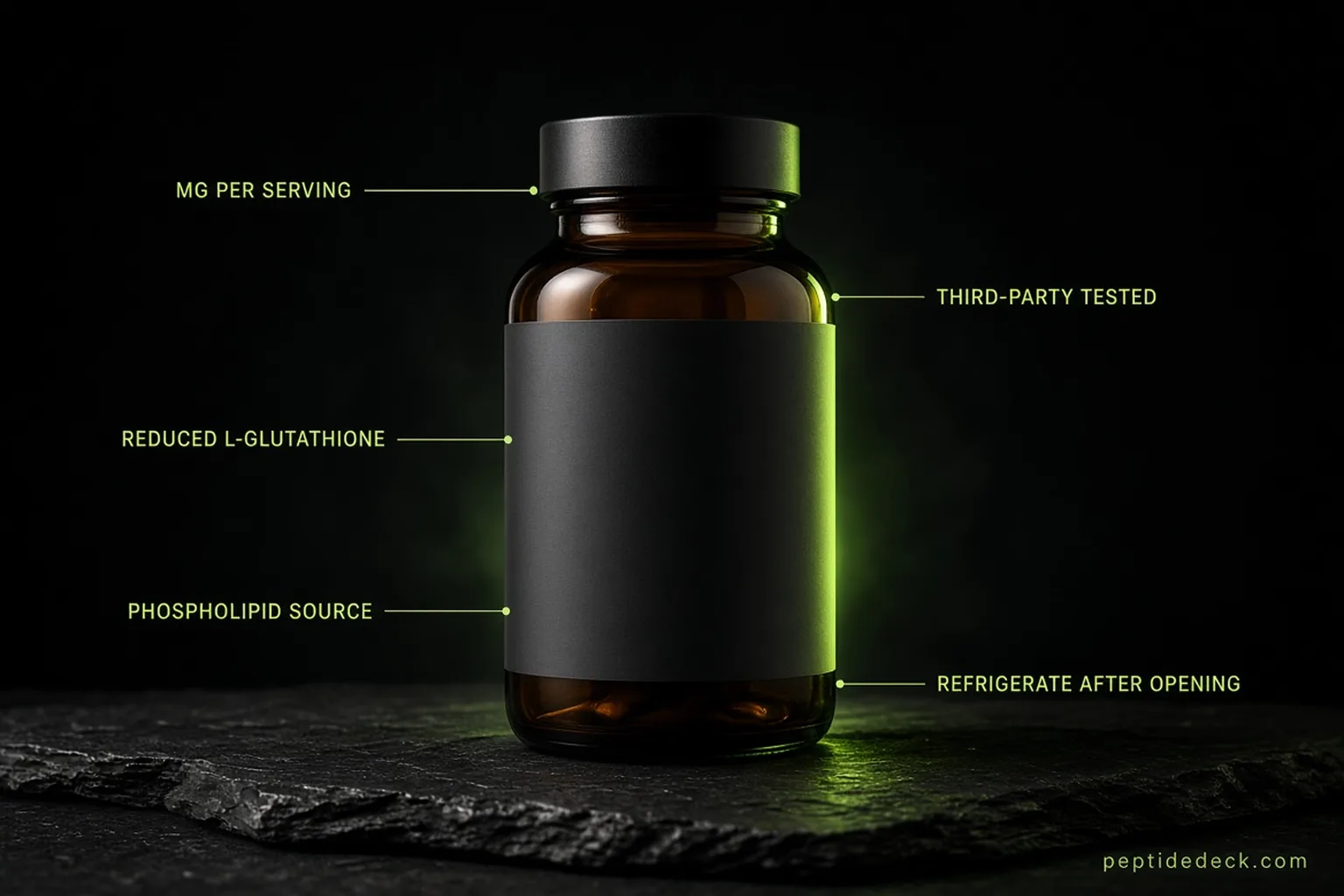
- Milligrams of glutathione per serving. Not the weight of the whole liposomal blend. The trials above used 250–1,260 mg of glutathione a day.
- The form: reduced L-glutathione. Setria is one branded version. "Glutathione complex" or "proprietary blend" without a number is a red flag.
- The phospholipid source. Sunflower or soy lecithin, or phosphatidylcholine. Useful if you avoid soy, and a sign the maker is being specific.
- Third-party testing. A certificate of analysis or a seal from an independent lab. Supplements are not approved by the FDA before sale, so this is your only check that the dose on the label is in the bottle.
- Storage instructions. A liquid that needs no refrigeration after opening may rely on preservatives or alcohol. Neither is harmful in small amounts, but they are worth knowing about.
Claims about particle size in nanometers, "clinically proven absorption" or a specific multiplier are almost never backed by a trial of that exact product. Treat them as advertising.
When Swallowing Glutathione Stops Making Sense
Oral glutathione raises blood levels slowly and modestly. If you have tried a liposomal liquid for a couple of months and felt nothing, you have three other routes, each with its own trade-offs.
Injections and IV. Glutathione given into a vein or muscle skips the gut completely, so absorption is no longer the question. In the US it needs a prescription, usually through a clinic, IV lounge or telehealth service that uses a compounding pharmacy. Our glutathione injections guide covers doses, cost and risks, and the glutathione dosage chart shows typical injectable schedules.
Precursors. Your body builds glutathione from cysteine, and NAC is a cheap, well-studied source of it. Whether that beats swallowing glutathione itself is covered in NAC vs glutathione. Combining NAC with glycine, known as GlyNAC, has its own set of trials in older adults.
A different target. If your real goal is energy or healthy aging, glutathione may not be the bottleneck. NAD+ vs glutathione compares the two for those goals.
Frequently Asked Questions
Medical Disclaimer: This article is for informational purposes only and does not constitute medical advice. Glutathione supplements are not approved by the FDA to treat, cure or prevent any disease, and the human trials described here were small and mostly funded by manufacturers. Talk to your doctor before starting glutathione, especially if you are pregnant, breastfeeding, having cancer treatment or taking prescription medicines.