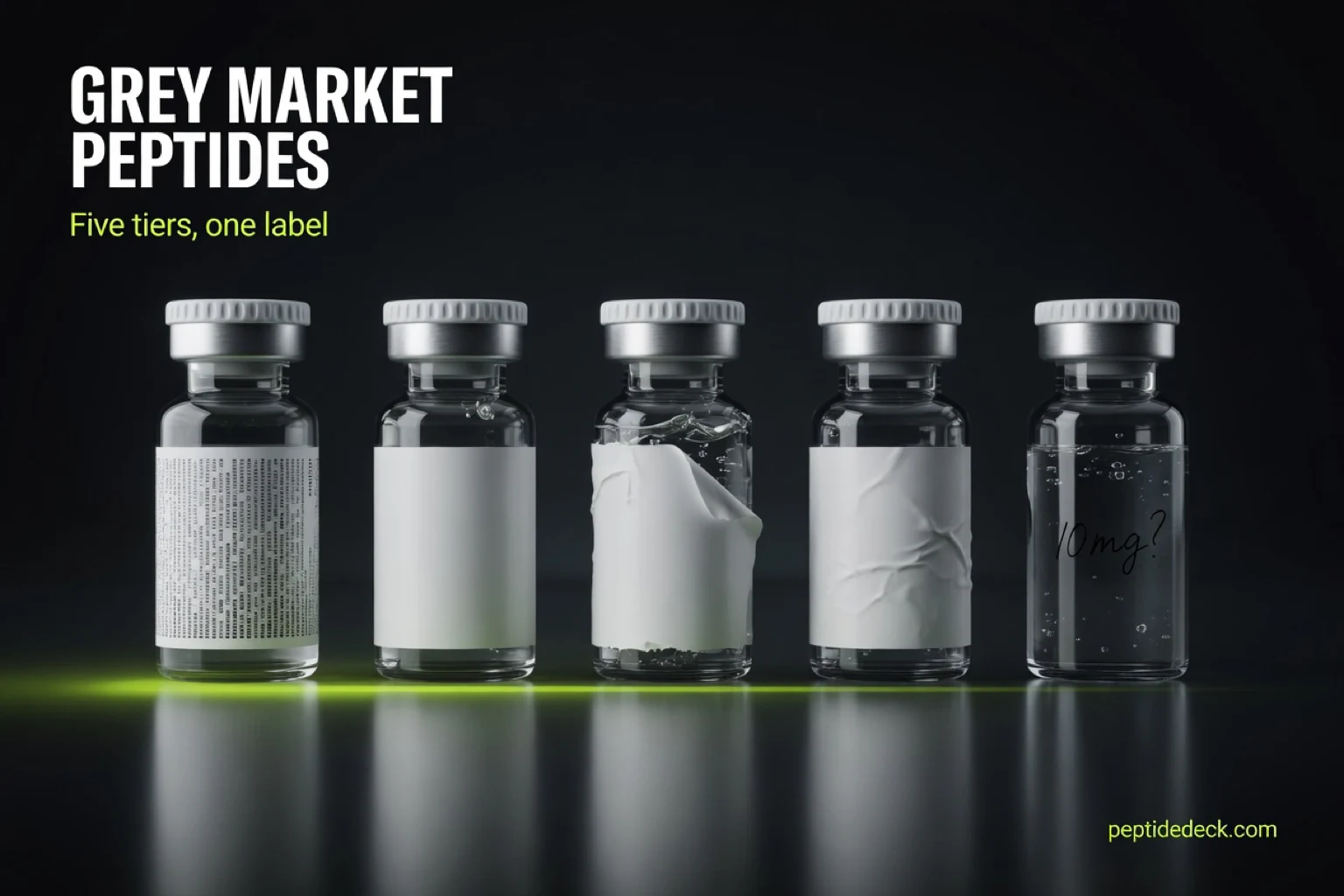
Nobody calls their own supplier grey market.
They say "my source." They say "the site I use." And the vial that turns up looks fine, because a vial always looks fine. White powder, rubber stopper, aluminium crimp. There is nothing about it that tells you which of five very different supply chains it came out of.
That is the actual problem with grey market peptides. Not that the category is uniformly dangerous, and not that it is uniformly fine. It is that the label on the vial is the one piece of information that carries no weight at all, and most people are making a decision based on it.
🔑 Key Takeaways
- "Grey market" is not one thing. It covers five tiers that differ enormously in risk, and most warnings you have read collapse all five into a single scary word.
- One four-word sentence on the label is what makes the whole category legal. It is a legal position rather than a quality statement, and knowing what it actually does changes how you read every vendor site.
- A certificate of analysis is the only real check available to you — but most people read the wrong number on it, and the number that matters is not the purity percentage.
- Two peptides that were widely compounded by pharmacies in 2023 are no longer legally available that way. If your supplier still offers them as "pharmacy grade", that tells you something.
- There is one question that separates a real vendor from a reshipper, and it takes one email to ask.
This page maps the tiers, explains what actually goes wrong at each one, and gives you the check that takes ten minutes. It also tells you where this site sits in that map, because we run affiliate links and you should weigh what you read here accordingly.
What "grey market peptides" actually means
It means legal to sell, not legal to sell for you.
That is the whole trick, and once you see it the category stops being mysterious. A compound like BPC-157 or semaglutide can be manufactured and sold legitimately as a laboratory chemical. What cannot happen, without a prescription and an approved product, is selling it to a person for injection.
So the market solved it with a sentence. Vendors label the vial for laboratory use only, state plainly that it is not intended for people, and sell it openly. The buyer reads that sentence, ignores it, and injects the contents. Both sides understand exactly what is happening. Neither side says so.
That is the grey. Not smuggling, not counterfeiting, not a back alley. A legal product sold through a legal channel into a use it is explicitly not sold for. Everything difficult about the category follows from that one arrangement, because a product sold "not for human use" carries no obligation to be safe for human use.
Worth separating from two neighbours it gets confused with. Black market means the product itself is illegal or counterfeit — a fake Ozempic pen with a forged serial. White market means a prescription drug dispensed by a pharmacy against a prescription. Grey sits between them, and it is the only one of the three where the legality depends on what you do next rather than on what was sold.
The five tiers hiding inside one phrase
This is where most coverage stops short.
Press articles and clinic blogs treat the grey market as a single block, which is why their advice comes out as "don't." But a compounding pharmacy filling a prescription and a stranger on Instagram are not the same risk, and lumping them together makes the warning easy to dismiss. Here is the actual spectrum:
The useful thing about this map is what it does to the advice. Tiers 4 and 5 are not a risk you manage, they are a risk you decline. Tier 3 is where verification actually changes your odds, which is why the rest of this page is about tier 3. And tier 2 is worth understanding because it moved recently, and a lot of sites have not caught up.
Why tier 2 stopped being a safe answer
Compounding was the obvious middle path.
A licensed pharmacy, a real prescription, a pharmacist on the hook. For a while that was the sensible recommendation for anyone who wanted a GLP-1 without the brand price. Two things changed it.
The first is the shortage rule. US pharmacies are permitted to compound copies of a commercially available drug in specific circumstances, and one of those is when the drug is in shortage. Semaglutide and tirzepatide were both on the FDA shortage list, which is what made compounded versions so widely available in 2023 and 2024. Both were subsequently declared resolved, and the legal basis for mass compounding went with it. Some operations kept going anyway.
The second is more specific to peptides. The FDA reviews bulk substances that compounders want to use and sorts them into categories. In 2023 it placed BPC-157 into Category 2 — substances with significant safety risks — alongside several other peptides. That is a direct statement that the agency did not consider the available safety data adequate for compounding use.
What this means when you are reading a vendor page
If a site is selling you BPC-157 and describing it as "pharmacy grade" or implying it comes from a compounding pharmacy, that description does not survive contact with the Category 2 listing. Compounding pharmacies are not supposed to be producing it.
This is not a reason to panic about BPC-157 specifically. It is a reason to notice that the vendor is using a word that sounds regulated to describe something that is not, which tells you how carefully the rest of their copy was written.
If you want the fuller picture on what is and is not legal, we cover it separately in are peptides legal, and the access routes specifically for GLP-1s in how to get retatrutide.
What actually goes wrong
Almost never what people fear.
The imagined failure is poison — something toxic deliberately substituted in. That is rare, because it serves nobody selling into a repeat market. The real failure modes are duller and much more common, and they are worth knowing by name because each one has a different tell.
- Underfill. The vial says 10mg and holds 7mg. Nothing about the powder looks different. You conclude the compound does not work at your dose, when the dose was never what you thought.
- Wrong but related compound. You ordered a modified peptide and received the plain one, which is cheaper to make. The two are genuinely different molecules with different behaviour, and the vial cannot tell you which you got.
- Degradation in transit. Lyophilised powder holds up reasonably well; liquid does not. A pre-mixed vial that spent a week in a hot warehouse is not the product that was tested.
- Endotoxin and sterility. This is the one that sends people to hospital. Bacterial contamination from non-sterile production causes injection site reactions and fever, and it is invisible in the powder.
- The certificate is real but not yours. The lab report is genuine, for a lot made two years ago. The vendor publishes it for every batch since.
Notice that four of those five are invisible on arrival. That is the honest core of the problem: you cannot inspect your way out of it, which is why the check has to happen before the money moves.
How to check a source in ten minutes
Most people check the wrong thing.
They look for the purity percentage, see 99%, and stop. Purity is the least informative number on the page, because it is the easiest to write down and the one every vendor quotes. What matters is whether the document is attached to the specific vial in your hand. Work through these in order:
- Find a lot number, and check it appears in two places. On the certificate and on the vial you are shipped. If the certificate has no lot, it is marketing, not testing.
- Look for the testing method, not just the result. Purity by HPLC and identity by mass spectrometry are the two you want. A certificate with a percentage and no named method is a claim with a border around it. We explain how to read these properly in understanding peptide purity.
- Check that identity was tested at all. This is the gap most people miss. Purity tells you the sample is 99% one thing. Mass spec is what tells you that thing is the peptide you ordered. Purity without identity is a statement about tidiness, not about contents.
- Find the lab's name. A third-party lab with a real name and a report date is a verifiable claim. "Third-party tested" as a bare phrase is not.
- Email and ask for the certificate matching your batch. This is the single highest-signal check available to you, and it costs one email. A tier 3 vendor answers it. A tier 4 reshipper cannot, because they never had one.
That last one is the test worth running before anything else. It takes a day to get an answer and it sorts the map for you more reliably than any amount of reading reviews.
Where this site sits
You should know this before you weigh anything above.
PeptideDeck carries affiliate links. When a page here links to a vendor and you buy, we may earn a commission, and that is true of the link in this article. Almost every vendor we link to sits at tier 3 in the table above: openly sold, labelled for laboratory use, no prescription involved. We are not linking to pharmacies and we are not pretending otherwise.
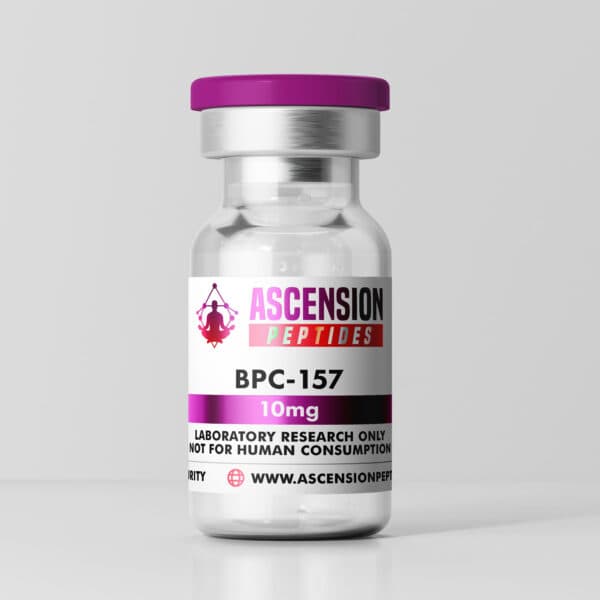
What we can do is run the checklist above before we link, and show you the result rather than assert it. So here is the vendor in the box, checked the way this page told you to check one:
The checklist, run on the vendor we link
Batch numbers, printed publicly. The BPC-157 listing shows lot 12-05260628 tested 10 July 2026, and lot 12-01260229 tested 6 March 2026. Dated, numbered, and visible before you buy rather than on request.
Two independent labs, both named. Kovera Labs and MZ Biolabs, one per batch. Two separate labs is a stronger signal than one, because a vendor shopping for a friendly result does not usually publish both.
Each certificate is downloadable, and there is a library of the rest. That is the difference between a vendor who tests and a vendor who says "third-party tested" and stops.
What you still have to do yourself: open the document and confirm it lists identity, not purity alone, and check the batch on your vial against the batch on the certificate. We are telling you the paperwork exists and is specific. We are not telling you it removes the need to read it.
That is what tier 3 looks like when the vendor has done the work. It is still tier 3. It is still a product labelled for laboratory use, and a certificate covers the lot it names and not automatically the vial you are sent — which is exactly why the email in the checklist above is worth sending anyway. Good paperwork narrows the risk. It does not move the product into a different tier.
If you would rather see how we rank sources against each other, that work lives in verified peptides and the vendor comparison.
Questions worth asking before you buy
Five, and they are all short.
Send them in one email. What you are testing is not really the answers, it is whether anyone answers at all, and how fast. A vendor who takes nine days to produce a certificate does not have a filing system, and a filing system is the thing you are actually buying at tier 3.
- Can you send the certificate of analysis for the lot you would ship me?
- Which lab performed the testing, and on what date?
- Was identity confirmed by mass spectrometry, or is this purity only?
- How is the product stored before shipping, and is it shipped cold?
- What happens if the vial arrives damaged, and how long do I have to tell you?
The last one matters more than it looks. Short claim windows — 48 hours from delivery is common — are not necessarily a red flag, but you want to know the number before you need it rather than after.
Frequently Asked Questions
Medical disclaimer. This article is informational and does not replace individual medical advice, and nothing here is encouragement to inject a product sold for laboratory use. Compounds labelled for laboratory use have not been reviewed for human safety, are not manufactured to the standards that apply to medicines, and carry real risks including contamination and inaccurate dosing. If you are considering a peptide or a GLP-1 medication, the route worth exhausting first is a clinician who can prescribe an approved product and monitor you on it. Anyone pregnant, breastfeeding, taking prescription medication, or living with a chronic condition should speak to a doctor before starting anything discussed here.