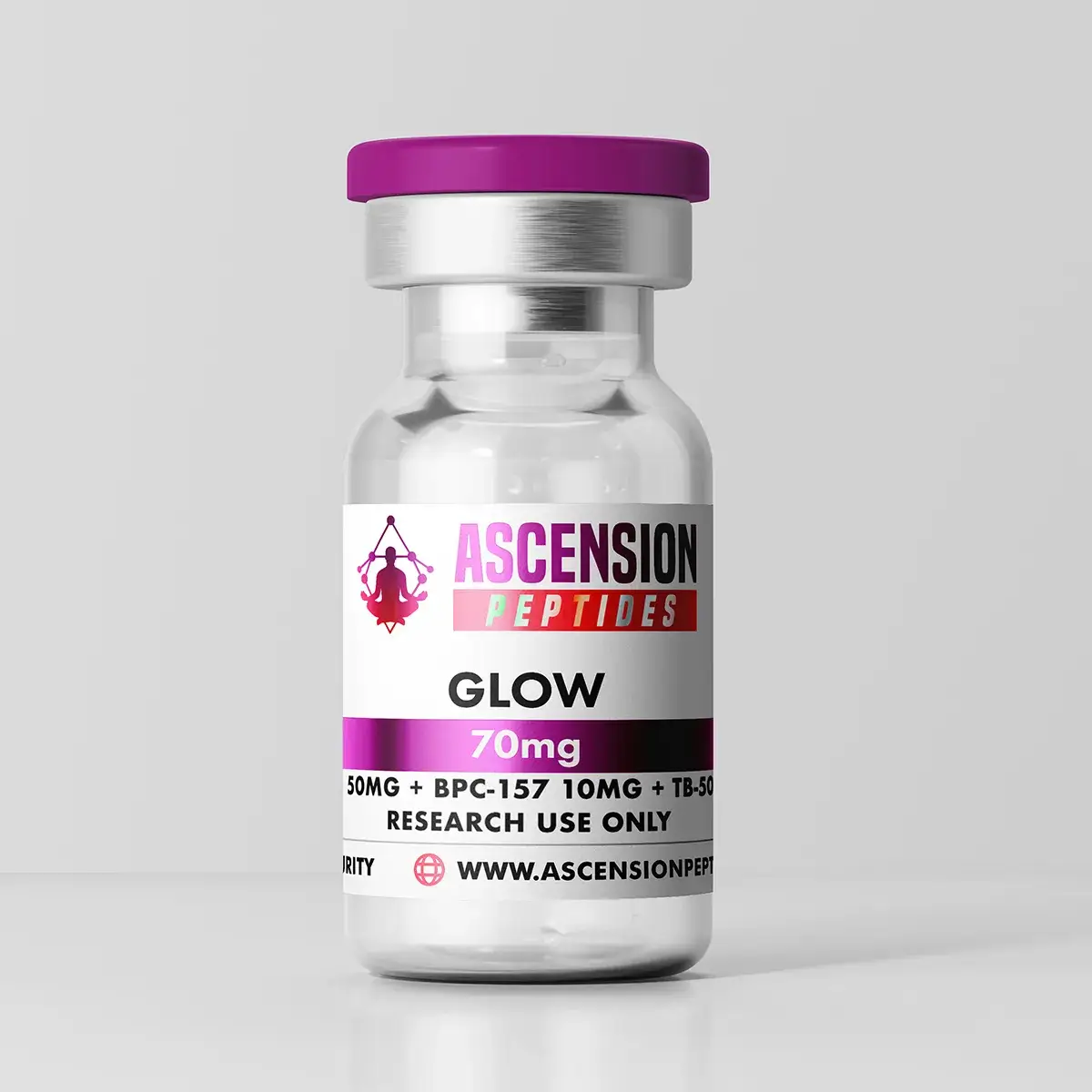
Your skin gets thinner every decade. Collagen production drops roughly 1% per year after age 20. By 50, you've lost nearly a third of what you had. GLOW is built to push that number back up.
🔑 Key Takeaways
- GLOW is a three-peptide blend (GHK-Cu 50mg, BPC-157 10mg, TB-500 10mg) specifically formulated for skin quality, anti-aging, and tissue recovery
- GHK-Cu is the primary active: it directly stimulates collagen I and III production, elastin synthesis, and fibroblast proliferation, reversing the structural decline that makes skin thinner, looser, and less resilient with age
- BPC-157 adds angiogenesis (new blood vessel formation) that improves nutrient delivery to skin tissue, plus gut-skin axis repair that addresses inflammatory skin conditions from the inside
- TB-500 promotes cell migration, moving repair cells to damaged tissue faster, and supports wound healing and scar remodeling
- Most users report noticeable changes by weeks 3 to 4: firmer skin texture, improved hydration, reduced fine lines, and a "glow" that comes from better blood flow and collagen density
- GLOW is particularly effective after cosmetic procedures (microneedling, laser, chemical peels) because it accelerates the healing and remodeling those procedures are designed to trigger
This page covers exactly how GLOW works on skin, what changes first, what takes longer, and how to get the most out of it for skin-specific goals.
How GLOW Works on Skin
Three peptides, three different skin mechanisms.
Skin aging happens because the cells that build skin structure slow down. Fibroblasts produce less collagen. Elastin fibers fragment. Blood supply to the dermis decreases. The extracellular matrix that holds everything together thins out. GLOW addresses each of these with a different peptide.
GHK-Cu: The Architect (50mg)
GHK-Cu is a naturally occurring copper peptide that your body produces in decreasing amounts with age. At the 50mg dose in GLOW, it directly activates the cellular machinery that builds skin structure:
- Collagen synthesis: Stimulates production of collagen type I (structural strength) and type III (skin elasticity and hydration). This is the primary mechanism behind skin firming.
- Elastin production: Increases elastin fiber formation, which is what prevents skin from sagging. Elastin is harder to rebuild than collagen, making GHK-Cu's effect on it particularly valuable.
- Glycosaminoglycan production: Stimulates production of hyaluronic acid and other molecules that bind water in the skin. This is what creates the plumping and hydration effect that many users describe as a "glow."
- Fibroblast proliferation: More fibroblasts means more collagen and elastin production capacity. GHK-Cu doesn't just stimulate existing cells to work harder, it increases the number of cells doing the work.
- Gene expression: GHK-Cu modulates the expression of over 4,000 genes related to tissue remodeling, anti-inflammation, and antioxidant defense. This is why its effects extend beyond just collagen.
In head-to-head testing, GHK-Cu performed comparably to tretinoin (prescription retinoid) for skin density improvement, without the peeling, irritation, and sun sensitivity that retinoids cause. For more on GHK-Cu specifically, see the GHK-Cu benefits and dosage page.
BPC-157: The Healer (10mg)
BPC-157 supports skin through two pathways that GHK-Cu doesn't cover:
Angiogenesis: BPC-157 promotes new blood vessel formation. Better blood supply means more oxygen and nutrients reaching the dermis, which directly supports collagen production and skin cell turnover. Poor microcirculation is one of the underrecognized drivers of dull, aging skin.
Gut-skin axis: Chronic gut inflammation reliably produces skin symptoms: dullness, redness, breakouts, sensitivity, rosacea flares. BPC-157's gut-protective effects address this connection. People with persistent skin issues despite good topical routines often see breakthroughs when gut inflammation is addressed.
TB-500: The Mobilizer (10mg)
TB-500 (thymosin beta-4 fragment) promotes cell migration, the process of moving repair cells to where they're needed. For skin, this means:
- Faster wound healing and scar remodeling
- Improved post-procedure recovery
- Anti-inflammatory effects that reduce chronic skin redness
- Keratinocyte migration for skin barrier repair
What Changes First: Skin Timeline
Not everything happens at once.
The GLOW before and after page has community photos and timelines.
GLOW for Specific Skin Goals
Anti-Aging and Wrinkle Reduction
The primary use case.
GLOW's collagen and elastin stimulation directly addresses the structural cause of wrinkles: weakened dermis that can no longer support the skin surface. Fine lines respond first (weeks 3 to 4). Deeper wrinkles take longer because they involve greater structural loss, but consistent use over 6 to 8 weeks produces visible improvement for most people. The effect is cumulative, with each cycle building on previous structural gains.
Post-Procedure Recovery
This is where GLOW really outperforms standalone topicals.
Cosmetic procedures like microneedling, laser resurfacing, and chemical peels work by creating controlled damage that triggers the body's healing response. GLOW amplifies that response: GHK-Cu accelerates collagen synthesis at the wound site, BPC-157 improves blood supply for faster healing, and TB-500 moves repair cells into position faster.
People running GLOW alongside microneedling consistently report faster recovery times and more pronounced results from each session. Starting GLOW 1 to 2 weeks before a procedure and continuing through the healing phase maximizes the synergy.
Hair and Scalp
A secondary benefit that surprises people.
GHK-Cu has direct effects on hair follicles: increased follicle size, extended growth phase (anagen), and improved blood supply to the scalp. Multiple users report thicker-feeling hair and less shedding during GLOW cycles. It's not a primary hair loss treatment, but for thinning hair alongside skin goals, the dual benefit is real. The GHK-Cu before and after page has examples.
Scar Healing
Old and new scars both respond.
GHK-Cu promotes extracellular matrix remodeling, the process by which scar tissue is gradually replaced with more organized collagen. BPC-157 and TB-500 support this by reducing local inflammation and improving cell migration to the scar site. Newer scars respond faster. Older scars take longer but can still show visible softening and flattening over 2 to 3 cycles.
How to Use GLOW for Skin
Keep it simple.
- Injection route: Subcutaneous (under the skin). Abdomen or thigh are most common. Some people inject closer to the target area (e.g., abdomen for facial skin is fine, there's no localized targeting with SubQ).
- Frequency: Daily or every other day. Daily produces faster results. Every other day stretches the vial longer and still works.
- Cycle length: 4 to 8 weeks on, 2 to 4 weeks off. Cycling prevents receptor desensitization and lets you assess progress between rounds.
- Best time: Evening injection before bed. Growth hormone release and tissue repair peak during sleep, which complements GLOW's mechanism.
For the full dosing protocol with reconstitution math, see the GLOW dosage page. If you need help with reconstitution calculations, the peptide calculator handles the math.
GLOW vs Other Skin Options
How GLOW compares to alternatives
Frequently Asked Questions
Medical Disclaimer: This article is for informational purposes only and does not constitute medical advice. GLOW is a peptide blend that has not been evaluated by the FDA for skin treatment. Individual results vary. Consult a licensed healthcare provider or dermatologist before starting any injectable skin protocol.