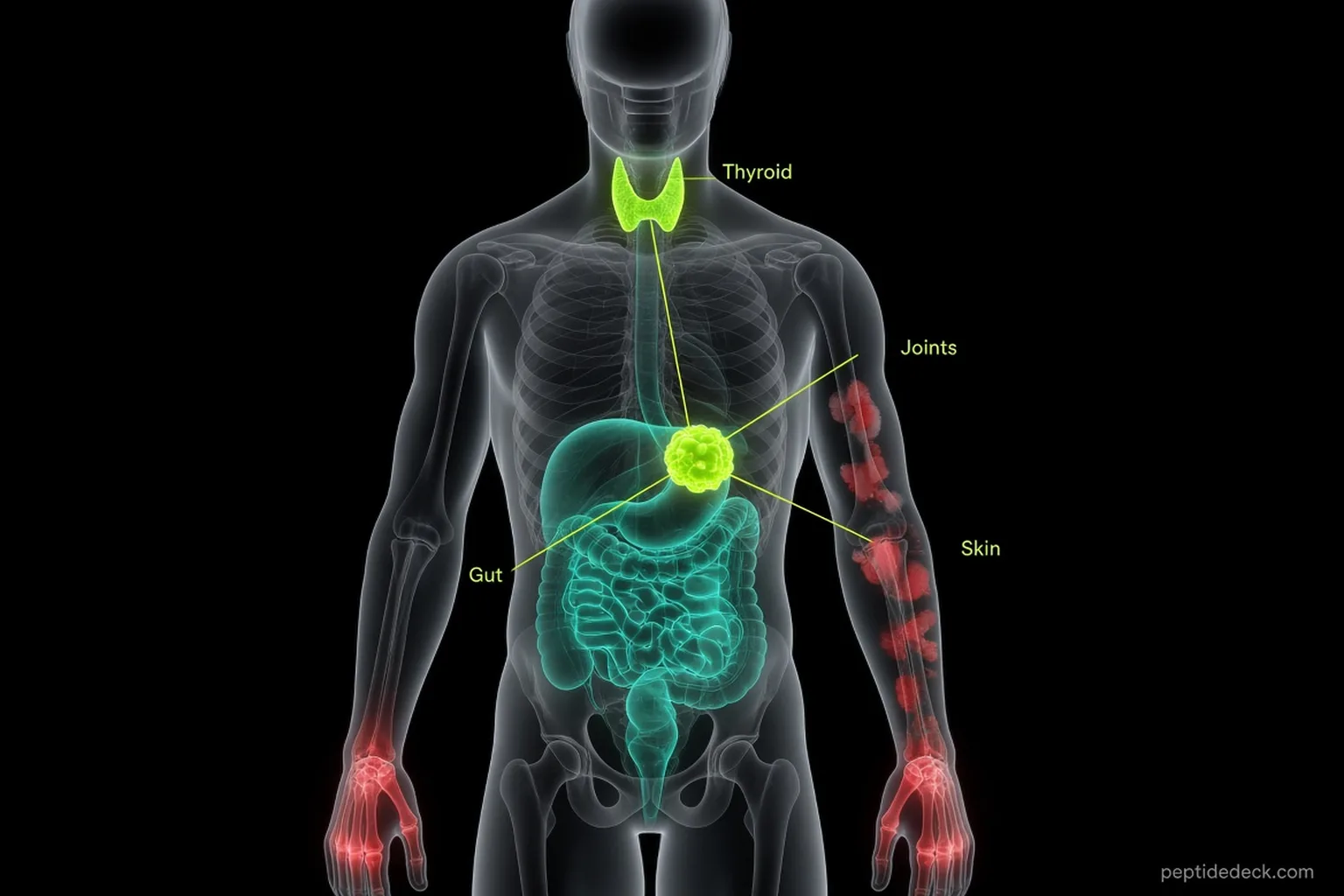
Autoimmune disease makes every promise sound tempting. Search for peptides for autoimmune disease and you will find clinics selling BPC-157, thymosin alpha-1 and KPV as immune "rebalancers". The surprise is that three peptide drugs are already FDA-approved for autoimmune conditions, including an oral IL-23 blocker cleared for psoriasis on 18 March 2026 (PMID 42433845). The vials sold online are a very different story.
🔑 Key Takeaways
- Which autoimmune diseases already have an approved peptide drug, and the one that arrived this year
- Why the most-tested "leaky gut" peptide never finished phase 3
- The popular immune peptide that turns out to be part of what drives lupus and psoriasis
- What happened when 1,106 people were given thymosin alpha-1 in its biggest trial
- Why peptide injections can set off mast cells, and which readers should care most
If you live with an autoimmune disease, you already know the trade-offs. The drugs that work bring infection risk and blood tests, and flares still happen. So an injection that promises to "modulate" the immune system sounds like exactly what is missing. This guide sorts every peptide people ask about into three piles, disease by disease: tested in people, tested only in animals or cells, and never tested at all.
What peptides for autoimmune disease actually means
The phrase covers two very different things. The first is prescription peptide drugs approved after controlled trials, and there are more than most people think:
- Repository corticotropin (Acthar Gel), a 39-amino-acid ACTH peptide, is FDA-approved as an add-on for rheumatoid arthritis and for lupus and MS flares.
- Glatiramer acetate (Copaxone and generics), a polymer of four amino acids, has been a first-line drug for relapsing MS since 1996.
- Icotrokinra (Icotyde), a once-daily oral peptide that blocks the IL-23 receptor, was approved for moderate-to-severe plaque psoriasis in March 2026.
- Teduglutide (Gattex), a GLP-2 analog, is approved for short bowel syndrome, a common result of repeated Crohn's surgery.
The second meaning is what most search results are selling: gray-market peptides such as BPC-157, TB-500, thymosin alpha-1, KPV and LL-37, bought as vials online. None of these has a published controlled trial in an autoimmune disease. The closest is larazotide, which went through four RCTs in celiac disease and then stopped.
A third group sits in between: GLP-1 drugs like semaglutide and tirzepatide, prescription peptides with a growing pile of studies in psoriasis, arthritis and gut inflammation in people who also carry extra weight.
Every sold peptide, graded on human evidence
Here is the whole field on one screen. Each row is a peptide you can buy online, the best human evidence it has in any autoimmune disease, the key number, and where to check it.
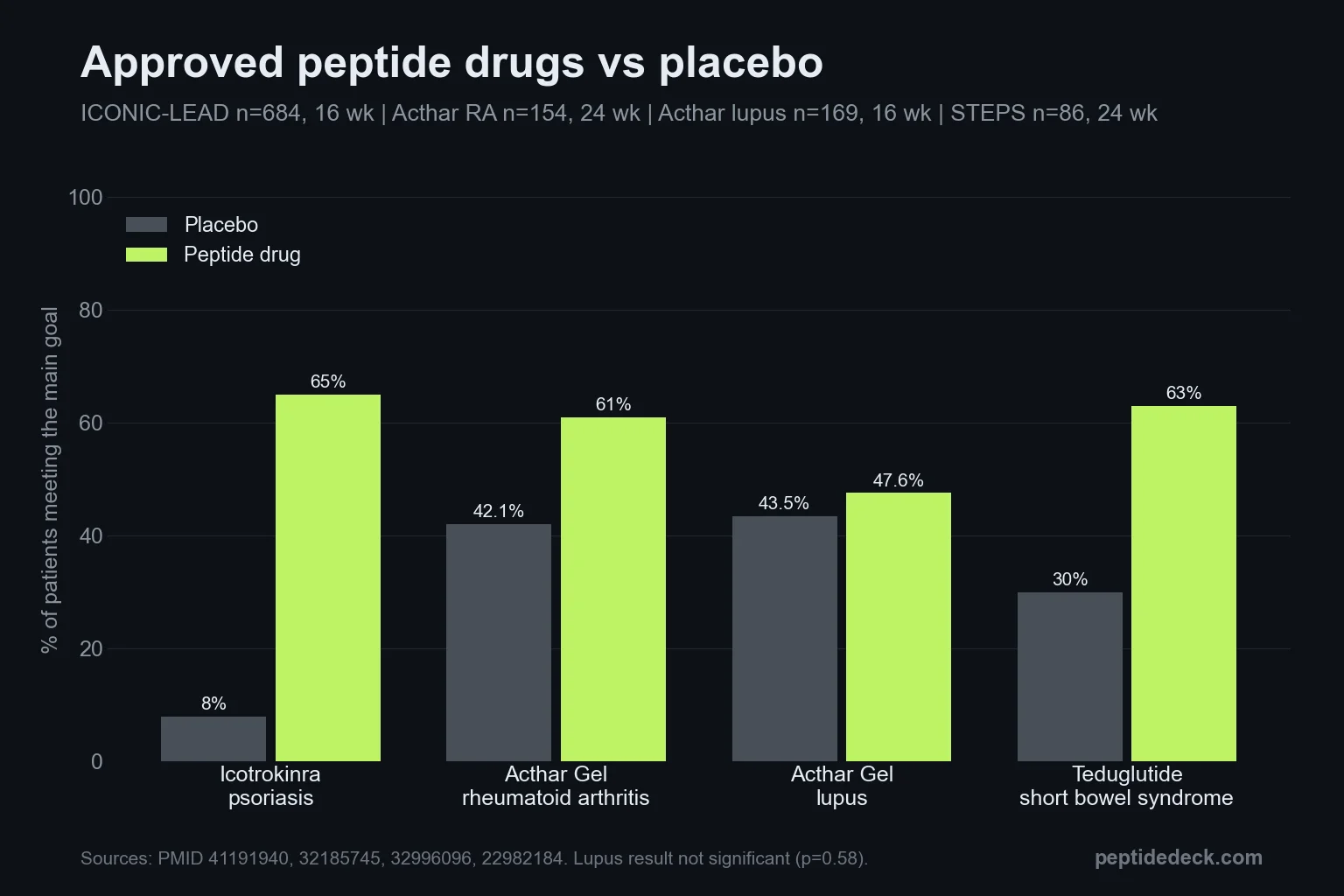
The chart below shows the gap disease by disease: the best evidence for any peptide drug, against the best for a gray-market peptide.
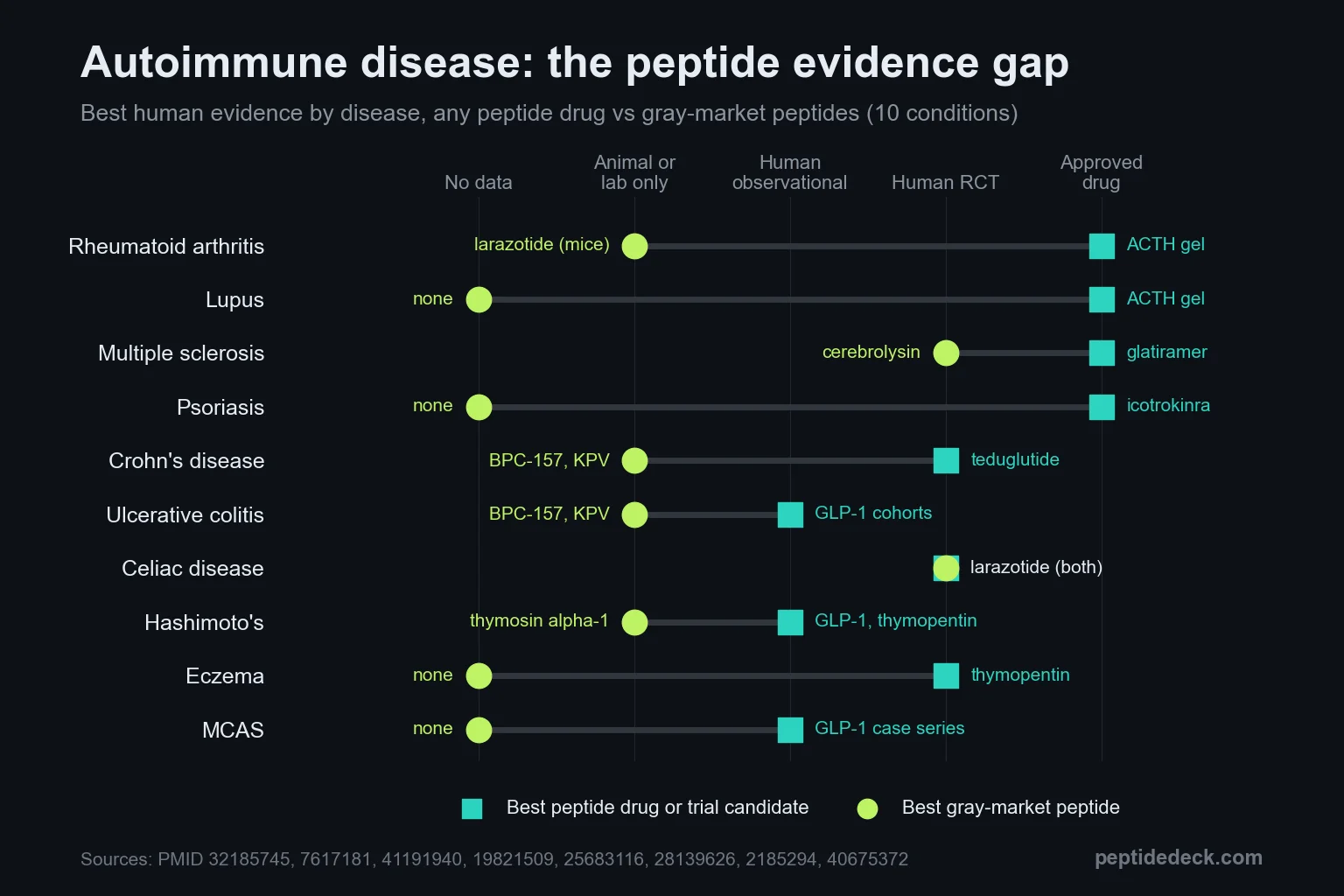
Rheumatoid arthritis: one approved peptide, no gray-market trials
The approved option is older than most rheumatologists. Acthar Gel was tested in a modern randomized withdrawal trial in 259 people whose RA stayed active despite steroids and DMARDs (PMID 32185745). After 12 open-label weeks, the 154 who reached low disease activity were randomized: 61.0% on Acthar kept it to week 24, against 42.1% on placebo.
Two catches: three authors worked for the maker, Mallinckrodt, and a 2022 JAMA Internal Medicine review called the evidence behind most of Acthar's labeled uses weak (PMID 34902005). As an ACTH hormone, it also brings steroid-type effects on blood sugar, bone and infection.
For sold peptides the record is thin. BPC-157's only joint data is a phone survey of 16 people with mixed knee pain at the authors' own peptide clinic: 14 reported relief, with no control group and no way to separate RA from meniscus tears (PMID 34324435). The thymic peptide thymopentin did beat placebo in two 1980s RA trials of 41 and 119 people, but the benefit faded within four weeks of stopping, and thymopentin is not what vendors sell (PMID 2858708, PMID 3276492).
GLP-1 drugs show a signal worth watching. In a 215-person chart review of overweight RA patients, those who took semaglutide or tirzepatide had bigger drops in disease activity and pain than those who did not, though about a third stopped for stomach side effects (PMID 40932015). The joint-by-joint version is in our guide to peptides for arthritis.
Lupus: where an "immune peptide" drives the disease
Lupus is where the hype runs backwards. Acthar Gel is FDA-approved for lupus, yet its phase 4 trial in 169 people missed its main goal: 47.6% responded on Acthar against 43.5% on placebo (p=0.58) (PMID 32996096). Joint counts and skin scores did improve.
Two lupus-specific peptides designed to retrain the immune system also stalled. Lupuzor (P140) helped 53.1% against 36.2% on placebo at one dose in a 149-person phase IIb, but not at the other dose (PMID 23172751). Edratide missed its co-primary endpoints in 340 people (PMID 26301100). Neither is approved.
No gray-market peptide has a lupus trial. Worse, LL-37, sold as an immune peptide, is part of the lupus process itself: neutrophils release LL-37 bound to the patient's own DNA, and that complex switches on the interferon-making cells that drive the disease (PMID 21389263). Even GLP-1 drugs come with a lupus caveat: case reports describe semaglutide-induced lupus (PMID 38559525).
Multiple sclerosis: a peptide drug is already standard care
MS shows what a real peptide therapy looks like. Glatiramer acetate cut the yearly relapse rate from 0.84 to 0.59, a 29% reduction, over two years in 251 people with relapsing MS (PMID 7617181). The trial was Teva-supported, the drug is now generic, and its most common side effect was a reaction right after the injection, in 15.2% against 3.2% on placebo.
Sold peptides are a long way from that bar. Cerebrolysin, a peptide mix from pig brain, was tested in 40 people recovering from a relapse: no difference in the main disability score (EDSS, p=0.665), with small gains on two secondary tests (PMID 28139626). The manufacturer supplied the drug. Thymosin alpha-1 has only been tested on MS patients' blood cells in a dish (PMID 28273784), and TB-500's myelin-repair claims come from animal models (PMID 26805386).
GLP-1 drugs did not help either. Adding dulaglutide to natalizumab for 12 months in 28 people changed weight and blood sugar but not nerve-damage markers, brain volume or cognition (PMID 42321509).
Psoriasis: the newest approved peptide is a pill
Psoriasis got a peptide pill this year. In the ICONIC-LEAD trial, 684 adults and teens with moderate-to-severe plaque psoriasis took icotrokinra 200 mg once daily or placebo (PMID 41191940). At week 16, 65% against 8% had clear or almost-clear skin, and 27% against under 1% were completely clear. Side effects hit 49% of both groups. Johnson & Johnson funded the trial.
GLP-1 drugs help mainly when weight is part of the picture. Adding tirzepatide to ixekizumab in 274 people with psoriasis and obesity raised complete clearance from 29.0% to 40.6% at 36 weeks (PMID 42139049). In 271 people with psoriatic arthritis, the same pairing lifted ACR50 response from 20.4% to 33.5% (PMID 41903163). Lilly makes both drugs and ran both trials. In 20 people without diabetes, liraglutide did nothing measurable for the skin (PMID 25139195).
BPC-157, KPV and thymosin alpha-1 have no psoriasis study at all, and LL-37 is a known psoriasis trigger (more below). Our full guide to peptides for psoriasis covers topical options and the GLP-1 data in detail.
Hashimoto's and Graves': no peptide lowers thyroid antibodies
No peptide has lowered thyroid antibodies in people. We found no human trial of BPC-157, KPV, larazotide or thymosin alpha-1 measuring TPO antibodies or thyroid function in Hashimoto's. Thymosin alpha-1's thyroid data is a 1985 mouse study (PMID 3873993). For Graves', the only peptide tested in people is an experimental TSH-receptor peptide therapy that is not sold: 7 of 10 completers improved in a 12-person phase I (PMID 31194638).
The peptides that really matter for your thyroid are ones people take for other reasons. Oral semaglutide raised levothyroxine exposure by 33% in a 45-person interaction study (PMID 34289755), and weight loss lowers dose needs, yet a 5,370-person Medicare study found TSH re-checks were no faster after starting a GLP-1 (PMID 41902399). GLP-1 drugs also carry a thyroid C-cell tumor warning, and a French study linked 1 to 3 years of use with higher thyroid cancer risk (HR 1.58) (PMID 36356111).
Growth-hormone peptides matter too: GH replacement unmasked low thyroid in 36% of previously normal adults with pituitary disease (PMID 17201804). If you take CJC-1295, ipamorelin or tesamorelin, re-check thyroid labs. More in our guide to peptides for thyroid.
Crohn's and ulcerative colitis: BPC-157's missing trial
BPC-157's best-known gut claim is a ghost. Many sites say it reached phase II for ulcerative colitis as an enema (PL 14736), but that claim traces only to reviews by its originating lab in Zagreb (PMID 22300085), with no published results anywhere. For Crohn's, zero PubMed records combine BPC-157 and the disease; the fistula claims rest on lab animals. KPV's colitis data is in mice (PMID 18061177).
The gut peptide that is approved is teduglutide, and its label is short bowel syndrome, not Crohn's itself. In 86 people with short bowel, 63% against 30% cut their IV nutrition by more than 20% (PMID 22982184). In a 100-person pilot in active Crohn's, the top dose looked better (44% against 32% response), but the trial was not powered to prove it (PMID 19821509). Its label warns about bowel blockage and polyp growth, which matters in a stricturing disease.
GLP-1 data conflict. A 19,532-person matched cohort linked GLP-1 use in Crohn's with obesity to fewer hospital stays, 10.0% against 24.7% (PMID 42321339). But a careful trial emulation in stable IBD found identical one-year relapse rates, 7.9% in both groups (PMID 42309434). Our gut health peptides guide covers the rest of the GI evidence.
Celiac disease: the most-tested sold peptide
Larazotide is the honest test case. It was designed to close the gaps between gut cells that gluten opens, the same "leaky gut" idea used to sell nearly every peptide on this page. In a 342-person, 12-week RCT, only the lowest dose (0.5 mg three times daily) beat placebo on symptoms, with 26% fewer symptomatic days; the 1 mg and 2 mg doses did no better than placebo (PMID 25683116). Staff of the developer co-authored it.
Across four RCTs and 626 people, larazotide did not improve gut permeability, the very thing it was built to change (PMID 34339872). During a gluten challenge, celiac antibodies rose less at 1 mg (5.78-fold against 19.0-fold on placebo) but still rose (PMID 23163616). The 307-person phase 3 was terminated by its sponsor in 2022 (NCT03569007). No peptide makes gluten safe, and gray-market larazotide is not the clinical product.
Eczema: thymic peptides tried, then abandoned
Eczema had its peptide moment in 1990. Thymopentin, a five-amino-acid thymic peptide, lowered severity scores, itch and redness more than placebo in 100 people with moderate-to-severe atopic dermatitis over six weeks (PMID 2185294). It beat placebo again in a 39-person trial of severe disease (PMID 8157786). Then development stopped, and it is not sold today.
None of today's sold peptides has an eczema trial. KPV, thymosin alpha-1 and BPC-157 return zero PubMed records with atopic dermatitis, and an antimicrobial peptide, omiganan, reached only small mechanism trials (NCT03091426).
MCAS: some peptides set off mast cells

For MCAS, caution comes first. The only peptide with any MCAS data is the GLP-1 class: at a single expert clinic, 89% of 47 hard-to-treat patients were judged to benefit, with no control group and no standard outcome (PMID 40675372). The authors themselves call for proper trials.
Several popular peptides point the other way. Thymosin beta-4 and its 17-23 fragment, the region TB-500 is based on, triggered mediator release from mast cells in lab tests (PMID 17289217). LL-37 degranulates mast cells too (PMID 41383625). BPC-157 and KPV have zero MCAS records, despite being sold as mast-cell calmers.
LL-37, thymosin alpha-1 and the immune-stimulation trap
Autoimmunity is an immune system doing too much. That makes the "immune support" pitch a poor fit. LL-37 is the clearest case: a 2007 Nature paper showed it turns the body's own DNA into an alarm signal in psoriasis (PMID 17873860), and later work found T cells in psoriasis patients that attack LL-37 itself (PMID 38797050). Adding more of it is the opposite of what these diseases need. Our LL-37 page covers its wound and infection uses.
Thymosin alpha-1 is sold as a modulator that "balances" the immune system. It has never been tested in a person with an autoimmune disease. Its largest trial, TESTS, gave it to 1,106 adults with sepsis: 28-day mortality was 23.4% against 24.1% on placebo, and an exploratory subgroup under 60 did worse (HR 1.67) (PMID 39814420). An immune stimulant is a strange choice when the immune system is already overactive, and no safety data exist for it in any autoimmune disease. Our thymosin alpha-1 dossier has the full trial history.
KPV, a fragment of alpha-MSH, is the gentler pitch: it calmed colitis in mice. No person has taken it for an autoimmune disease in a published study. See our KPV guide.
What can go wrong with peptides in autoimmune disease
Three risks matter more than the rest.
Mast cells react to injected peptides
Many injectable peptides activate mast cells directly through a receptor called MRGPRX2, the same receptor behind injection-site reactions to approved peptide drugs (PMID 25517090). People with MCAS, eczema, chronic hives or EDS are the most likely to react, with flushing, welts or a flare.
You are probably immunosuppressed
Methotrexate, JAK inhibitors, biologics and natalizumab all raise infection risk. Gray-market vials are not made to sterile drug standards, and a contaminated injection, or one into a joint, can mean a serious infection. If you are comparing the best peptide vendors anyway, look for published sterility and endotoxin tests, not just a purity number (vendors on that page, including Ascension, may pay us a commission at no extra cost to you).
Never stop the drug that is working
Untreated relapsing MS builds disability, untreated UC raises colectomy and colon cancer risk, and untreated lupus can damage the kidneys. No peptide in this guide has data that would justify stopping or delaying a DMARD, biologic or disease-modifying therapy.
What to ask your doctor
- Is there an approved peptide drug for my condition (Acthar Gel, glatiramer, icotrokinra, teduglutide), and am I a candidate?
- If I start a GLP-1 drug, how will weight loss change my other doses, including levothyroxine?
- Which of my medicines make a non-sterile injection risky?
- Could an immune-stimulating peptide such as thymosin alpha-1 work against my biologic or DMARD?
- Is there a clinical trial open to someone with my diagnosis?
Do not stop or change prescribed medication because of anything you read about peptides. Tell your specialist about every injection or supplement you add.
Frequently Asked Questions
Sources
- Fleischmann R, et al. Repository corticotropin injection for active rheumatoid arthritis despite aggressive treatment: a randomized controlled withdrawal trial. Rheumatol Ther. 2020. PMID 32185745
- Tran KA, et al. Characterization of the clinical evidence supporting repository corticotropin injection for FDA-approved indications: a scoping review. JAMA Intern Med. 2022. PMID 34902005
- Kellner DA, et al. Effect of GLP-1 receptor agonists on patients with rheumatoid arthritis. ACR Open Rheumatol. 2025. PMID 40932015
- Lee E, et al. Intra-articular injection of BPC 157 for multiple types of knee pain. Altern Ther Health Med. 2021. PMID 34324435
- Malaise MG, et al. Treatment of active rheumatoid arthritis with slow intravenous injections of thymopentin. Lancet. 1985. PMID 2858708
- Lemmel EM, et al. Immunomodulating therapy in chronic polyarthritis with thymopentin: a multicenter placebo-controlled study of 119 patients. Dtsch Med Wochenschr. 1988. PMID 3276492
- Askanase AD, et al. Repository corticotropin injection for persistently active systemic lupus erythematosus: phase 4 RCT. Rheumatol Ther. 2020. PMID 32996096
- Zimmer R, et al. Lupuzor/P140 peptide in patients with systemic lupus erythematosus: phase IIb trial. Ann Rheum Dis. 2013. PMID 23172751
- Urowitz MB, et al. Safety and efficacy of hCDR1 (edratide) in active systemic lupus erythematosus: phase II. Lupus Sci Med. 2015. PMID 26301100
- Lande R, et al. Neutrophils activate plasmacytoid dendritic cells by releasing self-DNA-peptide complexes in SLE. Sci Transl Med. 2011. PMID 21389263
- Castellanos V, et al. Semaglutide-induced lupus erythematosus with multiorgan involvement. Cureus. 2024. PMID 38559525
- Johnson KP, et al. Copolymer 1 reduces relapse rate and improves disability in relapsing-remitting MS: phase III trial. Neurology. 1995. PMID 7617181
- Khabirov FA, et al. Effect of cerebrolysin on remyelination in MS patients in relapse regression. Zh Nevrol Psikhiatr Im S S Korsakova. 2016. PMID 28139626
- Giacomini E, et al. Thymosin-alpha1 expands IL-10-producing regulatory B cell subsets in relapsing-remitting MS. Mult Scler. 2018. PMID 28273784
- Zhang J, et al. Thymosin beta4 promotes oligodendrogenesis in the demyelinating central nervous system. Neurobiol Dis. 2016. PMID 26805386
- Siarnik P, et al. Adjunctive dulaglutide in relapsing-remitting MS: randomized open-label proof-of-concept trial. Neurol Ther. 2026. PMID 42321509
- Bissonnette R, et al. Oral icotrokinra for plaque psoriasis in adults and adolescents (ICONIC-LEAD). N Engl J Med. 2025. PMID 41191940
- Abid MA, et al. FDA approves Icotyde (icotrokinra): a novel IL-23 receptor antagonist for plaque psoriasis. Ann Med Surg. 2026. PMID 42433845
- Lebwohl M, et al. Ixekizumab with or without tirzepatide in adults with psoriasis and overweight or obesity: phase 3b RCT. JAMA Dermatol. 2026. PMID 42139049
- Merola JF, et al. Ixekizumab with tirzepatide in psoriatic arthritis with overweight or obesity. Arthritis Rheumatol. 2026. PMID 41903163
- Faurschou A, et al. Lack of effect of liraglutide on psoriasis in glucose-tolerant patients: RCT. J Eur Acad Dermatol Venereol. 2015. PMID 25139195
- Lande R, et al. Plasmacytoid dendritic cells sense self-DNA coupled with antimicrobial peptide. Nature. 2007. PMID 17873860
- Favaro R, et al. Autoreactivity to self-antigens LL37 and ADAMTSL5 influences response to risankizumab in psoriasis. J Autoimmun. 2024. PMID 38797050
- Tomazic VJ, et al. Thymosin alpha 1-induced modulation of T-cell subsets in mice with experimental autoimmune thyroiditis. Cell Immunol. 1985. PMID 3873993
- Pearce SHS, et al. Antigen-specific immunotherapy with thyrotropin receptor peptides in Graves' hyperthyroidism: phase I. Thyroid. 2019. PMID 31194638
- Hauge C, et al. Effect of oral semaglutide on the pharmacokinetics of thyroxine after levothyroxine dosing. Expert Opin Drug Metab Toxicol. 2021. PMID 34289755
- Chen Y, et al. Patterns of TSH testing after GLP-1 RA initiation in patients on levothyroxine. J Clin Endocrinol Metab. 2026. PMID 41902399
- Bezin J, et al. GLP-1 receptor agonists and the risk of thyroid cancer. Diabetes Care. 2023. PMID 36356111
- Agha A, et al. Unmasking of central hypothyroidism following growth hormone replacement in adult hypopituitary patients. Clin Endocrinol. 2007. PMID 17201804
- Sikiric P, et al. Focus on ulcerative colitis: stable gastric pentadecapeptide BPC 157. Curr Med Chem. 2012. PMID 22300085
- Dalmasso G, et al. PepT1-mediated tripeptide KPV uptake reduces intestinal inflammation. Gastroenterology. 2008. PMID 18061177
- Jeppesen PB, et al. Teduglutide reduces need for parenteral support in short bowel syndrome with intestinal failure (STEPS). Gastroenterology. 2012. PMID 22982184
- Buchman AL, et al. Teduglutide for moderate to severe Crohn's disease. Inflamm Bowel Dis. 2010. PMID 19821509
- Ganju N, et al. GLP-1 receptor agonists and outcomes in adults with Crohn's disease and obesity. Sci Rep. 2026. PMID 42321339
- Yeh KH, et al. Adjunctive GLP-1 receptor agonists in IBD with obesity and/or diabetes: a target trial emulation. Clin Gastroenterol Hepatol. 2026. PMID 42309434
- Leffler DA, et al. Larazotide acetate for persistent symptoms of celiac disease despite a gluten-free diet: RCT. Gastroenterology. 2015. PMID 25683116
- Kelly CP, et al. Larazotide acetate in coeliac disease undergoing a gluten challenge: RCT. Aliment Pharmacol Ther. 2013. PMID 23163616
- Hoilat GJ, et al. Larazotide acetate for celiac disease: systematic review and meta-analysis of RCTs. Clin Res Hepatol Gastroenterol. 2022. PMID 34339872
- Leung DY, et al. Thymopentin therapy reduces the clinical severity of atopic dermatitis. J Allergy Clin Immunol. 1990. PMID 2185294
- Stiller MJ, et al. Thymopentin as an adjunctive treatment in atopic dermatitis: double-blind RCT. J Am Acad Dermatol. 1994. PMID 8157786
- Afrin LB, et al. Utility of GLP-1 receptor agonists in mast cell activation syndrome. Am J Med Sci. 2025. PMID 40675372
- Wyczolkowska J, et al. Thymosin beta4 and thymosin beta4-derived peptides induce mast cell exocytosis. Peptides. 2007. PMID 17289217
- Fan H, et al. LL37-driven mast cell degranulation and inflammation in rosacea via TLR2/JAK2/STAT3. Front Immunol. 2025. PMID 41383625
- McNeil BD, et al. Identification of a mast-cell-specific receptor crucial for pseudo-allergic drug reactions. Nature. 2015. PMID 25517090
- Wu J, et al. Thymosin alpha1 for sepsis (TESTS): multicentre, double-blind, randomised, placebo-controlled phase 3 trial. BMJ. 2025. PMID 39814420
- CedLara: larazotide acetate phase 3 in celiac disease (terminated by sponsor, 9 Meters Biopharma). NCT03569007
- Pharmacodynamics of omiganan in atopic dermatitis (Maruho). NCT03091426
Medical Disclaimer: This article is for educational purposes only and is not medical advice. Autoimmune diseases need diagnosis and treatment by a qualified clinician. Gray-market peptides are not approved drugs, are not made to pharmaceutical standards, and have no proven benefit in any autoimmune disease. Do not start, stop or change any medication without talking to your doctor.