A peptide pill is now approved for psoriasis. On 18 March 2026 the FDA approved icotrokinra (Icotyde), a once-daily oral peptide that blocks the IL-23 receptor, after a phase 3 trial in which 65% of people taking it reached clear or almost-clear skin by week 16, against 8% on placebo (PMID 41191940). That is the real story behind searches for peptides for psoriasis, and it sits a long way from the vials sold online.
🔑 Key Takeaways
- Why the headline peptide for psoriasis is one you swallow, not one you inject
- The group of people where GLP-1 drugs moved skin scores, and the trial where they did nothing at all
- The "antimicrobial" peptide that turns out to be part of the psoriasis disease process
- Why an immune booster points in the wrong direction for this disease
- Five questions to bring to your dermatologist before you add anything
If you live with psoriasis, you already know the routine. Creams that work until they stop. Flares that arrive with stress or a dry winter. It makes sense to look for something that calms the immune system from a different angle, and peptides keep coming up. This guide sorts each one by what was tested in people with psoriasis, and what it showed.
What Peptides for Psoriasis Actually Means
It means two very different things. One is a prescription pill built by a drug company and tested in hundreds of people. The other is a shelf of gray-market vials sold with promises that were never tested in psoriasis at all.
Icotrokinra (Icotyde): the approved oral peptide
Most peptide drugs are injected because the gut digests them. Icotrokinra is a ring-shaped (macrocyclic) peptide built to survive being swallowed. It binds the interleukin-23 receptor, switching off the same IL-23 pathway that injectable biologics such as risankizumab target.
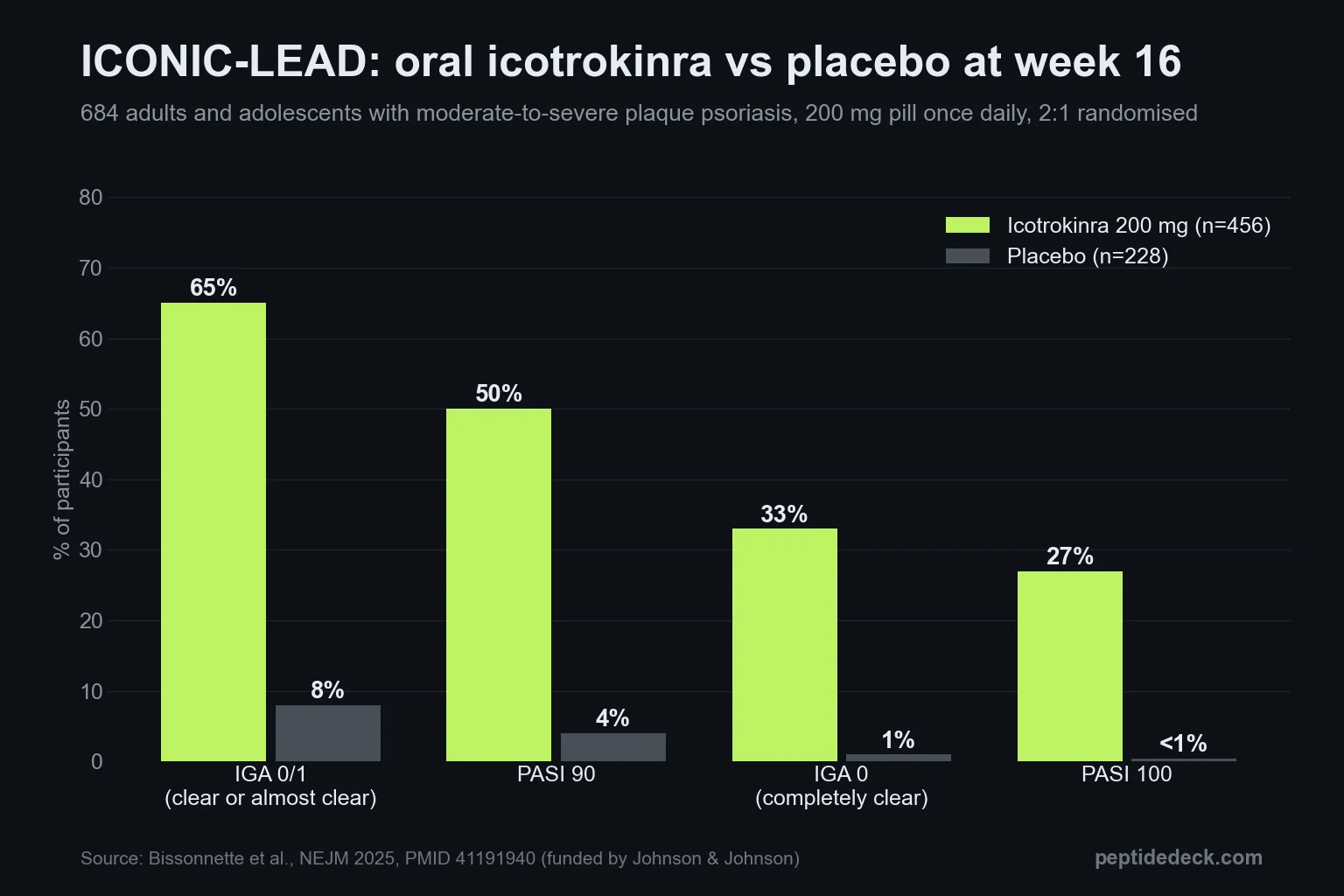
The key trial, ICONIC-LEAD, randomised 684 adults and adolescents aged 12 and over with moderate-to-severe plaque psoriasis (at least 10% of body surface, PASI 12 or higher) to icotrokinra 200 mg once daily or placebo in a 2:1 ratio (PMID 41191940, NCT06095115). At week 16:
- 65% vs 8% reached IGA 0/1, meaning clear or almost-clear skin.
- 50% vs 4% reached PASI 90, a 90% drop in the severity score.
- 33% vs 1% had completely clear skin (IGA 0), and 27% vs under 1% reached PASI 100.
- 49% in both groups reported at least one side effect, most often a cold or upper respiratory infection.
The FDA approved it on 18 March 2026 for moderate-to-severe plaque psoriasis in adults and in adolescents 12 and older who weigh at least 40 kg (PMID 42433845). Johnson & Johnson funded the trial. The placebo comparison lasted only 16 weeks, there was no head-to-head against an injectable biologic, and the authors say longer-term data are still needed.
You cannot buy it from a peptide vendor. It is a prescription drug, which is the point: a known dose, a pharmacy-made product and a doctor who knows your history.
Every Peptide People Ask About, Graded
Here is the whole field on one screen. Each row is graded by the best evidence in people with psoriasis or psoriatic arthritis, not by how the peptide is marketed.
The bottom four are what peptide shops sell for "autoimmune" or "skin" use, and none has a single psoriasis result in people. For a wider view of skin peptides, see our peptides for skin guide, and for the broader immune picture, peptides for autoimmune disease.
GLP-1 Drugs: Strongest When Weight Is Part of It
Weight and psoriasis feed each other. Overweight or obesity affects 60% to 78% of people with psoriasis, and it is tied to more severe disease and weaker responses to treatment (PMID 42139049). In one risankizumab study, people with a higher BMI cleared more slowly at weeks 4 and 16 (PMID 38797050).
TOGETHER-PsO: tirzepatide added to a biologic
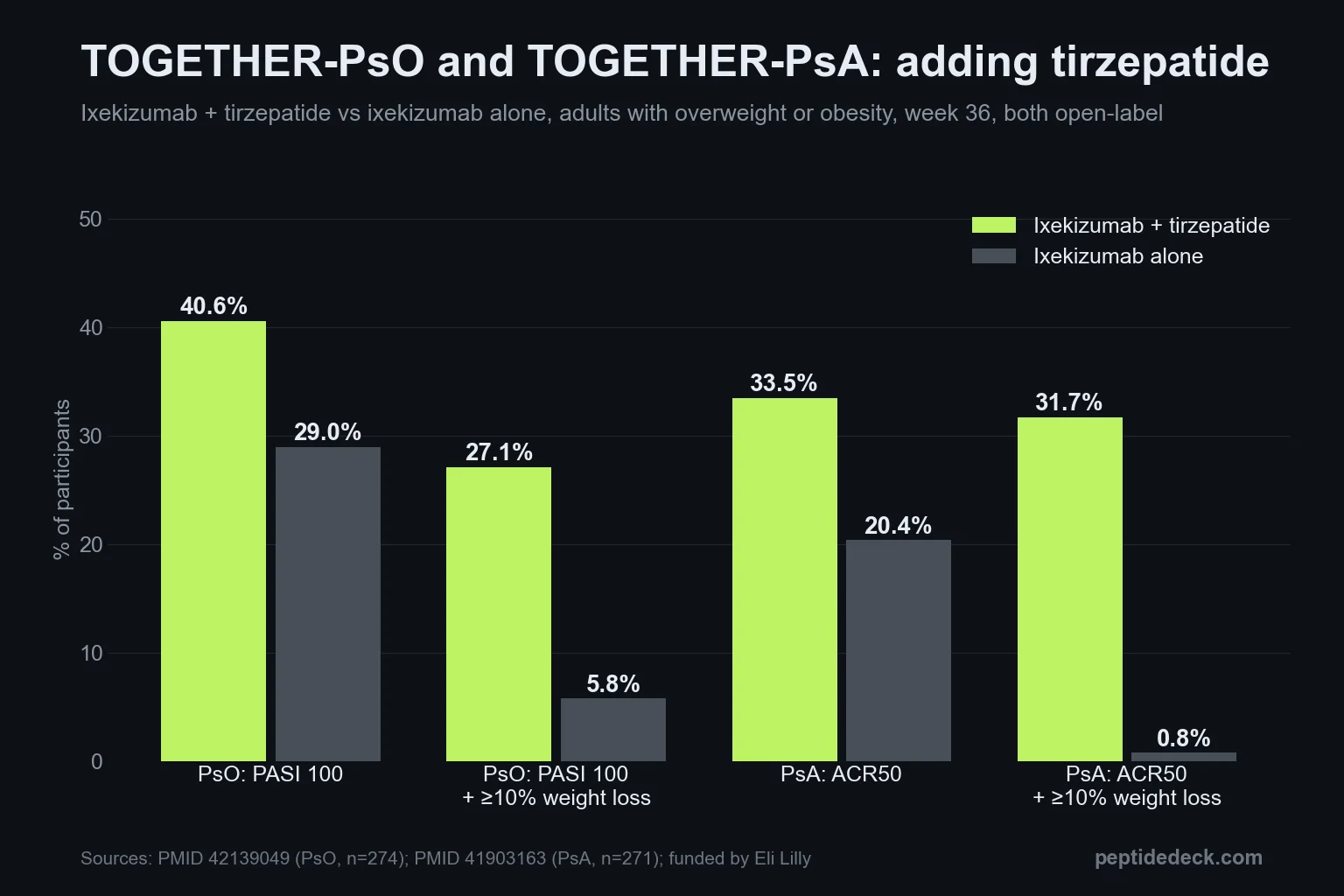
Eli Lilly ran this open-label trial at 72 US sites in 274 adults with moderate-to-severe plaque psoriasis and overweight or obesity (average BMI 39.2, average PASI 19.7). Everyone got the biologic ixekizumab; half also got tirzepatide (PMID 42139049, NCT06588283). By week 36:
- 40.6% vs 29.0% reached completely clear skin (PASI 100).
- 27.1% vs 5.8% reached both clear skin and at least 10% weight loss.
- 69.2% vs 9.1% lost at least 10% of their body weight.
The skin gain was modest: the confidence interval for PASI 100 ran from 0.3 to 22.9 points, so the true difference could be small. Lilly makes both drugs, and nobody was blinded.
TOGETHER-PsA: the joints moved too
The sister trial randomised 271 adults with active psoriatic arthritis and overweight or obesity. ACR50, a 50% improvement in joint symptoms, was reached by 33.5% on ixekizumab plus tirzepatide versus 20.4% on ixekizumab alone. Joint response plus 10% weight loss: 31.7% vs 0.8% (PMID 41903163, NCT06588296).
Smaller trials: semaglutide and liraglutide
In 31 people with psoriasis, obesity and type 2 diabetes, 12 weeks of semaglutide cut the median PASI from 21 to 10 and the median DLQI (a quality-of-life score) from 14 to 4, with lower IL-6 and CRP (PMID 39858442). The control group received no placebo, so expectation effects cannot be ruled out.
In 25 people with psoriasis and type 2 diabetes, 12 weeks of liraglutide dropped the average DLQI from 22.0 to 3.8, and skin samples showed less IL-17, IL-23 and TNF-alpha (PMID 32962477).
The liraglutide trial that found nothing
Most articles skip this one. A Danish double-blind trial gave liraglutide or placebo for 8 weeks to 20 obese people with plaque psoriasis but normal blood sugar (PMID 25139195). PASI fell 2.6 points on liraglutide and 1.3 on placebo, a difference that was not significant (p = 0.228). Quality of life and CRP did not change. Weight loss was 4.7 kg vs 1.6 kg, and 45% of people on liraglutide had nausea.
The pattern: skin scores moved in people with type 2 diabetes or large weight loss, and not in a short trial of people without diabetes who lost under 5 kg. Weight and metabolism look like the lever, not a direct skin effect.
Two honest caveats before you shop. The large trials used branded tirzepatide next to a biologic; compounded tirzepatide is the same molecule but is not what they tested. And one published case describes a psoriasis flare after starting tirzepatide in a patient whose disease had been in remission (PMID 42005509).
If obesity is part of your picture and your doctor agrees a GLP-1 makes sense, cost is usually the next wall. Our breakdown of the cheapest tirzepatide options compares brand and compounded prices per month (we earn a commission from some providers listed there, at no extra cost to you).
LL-37: Do Not Inject or Apply It
This one runs in the wrong direction. LL-37 is an antimicrobial peptide your own skin makes, and peptide shops sell it as an immune and infection helper. In psoriasis, though, it is part of the problem.
A 2007 study in Nature identified LL-37 as the key factor that switches on plasmacytoid dendritic cells in psoriasis. It binds the body's own DNA and turns it into a trigger for type 1 interferon, breaking immune tolerance to self (PMID 17873860). Later work found T cells that react to LL-37 as an autoantigen in a subset of patients, and people reacting to both LL-37 and a second skin protein (ADAMTSL5) responded less well to risankizumab from week 16 (PMID 38797050).
No trial has tested LL-37 as a psoriasis treatment. Injecting or rubbing in more of a known psoriasis autoantigen could plausibly feed a flare, so this is one peptide to rule out completely. Our LL-37 profile covers what it was studied for elsewhere.
Thymosin Alpha-1: Untested, and the Wrong Push
Thymosin alpha-1 is sold as an immune booster. The only psoriasis-related paper measured blood levels, not treatment: 120 people with psoriatic arthritis had lower serum thymosin alpha-1 than 120 blood donors, the lowest of any group tested (PMID 27350088). A low level does not mean topping it up helps, and the authors called for more studies.
There is also a direction problem. Psoriasis runs on an immune system already switched on, and every drug that works here blocks a signal (IL-23 or IL-17). A peptide marketed to activate immunity pushes the other way, and interferon-type immune activation is a known psoriasis trigger. That is a class concern, not a tested result. More detail is on our thymosin alpha-1 page.
KPV and BPC-157: A Gut-Skin Story Without Skin Data
The marketing pitch sounds tidy enough. Psoriasis, the story goes, starts with a leaky gut; calm the gut with BPC-157 or KPV and the skin follows.
The evidence does not get that far. PubMed returns zero records pairing BPC-157 with psoriasis and zero for KPV. KPV, a fragment of the hormone alpha-MSH, has anti-inflammatory results in animals only. Its parent hormone reduced plaques as a gel in one mouse psoriasis model (PMID 26582563), but KPV itself has never been tested in one. BPC-157's human reports come from one clinic group published in Alternative Therapies in Health and Medicine with no control arm, and none of them involved skin disease.
That does not prove they do nothing; it means anyone promising clearer skin is guessing. Our roundup of peptides for inflammation shows where each one has, and has not, been tested.
NAD+: A Small Immune Signal, No Skin Score
This one at least has a trial. Twenty-nine people with mild-to-moderate psoriasis took oral nicotinamide riboside (an NAD+ precursor) 500 mg twice daily or placebo for 4 weeks (PMID 42048163, NCT04271735). Their blood T cells became less prone to Th17 inflammation, the pathway psoriasis drugs block, and levels of a calming signal called SLIT2 rose.
What the published paper does not report is a skin score. No PASI, no IGA, no photo comparison. The trial was publicly funded by the US NHLBI, which helps, but it used a capsule, not the injectable NAD+ sold in vials. Treat it as an interesting lead, not a reason to start injecting.
Safety: What Can Go Wrong
Most risks here come from good intentions. Someone picks a product that pushes the immune system the wrong way, or adds it to a biologic without telling anyone.
- Feeding the disease. LL-37 is a psoriasis autoantigen (PMID 17873860), and immune-activating peptides such as thymosin alpha-1 push in the direction psoriasis already leans.
- Mast-cell reactions. Injectable peptides can activate skin mast cells directly through a receptor called MRGPRX2, which explains many injection-site reactions to approved peptide drugs (PMID 25517090). If your skin already reacts easily, expect more redness and itch where you inject.
- Infection on a biologic. IL-23 and IL-17 blockers dampen parts of your immune defence, which makes a non-sterile gray-market vial a bigger gamble.
- GLP-1 side effects. Gut side effects were more common when tirzepatide was added (PMID 42139049); 45% had nausea on liraglutide (PMID 25139195); and one case report links tirzepatide to a flare (PMID 42005509).
- Stopping what works. Do not stop or skip a prescribed biologic, pill or cream to make room for a peptide. Change your plan with your dermatologist, not around them.
If you also have joint pain, our sister guide on peptides for arthritis covers the joint evidence separately.
What to ask your doctor
- Am I a candidate for icotrokinra (Icotyde), and how would it compare with what I use now?
- Given my weight and blood sugar, would a GLP-1 drug make sense alongside my psoriasis treatment?
- If I start tirzepatide or semaglutide, which flare signs should I report?
- Is it safe to inject anything non-prescription while I am on a biologic?
- Which supplements or peptides could interfere with my current treatment?
Frequently Asked Questions
Sources
- Bissonnette R, et al. Oral icotrokinra for plaque psoriasis in adults and adolescents (ICONIC-LEAD). N Engl J Med. 2025;393(18):1784-1795. PMID 41191940
- Abid MA, et al. FDA approves Icotyde (icotrokinra): a novel IL-23 receptor antagonist for plaque psoriasis. Ann Med Surg. 2026;88(7):4769-4770. PMID 42433845
- Lebwohl M, et al. Ixekizumab with or without tirzepatide in adults with psoriasis and overweight or obesity (TOGETHER-PsO). JAMA Dermatol. 2026;162(7):709-719. PMID 42139049
- Merola JF, et al. Ixekizumab with tirzepatide in adults with psoriatic arthritis and overweight or obesity (TOGETHER-PsA). Arthritis Rheumatol. 2026;78(10):2089-2101. PMID 41903163
- Faurschou A, et al. Lack of effect of the GLP-1 receptor agonist liraglutide on psoriasis in glucose-tolerant patients. J Eur Acad Dermatol Venereol. 2015;29(3):555-9. PMID 25139195
- Lin L, et al. Liraglutide therapy for psoriasis patients with type 2 diabetes: a randomized-controlled trial. J Dermatolog Treat. 2022;33(3):1428-1434. PMID 32962477
- Petković-Dabić J, et al. Effects of semaglutide treatment on psoriatic lesions in obese patients with type 2 diabetes mellitus. Biomolecules. 2025;15(1):46. PMID 39858442
- Han K, et al. NAD+ augmentation by nicotinamide riboside engages SLIT2/ROBO1 signaling to attenuate Th17 inflammation in psoriasis. JCI Insight. 2026;11(12):e203826. PMID 42048163
- Lande R, et al. Plasmacytoid dendritic cells sense self-DNA coupled with antimicrobial peptide. Nature. 2007;449(7162):564-9. PMID 17873860
- Favaro R, et al. Autoreactivity to self-antigens LL37 and ADAMTSL5 influences the clinical response to risankizumab in psoriatic patients. J Autoimmun. 2024;147:103244. PMID 38797050
- Pica F, et al. Serum thymosin alpha 1 levels in patients with chronic inflammatory autoimmune diseases. Clin Exp Immunol. 2016;186(1):39-45. PMID 27350088
- Shah PP, et al. Percutaneous delivery of alpha-melanocyte-stimulating hormone for the treatment of imiquimod-induced psoriasis. J Drug Target. 2016;24(6):537-47. PMID 26582563
- Neptune Rosa JM, et al. Psoriasis flare following tirzepatide initiation in a patient with plaque psoriasis in remission. JAAD Case Rep. 2026;71:28-30. PMID 42005509
- McNeil BD, et al. Identification of a mast-cell-specific receptor crucial for pseudo-allergic drug reactions. Nature. 2015;519(7542):237-41. PMID 25517090
- ClinicalTrials.gov: NCT06095115 (ICONIC-LEAD)
- ClinicalTrials.gov: NCT06588283 (TOGETHER-PsO)
- ClinicalTrials.gov: NCT06588296 (TOGETHER-PsA)
- ClinicalTrials.gov: NCT04271735 (nicotinamide riboside pilot)
Medical Disclaimer: This article is for general information and is not medical advice. Psoriasis and psoriatic arthritis need a diagnosis and a treatment plan from a qualified clinician. Do not start, stop or change any prescribed medication, including biologics, pills or creams, without talking to your doctor. Gray-market peptides are not approved for psoriasis, and their purity and sterility are not guaranteed.