Every peptide price you have seen is probably real. A $49 vial, a $150 telehealth plan and a $445 clinic package can all describe the same molecule. That is why the peptides price question gets such wild answers, and why "how much do peptides cost" has no single number until you know two things: where you buy, and how much you inject.
🔑 Key Takeaways
- Two $50 vials can mean a $50 month or a $560 month. The reason is one number most price lists leave out.
- Price per milligram barely moves between popular peptides. Something else explains a tenfold gap in monthly cost.
- The same BPC-157 dose costs roughly three different amounts depending on which door you walk through.
- Brand-name GLP-1 prices dropped hard in 2026, and one of them now sits close to some vendor math.
- A few costs never show up on the product page. They add up faster than people expect.
Below you will find real listed prices checked on September 26, 2026, the dose each one assumes, and the math to turn a vial price into a monthly bill. Start with the thing that confuses almost everyone.
Why peptide prices look so random
The vial price is only half the story. If you have ever compared a $49 vial with a $400 monthly clinic quote and wondered who is lying, the answer is usually nobody.
Three things decide what you actually pay:
- The route. A peptide vendor sells you powder. A telehealth service adds a prescriber and a compounding pharmacy. An in-person clinic adds visits, bloodwork and supplies. A brand-name drug adds FDA approval and a manufacturer's price.
- Your dose. Some peptides are dosed in micrograms, others in milligrams. That single difference can multiply your monthly cost by ten.
- The vial size. Bigger vials usually cost less per milligram, but only if you finish them before the mixed solution expires.
Most price guides show you the first item. Very few show the second, and it is the one that decides whether your month costs $50 or $500.
Peptides price by route: vendor, telehealth, clinic or brand
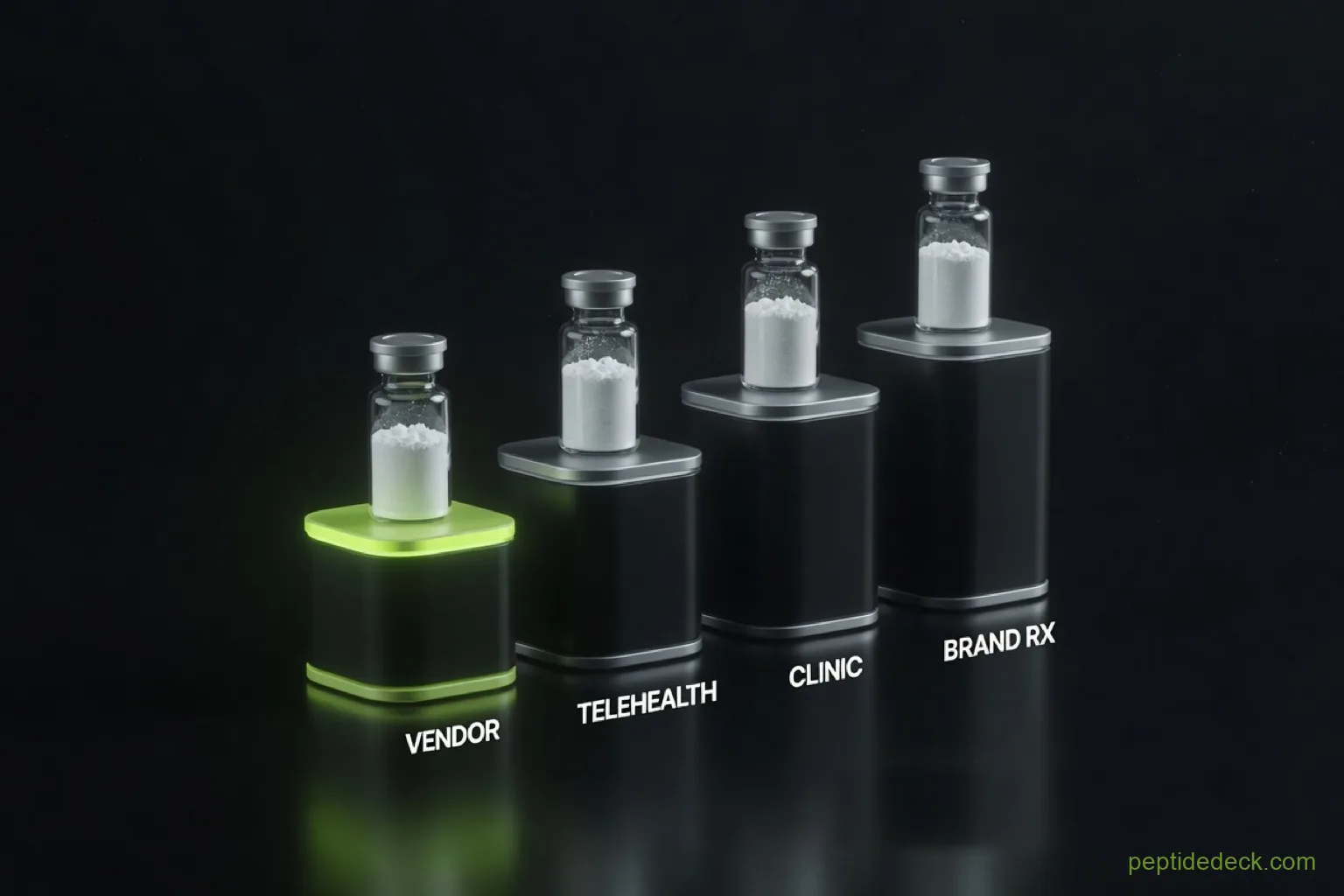
Same molecule, four very different bills. Here is what each route typically charges in 2026 and what the money actually buys.
Peptide vendors: cheapest, and you do the work
Vendors sell freeze-dried powder that you mix with bacteriostatic water and inject yourself. There is no consultation fee and no prescriber, which is why this route is the cheapest by a wide margin.
The tradeoff is real. Nobody checks whether a peptide suits you, and quality depends entirely on the seller. The only protection you have is a batch-matched certificate of analysis, and knowing how to read a peptide COA is worth more than any discount code. Peptides like BPC-157 and TB-500 are unapproved drugs in the US, so a vendor vial is not the same product as a pharmacy prescription.
Telehealth plus a compounding pharmacy: the middle price
Here a licensed prescriber reviews your intake and sends a prescription to a 503A compounding pharmacy, which ships a prepared vial. One telehealth service that publishes its prices lists a flat $39 visit fee plus around $80 for a compounded BPC-157 vial, and says most of its patients land between $65 and $260 a month.
Why did compounded BPC-157 prices start showing up at all? In July 2026, FDA's Pharmacy Compounding Advisory Committee met to weigh BPC-157, TB-500, KPV, MOTS-c, Semax, Epitalon and DSIP for the 503A bulks list, and BPC-157 was reported as recommended by an 8 to 6 vote with one abstention. That vote is non-binding. Our breakdown of the FDA peptide vote covers what still has to happen before pharmacies have clear legal footing.
In-person clinics: the most expensive, and the most support
Clinics bundle the consult, bloodwork, supplies, follow-ups and often body composition tracking. One Florida clinic publishes $445 per cycle for a single-peptide protocol and $795 to $1,295 per cycle for multi-peptide stacks. The peptide itself is a small slice of that bill. You are mostly paying for a clinician who knows your history, which is worth it if you have a medical condition or take other medications. Our peptide therapy guide explains what that supervision actually covers.
Brand-name prescription drugs: the reference price
Some peptides are approved drugs with a US prescription requirement: semaglutide (Wegovy), tirzepatide (Zepbound), tesamorelin (Egrifta) and bremelanotide (Vyleesi, the approved form of PT-141). For these, the brand price is the legitimate benchmark, and in 2026 the GLP-1 brands got much cheaper for people paying cash.
- Wegovy pens: $349 a month at NovoCare Pharmacy for every standard dose, with new patients paying $199 for each of their first two months on the 0.25 mg and 0.5 mg doses (offer runs through December 31, 2026).
- Zepbound vials: $299 for 2.5 mg, $399 for 5 mg, and $449 for 7.5 mg through 15 mg at LillyDirect, as long as you refill within 45 days. Miss that window and the higher doses cost up to $699.
If a GLP-1 is what you need, a prescription is the legal route, and at these prices it is closer to vendor territory than it has ever been.
How much do peptides cost per month? The dose decides
This is the table most price lists skip. It starts with the listed vial price, applies a commonly used dose, and shows how much powder that dose burns through in four weeks.
Listed Ascension Peptides prices checked September 26, 2026, before any discount code. Tesamorelin, PT-141 (bremelanotide) and retatrutide doses come from the FDA labels and published trials; the others are the doses people commonly inject, shown on our dosage charts. Figures are the cost of the powder you use; you buy whole vials, so round up.
Why tesamorelin costs ten times more than CJC-1295
Look at the price per milligram. Almost every peptide in the table sits between $4.90 and $10.80. So the molecule is not what makes one month expensive.
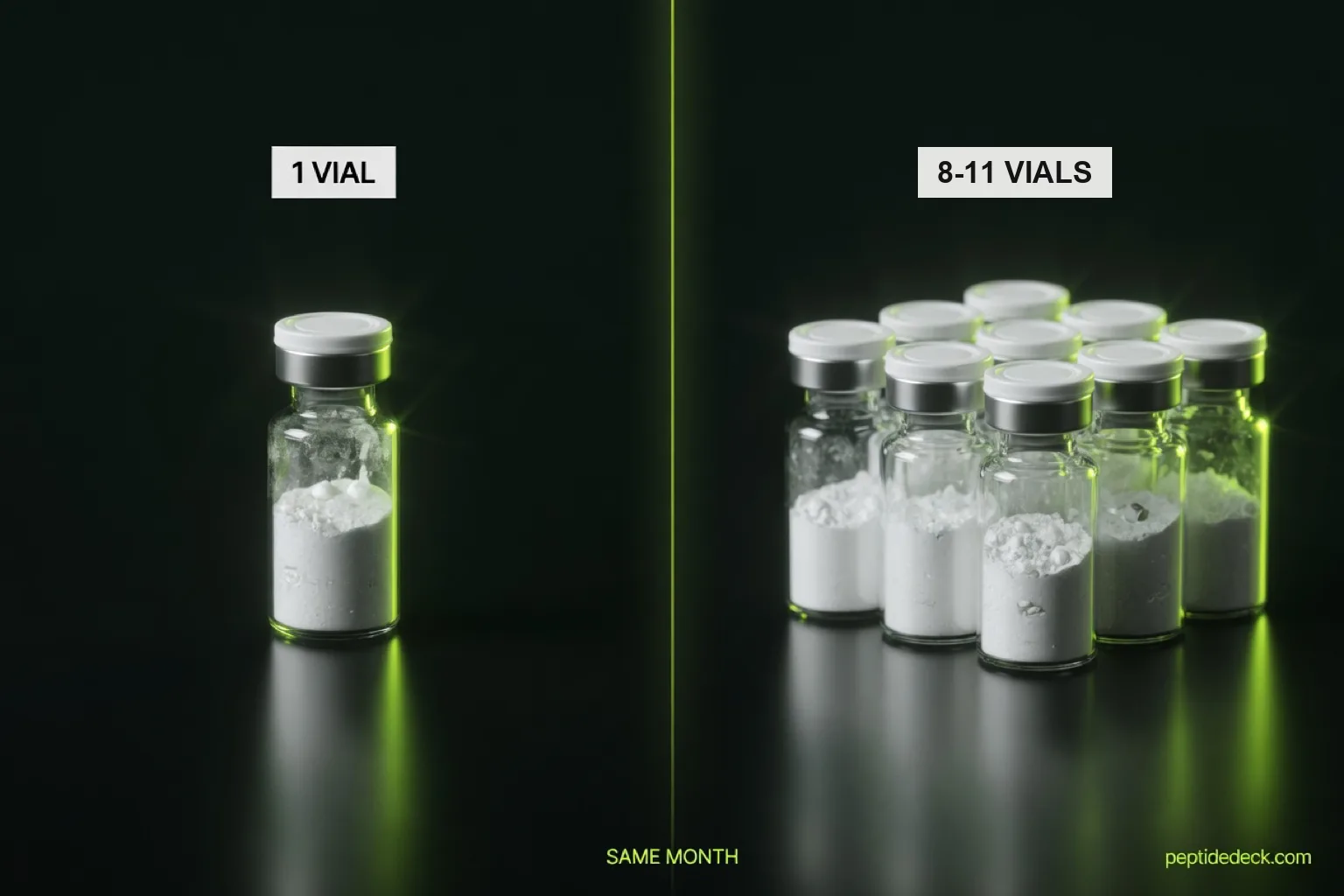
The dose is. CJC-1295 is commonly injected at 100 micrograms a night, which is under 3 mg in four weeks. Tesamorelin was studied at 2 mg a day in its phase 3 trial, and the current Egrifta SV label sets 1.4 mg a day. That is 39 to 56 mg a month from the same $50 vial size. Same shelf price, completely different month. Our tesamorelin dosage chart shows the full schedule.
Why BPC-157 is one of the cheapest peptides to run
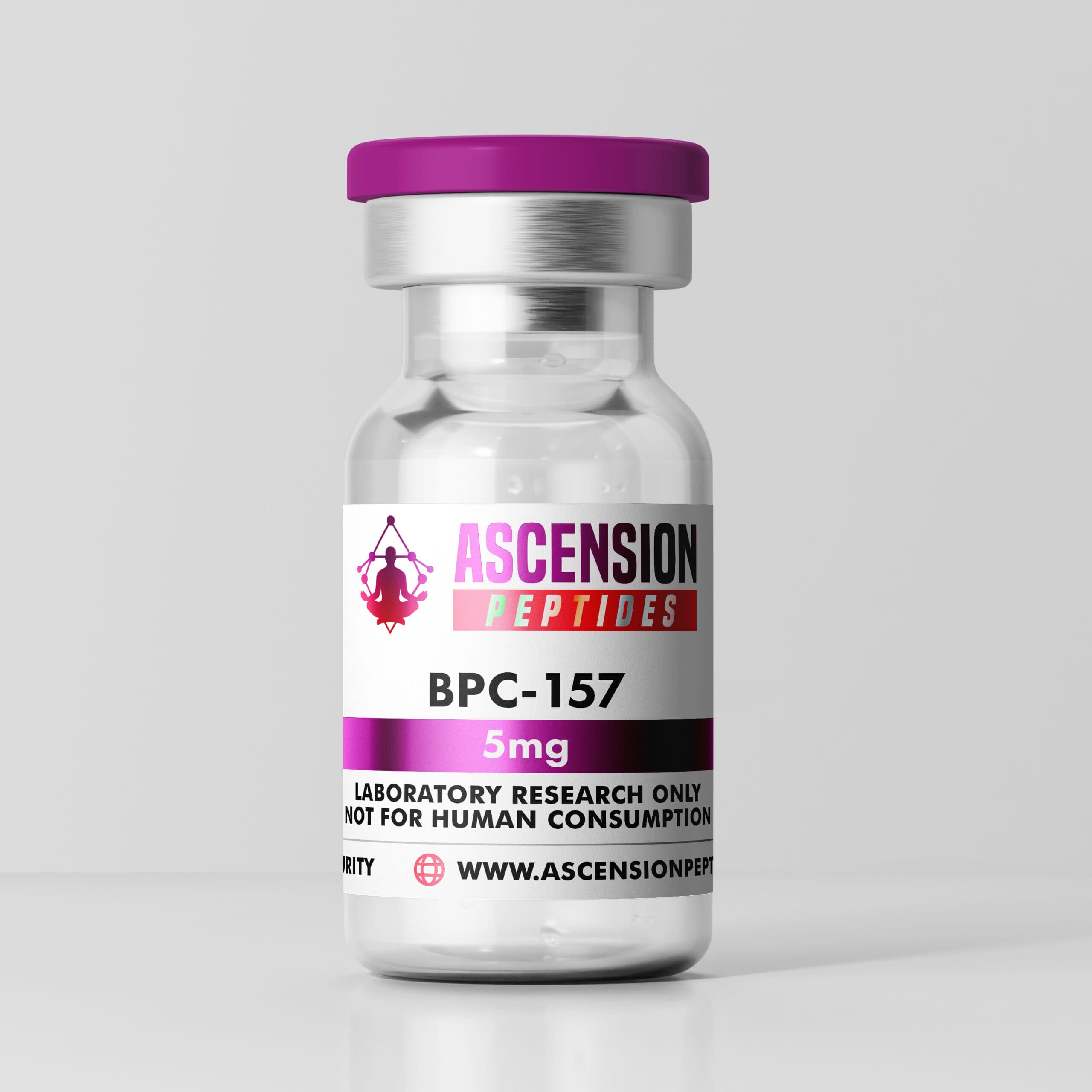
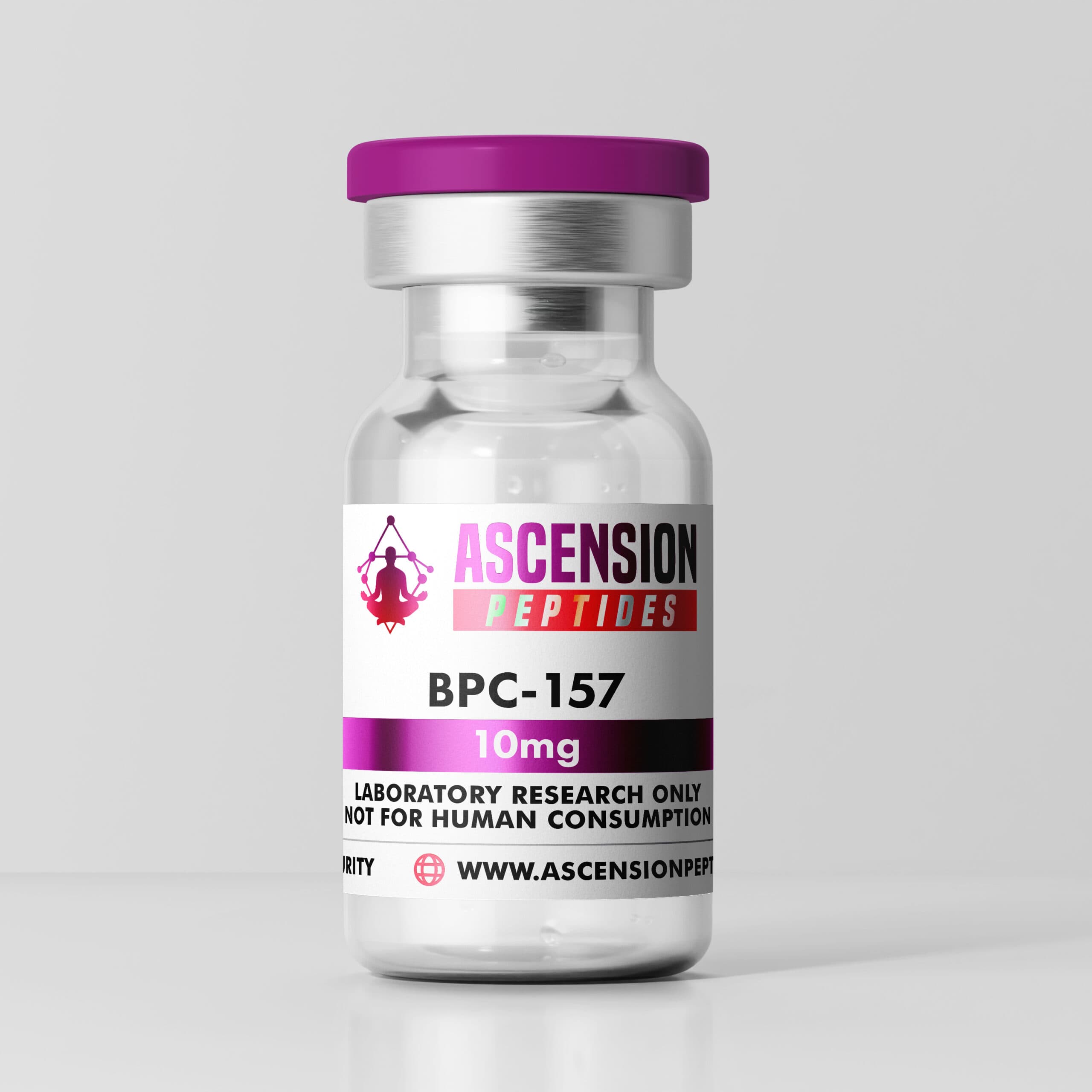
BPC-157 is dosed in micrograms and sold in 10 mg vials at under $5 per milligram. At the standard 250 mcg twice a day from our BPC-157 dosage chart, one vial lasts about 20 days. That works out to roughly $69 of powder over four weeks, or about $1.23 per shot.
Why TB-500 gets expensive in the first month
TB-500 is usually run as a loading phase. At 2.5 mg twice a week, you finish a 5 mg vial every week, so the first month is about $216. When most people drop to 2.5 mg once a week, the cost halves to about $108. The TB-500 dosage chart shows both phases.
Retatrutide: the price swings with the dose ladder
Retatrutide is not approved anywhere yet, so there is no prescription price to compare. In the phase 2 trial in NEJM, weekly doses ran from 1 mg to 12 mg, and the 12 mg group lost an average of 24.2% of body weight at 48 weeks. At 4 mg a week you use about 16 mg a month; at 12 mg you use 48 mg. That is the difference between roughly $128 and $320 a month in vial math. Our retatrutide cost breakdown walks through each step of the titration.
Work out your own monthly cost in 3 steps
- Daily dose in mg × days you inject in 4 weeks = mg you need. (250 mcg twice a day = 0.5 mg × 28 = 14 mg.)
- mg you need ÷ mg per vial = vials. (14 ÷ 10 = 1.4 vials.)
- Vials × vial price = your monthly cost. (1.4 × $49 = $68.60.)
The peptide calculator does the syringe side of this for you.
The costs that are not on the product page
The vial is rarely your only purchase. People budgeting for their first month often forget these.
- Bacteriostatic water. Usually $8 to $15 a vial, and a vial is good for 28 days after the first needle goes in. Our bacteriostatic water guide explains why the biggest size is often the wrong buy.
- Insulin syringes and alcohol swabs. A box of 100 syringes can run anywhere from about $15 to $70 depending on brand and store.
- Shipping. Many vendors ship free above a minimum order, which quietly pushes people into buying a second vial.
- Bloodwork. Clinics and many telehealth services require labs before they prescribe. That is extra unless the package says otherwise.
- Independent testing. A single third-party purity test often costs more than the vial it checks, which is why most people rely on the vendor's batch COA.
- Waste. Once mixed, most peptides are kept refrigerated and used within about four weeks. A big vial you cannot finish in that window is not a bargain.
What makes one peptide cost more than another
Even at the same route, prices are not arbitrary. Four things push a vial up or down.
- Chain length. Peptides are built one amino acid at a time. A longer chain like tesamorelin (44 amino acids) takes more steps and more purification than a 7-amino-acid fragment like TB-500.
- Purity and testing. Getting from 95% to 99% purity costs extra purification, and paying a lab for HPLC and mass spec on every batch adds more.
- Demand. Popular peptides like BPC-157 are made in large runs, which keeps them cheap. Niche peptides cost more per milligram.
- Vial size. A 30 mg retatrutide vial at $200 works out to $6.67 per mg, versus $8 per mg for the 10 mg size at $80.
Is the cheapest option the best value?
Not always. A $20 vial sounds great until you remember you cannot see what is in it. If a vial is underdosed, your real price per milligram goes up and your results go down, and you would never know why.
That is the whole argument behind checking a vendor before checking its price. If you are comparing peptides for sale, look for a batch number on the vial that matches a recent third-party COA, a published purity figure, and a US shipping address, and treat any price far below the numbers in this guide as a warning sign. For a ranked look at which sellers give the best value without cutting those corners, see our guide to the cheapest peptides in 2026 and our cheapest place to buy peptides comparison.
One honest limitation: the vendor route is the cheapest in every row of this guide, but it is also the only route with no clinician in the loop. If you take other medications, have a heart, kidney or hormone condition, or are pregnant, the cheaper month is not the better month. Talk to a prescriber first. Our guide on how to get peptides prescribed shows what to ask.
Peptide serums and collagen: a different price scale
Not every "peptide" shopper wants an injection. Peptide face serums and collagen peptide powders are sold in drugstores and supermarkets, often for less than a single injectable vial.
They are a different product doing a different job. Collagen peptides are a protein supplement you eat. Peptide serums sit on your skin. Neither delivers the peptides discussed above, so their prices do not compare. If you saw a peptide price that seemed impossibly low, check whether it was a skincare jar or a powder tub before assuming you found a deal.
Does insurance cover peptides?
Usually not, unless the peptide is an approved drug prescribed for its approved use. Compounded peptides and vendor vials are paid out of pocket. Brand-name drugs like Wegovy or Zepbound may be covered, often with prior authorization, and the self-pay prices above are what you pay when they are not.
If you have an HSA or FSA, prescribed medications are generally eligible expenses. Vendor vials bought without a prescription are not. Check with your plan administrator before counting on it.
Frequently Asked Questions
Medical Disclaimer: This article is for informational purposes only and does not constitute medical advice. Prices were checked on September 26, 2026 and change often; confirm current prices with the seller or pharmacy. BPC-157, TB-500 and retatrutide are unapproved drugs with no FDA-approved use. Talk to your doctor before starting any peptide, especially if you have a medical condition, are pregnant or take other medications.