MK-677 Dosage Guide: Ibutamoren Protocol, Timing & Cycle Length (2026)
MK-677 (ibutamoren, also designated MK-0677 and L-163,191) is a non-peptide, orally active ghrelin receptor agonist and growth hormone secretagogue. Unlike injectable GHRPs such as ipamorelin or GHRP-6 — see our peptides vs HGH comparison — MK-677 is a small molecule that mimics the action of ghrelin at the GHS-R1a receptor, stimulating pulsatile GH release and sustained IGF-1 elevation. Its oral bioavailability and 24-hour half-life make it unique among GH secretagogues — a single daily oral dose produces consistent, measurable GH and IGF-1 elevation, and no injection is required. MK-677 has been studied in published clinical trials for GH deficiency, muscle wasting, osteoporosis, and Alzheimer's disease, giving it an unusually robust human clinical data set — helping it rank high among growth hormone peptides. Getting the mk-677 dosage right matters more than people realize: as our MK-677 safety review details, the difference between 10 mg and 25 mg produces markedly different side effect profiles while offering diminishing incremental IGF-1 benefit.
- Typical research dose: 10–25 mg per day
- Frequency: Once daily (oral)
- Route: Oral (no injection required)
- Cycle length: 8–16 weeks
- Half-life: ~24 hours
- Best time to dose: Before bed (aligns with natural GH pulse)
MK-677 Dosage Chart — Quick Reference
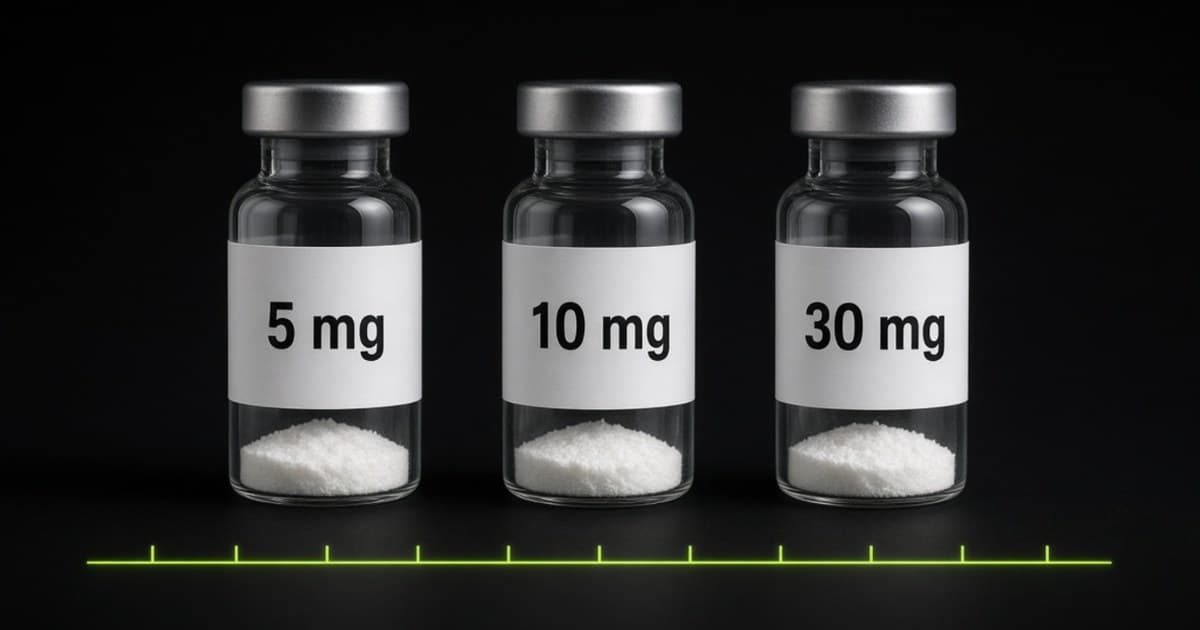
This mk-677 dosage chart summarizes the three main protocol tiers used in research. Most people start at the beginner level and assess tolerance before moving up. Many people settle at 15–20 mg to avoid the aggressive hunger and water retention that comes with 25 mg, although 25 mg is the standard dose used in clinical trials.
Note that 50 mg/day has been studied in clinical trials for muscle wasting and cachexia — but the side effect burden at that level (significant hunger, edema, insulin resistance) makes it impractical for most research applications. The ibutamoren dosage sweet spot is clearly in the 10–25 mg range, and the chart above reflects that.
Standard MK-677 Dosage Protocols
MK-677's clinical trial data provides unusually clear dosing guidance relative to most research peptides. Multiple published studies have used 10 mg, 25 mg, and 50 mg daily doses, with 25 mg being the most widely studied dose for GH/IGF-1 optimization:
The data from published trials (including those by Murphy et al. and Nass et al.) consistently show that 25 mg provides most of the IGF-1 benefit of 50 mg with substantially fewer side effects. The 10 mg dose is well-tolerated but produces more modest GH/IGF-1 responses. For most body composition and anti-aging research applications, 25 mg/day is the reference mk-677 dose.
Important distinction: MK-677 is not a peptide — it is a non-peptide small molecule that mimics peptide action at the ghrelin receptor. Unlike injectable GHRPs, it does not require reconstitution, syringes, or cold storage. It is typically supplied as oral capsules or a liquid solution for research purposes — see our guide to buying MK-677 for sourcing tips.
MK-677 Dosage for Women
The standard ibutamoren dosage literature is largely built on male research subjects, which means women are left guessing. Based on the available data and the compound's mechanism, the guidance is fairly straightforward: 10 mg/day is the right starting mk-677 dosage for women, and many find that's enough.
The key issue is that two of MK-677's main side effects — increased appetite and water retention — tend to be more pronounced in women at higher doses. Ghrelin receptor sensitivity may differ between sexes, and the hunger stimulation at 25 mg can be substantial enough to undermine body composition goals entirely. Water retention in the face and extremities is also more commonly reported by women at doses above 10 mg.
- 10 mg/day: Sweet spot for most women — delivers meaningful IGF-1 elevation (~40–52%), supports sleep quality, skin, and lean mass without overwhelming hunger
- 15 mg/day: Some women tolerate this well; assess hunger and water retention carefully before increasing from 10 mg
- 25 mg/day: Generally not recommended for women as a starting point — the side effect burden is significantly higher relative to the incremental benefit
For women focused on anti-aging, sleep quality, or skin health, the 10 mg mk-677 dosage is fully sufficient. There's no need to push higher unless a specific body composition goal demands it and tolerance at 10 mg has been established over several weeks.
MK-677 Dosage for Muscle Growth
If the primary goal is body recomposition — gaining lean mass and reducing fat — the mk-677 dosage needs to be in the 20–25 mg range to maximally elevate GH and IGF-1. This is where the compound earns its reputation — see our full MK-677 benefits and results breakdown. At 25 mg/day, published clinical trials have documented IGF-1 increases of 60–79% above baseline, sustained over months. That's a meaningful anabolic signal, particularly when combined with resistance training.
A few things to understand about MK-677 for muscle growth specifically:
- GH/IGF-1 elevation alone doesn't build muscle. MK-677 creates the hormonal environment for growth, but resistance training is required to direct that signal toward lean mass rather than just fat mobilization. Studies on MK-677 in sedentary elderly subjects showed fat-free mass increases even without exercise — but the response in trained individuals with progressive overload is substantially greater.
- The 25 mg mk-677 dose is the reference. Going to 50 mg produces only marginal additional IGF-1 elevation (~70–80% vs. 60–79%) with significantly more side effects. It's not worth it for muscle-building research.
- Allow 4–6 weeks for measurable changes. MK-677 works through GH pulse amplification — it's not a rapid responder like creatine. Body composition changes typically become apparent at the 6–8 week mark.
- Hunger management is critical. At 25 mg, appetite increases are significant. Unmanaged, this can lead to caloric surplus and fat gain rather than recomposition. Bedtime dosing helps by putting the peak hunger window during sleep.
Stacking MK-677 at 25 mg with ipamorelin or CJC-1295 for additional GH pulse stimulation is an advanced strategy some researchers use for maximum GH axis activation.
MK-677 Dosage for Anti-Aging
Here's where a lot of people over-engineer things. For anti-aging applications — GH restoration, sleep quality, skin thickness, cognitive sharpness — you don't need 25 mg. The 10–15 mg ibutamoren dosage range is usually enough.
That lower range is an extrapolation, not a tested result. Nass et al. (2008) gave healthy elderly subjects 25 mg daily for 12 months and found that the compound restored IGF-1 to levels seen in younger adults without significant adverse effects — making it a viable option as explored in our sermorelin vs TRT vs MK-677 comparison. The whole anti-aging case for MK-677 is built on restoring age-related GH decline — not maximizing GH beyond physiological norms.
At 10–15 mg/day for anti-aging research, you can expect:
- IGF-1 restoration toward youthful ranges (~40–55% increase from age-depleted baseline)
- Improved slow-wave sleep within 1–2 weeks (see section below)
- Skin hydration and thickness improvements over 8–12 weeks
- Potential improvements in bone mineral density over longer cycles
- Reduced hunger side effects compared to the 25 mg mk-677 dose
Older research subjects (50+) in particular tend to respond well at 10 mg because their baseline GH/IGF-1 is more depleted — the relative improvement is larger even at the lower dose. Pushing to 25 mg in this population increases insulin resistance risk without proportional benefit.
MK-677 Dosage for Sleep
Probably the most underappreciated application. At 10 mg taken before bed, MK-677 produces dramatic improvements in slow-wave (deep) sleep — typically within 1–2 weeks of starting the protocol. This isn't anecdotal. Murthy et al. documented significant increases in REM sleep and sleep quality markers in MK-677 research, consistent with ghrelin's known sleep-promoting effects at the hypothalamic level.
The mechanism makes sense: ghrelin receptor agonism promotes GH secretion, which is predominantly released during slow-wave sleep, and simultaneously amplifies the NREM sleep signal itself. You end up with more deep sleep and more GH output during that sleep — a compounding effect.
For sleep-focused research, the 10 mg mk-677 dosage is the practical recommendation (our peptide dosage calculator guide can help with conversions):
- Take 30–60 minutes before bed
- Effects on sleep quality are typically noticeable within the first week
- Vivid dreams are commonly reported in weeks 1–2, usually settling by week 3
- Going to 25 mg does not necessarily improve sleep further and significantly increases hunger at night
If the primary goal is sleep improvement, there's genuinely no reason to use more than 10 mg. Save the higher doses for when muscle growth or body recomposition is the target.
Morning vs Night Dosing: Which Is Better?
MK-677's ~24-hour half-life means once-daily dosing maintains consistent plasma levels and produces a sustained elevation in GH pulse amplitude and IGF-1. Splitting the dose is not required and provides no benefit over single daily dosing. But the timing still matters — and bedtime wins for most purposes.
Why bedtime dosing is optimal:
- Aligns GH stimulation with the natural nocturnal GH pulse, potentially amplifying total nightly GH output
- The hunger-stimulating effects of ghrelin receptor agonism are less disruptive during sleep — you're not awake fighting cravings
- Synergizes with slow-wave sleep promotion for a compounding GH effect
When morning dosing makes sense:
- When vivid dreams or sleep disturbance are a concern (occasional reports, especially in weeks 1–2)
- When the research subject's schedule makes consistent bedtime dosing difficult
- Morning dosing is compatible with fasted states post-waking, which may modestly enhance the GH pulse
MK-677 Dosage Calculator — Worked Examples
There's no official body-weight-based dosing protocol for MK-677 (unlike some peptides where mcg/kg matters significantly). Clinical trials used fixed doses — 10 mg, 25 mg, 50 mg — not weight-adjusted ones. That said, body size and composition do influence how people respond, particularly to the side effects.
Here's a practical framework for determining the right mk677 dosage for your research subject:
Start at 10 mg regardless of body weight
Week 1–2: 10 mg before bed. Assess hunger increase (scale of 1–10 compared to baseline) and any noticeable water retention or joint puffiness. Sleep quality changes are often apparent by day 4–7.
Decide at week 3 whether to increase
If hunger at 10 mg is manageable (5/10 or less) and the research goal is body recomposition or muscle growth, increase to 15 mg at week 3. If anti-aging or sleep is the goal, stay at 10 mg — it's sufficient.
Advance to 20–25 mg only if 15 mg is well-tolerated
If 15 mg shows acceptable side effects after 2 weeks, advance to 20–25 mg for the maximum muscle growth signal. Subjects over 90 kg who are highly active may tolerate 25 mg more readily than lighter subjects — not because of pharmacokinetics, but because the body composition goal warrants the hunger trade-off.
Example 1 — 70 kg male, body recomp goal: Start 10 mg weeks 1–2 → 15 mg weeks 3–4 → 20 mg week 5 onward. If hunger stays manageable at 20 mg, that's likely the ceiling. No need to push to 25 mg unless plateauing.
Example 2 — 80 kg male, maximum GH output goal: Start 10 mg weeks 1–2 → 15 mg weeks 3–4 → 25 mg week 5 onward. Manage hunger with bedtime dosing and disciplined diet structure.
Example 3 — 60 kg female, anti-aging / sleep: 10 mg, fixed dose, entire cycle. No escalation needed. The ibutamoren dosage at 10 mg is fully sufficient for these goals and keeps side effects minimal.
Cycle Length
MK-677 has the most robust clinical trial cycle length data of any GH secretagogue in research use:
Short cycle (8–12 weeks)
Sufficient for assessing changes in IGF-1, body composition, sleep quality, and recovery markers. An 8-week cycle at 25 mg/day is the standard structure for performance-focused research applications. A 4-week washout is typical.
Standard cycle (12–16 weeks)
The most common research framework. 16 weeks provides sufficient time for meaningful changes in lean mass, fat mass, and bone remodeling markers. A 4–8 week washout follows before re-initiation.
Extended / long-term research
Published clinical trials have studied MK-677 for up to 12 months (Nass et al., 2008) and even 2 years. These long-term studies provide important safety data but are not typical frameworks for general research. Long-term IGF-1 monitoring is essential in extended protocols, as sustained supraphysiological IGF-1 carries theoretical long-term risks.
Note on continuous vs. cycled use
Some research frameworks use a 5-days-on/2-days-off pattern or continuous dosing without cycling, arguing that MK-677's mechanism does not cause receptor desensitization at standard doses. However, extended continuous use warrants careful biomarker monitoring, and the published safety data beyond 2 years is limited.
MK-677 Long-Term Dosing — Can You Use It Indefinitely?
This is one of the most common questions around the ibutamoren dosage literature, and the answer is nuanced. MK-677 is one of the few research compounds with published 2-year safety data in humans. The Nass et al. study ran for 12 months; other trials have extended further. Receptor desensitization — the main concern with many GH secretagogues — has not been clearly demonstrated with MK-677 at standard doses.
So in principle, longer-term use appears feasible. But that doesn't mean it's the recommended approach.
The concerns with truly continuous, indefinite use:
- Sustained IGF-1 elevation: IGF-1 in the upper quartile of normal for extended periods is associated theoretically with increased proliferative risk. This hasn't been demonstrated definitively in MK-677 trials, but it's a monitoring consideration.
- Insulin resistance: Chronic GH elevation reduces insulin sensitivity. Long-term use without breaks may cumulatively affect glucose metabolism, particularly in subjects with baseline metabolic risk.
- Absence of washout data: We don't have good data on what happens after many years of continuous use. Prudence suggests cycling.
The practical recommendation: cycle 8–12 weeks on, 4–6 weeks off for most applications. If using for anti-aging over years, annual 8-week cycles are a reasonable model. The 2-year clinical data gives confidence that the compound isn't acutely dangerous long-term, but cycling still makes sense as standard practice.
Reconstitution & Preparation
MK-677 does not require reconstitution for most research preparations:
- Oral capsules: Pre-measured doses (typically 10 mg or 25 mg per capsule). No preparation required. Store at room temperature away from moisture and heat.
- Liquid solution: Often supplied at 25 mg/mL in a PEG-400 or DMSO/ethanol carrier. Use the provided dropper or micropipette to measure the dose. Shake well before use. Refrigerate after opening if directed by the supplier.
- Raw powder: If weighing raw powder for research, use a precision milligram scale. MK-677 can be dissolved in DMSO, ethanol, or PEG-400 for solution preparation, or encapsulated. Stable as a powder at room temperature for extended periods if stored away from moisture.
Administration Guide
As an oral compound, MK-677 administration does not involve injection technique considerations. Key administration notes:
- With or without food: The mk-677 dosage can be taken with or without food. Taking with a small meal may reduce GI discomfort at higher doses.
- Avoid alcohol: Alcohol suppresses GH release and undermines the GH secretagogue effect. Evening alcohol consumption is particularly counterproductive in bedtime-dosed protocols.
- Consistent daily timing: Due to the 24-hour half-life, dosing at approximately the same time each day maintains stable trough levels and avoids day-to-day variability in GH/IGF-1 data.
- Dose titration in research: Starting at 10 mg/day for 1–2 weeks before advancing to 25 mg/day is a common titration approach to assess tolerance to hunger stimulation and water retention before committing to the standard research dose.
Stacking MK-677
MK-677's oral route and distinct ghrelin receptor mechanism make it compatible with injectable peptides that operate via different pathways:
- MK-677 + Ipamorelin or CJC-1295: A hybrid GH stack combining oral and injectable secretagogues. MK-677 provides sustained IGF-1 elevation while ipamorelin/CJC-1295 produces additional discrete GH pulses. The combination produces significantly elevated total GH output and is used in advanced GH research. Ipamorelin is typically dosed on its standard schedule (200–300 mcg 1–2× daily) alongside MK-677's once-daily dose. See the Ipamorelin + CJC-1295 Stack Guide.
- MK-677 + BPC-157: Used in recovery-focused research. MK-677 contributes the anabolic GH/IGF-1 signal; BPC-157 handles local tissue repair. No interaction expected between these independent mechanisms.
- MK-677 + GHK-Cu: In anti-aging and skin health research models. GHK-Cu's collagen synthesis effects and MK-677's systemic GH/IGF-1 elevation provide complementary anabolic signals. See the GHK-Cu Guide.
Side Effects & Safety Considerations
MK-677 has the most characterized side effect profile of any GH secretagogue due to its clinical trial data. Researchers should be aware of the following dose-dependent effects:
- Increased hunger/appetite: The most common and dose-dependent effect. MK-677 acts on ghrelin receptors, which regulate appetite, and increased hunger — especially at 25 mg and above — is reported by most research subjects. Particularly pronounced in the first 2–4 weeks. At the 10 mg mk-677 dose, hunger stimulation is typically manageable.
- Water retention and edema: GH-mediated aldosterone effects lead to fluid retention, particularly in the extremities (hands, feet, face). Typically most pronounced in weeks 1–3 and partially resolves as the body adapts. More significant at 25 mg vs. 10 mg. High sodium intake exacerbates this.
- Lethargy and fatigue: Some research subjects report increased fatigue, particularly at the 25–50 mg range. This may be related to the ghrelin-mediated sleep-promoting effects. Bedtime dosing often converts this from a side effect to a benefit (improved sleep quality).
- Vivid dreams or sleep disturbance: Reported especially at higher doses or when dosing in the evening. Usually resolves after 2–3 weeks. Switching to morning dosing can mitigate this.
- Mild numbness or tingling: Reported in clinical trials, particularly in extremities. Thought to be carpal tunnel-related fluid retention rather than a direct neurotoxic effect.
- Transient insulin resistance: MK-677 can transiently raise fasting blood glucose, particularly at higher mk-677 doses. Published clinical trials document modest increases in fasting glucose and insulin levels. This is a key monitoring parameter in diabetic or metabolic research models.
- IGF-1 elevation: Consistent and dose-dependent. At 25 mg/day, IGF-1 typically increases 60–80% above baseline. Long-term implications of sustained IGF-1 elevation require monitoring.
- No impact on cortisol or prolactin: Unlike some GHRPs, MK-677 does not significantly raise cortisol or prolactin in published clinical studies at 25 mg/day.
What Happens If You Take Too Much MK-677?
Taking too much MK-677 isn't acutely dangerous in the way that overdosing on many research compounds can be. But it's genuinely unpleasant, and the side effects scale predictably with the mk-677 dosage.
Above 25 mg/day, and especially at 50 mg+:
- Hunger becomes overwhelming. At 50 mg, appetite stimulation is severe enough that caloric intake can skyrocket. This actively works against body recomposition goals. The ghrelin receptor agonism at that dose is far beyond what the body's normal hunger regulation can compensate for.
- Water retention is significant. Visible puffiness, particularly in the hands, face, and ankles. Joint discomfort from fluid pressure, especially carpal tunnel-type symptoms in the wrists.
- Insulin resistance increases meaningfully. As covered in our MK-677 safety guide, at high doses, fasting glucose elevation can move outside normal ranges, particularly in subjects with existing metabolic sensitivity. This is the most clinically relevant risk of over-dosing.
- Fatigue and cognitive fog. High-dose ghrelin agonism promotes excessive sedation. Not dangerous, but counterproductive.
Frequently Asked Questions
📚 References
- Nass R et al. "Effects of an oral ghrelin mimetic on body composition and clinical outcomes in healthy older adults: a randomized trial." Ann Intern Med. 2008;149(9):601-611. PubMed
- Murphy MG et al. "MK-677, an orally active growth hormone secretagogue, reverses diet-induced catabolism." J Clin Endocrinol Metab. 1998;83(2):320-325. PubMed
- Chapman IM et al. "Stimulation of the growth hormone (GH)-insulin-like growth factor I axis by daily oral administration of a GH secretagogue (MK-677) in healthy elderly subjects." J Clin Endocrinol Metab. 1996;81(12):4249-4257. PubMed
- Copinschi G et al. "Effects of a 7-day treatment with a novel, orally active, growth hormone (GH) secretagogue, MK-677, on 24-hour GH profiles." J Clin Endocrinol Metab. 1996;81(8):2776-2782. PubMed
- Svensson J et al. "Two-month treatment of obese subjects with the oral growth hormone (GH) secretagogue MK-677 increases GH secretion, fat-free mass, and energy expenditure." J Clin Endocrinol Metab. 1998;83(2):362-369. PubMed
- Murphy MG et al. "Effect of alendronate and MK-677 (a growth hormone secretagogue), individually and in combination, on markers of bone turnover and bone mineral density in postmenopausal osteoporotic women." J Clin Endocrinol Metab. 2001;86(3):1116-1125. PubMed
This article is intended for informational and research purposes only. MK-677 (ibutamoren) is a research compound and is not approved by the FDA or any equivalent regulatory body for human use, diagnosis, treatment, or prevention of any medical condition. While clinical trial data exists for MK-677, this information does not constitute medical advice or a recommendation for human self-administration. Consult a qualified healthcare professional before considering any research compound use.